
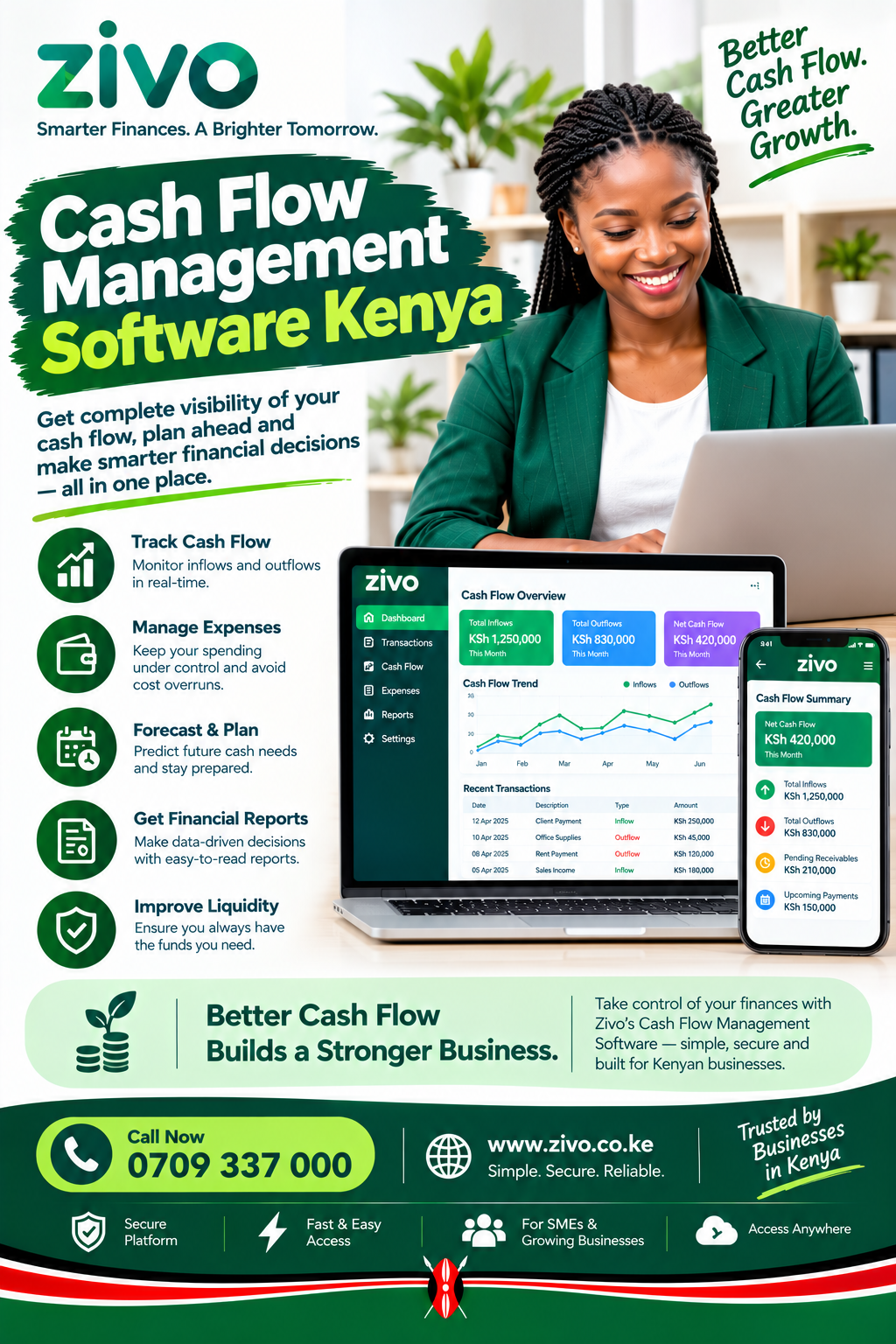
Cash Flow Management Software Kenya: Complete Guide to Better Financial Control for Kenyan Businesses
Cash flow is one of the most important financial considerations for any business. A company can generate strong sales, issue invoices and even report profits while still struggling to pay suppliers, employees, rent or other operating expenses when cash is not available at the right time. This is why Cash Flow Management Software Kenya is becoming increasingly important for Kenyan SMEs, retailers, distributors, contractors, service providers, property businesses and growing enterprises. A structured cash-flow system helps businesses understand money coming in, money going out, outstanding customer balances, expenses, supplier obligations and available funds without relying entirely on scattered spreadsheets, notebooks, bank statements and M-Pesa messages.
For many Kenyan businesses, cash-flow management is complicated by the number of payment channels involved. Customers may pay through M-Pesa, bank transfers, cash or other payment methods, while businesses simultaneously pay suppliers and expenses through M-Pesa, bank accounts and other channels. Cash Flow Management Software Kenya can bring these financial activities into a more organized workflow, making it easier for business owners and managers to understand their financial position.
The importance of Cash Flow Management Software Kenya goes beyond simply displaying a balance. Effective cash-flow management is about understanding timing. A business needs to know when money is expected, when money has actually arrived, which invoices remain unpaid, what expenses have already been incurred and what obligations are approaching. This information can help management make better decisions about spending, purchasing, hiring, stock and growth.
Zivo is designed around a connected business model that brings customers, payments, expenses and operational records together instead of scattering them across phones and spreadsheets. Its current finance controls include cash flow, profit, VAT, outstanding balances, M-Pesa and bank accounts, settlements, reconciliation and accounting journals.
What Is Cash Flow Management Software Kenya?
Cash Flow Management Software Kenya refers to software designed to help businesses monitor and manage the movement of money into and out of the business.
The basic concept is straightforward.
Cash inflows represent money entering the business.
Cash outflows represent money leaving the business.
Cash position represents the available financial resources after considering relevant inflows and outflows.
However, real businesses are more complicated than this simple definition suggests.
A business may have KSh 500,000 in unpaid invoices but only KSh 100,000 in its bank and M-Pesa accounts. On paper, the business has generated significant revenue, but it cannot necessarily use unpaid invoices to pay today’s supplier obligations.
This is why Cash Flow Management Software Kenya can be valuable. It helps distinguish between money that is expected and money that is actually available.
A useful cash-flow system should help answer questions such as:
- How much money came into the business today?
- How much money went out?
- Which customers have unpaid invoices?
- Which expenses have been recorded?
- Which supplier payments are approaching?
- How much is available across business payment accounts?
- Which M-Pesa payments have been received?
- Which transactions still require reconciliation?
- What is the current cash position?
- How is cash flow changing over time?
These questions are particularly important for Kenyan SMEs because owners often manage multiple financial activities at the same time.
Why Cash Flow Matters to Kenyan SMEs
Many small businesses concentrate heavily on sales and profit.
Sales are important, but sales alone do not guarantee financial stability.
A customer may purchase products worth KSh 200,000 but pay after 30 days. The business may still need to purchase replacement stock tomorrow.
A contractor may complete a KSh 1 million project but receive payment several weeks later. Meanwhile, wages, transport and materials may need to be paid immediately.
A school, agency or professional service business may invoice customers at the beginning of the month while expenses occur throughout the month.
This is where Cash Flow Management Software Kenya becomes useful.
The software does not magically create cash. Instead, it gives management a clearer picture of the money that is available, expected and already committed.
Better visibility can help an owner decide whether to:
- Delay a non-essential purchase
- Follow up an overdue customer
- Negotiate supplier payment terms
- Reduce unnecessary expenses
- Increase collections
- Prepare for upcoming obligations
- Maintain an appropriate cash reserve
The Problem With Manual Cash-Flow Tracking
Many Kenyan businesses begin with simple financial tools.
An owner may maintain an Excel spreadsheet while also checking:
- M-Pesa messages
- Bank statements
- Physical receipts
- Customer invoices
- Supplier invoices
- WhatsApp conversations
- Expense notebooks
- Accounting records
These methods can work when transaction volumes are small.
The problem begins when the business grows.
Imagine a distributor with 300 customers, 40 suppliers and several employees processing payments every day. Trying to manually match every invoice, receipt, expense and payment can consume considerable time.
Cash Flow Management Software Kenya can reduce the need to reconstruct the financial position manually from separate records.
Instead of asking employees to search several systems, management can use connected financial records to review the position.
Cash Inflows Every Business Should Monitor
A business may receive money through several channels.
Common cash inflows include:
- M-Pesa collections
- Bank transfers
- Cash sales
- Customer invoice payments
- Subscription payments
- Deposits
- Project payments
- Other business receipts
Cash Flow Management Software Kenya can help organize these inflows so that management can distinguish between money that has been invoiced and money that has actually been received.
This distinction is critical.
For example, a business may have issued invoices worth KSh 1.5 million during the month but received only KSh 900,000.
The KSh 600,000 difference is not necessarily available cash.
A good financial system should make this distinction visible.
Zivo’s accounting information describes a connected flow in which invoices record what is owed, payments record what has been received, expenses record money going out, and reports explain the financial position.
Tracking Cash Outflows
Cash leaving the business is equally important.
Common outflows include:
- Supplier payments
- Rent
- Salaries and staff-related costs
- Transport
- Utilities
- Stock purchases
- Marketing
- Repairs
- Equipment
- Professional services
- Taxes and statutory obligations
- Operational expenses
Cash Flow Management Software Kenya can help businesses organize these outflows and associate expenses with the appropriate records.
Zivo’s finance and spend controls include itemized expense requests, suppliers and payees, receipts, departments, approval status, payment accounts, payment vouchers and M-Pesa payouts.
This is important because expense tracking should not simply answer, “How much did we spend?”
It should also help answer:
What was the money spent on?
Who requested it?
Who approved it?
Which supplier received it?
Which payment account was used?
Understanding Available Cash
A business needs to know how much money is actually available.
This may require considering balances across different business accounts.
For example:
| Account | Balance |
|---|---|
| M-Pesa business account | KSh 85,000 |
| Bank account A | KSh 240,000 |
| Bank account B | KSh 120,000 |
| Cash | KSh 25,000 |
| Total | KSh 470,000 |
However, even KSh 470,000 should not necessarily be treated as freely available.
The business may already have upcoming obligations.
It may owe:
- KSh 150,000 to suppliers
- KSh 80,000 in wages
- KSh 50,000 in rent
- KSh 40,000 in utilities
This means the business’s practical financial position is different from simply looking at the total account balances.
Cash Flow Management Software Kenya can provide a more organized basis for reviewing money in, money out and outstanding obligations.
Cash Flow and Outstanding Invoices
Unpaid invoices are one of the biggest challenges affecting business cash flow.
A company can make a sale today but receive the money weeks later.
This creates a gap between revenue and cash.
For example:
- January invoices: KSh 800,000
- January collections: KSh 500,000
- Outstanding invoices: KSh 300,000
The business may have generated KSh 800,000 in sales, but only KSh 500,000 has actually arrived.
Cash Flow Management Software Kenya can help management monitor outstanding balances and prioritize collections.
Zivo’s public product information includes customer balances, invoices, receipts, statements and collections workflows.
Customer Collections and Cash Flow
Good cash-flow management depends partly on good collections.
Businesses should know:
- Which invoices are overdue
- How much each customer owes
- When payment was expected
- How long invoices have remained unpaid
- Which customers regularly delay payment
Cash Flow Management Software Kenya can support this visibility when invoice and payment records are maintained in one system.
A business can then prioritize collection activity based on actual outstanding balances rather than relying on memory.
This is especially valuable for businesses with recurring customers.
M-Pesa and Cash Flow Management
M-Pesa is an important part of the Kenyan business environment.
Customers may pay through M-Pesa while businesses also use M-Pesa to make supplier and expense payments.
This makes M-Pesa records an important part of cash-flow management.
However, receiving an M-Pesa notification does not automatically create a complete financial record.
The business may still need to determine:
- Who made the payment?
- Which invoice does it relate to?
- Was the amount correct?
- Has it been recorded?
- Does it need reconciliation?
- Has the customer’s balance been updated?
Cash Flow Management Software Kenya can help businesses build more structured financial processes around these questions.
Zivo’s current product information describes M-Pesa collection, automatic matching and exception reconciliation on applicable plans.
M-Pesa Reconciliation
Reconciliation is important because financial records need to agree with actual transactions.
Suppose a business has 200 M-Pesa transactions during the week.
The finance team may need to determine which transactions correspond to:
- Customer invoices
- Deposits
- Supplier payments
- Expense payments
- Refunds
- Other transactions
Cash Flow Management Software Kenya can help businesses create a more structured process for reviewing financial transactions.
Zivo’s finance platform specifically includes M-Pesa and bank accounts, settlements and reconciliation as part of its finance control room.
Cash Flow and Bank Accounts
M-Pesa is only one part of the financial picture.
Businesses also receive and make payments through bank accounts.
A business may have:
- Main operating account
- Payroll account
- Savings account
- M-Pesa business account
- Other payment accounts
Cash Flow Management Software Kenya can be useful when management needs to consider these financial channels together.
The objective is to avoid making decisions based on only one account while ignoring the rest of the business’s financial position.
Cash Flow and Expenses
Expenses directly affect cash flow.
However, not all expenses have the same effect.
Some expenses are predictable.
Examples include:
- Rent
- Salaries
- Insurance
- Recurring software
- Regular subscriptions
Other expenses vary.
Examples include:
- Repairs
- Transport
- Packaging
- Emergency purchases
- Marketing campaigns
- Stock purchases
Cash Flow Management Software Kenya can help businesses categorize and review expenses so management can understand spending patterns.
Zivo’s current platform includes expense records, suppliers, payment accounts and customer statements as part of its finance capabilities.
Fixed and Variable Expenses
Understanding fixed and variable expenses can improve cash-flow planning.
Fixed costs tend to remain relatively stable over a given period.
Variable costs change depending on business activity.
For example, a delivery company may have a relatively predictable office rent but variable fuel and vehicle maintenance costs.
A retailer may have predictable rent but changing stock purchases.
Cash Flow Management Software Kenya can help management organize these expenses and review how they affect the financial position.
This can support better budgeting.
Cash Flow Forecasting
Cash-flow forecasting involves estimating future cash inflows and outflows.
A simple forecast might look like this:
| Period | Expected Inflows | Expected Outflows | Expected Net Movement |
|---|---|---|---|
| Week 1 | KSh 400,000 | KSh 280,000 | KSh 120,000 |
| Week 2 | KSh 300,000 | KSh 350,000 | -KSh 50,000 |
| Week 3 | KSh 450,000 | KSh 290,000 | KSh 160,000 |
| Week 4 | KSh 350,000 | KSh 380,000 | -KSh 30,000 |
The business can see that Week 2 and Week 4 may require additional attention.
Cash Flow Management Software Kenya can support the process by making historical financial information easier to review.
However, businesses should remember that forecasts are estimates. They should be updated when customer payment patterns, expenses or other assumptions change.
Cash Flow and Working Capital
Working capital is closely connected to cash flow.
A business may have:
- Stock
- Unpaid customer invoices
- Supplier obligations
- Available cash
The challenge is keeping enough liquid resources available for day-to-day operations.
For example, a wholesaler may have KSh 2 million worth of inventory but only KSh 150,000 in available cash.
The business may look asset-rich but still face immediate payment pressure.
Cash Flow Management Software Kenya can help management understand the financial information surrounding working-capital decisions.
Cash Flow and Inventory
Inventory can absorb significant amounts of cash.
When a retailer purchases stock, money leaves the business.
The stock only converts back into cash after customers purchase it and payments are collected.
This means purchasing decisions directly affect liquidity.
Cash Flow Management Software Kenya can help businesses consider purchasing and stock activity alongside financial information.
Zivo’s broader platform includes stock, purchase orders and delivery within its business capabilities, while its finance controls include cash flow and related financial reporting.
Avoiding Excessive Stock Purchases
A business may purchase too much stock because management expects strong demand.
If the stock sells slowly, cash becomes tied up.
This can create pressure when the business needs money for other obligations.
Cash-flow visibility can encourage more deliberate purchasing decisions.
Businesses can ask:
- Is this stock needed now?
- How quickly does it normally sell?
- How much cash will the purchase consume?
- When is payment due?
- How quickly is the stock expected to convert back into cash?
Cash Flow Management Software Kenya can form part of this decision-making process when purchasing, inventory and financial information are connected.
Cash Flow and Supplier Payments
Supplier relationships can have a major effect on cash flow.
A supplier may require immediate payment, while another may offer 30-day or 60-day terms.
Understanding these obligations helps businesses plan.
Cash Flow Management Software Kenya can help management maintain better visibility into supplier-related financial commitments.
A business may then be able to prioritize payments based on due dates, available cash and supplier importance.
Cash Flow and Procurement
Procurement decisions should consider more than price.
Suppose two suppliers offer the same product:
- Supplier A: KSh 500,000 upfront
- Supplier B: KSh 520,000 with 30-day terms
Supplier B appears more expensive, but the payment terms may provide additional working-capital flexibility.
This does not automatically mean Supplier B is the better option.
The business should consider quality, reliability, delivery, financing cost and expected sales.
Cash Flow Management Software Kenya can help provide the financial context needed for these decisions.
Cash Flow for Service Businesses
Service businesses face unique cash-flow challenges.
A business may complete work before receiving payment.
For example, an IT company may complete a project in March and receive payment in April.
The company still needs to pay employees and other expenses during March.
Cash Flow Management Software Kenya can help service businesses track invoices, payments and expenses more systematically.
Zivo’s current platform connects invoices, payments, expenses and jobs within a broader operating model.
Cash Flow for Contractors
Contractors often deal with large projects and payment milestones.
A construction company may need to purchase:
- Cement
- Steel
- Timber
- Plumbing materials
- Electrical materials
- Labour
- Transport
before receiving the next client payment.
This creates significant cash-flow pressure.
Cash Flow Management Software Kenya can help contractors organize financial information around the transactions that drive project costs and collections.
The key objective is visibility.
Management should understand when money is expected and when project-related obligations must be paid.
Cash Flow for Retail Businesses
Retail businesses experience frequent transactions.
A shop may make hundreds of sales in a single day while also purchasing stock from numerous suppliers.
Cash-flow management becomes important because sales do not automatically translate into available cash if some transactions involve credit.
Cash Flow Management Software Kenya can help retailers maintain a clearer financial record.
Zivo’s retail/POS capabilities include sales, stock, payments, fulfilment and delivery, while its finance capabilities cover expenses and cash-flow reporting.
Cash Flow for Distributors
Distributors often operate with significant inventory and customer credit.
They may purchase stock in bulk and sell to customers who pay later.
This makes cash conversion particularly important.
Cash Flow Management Software Kenya can support better visibility into the relationship between sales, collections, purchasing and expenses.
A distributor should regularly review:
- Customer balances
- Supplier balances
- Inventory levels
- Purchase commitments
- Expected collections
- Available cash
Cash Flow for Multi-Branch Businesses
Businesses with several branches may have financial activity occurring in different locations.
One branch may generate strong sales while another may require additional working capital.
Without centralized reporting, management can struggle to understand the overall picture.
Cash Flow Management Software Kenya can help businesses establish a more consistent financial reporting process across branches.
Zivo’s finance control room is positioned for owner-managed and multi-branch businesses needing daily financial control.
Cash Flow and Business Growth
Growth can actually increase cash-flow pressure.
A company may win more customers and therefore need to:
- Purchase more stock
- Hire more employees
- Rent additional space
- Increase transport
- Spend more on marketing
- Extend more customer credit
Revenue may increase while cash becomes tighter.
Cash Flow Management Software Kenya can provide greater visibility during this growth phase.
Growth should therefore be managed not only through sales targets but also through financial capacity.
Cash Flow and Profit Are Not the Same
One of the most important concepts business owners should understand is that profit and cash flow are different.
Consider this example:
A company makes sales worth KSh 1 million.
Its expenses are KSh 700,000.
The company therefore appears to have KSh 300,000 in profit.
But suppose customers have only paid KSh 400,000 so far.
The business cannot necessarily use the unpaid KSh 600,000 immediately.
This is why Cash Flow Management Software Kenya is useful for businesses that want to distinguish financial performance from actual liquidity.
Zivo’s finance information explicitly separates cash-flow reporting from profit reporting.
Cash Flow Dashboards
A dashboard can make financial information easier to interpret.
A useful dashboard may show:
- Cash received
- Cash spent
- Current balances
- Outstanding invoices
- Expenses
- Profit
- M-Pesa activity
- Bank activity
- Reconciliation status
Cash Flow Management Software Kenya can provide management with a more immediate view of financial activity than manually reviewing several spreadsheets.
The value of a dashboard is not the graphics themselves.
The real value is whether management can use the information to make decisions.
What Should a Business Look for in Cash-Flow Software?
Before choosing a solution, businesses should evaluate its ability to support their actual financial workflow.
Invoice Management
Can the system record invoices and show what customers owe?
Payment Tracking
Can it record payments and update customer balances?
Expense Management
Can it record expenses with relevant documentation?
M-Pesa
Can it support M-Pesa collections and reconciliation?
Bank Accounts
Can it maintain visibility across relevant payment accounts?
Supplier Records
Can it organize supplier-related expenses and payments?
Reporting
Can management review cash flow and profitability?
Reconciliation
Can unmatched or exceptional transactions be investigated?
Scalability
Can the system support the business as transaction volumes increase?
Cash Flow Management Software Kenya should therefore be evaluated based on real business workflows rather than the number of features listed on a website.
Why Connected Financial Records Matter
Many businesses use separate applications for:
- Invoicing
- M-Pesa
- Expenses
- Stock
- Customer management
- Accounting
The problem is that separate systems may require information to be entered repeatedly.
For example, an employee may record a customer payment in one system and then manually update another spreadsheet.
This creates opportunities for errors.
Cash Flow Management Software Kenya can be more valuable when financial activities are connected.
Zivo describes its platform as keeping customer, payment, expense, staff and operational records together rather than scattering them across phones and spreadsheets.
Reducing Manual Reconciliation
Manual reconciliation can consume significant time.
Finance staff may have to:
- Download a statement.
- Review transactions.
- Find the corresponding invoice.
- Search for the customer.
- Check the payment amount.
- Mark the invoice as paid.
- Update another spreadsheet.
- Investigate unmatched transactions.
A connected Cash Flow Management Software Kenya workflow can reduce unnecessary duplication.
Zivo’s product information includes automatic matching and exception reconciliation for M-Pesa on applicable plans.
Expense Approval and Cash Control
Cash-flow management also involves controlling expenses before money leaves the business.
An employee may request funds for transport, equipment or supplies.
A structured workflow can record:
- Request
- Amount
- Department
- Supplier
- Receipt
- Approval status
- Payment account
- Payment
Cash Flow Management Software Kenya can help organizations establish better controls around expenditure.
Zivo’s expense and payout control includes itemized requests, departments, approval status, payment accounts and payment vouchers.
Cash Flow and Financial Discipline
Good cash flow requires discipline.
Businesses should establish procedures around:
- Invoicing customers promptly
- Following up overdue invoices
- Recording expenses
- Approving purchases
- Reconciling payments
- Monitoring supplier obligations
- Reviewing cash balances
- Forecasting upcoming requirements
Cash Flow Management Software Kenya can support these processes, but software should complement sound financial practices rather than replace them.
Example: A Nairobi-Based Distributor
Consider a Nairobi distributor that sells products to supermarkets and smaller retailers.
During one month, the distributor:
- Invoices customers: KSh 8 million
- Receives customer payments: KSh 5.5 million
- Purchases stock: KSh 3 million
- Pays operating expenses: KSh 1 million
- Owes suppliers: KSh 1.5 million
Management needs to understand more than the KSh 8 million in sales.
It needs to know what has actually been collected and what remains committed.
Cash Flow Management Software Kenya can help bring invoices, payments, expenses and outstanding balances into one financial view.
This makes it easier to identify collection priorities and upcoming obligations.
Example: A Professional Services Company
A consulting firm may invoice KSh 2 million in a month.
However, some clients pay after 30 days.
During the same month, the firm needs to pay:
- Salaries
- Rent
- Internet
- Transport
- Professional subscriptions
- Taxes and other expenses
The business may therefore have good revenue but still need to manage liquidity carefully.
Cash Flow Management Software Kenya can provide visibility into the relationship between invoices, payments and expenses.
Example: A Hardware Business
A hardware business may purchase stock worth KSh 2 million while selling products worth KSh 3 million during a month.
If many customers purchase on credit, the business may not immediately receive all KSh 3 million.
Meanwhile, suppliers may expect payment.
Cash Flow Management Software Kenya can help management understand this timing difference.
This can support more disciplined purchasing and collection decisions.
Cash Flow and Supplier Management
Supplier management and cash flow are closely connected.
A business may have dozens of suppliers with different payment terms.
Some may require payment on delivery.
Others may offer credit.
Some may provide discounts for early payment.
Cash Flow Management Software Kenya can help businesses maintain better visibility around supplier-related expenses and payments.
Zivo’s broader platform includes suppliers and procurement controls alongside financial and expense management.
Cash Flow and Budgeting
A budget estimates how much a business expects to receive and spend.
Cash flow shows what actually happens over time.
Comparing the two can provide valuable insight.
For example, if the business expected monthly expenses of KSh 600,000 but actual expenses were KSh 850,000, management needs to understand why.
Cash Flow Management Software Kenya can support this review by keeping financial records organized.
The goal is not simply to produce a report.
The goal is to identify patterns and improve decisions.
Monitoring Cash-Flow Trends
One month’s cash position may not tell the whole story.
Businesses should look for trends.
Questions may include:
- Is cash increasing?
- Are expenses growing faster than sales?
- Are customer balances increasing?
- Are suppliers being paid more slowly?
- Are M-Pesa collections increasing?
- Is inventory consuming more cash?
- Are operating costs rising?
Cash Flow Management Software Kenya can help businesses use historical records to understand these trends.
Cash Flow and Emergency Planning
Unexpected expenses can occur.
A vehicle may break down.
Equipment may need replacement.
A major customer may delay payment.
A supplier may change terms.
An important order may require upfront expenditure.
A business with good cash-flow visibility is better positioned to identify how much flexibility it has.
Cash Flow Management Software Kenya can form part of a broader financial-control strategy that helps management monitor available resources.
Cash Flow and Decision-Making
Business owners make financial decisions every day.
Should we hire another employee?
Should we purchase more stock?
Should we open another branch?
Should we offer a customer credit?
Should we pay a supplier early?
Should we invest in new equipment?
These decisions require financial information.
Cash Flow Management Software Kenya can help make that information easier to access when invoices, payments, expenses and related financial records are maintained in the same environment.
Cash Flow Management Software for Growing SMEs
A business may begin with a simple notebook.
Then it moves to Excel.
Then it adds an accounting system.
Then M-Pesa becomes important.
Then more employees become involved.
Then there are multiple branches and suppliers.
Eventually, the business needs connected systems.
Cash Flow Management Software Kenya can become particularly valuable at this stage because financial complexity often increases faster than the number of employees.
A growing business needs systems that can grow with it.
Benefits of Cash Flow Management Software
The main benefits can be summarized as follows:
| Benefit | Business Impact |
|---|---|
| Better cash visibility | Management understands current position |
| Invoice tracking | Makes outstanding balances easier to monitor |
| Expense tracking | Improves spending visibility |
| M-Pesa reconciliation | Reduces unmatched transactions |
| Supplier visibility | Helps manage obligations |
| Bank visibility | Supports broader financial review |
| Cash-flow reports | Supports financial planning |
| Profit reports | Separates profitability from liquidity |
| Customer statements | Supports collection follow-up |
| Connected records | Reduces duplicate data entry |
A business adopting Cash Flow Management Software Kenya should focus on whether these benefits solve actual problems in its financial workflow.
How to Implement Cash-Flow Software
Technology implementation should be approached systematically.
Step 1: Identify the Current Financial Process
Document how the business currently records:
- Sales
- Invoices
- Payments
- Expenses
- Supplier obligations
- M-Pesa
- Bank transactions
Step 2: Identify Gaps
Determine where information gets lost or duplicated.
Step 3: Organize Customer Records
Ensure customer balances are accurate.
Step 4: Organize Supplier Records
Maintain consistent supplier information.
Step 5: Standardize Expense Recording
Create appropriate expense categories.
Step 6: Connect Payment Channels
Where supported, connect relevant payment workflows.
Step 7: Reconcile Transactions
Establish a regular reconciliation routine.
Step 8: Review Reports
Use reports to monitor cash flow and profitability.
Cash Flow Management Software Kenya works best when employees understand the processes behind the technology.
Why Zivo Is Relevant to Cash-Flow Management
Zivo’s current platform is designed around a connected view of business operations. It provides tools for invoicing, payments, expenses, customer balances and cash-flow visibility, while additional workflows cover M-Pesa, stock, procurement and operations.
Its accounting information specifically describes the relationship between invoices, payments, expenses and reports. The platform provides cash-flow and profit reports alongside VAT summaries, journals, customer statements, expenses and suppliers.
This makes Cash Flow Management Software Kenya particularly relevant for Kenyan businesses that want to move away from disconnected financial records.
The platform can be started around a specific business problem and expanded as the business grows, according to Zivo’s current solutions positioning.
Cash Flow and Management Reporting
Management reporting should help answer practical questions.
For example:
How much did we collect this month?
How much did we spend?
How much do customers owe?
How much do we owe suppliers?
What is our current cash position?
Are expenses increasing?
Is the business profitable?
Cash Flow Management Software Kenya can help bring these questions into a structured reporting process.
The quality of a report depends on the quality of the underlying records, so businesses should maintain accurate transaction information.
Cash Flow and Accountability
Financial accountability becomes more important as a business grows.
When only one person handles every transaction, they may remember what happened.
When responsibilities are distributed across several people, records become more important.
A structured system can show who created or approved transactions where the relevant workflow supports those controls.
Cash Flow Management Software Kenya can therefore contribute to stronger financial accountability.
Zivo’s management controls include departments, roles, approvals, audit exports, operating scorecards and performance indicators.
Cash Flow and Business Owners
Business owners need financial information that is understandable.
A complicated accounting report may contain valuable information but still be difficult for an owner to use every day.
The ideal management view should make important issues obvious.
For example:
- Cash received today
- Cash spent today
- Unpaid invoices
- Current balances
- Expenses
- Upcoming obligations
Cash Flow Management Software Kenya can help put these areas into a more accessible financial workflow.
Common Cash-Flow Mistakes Businesses Make
1. Confusing Sales With Cash
A sale does not necessarily mean money has been received.
2. Ignoring Small Expenses
Small expenses can accumulate.
3. Failing to Follow Up Invoices
Late collections can create serious cash pressure.
4. Purchasing Too Much Stock
Excess inventory can tie up working capital.
5. Paying Suppliers Without Planning
Unplanned supplier payments can reduce liquidity.
6. Failing to Reconcile M-Pesa
Unmatched payments make financial records less reliable.
7. Reviewing Cash Flow Too Infrequently
Problems can develop before management notices them.
Cash Flow Management Software Kenya can help address the visibility side of these challenges.
The Importance of Timely Financial Data
Financial information loses value when it is consistently delayed.
If an owner only discovers at the end of the month that customers owe KSh 1 million, collection opportunities may already have been missed.
If management only discovers after payment that a major expense exceeded expectations, the opportunity to control it has passed.
Cash Flow Management Software Kenya can help businesses move toward more timely financial visibility.
Cash Flow and Digital Transformation in Kenya
Digital transformation is not simply about replacing paper.
It is about creating better ways to run everyday business processes.
For financial management, this means connecting:
Sales → Invoice → Payment → Receipt → Customer balance → Cash-flow report
It can also mean:
Expense request → Approval → Payment → Receipt → Expense record → Financial report
Cash Flow Management Software Kenya fits into this broader transformation because cash flow is connected to nearly every part of business operations.
Is Cash Flow Software Only for Large Companies?
No.
Small businesses can benefit from better financial visibility when their transaction volume or complexity begins to exceed what manual records can comfortably handle.
A five-person company can still have dozens of customers and suppliers.
A ten-person company can process hundreds of payments.
A growing business can quickly outgrow a single spreadsheet.
Cash Flow Management Software Kenya can therefore be useful for businesses at different stages of growth.
The right solution should be proportionate to the business’s actual needs.
Can Cash Flow Software Replace an Accountant?
Software and professional accounting are not necessarily substitutes.
Software can help organize transactions, reports and financial information.
An accountant may still be needed for:
- Accounting policies
- Tax matters
- Statutory requirements
- Financial review
- Reconciliation oversight
- Financial advice
- Year-end processes
Cash Flow Management Software Kenya should therefore be viewed as a tool that supports better financial operations, not automatically as a replacement for qualified professionals.
Frequently Asked Questions
What is Cash Flow Management Software Kenya?
Cash Flow Management Software Kenya is software that helps Kenyan businesses monitor money coming in, money going out, outstanding invoices, expenses, payment accounts and other information relevant to cash management.
Why is cash flow important for Kenyan SMEs?
Cash flow determines whether a business has sufficient available funds to meet its immediate financial commitments. A profitable business can still experience cash shortages when customers pay late or expenses become due before collections arrive.
Can Zivo track cash flow?
Yes. Zivo’s current finance control room includes cashflow, profit, VAT, outstanding balances, M-Pesa and bank accounts, settlements, reconciliation and accounting journals.
Can Zivo track expenses?
Yes. Zivo provides expense and payout controls covering itemized requests, suppliers and payees, receipts, departments, approval status, payment accounts and payment vouchers.
Can cash-flow software track customer balances?
A suitable system can track invoices, receipts and customer statements. Zivo’s accounting information includes customer statements and records linking invoices with payments.
Does M-Pesa affect cash-flow management?
Yes. M-Pesa is an important business payment channel in Kenya, so businesses need accurate records of collections, payments and reconciliation. Zivo supports M-Pesa-related collection, matching and reconciliation workflows on applicable plans.
Is cash flow the same as profit?
No. Profit measures financial performance over a period, while cash flow focuses on money actually moving into and out of the business.
Can retailers use cash-flow software?
Yes. Retail businesses can benefit from connecting sales, stock, payments, expenses and cash-flow reporting.
Can service businesses use cash-flow software?
Yes. Service businesses can use it to monitor invoices, customer payments, expenses and available funds.
Can distributors use cash-flow software?
Yes. Distributors often have significant inventory, supplier obligations and customer credit, making cash-flow visibility especially important.
How often should a business review cash flow?
The appropriate frequency depends on the business. Businesses with frequent transactions or tight liquidity may benefit from daily monitoring, while others may conduct structured weekly or monthly reviews.
How Cash Flow Management Supports Sustainable Growth
Growth should not be measured only by sales.
A business that doubles sales but also doubles its cash requirements may experience financial pressure.
Before expanding, management should consider:
- Customer payment patterns
- Supplier terms
- Stock requirements
- Staffing costs
- Rent
- Equipment
- Transport
- Marketing
- Available cash reserves
Cash Flow Management Software Kenya can help provide the financial information needed for these decisions.
Building a Cash-Flow Culture
Cash-flow management should not be the responsibility of the finance department alone.
Sales teams influence collections.
Procurement influences spending.
Operations influence expenses.
Managers influence approvals.
Owners influence investment decisions.
Everyone’s actions can affect cash.
Cash Flow Management Software Kenya can support a more connected approach in which financial information is available to the people responsible for business decisions.
Cash Flow and Operational Efficiency
Financial problems are sometimes caused by operational inefficiencies.
For example:
- Slow invoicing delays collections.
- Poor inventory planning ties up cash.
- Missing receipts complicate expense tracking.
- Weak approval procedures lead to unnecessary spending.
- Delayed reconciliation makes financial reporting less reliable.
Cash Flow Management Software Kenya can help connect these operational activities with financial information.
Zivo’s broader platform is designed around connected workflows spanning sales, payments, expenses and operations.
Cash Flow and Financial Visibility
The ultimate goal of cash-flow management is visibility.
A business owner should not have to ask several employees to calculate the financial position every time a major decision needs to be made.
The information should already exist in the business records.
Cash Flow Management Software Kenya can make financial information easier to organize and review.
This creates a stronger foundation for management decisions.
What Makes a Good Cash-Flow System?
A good cash-flow system should ideally be:
Accurate
Financial records should reflect actual transactions.
Timely
Information should be available when decisions are being made.
Connected
Invoices, payments, expenses and reports should relate to one another.
Easy to Understand
Business owners should be able to identify important information without unnecessary complexity.
Scalable
The system should support the business as transaction volumes increase.
Appropriate for Kenya
It should accommodate workflows relevant to Kenyan businesses, including M-Pesa where applicable.
Cash Flow Management Software Kenya should be assessed against these principles before a business commits to a solution.
Cash Flow Management and Business Resilience
Unexpected events can put pressure on any business.
A customer may delay payment.
A supplier may change terms.
A major machine may require repair.
Sales may decline temporarily.
An emergency expense may arise.
Businesses with stronger financial visibility can respond more deliberately because management understands what resources are available.
Cash Flow Management Software Kenya can therefore contribute to business resilience by making financial information easier to access.
The Role of Management in Cash-Flow Control
Technology can provide information, but management still needs to act on it.
If outstanding invoices are increasing, management should investigate collections.
If expenses are rising, management should investigate spending.
If stock purchases are consuming too much cash, procurement should be reviewed.
If supplier obligations are increasing, payment planning may need adjustment.
Cash Flow Management Software Kenya is most valuable when its information is actively used in decision-making.
Conclusion
Cash flow is one of the clearest indicators of a business’s ability to continue operating smoothly. Sales, revenue and profit are important, but businesses also need to know whether money is actually available when obligations become due.
For Kenyan SMEs, managing cash flow can be challenging because financial activity may be distributed across M-Pesa, bank accounts, invoices, customer statements, supplier records, expense receipts, spreadsheets and messaging applications.
Cash Flow Management Software Kenya can help bring these activities into a more structured financial workflow.
The value of the software is not simply that it produces another report. The real value is that it can help management understand the story behind the numbers.
How much has been billed?
How much has been collected?
How much do customers still owe?
How much has been spent?
What expenses are approaching?
Which suppliers need to be paid?
How much cash is available?
Which transactions still need reconciliation?
Cash Flow Management Software Kenya can help businesses organize these questions around a connected financial record.
Zivo’s current product capabilities are designed around this connected approach. Its finance controls include cashflow, profit, VAT, outstanding balances, M-Pesa and bank accounts, settlements, reconciliation and accounting journals.
Its accounting workflow also connects invoices, payments, expenses and financial reports, helping businesses see what is owed, what has been received and what has been spent.
For businesses using M-Pesa, Zivo also provides collection and reconciliation-related workflows, helping reduce the need to rebuild payment records manually.
The most important step for any business is to understand its own cash-flow process.
Identify how customers pay.
Identify how expenses are recorded.
Identify how supplier payments are handled.
Identify where invoices are stored.
Identify how M-Pesa transactions are reconciled.
Identify how management currently determines the available cash position.
Then select technology that supports those processes without adding unnecessary complexity.
Cash Flow Management Software Kenya can be part of a broader digital strategy in which sales, invoices, payments, expenses, suppliers, inventory and operations are connected.
For a growing Kenyan business, this can mean fewer scattered records, better visibility and more informed financial decisions.
Ultimately, effective cash-flow management is about knowing where the money is, where it came from, where it is going and what still needs to happen.
That visibility gives business owners a stronger foundation for managing expenses, following up collections, planning purchases, protecting working capital and supporting sustainable growth.
When financial information is accurate, connected and available at the right time, business decisions become easier to make.
And for Kenyan SMEs operating in an increasingly digital economy, that is the practical value of Cash Flow Management Software Kenya: helping transform cash-flow information from scattered records into a useful management resource.