
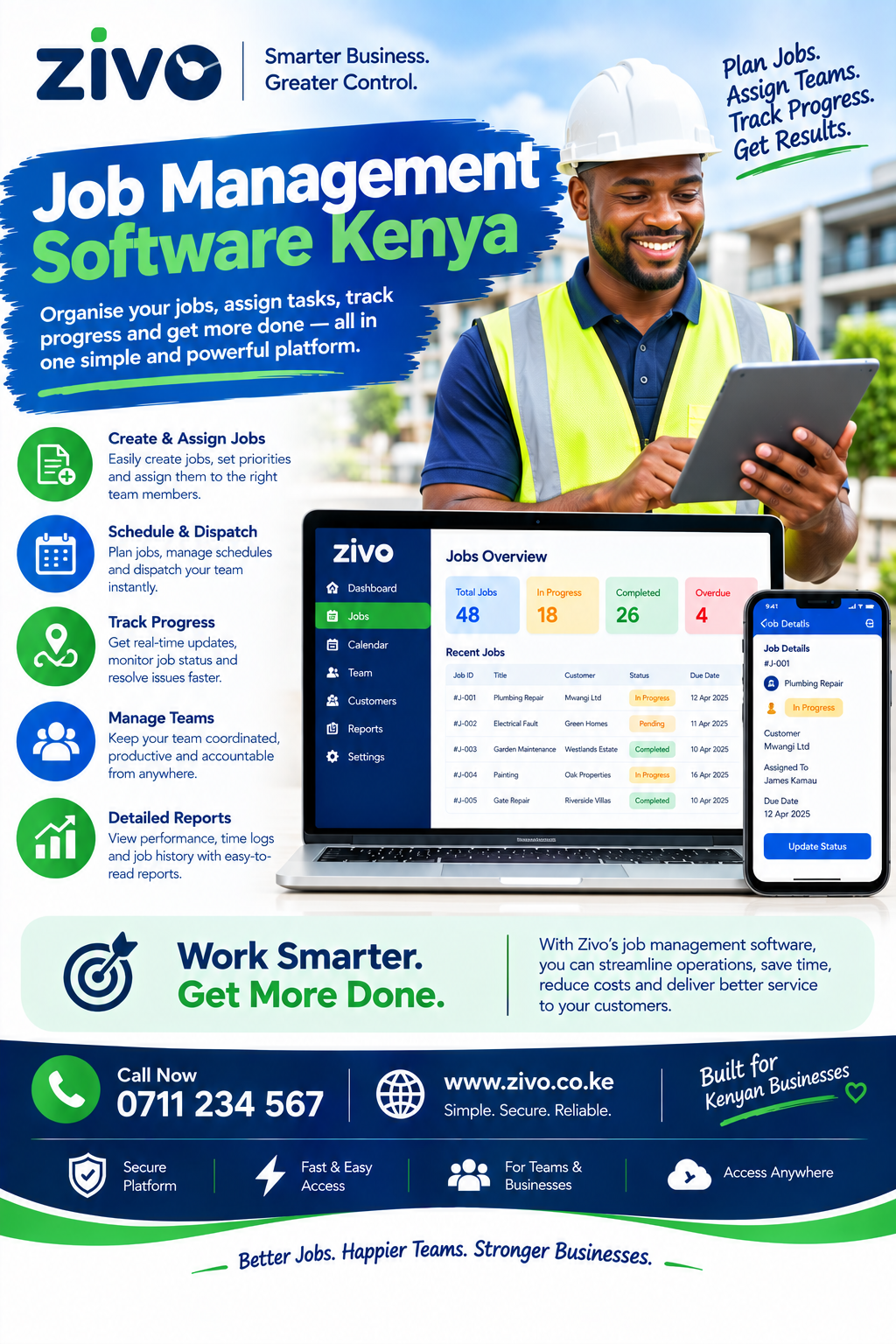
Job Management Software Kenya: A Complete Guide for Better Business Operations
Managing jobs efficiently can become difficult when a business relies on notebooks, spreadsheets, WhatsApp messages, phone calls, and disconnected records. As the number of customers, employees, assignments, and invoices grows, it becomes harder to know which jobs are pending, who is handling them, what has already been completed, and whether the business has been paid. This is where Job Management Software Kenya becomes useful. This guide explains how job management systems can help Kenyan businesses organize daily work, manage employees, monitor job progress, control costs, communicate with customers, and improve reporting.
For service-based companies, contractors, repair businesses, maintenance providers, agencies, cleaning companies, technicians, consultants, and other SMEs, having a central system for managing work can make everyday operations easier. Instead of keeping information in several places, a business can organize important job details in one digital environment.
This article explains what Job Management Software Kenya is, how it works, the problems it solves, the features businesses should consider, and how organizations can choose a system that fits their operations.
What Is Job Management Software?
Job Management Software Kenya refers to a digital system designed to help businesses organize and control jobs from the moment a customer makes a request until the work is completed and recorded. Depending on the business, a job could be a repair, installation, inspection, maintenance visit, cleaning assignment, delivery-related task, consulting engagement, construction activity, or another type of service.
A job management platform normally brings several activities together. These can include:
- Creating and assigning jobs
- Recording customer information
- Scheduling work
- Monitoring job status
- Assigning employees or technicians
- Recording materials and expenses
- Tracking job progress
- Managing invoices
- Recording payments
- Producing reports
- Maintaining job histories
For a growing Kenyan business, Job Management Software Kenya can provide a structured way to manage these activities without depending entirely on manual records.
The main idea is simple: each job should have a clear record showing what needs to be done, who is responsible, when it should happen, what resources are required, and what happened after completion.
Why Job Management Matters
A business can have good employees and many customers but still experience operational problems if jobs are not properly organized. A customer may call to ask for an update while the person answering the phone has to search through messages to find the relevant information.
Similarly, a manager may want to know how many jobs were completed during the week but discover that employees recorded their work differently.
Job Management Software Kenya helps create a consistent process. Every job can follow a defined workflow, making it easier for management and staff to understand what is happening.
Why Kenyan Businesses Need Better Job Management
Many Kenyan SMEs operate with lean teams. One person may handle customer communication, another may perform the work, while an administrator manages payments and records. As the business grows, this arrangement can create confusion.
Job Management Software Kenya can help bring those activities into a shared system.
Consider a maintenance company in Nairobi. A customer contacts the company about an equipment problem. The business needs to record the request, identify the customer, assign a technician, schedule a visit, record materials used, complete the work, and eventually invoice the customer.
Without a structured process, information can become scattered across calls, SMS messages, WhatsApp conversations, paper notes, and spreadsheets.
With Job Management Software Kenya, the business can organize the job as one record and update it as it progresses.
This is particularly useful for businesses that manage multiple jobs simultaneously.
Common Challenges With Manual Job Management
Businesses that rely heavily on manual systems can experience problems such as:
- Lost job information
- Missed appointments
- Poor employee coordination
- Difficulty tracking job progress
- Delayed invoicing
- Inaccurate expense records
- Duplicate data entry
- Limited management visibility
- Difficulty finding previous job records
- Slow reporting
These problems may appear small individually, but together they can consume significant amounts of staff time.
Job Management Software Kenya gives businesses a central place to manage information and reduce unnecessary administrative work.
How Job Management Software Works
The exact workflow depends on the system and business, but a typical process can follow several stages.
1. Create the Customer Record
The business first records the customer and relevant contact information.
A customer profile can provide a history of previous jobs, invoices, payments, notes, and interactions. This can be especially useful when a customer requests repeat services.
2. Create the Job
The business then creates a job containing information such as:
- Job title
- Customer
- Location
- Description
- Priority
- Assigned employee
- Scheduled date
- Expected completion date
- Required materials
- Estimated cost
- Job status
Job Management Software Kenya can help standardize this process so employees do not have to create their own informal methods of recording assignments.
3. Assign Employees
Once the job has been created, management can assign it to the appropriate employee or team.
For field-service businesses, this may involve assigning technicians based on location, availability, specialization, or workload.
4. Track Progress
Jobs can move through different statuses.
For example:
New → Assigned → Scheduled → In Progress → Completed → Invoiced → Paid
This type of workflow gives managers a quick understanding of what is happening.
Job Management Software Kenya can be especially useful where a business has many active assignments and needs a consistent way to monitor them.
5. Complete and Record the Work
After the job has been completed, employees can record relevant information such as work performed, materials used, notes, and completion details.
A complete job record can become useful later if the customer needs another service.
Important Features to Look For
Businesses should not select software simply because it has many features. The system should contain features that match the company’s actual workflow.
Job Management Software Kenya should make everyday work easier rather than introduce unnecessary complexity.
Job Creation and Tracking
The ability to create jobs quickly is fundamental.
A good system should allow authorized users to create a job, assign responsibility, set a deadline, and monitor the status.
Managers should be able to distinguish between new, active, delayed, completed, and cancelled jobs.
Employee Assignment
Businesses need to know who is responsible for each task.
Job Management Software Kenya can help managers assign work and maintain clearer accountability.
Instead of asking several employees which job they are working on, a manager can use the system to review assignments.
Scheduling
Scheduling is important for businesses that perform work at customer locations.
A scheduling feature can help organize:
- Appointments
- Technician visits
- Maintenance activities
- Installations
- Inspections
- Follow-up visits
- Recurring work
Good scheduling reduces the risk of overlapping assignments.
Customer Management
Customer information should ideally connect to job records.
Job Management Software Kenya can help businesses maintain a history of work performed for each customer.
This makes it easier to answer questions such as:
- When was the customer’s last service?
- What work was performed?
- Who handled the job?
- Was an invoice issued?
- Has the customer paid?
- Are there outstanding issues?
Job Cost Tracking
Job profitability depends partly on understanding what each assignment costs.
Costs may include:
- Labour
- Materials
- Transport
- Equipment
- Subcontractors
- Other job-related expenses
Job Management Software Kenya can support better cost visibility when expenses are properly recorded.
Job Management and Financial Control
Operations and finances are closely connected.
A completed job that has not been invoiced can represent delayed revenue. An invoice that has not been followed up can contribute to outstanding receivables. An expense that is not assigned to the relevant job can make profitability harder to understand.
Job Management Software Kenya can help connect operational information with financial processes.
For example, imagine a Kenyan repair company completing ten jobs in one week. If the business records all completed work in a structured system, management can review which jobs were completed, which require invoicing, and which have already generated payments.
This is more organized than relying on memory or searching through multiple spreadsheets.
Invoicing
Businesses can use job information as the basis for invoicing.
A job record may contain the agreed service, labour, materials, and other billable items.
Job Management Software Kenya can help create a more consistent process between completing work and recording the resulting financial transaction.
Expense Recording
Job-related expenses should also be captured.
Suppose a technician purchases replacement parts while handling a customer assignment. If that expense is not recorded, the business may underestimate the cost of completing the job.
Job Management Software Kenya can help businesses maintain clearer records of expenses associated with specific assignments.
The Role of M-Pesa in Kenyan Business Operations
M-Pesa is widely used for business payments in Kenya, making payment records an important consideration for many local businesses.
A business may receive customer payments through M-Pesa while also accepting bank transfers or other payment methods. If payment information is recorded manually, reconciling transactions can become time-consuming.
Job Management Software Kenya can support businesses that want a more organized approach to recording job-related payments and financial information.
The exact payment capabilities of a software platform should always be confirmed before purchase. Businesses should determine whether the system supports the payment workflows they currently use.
Improving Employee Accountability
Managers need visibility into work without constantly interrupting employees.
Job Management Software Kenya can give organizations a central record of assignments and progress.
For example, a supervisor can review:
- Assigned jobs
- Pending jobs
- Completed jobs
- Delayed assignments
- Employee workloads
- Job notes
- Completion records
This does not eliminate the need for communication. Instead, it provides a shared operational record that supports better communication.
Measuring Productivity
Job records can also provide useful information for internal analysis.
A business may review the number of jobs completed during a period, average completion times, repeat visits, or workload distribution.
Job Management Software Kenya can help create the structured records required for this type of analysis.
However, businesses should interpret productivity information in context. A complex installation should not necessarily be compared directly with a simple service call.
Job Management for Different Types of Businesses
One of the strengths of a job management platform is that the underlying concept can apply to many industries.
Cleaning Companies
Cleaning businesses may manage recurring and one-time assignments.
Job Management Software Kenya can help organize customer details, service schedules, assigned cleaners, job status, and billing information.
Repair and Maintenance Companies
Repair businesses often need to track service requests, technicians, spare parts, work completed, and customer payments.
A central job record can make this information easier to manage.
Construction Businesses
Construction companies may use job management processes to organize assignments, materials, labour, subcontractors, expenses, and project progress.
Job Management Software Kenya can help demonstrate how structured digital workflows can be adapted to businesses with multiple operational activities.
IT Service Providers
IT companies may manage installation requests, troubleshooting assignments, system maintenance, and support tickets.
A job system can help technicians know what needs attention and allow management to monitor unresolved work.
Electrical and Plumbing Businesses
Electricians and plumbers often work at different customer locations.
Job Management Software Kenya can help illustrate the value of centralized information when service businesses need to coordinate customers, assignments, schedules, and records.
Consulting Businesses
Consultants may use job records to manage client assignments, deliverables, deadlines, billable activities, and invoices.
The software does not have to be limited to physical fieldwork. The core concept is managing a defined piece of work from start to finish.
Benefits of Using Job Management Software
The benefits depend on the features implemented and how consistently staff use the system.
Better Organization
A central system reduces the need to search through multiple sources.
Job Management Software Kenya can give staff a structured place to find job information.
Faster Access to Information
When a customer asks for an update, employees can refer to the relevant job record instead of searching through old conversations.
Improved Scheduling
Digital scheduling can help businesses coordinate assignments and reduce avoidable clashes.
Better Customer Service
Customers generally want clear information about appointments, progress, completion, and payments.
Job Management Software Kenya can support more organized customer service by keeping relevant job information accessible.
More Accurate Records
Digital records can be easier to search, update, and review than scattered paper documents.
Better Management Visibility
Managers can monitor the status of jobs without relying entirely on verbal updates.
How Job Management Software Can Support Growth
Growth creates operational pressure.
A business handling five jobs a week may be able to manage records manually. A business handling fifty or several hundred assignments may need more structure.
Job Management Software Kenya can become increasingly valuable as job volume increases.
Growth may introduce:
- More customers
- More employees
- More locations
- More invoices
- More expenses
- More appointments
- More communication
- More historical records
The objective of software is not simply to digitize existing paperwork. It should help create a repeatable workflow that can continue functioning as the organization becomes more complex.
Centralizing Business Information
One common problem in growing businesses is information fragmentation.
Customer information may be stored in one spreadsheet. Job assignments may be in another. Payment information may be in a mobile-money statement. Employees may have additional details in WhatsApp conversations.
Job Management Software Kenya can help reduce fragmentation by creating a centralized operational record.
Centralization can make it easier to answer basic management questions.
For example:
Which jobs are currently pending?
Which employee is assigned to each job?
Which jobs were completed this week?
Which jobs need invoicing?
Which customers have outstanding balances?
What expenses were incurred while completing a particular assignment?
A well-designed system can make these questions easier to answer.
Reporting and Business Decisions
Reports are valuable because they turn operational records into information that management can review.
Job Management Software Kenya may support reports around job status, completion, costs, employees, customers, or financial activity, depending on the system’s capabilities.
Management can use reports to identify patterns such as:
- Increasing numbers of overdue jobs
- Customers requiring frequent service
- High-cost assignments
- Repeated service problems
- Uneven employee workloads
- Delays between job completion and invoicing
The purpose is not to create reports for their own sake. Reports should help management understand the business and identify areas requiring attention.
Mobile Access for Field Teams
Many service businesses have employees who spend most of their working day outside the office.
For such organizations, Job Management Software Kenya can be more useful when important functions are accessible through mobile devices.
A field employee may need to:
- View assigned work
- Check customer details
- Update job status
- Add notes
- Record materials
- Confirm completion
- Submit expenses
Mobile access can reduce the need for employees to return to the office simply to update paperwork.
Businesses should check whether a particular platform supports the mobile features they require before selecting it.
Data Security and Access Control
Business records can contain sensitive information, including customer contacts, financial information, invoices, employee details, and operational data.
Job Management Software Kenya should therefore be evaluated partly on how users access and manage information.
Businesses should consider:
- User accounts
- Password controls
- Permissions
- Access levels
- Data backup
- Audit trails
- Account management
- Data export options
Different employees may not need access to every part of the system. For example, a technician may need job information while an administrator may need access to invoicing and financial records.
Choosing the Right Job Management System
Selecting software should begin with the business process rather than the feature list.
Job Management Software Kenya should solve real operational problems.
Before making a decision, identify:
Current Problems
Write down the biggest challenges in the existing process.
For example:
- Jobs are forgotten
- Employees miss assignments
- Customers wait too long for updates
- Invoices are delayed
- Expenses are not recorded
- Managers lack visibility
Required Features
Separate essential features from optional ones.
Essential features might include job creation, assignment, scheduling, status tracking, customer management, and reporting.
Optional features could include advanced automation or specialized integrations.
Number of Users
Determine who will use the system.
Consider administrators, managers, field workers, accountants, supervisors, and other staff.
Job Management Software Kenya should be practical for the people who will use it every day.
Ease of Use
Complex software can fail if employees do not use it consistently.
The interface should be understandable, and the workflow should make sense to staff.
Scalability
Think about future requirements.
A system that works for a small team should ideally not become impractical as the number of customers and employees increases.
Questions to Ask Before Buying
Businesses can ask software providers questions such as:
- What job management features are included?
- Can jobs be assigned to individual employees?
- Can managers monitor job status?
- Does the system support customer records?
- Can job expenses be recorded?
- Does it support invoicing?
- Can payments be recorded?
- Does it support mobile users?
- Can different employees have different permissions?
- What reporting options are available?
- Can the system be customized?
- How is business data backed up?
- How are software updates handled?
- What training or support is provided?
- What is included in the subscription?
Job Management Software Kenya should be assessed against actual business requirements rather than purchased solely because another company uses it.
Common Mistakes When Implementing Job Management Software
Buying software does not automatically improve operations.
Mistake 1: Choosing Too Many Features
A business may choose a system because it has a long list of features without checking whether those features are relevant.
The result can be unnecessary complexity.
Mistake 2: Not Training Employees
Employees need to understand how and when they should use the system.
Job Management Software Kenya becomes more valuable when employees follow the same processes.
Mistake 3: Keeping Parallel Manual Records Forever
During transition, businesses may temporarily use both paper records and software. However, keeping duplicate systems indefinitely can create additional work.
Mistake 4: Poor Data Entry
If employees enter incomplete or inconsistent information, reports will be less useful.
The business should establish simple rules for entering customer names, job descriptions, costs, statuses, and other important information.
Mistake 5: Ignoring Workflow Design
Software should reflect how the business actually operates.
Job Management Software Kenya should support a clear workflow rather than simply replacing paper with digital forms.
Creating a Simple Job Workflow
A business can start with a straightforward process:
Step 1: Customer submits a request.
Step 2: Staff creates a customer record.
Step 3: A job is created.
Step 4: The job is assigned.
Step 5: The appointment is scheduled.
Step 6: Employee performs the work.
Step 7: Materials and expenses are recorded.
Step 8: Job is marked complete.
Step 9: Invoice is prepared.
Step 10: Payment is recorded.
Step 11: Job history is retained.
Job Management Software Kenya can help businesses structure this workflow in a consistent manner.
Improving Customer Communication
Customers often become frustrated when businesses cannot provide basic information about their service request.
A centralized job record can make communication easier.
For example, when a customer calls about a pending repair, the employee can review the job status and provide an update based on the available information.
Job Management Software Kenya can support this type of organized customer service.
Customer communication can also become more consistent when businesses establish standard processes for appointment confirmation, job completion, invoicing, and follow-up.
Managing Recurring Jobs
Some businesses perform work repeatedly for the same customers.
Examples include:
- Cleaning
- Equipment maintenance
- Security-related services
- Landscaping
- Inspection
- Routine repairs
- IT support
Job Management Software Kenya can be useful when a business needs to maintain records of recurring assignments.
A recurring service history can help staff understand what was done previously and what may need attention during the next visit.
Managing Job Delays
Delays are sometimes unavoidable.
A technician may be unavailable. A required part may be out of stock. A customer may request a different appointment time.
The important thing is to identify delays early.
Job Management Software Kenya can help managers see jobs that remain incomplete and take action where necessary.
A clear status system can distinguish between ordinary pending jobs and assignments that require immediate attention.
Job Management and Profitability
Revenue alone does not show whether a job was profitable.
A business needs to consider the resources consumed while delivering the service.
Suppose a company charges a customer KSh 20,000 for a service. If labour, transport, materials, and subcontracting costs are significant, the actual margin may be much lower than the invoice value suggests.
Job Management Software Kenya can support more organized job cost records when the relevant information is entered correctly.
Businesses can then review costs alongside revenue instead of looking at sales figures alone.
Using Job Histories to Improve Service
Historical job information can be useful for repeat customers.
Suppose a customer has a recurring equipment issue. Reviewing previous job records may reveal what was repaired, which parts were replaced, and when the previous service occurred.
Job Management Software Kenya can help businesses maintain this historical context.
Over time, job histories can become an important source of operational knowledge.
Automation and Administrative Efficiency
Automation can reduce repetitive administrative tasks.
Depending on the software, automation may help with:
- Job status updates
- Notifications
- Recurring assignments
- Invoice preparation
- Reminders
- Report generation
- Data organization
Job Management Software Kenya can support businesses that want to reduce repetitive manual processes, provided the available automation matches their requirements.
Automation should be introduced carefully. A poorly designed automated workflow can create errors faster than a manual one.
Integrating Job Management With Other Business Functions
Job management does not operate in isolation.
It can connect with areas such as:
- Accounting
- Customer management
- Inventory
- Payments
- Procurement
- Employee management
- Reporting
Job Management Software Kenya can become part of a wider business management environment when the necessary integrations are available.
For example, a repair company may need a job record to connect with inventory so that spare parts used during service are reflected in stock records.
Another business may want completed jobs to connect with invoicing.
Cost Considerations for Kenyan SMEs
The cost of software varies depending on the provider, features, number of users, integrations, support arrangements, and pricing model.
Businesses should avoid selecting a system solely because it has the lowest advertised price.
Job Management Software Kenya should be evaluated based on the value it provides relative to the organization’s actual operational needs.
Before committing, ask what the quoted cost includes.
Consider whether there are separate charges for:
- Additional users
- Setup
- Training
- Support
- Integrations
- Data migration
- Advanced reporting
- Customization
A clear understanding of total costs makes budgeting easier.
How to Prepare Your Business for Implementation
Implementation becomes easier when the organization prepares before switching systems.
Document Existing Processes
Write down how jobs are currently received, assigned, completed, invoiced, and paid.
Clean Existing Data
Remove duplicate or outdated customer records where possible.
Define Job Statuses
Agree on a standard set of statuses.
Assign Responsibilities
Decide who creates jobs, who assigns them, who updates them, and who closes them.
Train Staff
Provide practical training based on real business scenarios.
Job Management Software Kenya can be introduced more effectively when employees understand why the new process is being adopted.
Measuring the Results After Implementation
Businesses should review whether the software is actually improving operations.
Useful questions include:
- Are fewer jobs being missed?
- Are employees updating assignments consistently?
- Are invoices being issued faster?
- Can managers find information more quickly?
- Are customer records more organized?
- Are job expenses being captured?
- Are reports easier to prepare?
- Are customers receiving clearer updates?
Job Management Software Kenya should ultimately support measurable operational improvements rather than becoming another administrative task.
Practical Example: A Nairobi Maintenance Business
Consider a hypothetical maintenance company operating in Nairobi.
The company receives service requests from residential and commercial customers. Previously, requests were recorded through phone calls and WhatsApp messages. Technicians received assignments through individual messages, and invoices were prepared separately.
As the number of jobs increased, management struggled to determine which assignments were still pending.
The company introduces Job Management Software Kenya.
Now, each request is entered as a job. The customer is attached to the assignment, the technician is assigned, the appointment is scheduled, and the job status is updated as work progresses.
After completion, the technician records relevant notes and expenses. The administrator can then review completed jobs and handle invoicing.
The example demonstrates an important point: software is valuable because it creates a structured process, not simply because information has been moved from paper to a computer.
Practical Example: A Small Electrical Contractor
A small electrical contractor may have several technicians working across different locations.
Without a central system, the owner may spend much of the day coordinating assignments.
With Job Management Software Kenya, the owner can create jobs and assign them to available workers.
Each assignment can have a customer, location, description, scheduled time, status, and completion record.
The owner can then review outstanding work and identify jobs requiring follow-up.
Practical Example: A Cleaning Company
A cleaning company may have recurring customers with different schedules.
Job Management Software Kenya can support a structured approach to scheduling recurring assignments, assigning cleaners, recording completed work, and maintaining customer histories.
This can reduce dependence on separate notebooks and personal calendars.
Why Data Accuracy Matters
Even good software cannot compensate for poor information.
If a business records the wrong customer, incorrect job status, missing expenses, or inaccurate payment information, management reports may become unreliable.
Employees should therefore understand that accurate data entry is part of their job.
Job Management Software Kenya works best when everyone follows consistent data-entry procedures.
Simple rules can make a major difference.
For example:
- Use standardized customer names.
- Include useful job descriptions.
- Update statuses promptly.
- Record expenses when they occur.
- Close completed jobs.
- Attach relevant notes to the correct assignment.
Future-Proofing Business Operations
A business should consider where it wants to be in the next few years.
If the company expects to add employees, customers, service areas, or new service categories, its systems should be able to accommodate that growth.
Job Management Software Kenya can be considered as part of a broader strategy for creating scalable operational processes.
The objective is not to predict every future requirement. Instead, businesses should avoid choosing systems that are clearly too limited for expected growth.
Frequently Asked Questions
1. What is Job Management Software Kenya?
Job Management Software Kenya is software designed to help businesses organize jobs, customers, employees, schedules, progress, expenses, invoices, and related operational information. The exact features vary between software providers.
2. Who can use job management software?
Many service-based businesses can use job management systems. Examples include maintenance companies, repair businesses, contractors, cleaning companies, IT providers, electricians, plumbers, consultants, and other organizations that manage defined assignments.
Job Management Software Kenya can be adapted to different workflows depending on the capabilities of the selected platform.
3. Can job management software help Kenyan SMEs?
Yes. Kenyan SMEs that handle multiple assignments can use digital job records to organize work, monitor progress, manage customer information, and improve operational visibility.
Job Management Software Kenya may be particularly useful when a business has outgrown informal methods such as notebooks, spreadsheets, and scattered messages.
4. Can job management software support M-Pesa payments?
Some business systems can support payment-related workflows or integrations, but capabilities vary by provider.
Businesses should confirm whether Job Management Software Kenya supports their specific M-Pesa requirements before implementation.
5. Can job management software track expenses?
Many job management systems include expense tracking or related financial features. These can help businesses associate costs with particular jobs.
Job Management Software Kenya may therefore support better visibility into job costs when expenses are recorded accurately.
6. Can field employees use job management software?
Some platforms provide mobile functionality that allows field workers to view assignments, update statuses, record notes, and submit information from customer locations.
Businesses should confirm the exact mobile capabilities before selecting Job Management Software Kenya.
7. Does job management software replace accounting software?
Not necessarily. Job management and accounting systems can serve different purposes, although some platforms provide both operational and financial features.
Job Management Software Kenya should therefore be evaluated based on whether the business needs standalone job management, accounting integration, or a broader business management solution.
8. How should a business choose job management software?
Start by identifying operational problems, required features, number of users, workflow requirements, integration needs, security considerations, support requirements, and budget.
Job Management Software Kenya should be selected based on actual business needs rather than the number of features advertised.
9. Is job management software suitable for a small business?
Yes. A small business can benefit when it has enough jobs, customers, employees, or administrative activity to make manual tracking difficult.
Job Management Software Kenya can provide structure as a company grows and its workload becomes more complex.
10. What should happen after a job is completed?
The business should record completion details, relevant expenses and materials, customer information, and any other required documentation. If the work is billable, the next step may include invoicing and payment tracking.
Job Management Software Kenya can support this workflow where the relevant features are available.
Final Thoughts
Effective job management is about creating a reliable process for moving work from customer request to completion and payment. For Kenyan businesses, the process becomes increasingly important as customer numbers, employees, service locations, and assignments increase.
Job Management Software Kenya can help businesses bring job information into a structured digital workflow. Instead of depending entirely on paper records, spreadsheets, calls, or scattered messages, organizations can maintain clearer records of customers, assignments, schedules, progress, costs, invoices, and payments.
The most important consideration is not simply whether a system has many features. The right solution should fit the business’s workflow, be practical for employees, provide useful management visibility, and support accurate records.
Job Management Software Kenya can be particularly valuable for businesses that need greater control over multiple ongoing assignments and want to establish repeatable processes.
Before choosing a platform, businesses should document their current challenges, identify essential features, assess the number of users, understand pricing, evaluate security and support, and determine whether the system can grow with the organization.
For a Kenyan SME, adopting a structured job management process can be an important step toward better organization and operational control. The goal should be simple: make it easier for the right employee to know what needs to be done, when it needs to be done, for whom it needs to be done, what it costs, and what happens after completion.
Job Management Software Kenya therefore fits into a broader business objective: creating a clear connection between customers, employees, jobs, expenses, invoices, payments, and management information.
When those activities are organized in one workflow, business owners and managers can spend less time searching for information and more time focusing on customers, employees, service quality, and growth.
Job Management Software Kenya should ultimately be viewed as an operational tool rather than simply another piece of business software. Its value comes from helping the organization establish consistent processes and maintain reliable information.
For businesses that are currently struggling with missed assignments, scattered customer information, delayed invoicing, unclear job status, or limited visibility into daily operations, evaluating a suitable digital job management solution can be a practical next step.
Job Management Software Kenya can form part of that transition by giving businesses a structured way to organize work and manage the information associated with every assignment.