
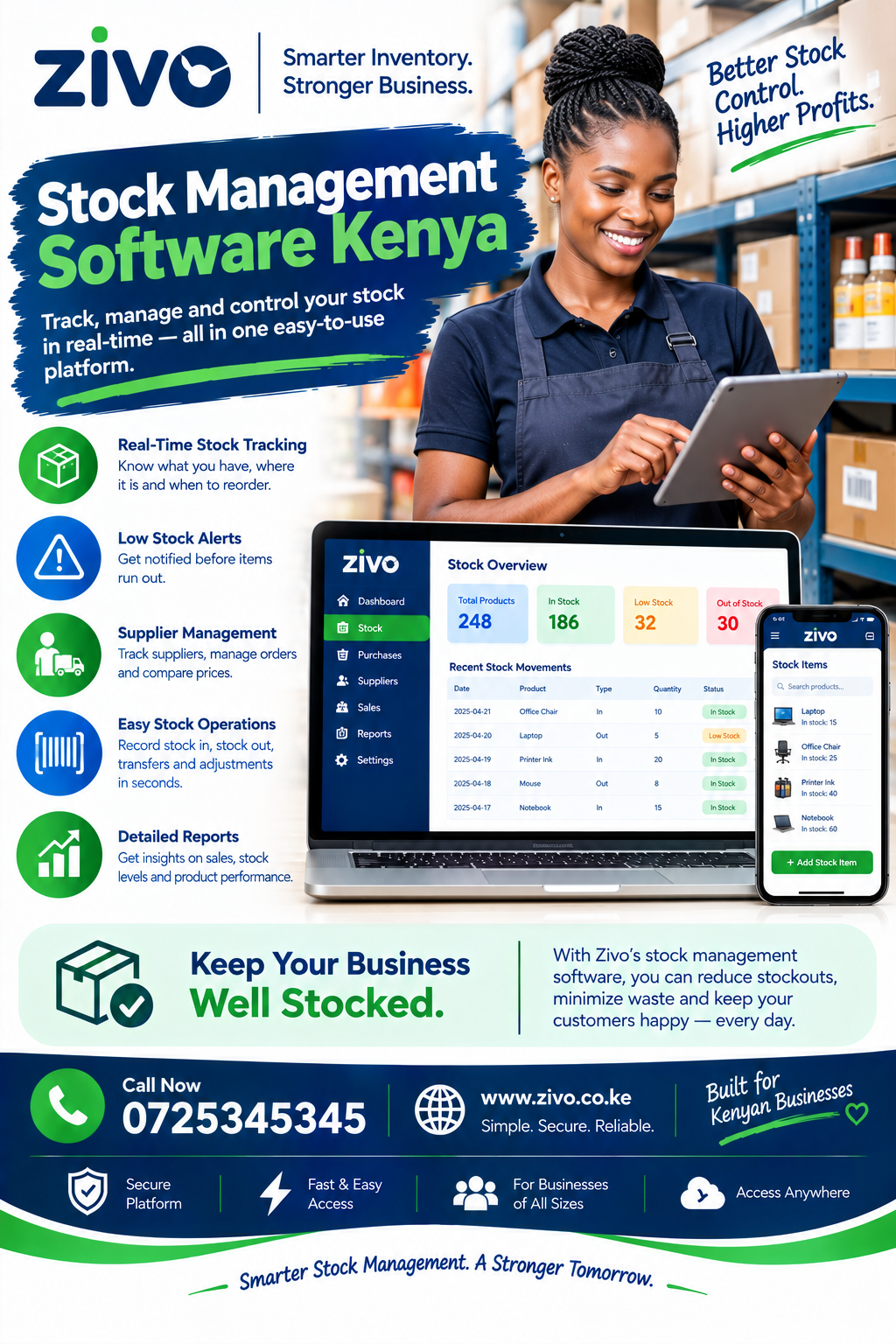
Stock Management Software Kenya: A Complete Guide to Better Inventory Control
Knowing exactly what is available for sale, what has been purchased, what has been sold, and what needs to be reordered is essential for any business that handles physical products. When stock records are maintained through notebooks, loose documents, spreadsheets, or memory, errors can quickly affect sales, purchasing, cash flow, and customer service. This is where Stock Management Software Kenya can provide a more organized approach to inventory control. This guide explains how stock management software works, why it matters to Kenyan businesses, which features to consider, and how a digital stock system can help businesses maintain more accurate inventory records.
Stock is one of the most important assets for retailers, wholesalers, distributors, hardware businesses, pharmacies, electronics shops, agrovet businesses, clothing stores, supermarkets, restaurants, and many other organizations. If a business does not know what it has in stock, it becomes difficult to make reliable purchasing and sales decisions.
For a growing business, Stock Management Software Kenya can bring product records, purchases, sales, stock movements, suppliers, customers, and reporting into a more structured system.
The objective is straightforward: help the business know what it has, where it is, how it got there, how much has moved, and when action is required.
What Is Stock Management Software?
Stock Management Software Kenya is a digital system that helps businesses record, monitor, and control the movement of inventory. It can be used to maintain product records, track quantities, record purchases, deduct stock after sales, monitor adjustments, and generate reports.
Depending on the system, stock management may include features such as:
- Product catalogues
- Stock quantity tracking
- Purchase records
- Supplier management
- Sales integration
- Low-stock alerts
- Stock transfers
- Stock adjustments
- Stock-taking
- Barcode support
- Batch tracking
- Expiry-date management
- Inventory reports
- User permissions
- Multi-branch inventory
A business does not necessarily need every feature listed above. The right combination depends on the type and size of the organization.
Stock Management Software Kenya becomes particularly useful when a business has enough products or transactions that manual stock tracking starts becoming difficult.
Why Stock Management Matters
Poor stock control can affect almost every part of a business.
A shop may have products physically available but records showing a different quantity. A wholesaler may reorder an item that is already sitting in a warehouse. A retailer may advertise a product that has already run out.
These situations can create unnecessary costs and customer frustration.
Stock Management Software Kenya provides a structured way to keep inventory information updated as stock moves through the business.
Good stock management helps answer practical questions:
- How many units are available?
- Which products are selling quickly?
- Which products are moving slowly?
- Which items need to be reordered?
- Which products have been damaged?
- Which items were received from a supplier?
- Which products were transferred between locations?
- What is the value of current inventory?
These questions are important for daily business decisions.
Stock Management Challenges Faced by Kenyan Businesses
Many Kenyan businesses begin with simple stock records.
A small shop might use an exercise book. Another business may create an Excel spreadsheet. Some owners rely heavily on memory, especially when the number of products is small.
As the business grows, these methods can become difficult to maintain.
Stock Management Software Kenya can help businesses transition from informal stock tracking to a more structured digital process.
Common challenges include:
Manual Data Entry
Employees may record purchases and sales separately, creating opportunities for mistakes.
Missing Stock Records
Products can move without the corresponding record being updated.
Unclear Reorder Levels
Managers may not know when an item has reached a level that requires replenishment.
Stock Variances
Physical counts may not match recorded quantities.
Poor Supplier Records
Businesses may struggle to determine which supplier provided particular products or how much was paid.
Multiple Locations
Managing inventory across different branches can be difficult without centralized records.
A digital system can help address these issues when it is properly configured and consistently used.
How Stock Management Software Works
A typical stock management process begins when products are added to the system.
Each product can have information such as:
- Product name
- SKU
- Category
- Selling price
- Buying price
- Quantity
- Reorder level
- Supplier
- Unit of measurement
- Barcode
- Batch number
- Expiry date
Stock Management Software Kenya can then record stock movement as products enter or leave the business.
For example:
Purchase → Stock Received → Inventory Updated → Sale → Stock Deducted → Reorder Alert
This creates a clear trail of inventory movement.
Creating a Product Catalogue
A product catalogue is the foundation of digital inventory management.
Each item should have a clear and consistent record.
Stock Management Software Kenya can help businesses organize large numbers of products into categories and records.
For example, a hardware business may create categories such as:
- Plumbing
- Electrical
- Building materials
- Tools
- Paint
- Safety equipment
An electronics business may organize products into:
- Mobile phones
- Chargers
- Earphones
- Computers
- Accessories
- Batteries
Good categorization makes products easier to find and reports easier to understand.
Recording Purchases
When a business purchases stock, the quantity should be added to the inventory record.
Stock Management Software Kenya can support this process by connecting purchase records with inventory quantities.
A purchase record may include:
- Supplier
- Purchase date
- Products
- Quantities
- Unit costs
- Total cost
- Payment status
- Delivery information
This information can help businesses understand how much they are spending on inventory.
Supplier Management
Stock control is closely connected to purchasing.
A business may purchase products from several suppliers. Without proper records, it can become difficult to determine who supplied a particular product or how much the business normally pays.
Stock Management Software Kenya can help organize supplier information alongside purchase records.
Supplier records may contain:
- Supplier name
- Contact information
- Products supplied
- Purchase history
- Outstanding balances
- Payment records
- Notes
This can make procurement more organized.
Recording Sales and Stock Deduction
When a product is sold, the stock quantity should decrease.
For example, if a shop has 100 units of a product and sells 7 units, the recorded quantity should become 93.
Stock Management Software Kenya can automate this relationship when inventory is connected to sales or point-of-sale functionality.
Automatic stock deduction reduces the need for employees to manually update quantities after every transaction.
The exact workflow depends on the software being used.
Low-Stock Alerts
Running out of popular products can result in missed sales.
A low-stock feature can notify the business when a product reaches a defined threshold.
Stock Management Software Kenya can help businesses identify products that require replenishment when low-stock functionality is available.
For example:
| Product | Current Stock | Reorder Level | Action |
|---|---|---|---|
| Product A | 5 | 10 | Reorder |
| Product B | 45 | 15 | No immediate action |
| Product C | 8 | 8 | Review |
| Product D | 0 | 12 | Urgent replenishment |
The reorder level should be based on the business’s actual sales patterns and supplier lead times.
Avoiding Overstocking
Stock shortages are not the only problem.
A business can also purchase too much of a product that sells slowly.
Stock Management Software Kenya can help managers review stock movement and identify products that may require closer attention.
Overstock can tie up money that could otherwise be used for:
- Business expenses
- New products
- Marketing
- Staff
- Equipment
- Expansion
The goal is not to keep the maximum possible amount of stock. The goal is to maintain an appropriate level for the business.
Fast-Moving and Slow-Moving Products
Not every product sells at the same rate.
A supermarket may sell certain household products every day while other items remain on shelves for much longer.
Stock Management Software Kenya can help businesses analyze product movement where reporting features support this.
Fast-moving products may require closer replenishment monitoring.
Slow-moving products may require different purchasing decisions.
Managers can use this information when deciding what to order and in what quantities.
Stock-Taking
Physical stock-taking is an important part of inventory control.
Even when digital records are maintained carefully, the physical quantity may differ from the system because of:
- Damage
- Theft
- Miscounting
- Unrecorded sales
- Returns
- Data-entry mistakes
- Internal transfers
- Expired products
Stock Management Software Kenya can help businesses compare recorded quantities with physical counts when stock-taking functionality is available.
A stock-take should be treated as a control activity rather than simply a counting exercise.
Understanding Stock Variances
A stock variance occurs when the quantity recorded in the system does not match the physical quantity.
For example, the system may show 50 units while the physical count finds 46.
The difference should be investigated.
Stock Management Software Kenya can help businesses record adjustments and maintain clearer inventory histories.
The reason for a variance should be considered where possible.
Stock Adjustments
Sometimes inventory needs to be adjusted for legitimate reasons.
Examples include:
- Damaged products
- Expired goods
- Samples
- Internal use
- Corrections
- Returns
- Opening stock corrections
Stock Management Software Kenya can provide a structured method for recording such adjustments.
Businesses should limit adjustment permissions to appropriate users where possible.
Managing Multiple Branches
A business with multiple shops or warehouses has additional inventory requirements.
Management may need to know:
- What is available at each branch?
- Which branch has excess stock?
- Which location is running low?
- What stock was transferred?
- What products are selling in each location?
Stock Management Software Kenya can help businesses organize inventory across locations when multi-branch functionality is available.
Stock Transfers
Instead of purchasing new products, a business may transfer stock from one location to another.
For example, Branch A may have 100 units while Branch B has only 10.
A stock transfer can move part of Branch A’s inventory to Branch B.
The system should record both sides of the movement.
Barcode Management
Businesses with many products may benefit from barcode functionality.
Stock Management Software Kenya can support barcode-based workflows when the platform provides barcode capabilities.
Barcodes can make it easier to identify products during:
- Sales
- Receiving
- Stock-taking
- Transfers
- Returns
They can also reduce manual product selection in some workflows.
Batch and Expiry Management
Certain businesses need to know not only how many products they have but also which batches they belong to and when they expire.
This is particularly relevant for businesses handling products with expiry dates.
Stock Management Software Kenya can support batch or expiry workflows where these features are available.
Examples include:
- Pharmacies
- Food businesses
- Cosmetics businesses
- Agrovet shops
- Health-related product suppliers
A business should choose a system that supports the specific inventory attributes it needs.
Managing Stock in Pharmacies
Pharmacies may have more detailed stock requirements than ordinary retail shops.
They may need to track:
- Product names
- Quantities
- Batches
- Expiry dates
- Suppliers
- Purchase prices
- Selling prices
Stock Management Software Kenya can be part of a broader inventory workflow, although businesses should confirm that any specialized regulatory or operational requirements are supported before implementation.
Expiry management is especially important for products that cannot be sold after a specified date.
Stock Management for Hardware Businesses
Hardware shops often carry thousands of products with different units and packaging.
Products may be sold by:
- Piece
- Box
- Metre
- Kilogram
- Bag
- Roll
- Packet
Stock Management Software Kenya can help businesses maintain clearer product records when the system supports multiple units and categories.
A well-organized catalogue can make it easier for staff to find the correct item during sales.
Stock Management for Electronics Businesses
Electronics businesses may need to track serial numbers, models, colours, storage capacities, or other product variations.
Stock Management Software Kenya can support structured product records where these capabilities are included.
For example, a mobile phone business may have the same model available in different storage capacities and colours.
Treating each variation as a properly defined product can make inventory reporting more accurate.
Stock Management for Wholesalers
Wholesalers often handle large quantities and multiple customers.
They may purchase in bulk and distribute products to retailers.
Stock Management Software Kenya can help wholesalers manage purchasing, stock levels, sales, customer orders, and supplier information in a more organized workflow.
Wholesalers may also require:
- Multiple warehouses
- Bulk pricing
- Customer credit
- Sales orders
- Delivery records
- Stock transfers
These requirements should be considered when choosing software.
Stock Management for Supermarkets and Retail Shops
Retail shops have frequent stock movements.
A single day may involve hundreds of product sales.
Stock Management Software Kenya can help retailers connect sales activity with inventory records.
When a sale is recorded, the relevant product quantity can be reduced automatically if the system supports integrated sales and inventory.
This reduces the need for separate manual updates.
Stock Management for Restaurants
Restaurants also manage inventory, although the process can differ from traditional retail.
Products may include:
- Food ingredients
- Beverages
- Packaging
- Cleaning supplies
- Kitchen supplies
Stock Management Software Kenya can help restaurants organize stock records depending on their requirements.
Restaurants may also need recipe-level inventory deductions, waste tracking, and ingredient management, so businesses should verify whether those features are available.
Managing Stock Purchases
Purchasing decisions should be based on reliable inventory information.
A business needs to know what it already has before ordering more.
Stock Management Software Kenya can help connect stock levels with purchasing decisions.
A basic purchasing workflow can be:
Check Stock → Identify Required Items → Create Purchase Order → Receive Goods → Verify Quantities → Update Inventory → Record Supplier Information
This creates a clear link between procurement and inventory.
Purchase Orders
A purchase order can document what the business intends to buy before goods arrive.
Stock Management Software Kenya can support purchase-order workflows where the feature is available.
A purchase order can include:
- Supplier
- Product
- Quantity
- Unit price
- Expected delivery
- Total value
When goods arrive, the business can compare the delivery against the order.
Receiving Stock
Receiving stock should be treated as an important control point.
Employees should verify:
- Product
- Quantity
- Condition
- Batch
- Expiry date where applicable
- Purchase documentation
Stock Management Software Kenya can help create a structured receiving process when inventory receiving features are supported.
Incorrect receiving can cause problems throughout the rest of the inventory system.
Stock Valuation
Businesses may need to understand the value of the inventory they currently hold.
Stock valuation can be useful for management and accounting purposes.
Stock Management Software Kenya can provide inventory-related information that supports this process where the appropriate valuation features are available.
The exact valuation method should align with the business’s accounting requirements and professional advice where necessary.
Inventory and Cash Flow
Stock and cash flow are closely connected.
When a business buys inventory, cash is spent before the products are necessarily sold.
Stock Management Software Kenya can help management understand purchasing and stock activity as part of wider business monitoring.
Too much money tied up in slow-moving stock can reduce the cash available for other needs.
At the same time, insufficient stock can prevent sales.
Effective inventory management therefore requires balance.
Inventory and Profitability
Sales revenue alone does not tell a business which products are performing well.
Management may want to understand:
- Purchase cost
- Selling price
- Quantity sold
- Gross margin
- Stock remaining
Stock Management Software Kenya can help organize the information required for this type of analysis where reporting capabilities support it.
Product-level reporting can help businesses identify items that contribute meaningfully to sales and margins.
Customer Orders and Stock Availability
Customers do not want to order products only to discover later that they are unavailable.
Stock Management Software Kenya can help businesses maintain clearer visibility of available inventory.
Before confirming an order, staff can check the current stock level.
This is particularly useful for businesses receiving orders through multiple channels, such as:
- Physical stores
- Phone calls
- Online stores
- Sales representatives
Businesses should ensure that all sales channels feed accurate information into the stock process.
Managing Returns
Returns can affect stock records.
When a customer returns a product, the business needs to determine whether it should:
- Return the item to saleable inventory
- Mark it as damaged
- Send it for repair
- Return it to the supplier
- Dispose of it
Stock Management Software Kenya can help businesses maintain accurate records when return and adjustment features are available.
Every return should have a clear outcome.
Managing Damaged Stock
Not all products that leave inventory are sold.
Some may be damaged during handling, transportation, storage, or customer returns.
Stock Management Software Kenya can help businesses record damaged products separately from normal sales.
This prevents damaged items from continuing to appear as available stock.
Stock Security and User Permissions
Inventory records should not be editable by everyone.
Stock Management Software Kenya can provide role-based access where user permissions are supported.
For example:
- Sales staff may record sales.
- Storekeepers may receive stock.
- Managers may approve adjustments.
- Administrators may manage product records.
- Owners may access reports.
The exact roles depend on the business.
Access control can reduce the risk of unauthorized changes.
Inventory Audit Trails
An audit trail records changes made to important information.
Stock Management Software Kenya can be useful where the system provides inventory activity histories.
An audit trail can help answer questions such as:
- Who adjusted the stock?
- When was the adjustment made?
- What quantity changed?
- Which product was affected?
This information can support internal controls.
Mobile Stock Management
Many Kenyan business owners and employees rely heavily on mobile devices for daily operations.
A mobile-friendly system can make inventory information accessible while away from the office.
Stock Management Software Kenya can be more convenient when authorized users can check stock and perform relevant tasks through a phone or tablet.
Mobile access can be useful for:
- Store managers
- Sales representatives
- Business owners
- Warehouse staff
- Procurement teams
Businesses should test the system on the devices and internet connections their employees actually use.
Offline Considerations
Internet connectivity may not always be consistent.
For businesses operating outside major urban centres or in locations with unreliable connectivity, offline functionality can be an important consideration.
Stock Management Software Kenya should be evaluated to determine whether it can support the business’s connectivity requirements.
If offline functionality is available, businesses should understand how data is synchronized once an internet connection returns.
M-Pesa and Inventory Operations
M-Pesa is commonly used by Kenyan businesses and customers for payments.
When payment information and sales records are connected, businesses can potentially reduce manual reconciliation work.
Stock Management Software Kenya may support payment-related workflows depending on the platform’s capabilities and integrations.
The important point is that payment records and stock movement should remain consistent.
For example, if an order is paid and stock is reserved or deducted, the business should have a clear record of what happened.
Inventory Reporting
Reports can help turn raw stock information into useful management information.
Stock Management Software Kenya can support inventory reporting where the required reports are available.
Useful reports may include:
- Current stock
- Low-stock items
- Stock valuation
- Fast-moving products
- Slow-moving products
- Purchase history
- Sales history
- Stock adjustments
- Stock transfers
- Expired products
- Damaged products
Reports should be reviewed regularly rather than generated only when a problem occurs.
Common Inventory Reports
A business can use several reports to monitor its stock.
Current Stock Report
Shows the quantity available for each product.
Low-Stock Report
Highlights products below their defined reorder levels.
Stock Movement Report
Shows stock entering and leaving inventory.
Purchase Report
Shows products purchased and supplier activity.
Sales Report
Shows products sold during a selected period.
Stock-Take Variance Report
Compares recorded stock with physical quantities.
Stock Management Software Kenya can support these types of reports where they are included in the system.
Benefits of Digital Stock Management
There are several potential benefits to moving from manual records to a digital system.
Better Accuracy
Automated stock deductions can reduce repetitive manual calculations.
Faster Information Access
Employees can search for products instead of checking several books.
Better Purchasing Decisions
Managers can review stock levels before placing orders.
Improved Customer Service
Staff can provide clearer information about availability.
Better Loss Control
Stock movements can be monitored more consistently.
Easier Reporting
Management can generate reports without manually combining multiple spreadsheets.
Stock Management Software Kenya can support these improvements when the system is configured correctly and employees use it consistently.
How to Choose the Right Stock Management System
Businesses should begin with their requirements.
Stock Management Software Kenya should solve actual inventory problems rather than simply provide a long list of features.
Start by asking:
- How many products do we manage?
- How many sales do we process?
- Do we have multiple locations?
- Do products have expiry dates?
- Do we use barcodes?
- Do we need batch tracking?
- Do we need supplier management?
- Do we need purchase orders?
- Do we need M-Pesa integration?
- Do we need POS integration?
- How many employees need access?
- What reports does management require?
These questions can help narrow the options.
What Kenyan SMEs Should Look For
A Kenyan SME may prioritize different features from a large corporation.
Stock Management Software Kenya should be affordable, practical, easy to use, and suitable for the business’s day-to-day operations.
Important considerations may include:
- Mobile access
- M-Pesa-related workflows
- Local currency support
- Sales integration
- Supplier records
- Customer credit
- Stock alerts
- Reporting
- Multiple users
- Multiple branches
- Data security
The business should prioritize features that solve real problems.
Implementation Steps
Implementing stock management software requires preparation.
Step 1: List Existing Products
Create a clean product list.
Step 2: Remove Duplicates
Identify products that have been entered multiple times under different names.
Step 3: Verify Quantities
Conduct an initial physical stock count.
Step 4: Set Product Information
Add categories, prices, units, suppliers, and reorder levels.
Step 5: Define User Roles
Determine who can view, add, edit, sell, receive, adjust, and approve inventory.
Step 6: Train Employees
Show staff how to perform their specific tasks.
Step 7: Start Recording All Movements
Avoid mixing digital and manual processes unnecessarily after implementation.
Stock Management Software Kenya becomes more effective when the entire team follows the same inventory process.
Common Stock Management Mistakes
Mistake 1: Failing to Count Opening Stock
If opening quantities are wrong, future reports will also be unreliable.
Mistake 2: Creating Duplicate Products
A product should have a consistent name and identifier.
Mistake 3: Ignoring Damaged Stock
Damaged products should not continue appearing as available stock.
Mistake 4: Not Recording Transfers
Moving products between branches without recording the movement causes discrepancies.
Mistake 5: Allowing Uncontrolled Adjustments
Stock adjustments should be restricted and reviewed.
Stock Management Software Kenya can help structure these processes when the relevant controls are available.
Training Employees
Employees should understand that stock accuracy is a shared responsibility.
A cashier, salesperson, storekeeper, procurement officer, and manager may each interact with inventory differently.
Stock Management Software Kenya should therefore be introduced with role-specific training.
For example, sales employees need to know how to record sales correctly.
Storekeepers need to understand receiving and stock transfers.
Managers need to understand reports and approvals.
Monitoring Inventory Performance
After implementation, management should regularly review stock information.
Stock Management Software Kenya can provide useful data for monitoring inventory performance where appropriate reports are available.
Questions to review may include:
- Which products are selling fastest?
- Which products are rarely moving?
- Which items are repeatedly running out?
- Which products have high stock variances?
- Which suppliers are used most often?
- Which branches have excess stock?
- Which products are approaching expiry?
The answers can inform future purchasing and sales decisions.
Practical Example: Nairobi Retail Shop
Consider a hypothetical retail shop in Nairobi selling household goods.
The owner manages approximately 1,000 product variations.
Previously, sales were recorded in a notebook while stock counts were performed manually every few weeks.
The owner frequently discovered that popular products had run out without anyone noticing.
After implementing Stock Management Software Kenya, the business creates product records and establishes reorder levels.
Sales are connected to stock deductions.
The owner can now review inventory information before placing new purchase orders.
The system does not eliminate the need for physical stock-taking, but it provides a better baseline for comparison.
Practical Example: Hardware Business
A hardware shop manages thousands of products across plumbing, electrical, tools, and construction materials.
Some products are sold individually while others are sold by box or package.
Stock Management Software Kenya can help organize product records and categories.
When a customer purchases materials, the sales transaction can update the relevant stock quantities where the system supports integrated inventory.
The owner can then review which products require replenishment.
Practical Example: Wholesaler
A wholesaler receives large deliveries and distributes products to smaller retailers.
The business has a warehouse and several sales representatives.
Stock Management Software Kenya can help create a central record of inventory movement where multi-location and sales features are available.
Purchases increase inventory, sales reduce inventory, and transfers can move products between locations.
This creates a clearer picture of available stock.
Practical Example: Pharmacy
A pharmacy needs to maintain careful records of products, batches, and expiry dates.
Stock Management Software Kenya can support structured inventory records where batch and expiry features are available.
Before selecting software for a specialized business, management should confirm that the system supports all relevant operational and regulatory requirements.
Practical Example: Electronics Shop
An electronics retailer sells phones, laptops, chargers, headphones, and accessories.
Some products have serial numbers.
Stock Management Software Kenya can help the business maintain detailed product records where serial-number functionality is supported.
This can make it easier to connect products with sales and customer records.
Inventory and Customer Credit
Some Kenyan businesses allow trusted customers to purchase products on credit.
Credit sales can affect both inventory and receivables.
Stock Management Software Kenya can help businesses maintain clearer records when customer credit and inventory features are connected.
When a credit sale occurs, the stock should still be deducted even though the customer has not yet paid.
The financial balance should be tracked separately.
Inventory and Sales Forecasting
Historical sales information can help businesses understand demand patterns.
Stock Management Software Kenya can provide sales and inventory information that may support internal planning.
For example, a business may notice that certain products sell more during particular seasons.
Management can use that information to plan purchasing.
Forecasting should not rely only on historical sales. Businesses should also consider supplier lead times, market conditions, product changes, and other relevant factors.
Inventory and Procurement
Procurement teams need reliable stock information.
If current inventory is unclear, purchasing decisions become more difficult.
Stock Management Software Kenya can connect purchasing information with stock records where the appropriate functionality is available.
A good procurement process should answer:
- What do we need?
- How much do we need?
- What do we already have?
- Who supplies it?
- What does it cost?
- When will it arrive?
Inventory Security
Inventory is valuable, so businesses should take steps to protect it physically and digitally.
Stock Management Software Kenya can support digital controls such as user permissions and activity records where these features are available.
Physical controls may include:
- Restricted warehouse access
- Proper storage
- Stock-taking
- Receiving checks
- Dispatch verification
- Segregation of duties
Software should complement these controls rather than replace them.
Data Backup
Inventory information should be protected against accidental loss.
Stock Management Software Kenya should be evaluated for its backup and recovery arrangements before implementation.
Businesses should understand:
- How frequently data is backed up
- Where backups are stored
- How data can be restored
- Who can access backups
- Whether data can be exported
These questions are particularly important for businesses that depend heavily on digital records.
Scaling Inventory Management
A system should be able to support business growth.
Stock Management Software Kenya may be useful as an organization increases its product range, staff, branches, or sales volume, provided the platform can scale accordingly.
A business should think beyond today’s inventory.
If the company expects to add branches or warehouses, those future requirements should be considered before selecting software.
Stock Management and Business Growth
Better inventory control can help management make more informed decisions.
Stock Management Software Kenya can provide a clearer view of products, purchases, sales, and stock movements.
With better information, a business can identify opportunities such as:
- Expanding profitable product lines
- Reducing slow-moving inventory
- Improving reorder processes
- Negotiating with suppliers
- Moving stock between branches
- Improving product availability
The software itself does not make these decisions. It provides information that management can use.
Frequently Asked Questions
What is Stock Management Software Kenya?
Stock Management Software Kenya refers to digital software used by Kenyan businesses to track and manage inventory. Depending on the platform, it can cover products, purchases, sales, suppliers, stock movements, adjustments, reporting, and multiple locations.
Who needs stock management software?
Businesses that buy, store, sell, or distribute physical products can benefit from structured inventory management.
Stock Management Software Kenya can be useful for retailers, wholesalers, supermarkets, hardware shops, electronics businesses, pharmacies, agrovet businesses, restaurants, distributors, and other product-based businesses.
Can small businesses use stock management software?
Yes. Small businesses can use Stock Management Software Kenya when their product range or sales volume makes manual tracking difficult.
The system should be appropriately sized for the business rather than unnecessarily complicated.
Can stock management software track M-Pesa payments?
Some platforms provide M-Pesa integrations or payment-related features.
Businesses should confirm whether Stock Management Software Kenya supports their specific payment workflow before implementation.
Can stock management software manage multiple branches?
Many inventory platforms support multiple locations, but capabilities vary.
Stock Management Software Kenya can help businesses manage branch-level inventory where multi-location functionality is included.
Can software help prevent stockouts?
Low-stock alerts and reorder levels can help businesses identify products approaching their minimum quantity.
Stock Management Software Kenya can support this process where these inventory features are available.
Businesses should still review demand and supplier lead times before ordering.
Can stock management software track expired products?
Some systems provide batch and expiry-date tracking.
Stock Management Software Kenya can support expiry-related workflows where these capabilities are included.
Businesses handling expiry-sensitive products should verify the exact functionality before selecting a platform.
Can stock management software track damaged goods?
Yes, depending on the system.
Stock Management Software Kenya can help record inventory adjustments for damaged products when adjustment functionality is available.
Can stock management software integrate with POS?
Many platforms connect inventory with point-of-sale transactions.
Stock Management Software Kenya can support this type of workflow where POS integration is included.
When a sale occurs, the relevant stock quantity can be updated automatically.
What should I consider before choosing stock management software?
Consider product volume, number of locations, number of users, barcode requirements, batch and expiry tracking, supplier management, purchasing, POS integration, payment workflows, reporting, security, mobile access, support, and scalability.
Stock Management Software Kenya should ultimately fit the actual needs of the business.
Final Thoughts
Inventory is too important to manage entirely through guesswork.
When stock records are inaccurate, businesses can experience shortages, excess inventory, purchasing mistakes, customer dissatisfaction, and difficulty understanding profitability.
Stock Management Software Kenya provides a structured way to record and monitor inventory activity.
A good stock management process starts with accurate product records. From there, every major stock movement should be recorded consistently.
Purchases should increase inventory.
Sales should reduce inventory.
Transfers should move stock between locations.
Returns and damaged products should be handled appropriately.
Stock adjustments should be controlled.
Physical stock-taking should be used to verify digital records.
Stock Management Software Kenya can help businesses bring these activities into a central system when the necessary features are available.
For Kenyan SMEs, the right solution should also reflect the realities of local business operations. Businesses may need mobile access, multiple payment methods, customer credit tracking, supplier management, branch-level stock control, and practical reporting.
The system should be easy enough for employees to use consistently.
Stock Management Software Kenya should not make stock control more complicated. Its purpose should be to make information easier to capture, find, review, and act upon.
Businesses should also avoid assuming that software eliminates the need for physical controls. Regular stock-taking, secure storage, proper receiving procedures, and appropriate user permissions remain important.
Digital records and physical controls work together.
Stock Management Software Kenya can become particularly valuable when a business has outgrown notebooks and spreadsheets and needs greater visibility into its inventory.
Before choosing a solution, management should document its current problems and determine the features that will solve them.
A retailer may prioritize POS integration and low-stock alerts.
A wholesaler may need warehouse and branch management.
A pharmacy may require batch and expiry tracking.
A hardware shop may need flexible product units.
An electronics business may require serial-number management.
A distributor may need purchasing, sales orders, transfers, and supplier management.
Stock Management Software Kenya should therefore be selected according to the organization’s actual workflow.
Implementation is just as important as software selection. Employees need training, opening stock needs to be verified, product information needs to be cleaned, and clear procedures need to be established.
Once the system is running, management should regularly review inventory reports.
Stock Management Software Kenya can provide information that helps businesses understand which products are moving, which are running low, which are accumulating, and where stock discrepancies may exist.
This information can support better purchasing and operational decisions.
For businesses with multiple branches, centralized inventory visibility can also make it easier to identify where products are available and where additional stock may be needed.
Stock Management Software Kenya can support this type of visibility when multi-location features are available.
The most important objective is not simply to have a digital stock system. The objective is to have reliable inventory information that employees and management can use every day.
When product records are accurate, stock movements are recorded consistently, purchases are controlled, and sales are connected to inventory, a business has a much clearer picture of its operations.
Stock Management Software Kenya can form part of that broader process.
For a Kenyan business considering a move away from manual stock tracking, the best starting point is to identify the biggest current inventory problems.
Are products frequently running out?
Are there unexplained stock differences?
Is too much cash tied up in slow-moving products?
Are employees struggling to find product information?
Are purchasing decisions based mainly on guesswork?
Are branch inventories difficult to compare?
If the answer to several of these questions is yes, a structured stock management system may be worth evaluating.
Stock Management Software Kenya can help create a more consistent process for managing inventory when it is properly implemented.
Businesses should then compare available solutions based on functionality, usability, support, security, integration requirements, and overall suitability.
The cheapest system may not always meet the organization’s requirements, while the most complex system may contain features that the business does not need.
Stock Management Software Kenya should be practical, understandable, and aligned with the way employees actually work.
Ultimately, effective stock management is about maintaining control.
The business should know what it owns, where the products are, what is moving, what needs attention, and how inventory affects purchasing, sales, cash flow, and profitability.
Stock Management Software Kenya can help turn those questions into accessible business information.
For growing Kenyan SMEs, that visibility can become increasingly important as the number of products, customers, employees, suppliers, and locations increases.
A structured inventory system can give business owners a clearer operational foundation from which to make purchasing, sales, and growth decisions.
Stock Management Software Kenya can therefore be considered not simply as a tool for counting products, but as part of a wider system for controlling business operations.
The next step for a business considering digital stock management is to map its current inventory workflow, identify the gaps, list the essential features, and compare suitable solutions.
When implemented correctly, a stock management system can make everyday inventory tasks more organized while giving management better information for running the business.
Stock Management Software Kenya is ultimately about replacing uncertainty with clearer records and creating a repeatable process for managing stock from purchase through sale.
For businesses that want to improve inventory control, reduce manual work, monitor stock levels, organize purchasing, and gain better visibility into product movement, evaluating a suitable digital solution can be a practical step toward stronger business operations.
Stock Management Software Kenya can be part of that transition, provided the chosen platform matches the business’s actual requirements.
The strongest implementation is one that employees can use consistently, managers can understand quickly, and the business can continue using as it grows.
Stock Management Software Kenya should ultimately support a simple business objective: having the right stock, in the right place, at the right time, with accurate information available when decisions need to be made.