
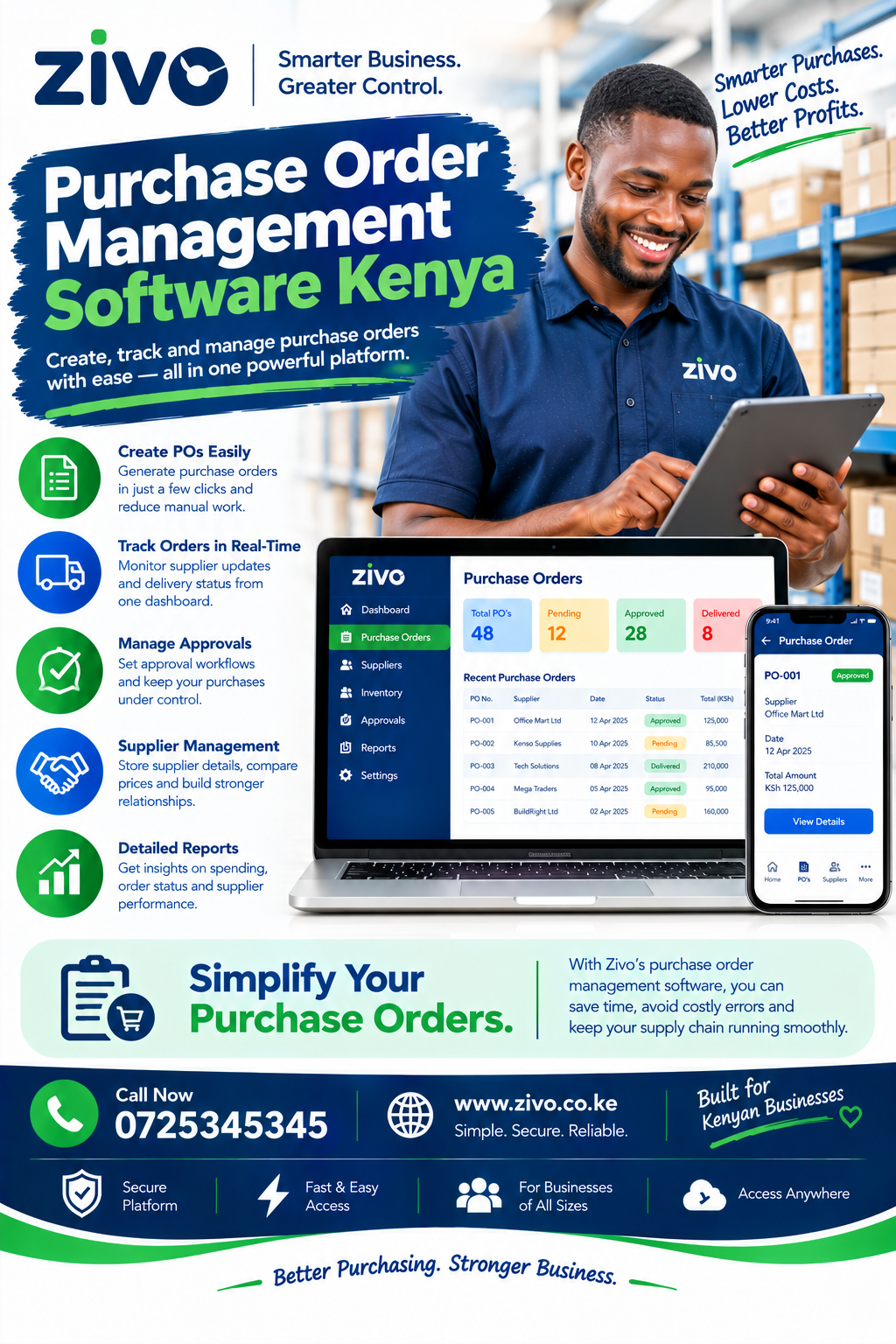
Purchase Order Management Software Kenya: A Complete Guide for Managing Business Purchases
Purchasing is one of the most important activities in any business. Whether a company buys office supplies, inventory, equipment, raw materials, services, or other operational resources, every purchase needs to be properly planned, approved, recorded, and monitored.
As businesses grow, managing purchases manually can become difficult. Purchase requests may be communicated through emails, WhatsApp messages, spreadsheets, paper forms, or verbal instructions. When different employees are involved in purchasing, finance, procurement, and management, it can become increasingly difficult to know which purchases have been approved, which orders have been sent to suppliers, what has already been delivered, and how much the business has spent.
This is where Purchase Order Management Software Kenya can provide a structured approach to purchasing. A digital purchase order system can help businesses create purchase orders, route them for approval, track suppliers, monitor order status, maintain records, and connect purchasing information with broader financial processes.
For Kenyan businesses, having a clear purchasing process is particularly useful because businesses often need to manage multiple suppliers, branches, payment methods, products, services, and operational expenses at the same time.
A well-configured Purchase Order Management Software Kenya solution can help establish a central process where purchase requests and orders are easier to monitor from creation to completion.
This guide explains what purchase order management software is, how it works, its benefits, important features, implementation considerations, and how Kenyan businesses can use it to improve purchasing operations.
What Is Purchase Order Management Software?
Purchase Order Management Software Kenya is a digital solution designed to help businesses create, approve, issue, track, and manage purchase orders.
A purchase order, commonly called a PO, is a formal document that a buyer sends to a supplier to communicate what the business wants to purchase. It may include information such as:
- Supplier details
- Products or services required
- Quantities
- Prices
- Delivery information
- Payment terms
- Purchase order number
- Requested delivery date
- Approval information
- Additional notes
Instead of preparing and tracking these documents manually, businesses can use software to centralize the entire process.
With Purchase Order Management Software Kenya, a company can create a purchase request, obtain the necessary approvals, issue an order to the supplier, track the order, and retain the purchasing record for future reference.
This creates a more organized procurement workflow.
Why Purchase Orders Matter to Kenyan Businesses
Purchase orders provide businesses with a documented record of what they intend to purchase. This can be valuable when several employees or departments participate in procurement.
For example, a company may have an employee request office equipment. The procurement team may review the request, management may approve it, and the supplier may then receive the purchase order.
Without a structured system, each step can happen through separate communication channels.
With Purchase Order Management Software Kenya, these activities can be brought together into one purchasing workflow.
Purchase orders can help businesses:
- Establish clear purchasing procedures
- Reduce unauthorized purchases
- Improve communication with suppliers
- Track outstanding orders
- Maintain procurement records
- Monitor purchasing commitments
- Improve accountability
- Simplify internal approvals
- Support financial reporting
The objective is not simply to generate purchase orders. It is to create a purchasing process that can be monitored and controlled.
How Purchase Order Management Software Works
A typical purchasing workflow can contain several stages.
1. Purchase Request
The process can begin when an employee or department identifies a need.
For example, the sales department may need additional computers, or a retail business may need additional stock.
The employee submits a purchase request containing the required information.
2. Review
The request can then be reviewed by the relevant person or department.
The reviewer may confirm:
- What is being purchased
- Why it is required
- Quantity needed
- Estimated cost
- Supplier
- Available budget
3. Approval
Depending on the organization’s purchasing policy, the request may require approval from a manager, department head, finance officer, or business owner.
Purchase Order Management Software Kenya can help businesses create approval workflows based on their internal procedures.
4. Purchase Order Creation
Once approved, a purchase order can be generated.
The order can contain the supplier and purchasing information required to proceed.
5. Supplier Communication
The purchase order can then be shared with the supplier.
This provides the supplier with a clear record of what the business has requested.
6. Order Tracking
The business can track the order after it has been issued.
Possible statuses may include:
- Draft
- Pending approval
- Approved
- Sent
- Partially received
- Completed
- Cancelled
7. Delivery and Reconciliation
When the goods or services are delivered, the business can compare the delivery against the original purchase order.
This can help identify missing quantities, incorrect items, or differences between the order and delivery.
Benefits of Purchase Order Management Software Kenya
One of the main reasons businesses adopt Purchase Order Management Software Kenya is to gain better control over purchasing activities.
The benefits can extend beyond procurement.
Better Purchasing Control
A centralized system can give management greater visibility into purchasing activities.
Rather than relying on scattered spreadsheets and messages, managers can review purchase requests and orders within one system.
This can make it easier to determine which purchases are pending, approved, or completed.
Improved Approval Processes
Manual approval processes can sometimes result in delays.
A purchase request might remain in someone’s inbox or on a desk for several days.
With Purchase Order Management Software Kenya, businesses can establish structured approval procedures.
This can make responsibilities clearer and reduce uncertainty about who needs to approve a purchase.
Reduced Unauthorized Purchasing
Businesses need to control spending.
Employees making purchases without authorization can create budget problems and make financial reporting more difficult.
A digital purchasing system can require approval before an order is issued.
This can help businesses maintain purchasing controls.
Better Supplier Management
Businesses often work with multiple suppliers.
Keeping supplier information in one place can make procurement administration easier.
Supplier records can include:
- Supplier name
- Contact information
- Products supplied
- Purchase history
- Payment details
- Order records
This information can help procurement teams manage supplier relationships more systematically.
Easier Order Tracking
A purchase order should not disappear after it is sent.
The business needs to know whether the supplier has accepted the order, whether goods have been delivered, and whether the order is complete.
Purchase Order Management Software Kenya can provide a centralized view of purchasing activity.
Purchase Order Management for Small Businesses
Small businesses sometimes assume that purchase order systems are only useful for large companies.
However, even a small business can benefit from organized purchasing.
A growing business may have several employees buying supplies or services. Without a standard process, management may not have a complete view of purchasing commitments.
For a small Kenyan business, Purchase Order Management Software Kenya can help introduce a structured procurement process without relying entirely on paper documents or spreadsheets.
A small business may use purchase orders for:
- Office supplies
- Packaging
- Stock
- Equipment
- Repairs
- Marketing services
- Cleaning services
- Professional services
- Construction materials
- IT equipment
The system can help owners and managers understand what the business has ordered and what is still outstanding.
Purchase Order Management for Medium-Sized Businesses
As a business expands, procurement becomes more complex.
There may be multiple departments, locations, suppliers, and purchasing officers.
This creates a greater need for centralized purchasing information.
Purchase Order Management Software Kenya can help medium-sized organizations establish consistent purchasing procedures across departments.
For example, a company can require departments to submit purchase requests before procurement creates official purchase orders.
This creates separation between requesting, approving, and purchasing.
Purchase Order Management for Large Organizations
Larger businesses may handle hundreds or thousands of purchasing transactions.
In such environments, manual tracking can become increasingly difficult.
Purchase Order Management Software Kenya can support centralized procurement workflows that help organizations monitor purchasing activity at scale.
Businesses can potentially use the system to manage:
- Multiple departments
- Multiple branches
- Different suppliers
- Large purchase volumes
- Approval levels
- Recurring purchases
- Procurement budgets
- Delivery tracking
The exact workflow should depend on the organization’s structure and procurement policies.
Key Features to Look for in Purchase Order Software
When selecting Purchase Order Management Software Kenya, businesses should examine the features available and determine whether they support the organization’s purchasing workflow.
Purchase Request Management
A good purchasing system should provide a way for employees or departments to request purchases.
The request should contain sufficient information for the responsible person to evaluate it.
Purchase Order Creation
The software should make it easy to create purchase orders from approved requests.
This can reduce repetitive data entry and improve consistency.
Approval Workflows
Approval functionality is important for businesses that want to control purchasing.
Different businesses may have different approval rules.
For example, smaller purchases may require one approval while larger purchases may require multiple approvals.
Supplier Records
Supplier management can help businesses keep purchasing information organized.
Instead of maintaining supplier details across separate spreadsheets, the business can maintain centralized records.
Order Status Tracking
Order tracking allows users to determine the status of a purchase.
This is particularly important when businesses have many open orders.
Purchase History
A purchasing history allows businesses to review previous orders.
This can help management understand purchasing patterns and supplier activity.
Reporting
Reports can provide useful information about purchasing.
Possible reports include:
- Purchase orders by supplier
- Purchases by department
- Pending purchase orders
- Completed orders
- Purchase values
- Supplier activity
- Purchase trends
Document Management
Businesses may need to retain purchase orders and related documents.
A centralized system can make procurement documentation easier to locate.
How Purchase Order Software Improves Procurement Efficiency
Procurement efficiency involves getting the required goods and services while maintaining appropriate controls.
A manual procurement process can require employees to repeatedly enter the same information.
For example, a purchase request might be entered into a spreadsheet, then copied into an email, then converted into a document, and later entered into accounting records.
This can create unnecessary administrative work.
With Purchase Order Management Software Kenya, information can be captured in a structured digital workflow.
This can reduce duplication and make procurement information easier to access.
Reducing Errors in Purchase Orders
Errors in purchase orders can create problems.
Examples include:
- Incorrect quantities
- Incorrect supplier details
- Wrong product descriptions
- Incorrect prices
- Missing delivery information
- Duplicate orders
Manual processes can make such errors more likely when information is copied between multiple documents.
Purchase Order Management Software Kenya can help standardize purchase order creation.
Templates and predefined fields can help ensure that important information is captured consistently.
Improving Budget Visibility
Purchasing decisions affect business cash flow and budgets.
A business may have money in its bank account but still have significant outstanding purchasing commitments.
For example, several approved purchase orders may not have been paid yet.
A structured purchasing system can help management distinguish between completed purchases, pending orders, and future commitments.
Purchase Order Management Software Kenya can therefore contribute to better visibility around procurement activity.
Businesses can use purchasing information alongside their financial management processes to understand their obligations.
Purchase Orders and Supplier Relationships
Supplier relationships depend partly on clear communication.
Suppliers need to know what the buyer expects.
A purchase order can provide a documented description of the requested goods or services.
Using Purchase Order Management Software Kenya can help businesses maintain consistent purchase documentation.
When a supplier asks about an order, employees can refer to the relevant purchase order rather than searching through multiple communication channels.
This can make supplier communication more efficient.
Tracking Outstanding Purchase Orders
One common procurement challenge is forgetting about open orders.
A business may place an order and then become occupied with other activities.
If there is no central tracking system, following up can become difficult.
Purchase Order Management Software Kenya can help procurement teams maintain visibility over open purchase orders.
Users can identify orders that are:
- Awaiting approval
- Awaiting supplier confirmation
- Awaiting delivery
- Partially fulfilled
- Completed
- Cancelled
This can help procurement teams follow up at the right time.
Purchase Order Management and Inventory
Purchasing and inventory are closely connected.
When a business orders stock, procurement teams need to know what has been requested, what has been ordered, and what has been received.
A purchasing system can help provide this information.
Purchase Order Management Software Kenya can support a more organized connection between purchasing activity and stock-related processes.
For businesses dealing with physical products, this can help reduce uncertainty around incoming inventory.
Purchase Orders for Service-Based Businesses
Purchase orders are not only useful for businesses that buy physical products.
Service-based companies may also purchase:
- Consulting services
- Cleaning services
- Repairs
- Advertising
- Software subscriptions
- Training
- Professional services
- Transport services
Purchase Order Management Software Kenya can be used to document service purchases as well as physical goods.
The purchase order can describe the service, agreed cost, delivery period, and relevant conditions.
Purchase Order Management in Different Kenyan Industries
Different industries can use purchase orders in different ways.
Retail Businesses
Retailers purchase inventory from suppliers regularly.
They can use Purchase Order Management Software Kenya to manage supplier orders and monitor incoming stock.
Wholesale Businesses
Wholesalers often deal with large purchasing volumes.
Centralized purchasing information can help procurement teams monitor multiple suppliers and orders.
Manufacturing Businesses
Manufacturers may purchase raw materials, packaging, spare parts, and equipment.
Purchase order management can help coordinate these purchases.
Construction Businesses
Construction companies often purchase materials and services for specific projects.
A structured purchasing system can help organize orders according to projects, suppliers, or departments.
Hospitality Businesses
Hotels, restaurants, and other hospitality businesses regularly purchase food, beverages, cleaning supplies, equipment, and services.
A centralized system can help them manage recurring and one-time purchases.
Professional Services
Professional service businesses may purchase technology, office equipment, marketing services, and other operational resources.
Purchase orders can help formalize these expenses.
Why Kenyan Businesses Are Moving Toward Digital Procurement
Businesses increasingly rely on digital tools to manage operational processes.
Procurement is one area where digitization can create significant organizational benefits.
Manual purchasing processes can be difficult to monitor as transaction volumes increase.
With Purchase Order Management Software Kenya, organizations can create a more structured digital workflow.
Digital records can also make it easier for authorized users to access procurement information when needed.
Purchase Order Approval Policies
Technology alone does not create effective procurement controls.
Businesses should also establish clear purchasing policies.
A purchasing policy can define:
- Who can request purchases
- Who can approve purchases
- Approval limits
- Preferred suppliers
- Required documentation
- Procurement procedures
- Emergency purchasing procedures
- Payment procedures
Purchase Order Management Software Kenya can then be configured to support these procedures.
This combination of policy and technology can create a clearer purchasing environment.
Separating Purchase Requests from Approvals
One useful internal control is separating purchasing responsibilities.
For example:
- Employee requests goods.
- Department manager reviews the request.
- Finance confirms budget availability.
- Procurement creates the purchase order.
- Authorized management approves the order.
- Supplier receives the order.
- Goods are received.
- Finance processes payment.
The exact structure depends on the organization.
Purchase Order Management Software Kenya can help businesses structure these stages digitally.
Purchase Order Tracking and Accountability
Accountability is an important part of financial management.
Businesses need to know who requested a purchase, who approved it, which supplier received the order, and whether the order was fulfilled.
Purchase Order Management Software Kenya can create a more organized record of procurement activities.
This can make it easier to investigate discrepancies and understand how a purchase moved through the organization.
Managing Recurring Purchases
Many businesses make recurring purchases.
Examples include:
- Cleaning supplies
- Packaging
- Office stationery
- Maintenance services
- Internet services
- Software services
- Regular stock orders
Recurring purchasing processes can become repetitive when handled manually.
Purchase Order Management Software Kenya can help businesses maintain organized records for recurring purchasing activities.
Businesses should still review recurring purchases periodically to confirm that the goods, services, quantities, and pricing remain appropriate.
Purchase Orders and Financial Records
Procurement and finance are closely connected.
Every purchase eventually affects the organization’s financial records.
A purchase order provides information about what the organization intends to buy, while invoices and payment records provide information about what has been billed and paid.
Purchase Order Management Software Kenya can help businesses maintain better purchasing documentation that can support financial processes.
The system should be used alongside the organization’s accounting procedures and controls.
Matching Purchase Orders with Deliveries
Businesses need to confirm that suppliers deliver what was ordered.
For example, a business may order:
- 100 units
- 20 boxes
- 10 laptops
If only part of the order arrives, the business should be able to identify what remains outstanding.
Purchase Order Management Software Kenya can help businesses compare order information with delivery information.
This can be particularly useful for organizations with frequent supplier deliveries.
Handling Partial Deliveries
Suppliers may sometimes deliver an order in multiple batches.
For example, a business may order 500 units but receive 300 units initially.
The remaining 200 units may arrive later.
A purchase order management process should allow businesses to track partial fulfillment rather than immediately marking the order as complete.
Purchase Order Management Software Kenya can support this type of tracking where the software provides partial-receipt functionality.
Managing Purchase Order Changes
Business requirements can change after an order is created.
A supplier may confirm that a particular item is unavailable. Prices may change before an order is finalized, or the requested quantity may need adjustment.
A controlled purchasing process should document changes rather than allowing informal modifications.
Purchase Order Management Software Kenya can help businesses maintain structured purchase order records.
Businesses should establish rules around who is authorized to modify approved orders.
Preventing Duplicate Purchase Orders
Duplicate orders can occur when different employees do not know that an order has already been placed.
For example, two employees may independently contact the same supplier about the same product.
A centralized purchasing system can help users check existing orders before creating another one.
Purchase Order Management Software Kenya can therefore contribute to better purchasing visibility.
Purchase Order Reporting
Reports can help managers understand procurement activity.
A business may want to know:
- How much has been ordered this month?
- Which suppliers receive the most orders?
- Which purchase orders remain open?
- Which departments purchase the most?
- Which orders are awaiting approval?
- How many orders have been completed?
- What types of products are being purchased?
Purchase Order Management Software Kenya can help organize this information where reporting functionality is available.
These reports can support operational planning and procurement reviews.
Procurement Data for Business Decisions
Procurement data can reveal purchasing patterns.
For example, a business may discover that it frequently buys the same product from different suppliers.
Management may then investigate whether supplier consolidation, negotiated pricing, or standardized purchasing could improve efficiency.
The system does not automatically make these decisions, but Purchase Order Management Software Kenya can provide structured purchasing information that management can review.
Improving Procurement Transparency
Transparency does not mean that every employee needs access to every financial record.
Instead, businesses can use role-based access so that authorized employees see the information necessary for their responsibilities.
Procurement staff may manage purchase orders while finance teams handle invoices and payments.
Purchase Order Management Software Kenya can support organized access where appropriate permissions are available.
Mobile-Friendly Purchase Order Management
Many Kenyan businesses operate across different locations.
Managers and employees may not always be sitting at the same office.
A mobile-friendly purchasing system can allow authorized users to review or approve requests while working remotely or away from their desks.
Purchase Order Management Software Kenya can therefore be particularly useful when businesses need purchasing information to remain accessible across locations.
The specific mobile capabilities depend on the software platform.
Cloud-Based Purchasing Systems
Cloud-based software can allow businesses to access their systems through an internet connection rather than relying entirely on a local computer.
This can be useful for businesses with multiple offices or distributed teams.
Purchase Order Management Software Kenya can support centralized purchasing information when implemented as a cloud-based solution.
Businesses should consider factors such as security, user access, backups, internet connectivity, and service availability when evaluating cloud software.
Security Considerations
Purchasing information can contain commercially sensitive information.
For example, businesses may store supplier information, pricing, order values, and purchasing history.
When choosing Purchase Order Management Software Kenya, organizations should consider security features such as:
- User authentication
- Role-based access
- Activity records
- Data backups
- Secure connections
- Permission management
- Account controls
Businesses should also establish internal rules for passwords, user access, and employee account management.
Integrating Purchase Orders with Other Business Processes
Purchasing does not operate independently.
It can connect with:
- Inventory management
- Supplier management
- Expense management
- Accounting
- Budget management
- Payment processing
- Reporting
This is why Purchase Order Management Software Kenya can be part of a broader business management system.
Integration can reduce the need to enter the same information into multiple systems.
Purchase Order Management and Expense Control
Expenses need to be planned and monitored.
A purchase order represents a purchasing commitment before the transaction is necessarily completed.
By tracking approved and outstanding orders, management can gain greater visibility into upcoming expenses.
Purchase Order Management Software Kenya can therefore complement expense management processes.
This can help businesses understand both current expenditure and planned purchasing activity.
Common Problems with Manual Purchase Orders
Manual purchase order processes can create several challenges.
Lost Documents
Paper documents can be misplaced.
Duplicate Data Entry
Employees may repeatedly enter the same information into different documents.
Slow Approvals
Managers may not see purchase requests quickly.
Limited Visibility
Management may struggle to see all outstanding orders.
Poor Supplier Follow-Up
Employees may forget to follow up on delayed deliveries.
Difficult Reporting
Collecting information from multiple spreadsheets can take significant time.
Digital procurement software is designed to address many of these administrative challenges.
How to Implement Purchase Order Software
Implementing a purchasing system should be approached carefully.
Step 1: Review Current Processes
Document how purchases currently happen.
Identify:
- Who requests purchases
- Who approves them
- Who contacts suppliers
- Who receives goods
- Who processes invoices
- Who makes payments
Step 2: Identify Problems
Look for common issues such as:
- Missing approvals
- Duplicate orders
- Delayed purchasing
- Poor supplier records
- Incomplete documentation
- Difficult reporting
Step 3: Define Requirements
Determine what the business needs from the software.
Requirements may include:
- Purchase requests
- Purchase orders
- Approval workflows
- Supplier management
- Reporting
- Inventory integration
- User permissions
Step 4: Configure the Workflow
The software should reflect the organization’s actual purchasing process.
Step 5: Train Employees
Employees should understand how and when to use the system.
Step 6: Monitor Adoption
Management should review whether employees are following the purchasing process.
Training Employees on Purchase Order Software
Software is only useful when employees use it correctly.
Training should cover:
- Creating purchase requests
- Reviewing requests
- Approving purchases
- Creating purchase orders
- Tracking order status
- Recording deliveries
- Searching purchase history
- Generating reports
When employees understand the reason behind each step, adoption can become easier.
Purchase Order Management Software Kenya can be introduced gradually, depending on the organization’s size and complexity.
Measuring Procurement Performance
Businesses can establish procurement metrics to understand whether their purchasing processes are improving.
Possible metrics include:
- Purchase order processing time
- Approval turnaround time
- Number of open purchase orders
- Supplier delivery performance
- Number of duplicate orders
- Purchasing spend by supplier
- Purchases by department
Purchase Order Management Software Kenya can help provide data for these measurements where reporting capabilities support them.
Choosing the Right Purchase Order System in Kenya
Businesses should evaluate software based on their actual requirements.
Important considerations include:
Ease of Use
Employees should be able to understand the system without unnecessary complexity.
Scalability
The system should be capable of supporting business growth.
Reporting
Management should be able to access relevant purchasing information.
Approval Controls
The system should support the organization’s approval procedures.
Supplier Management
Supplier information should be organized and accessible to authorized users.
Integration
The software should work well with other business systems where integration is required.
Support
Businesses should consider what technical and customer support is available.
Purchase Order Management Software Kenya can be evaluated alongside these considerations when businesses are reviewing their procurement technology options.
The Role of Automation in Procurement
Automation can reduce repetitive administrative work.
For example, instead of manually sending reminders about pending approvals, a system may provide notifications.
Instead of manually searching through spreadsheets for open orders, users can filter purchase records.
Instead of creating every purchase order from scratch, a system may use standardized templates.
Purchase Order Management Software Kenya can help businesses automate selected parts of the procurement workflow depending on the features available.
Purchase Order Management and Business Growth
Growth creates new procurement challenges.
A business that previously had ten suppliers may eventually work with fifty or more.
A company that once processed twenty purchase orders a month may later process hundreds.
Manual processes that worked at a smaller scale may become difficult to manage.
Purchase Order Management Software Kenya can help businesses establish structured procurement processes that can support increasing purchasing activity.
The goal is to create systems that can grow with the organization.
Benefits for Finance Teams
Finance teams often need purchasing information to understand business commitments.
They may need to compare purchase orders with invoices and payments.
Purchase Order Management Software Kenya can provide finance teams with organized procurement records that can support these processes.
This can improve communication between finance and procurement departments.
Benefits for Procurement Teams
Procurement employees can benefit from centralized information.
Instead of checking multiple spreadsheets and emails, they can review purchase requests and orders in one system.
Purchase Order Management Software Kenya can help procurement teams monitor outstanding work and maintain better supplier records.
This can allow procurement staff to spend more time on supplier coordination and purchasing planning rather than administrative searching.
Benefits for Business Owners and Managers
Business owners need visibility into how company money is being committed.
A structured purchase order process can help management understand what employees and departments are requesting and purchasing.
Purchase Order Management Software Kenya can give authorized managers access to purchasing information that supports operational oversight.
This can make it easier to review purchasing patterns and identify areas that require attention.
Using Purchase Orders to Improve Accountability
Accountability becomes more important as an organization grows.
When responsibilities are documented, employees know what they are responsible for.
A purchasing system can maintain records showing who requested and approved purchases.
Purchase Order Management Software Kenya can help create an audit trail of purchasing activity where such functionality is provided.
This can be useful during internal reviews.
Purchase Order Software and Audits
Businesses may need to review procurement records for internal purposes, financial reporting, compliance, or audits.
A centralized system can make it easier to retrieve purchasing documentation.
Purchase Order Management Software Kenya can help businesses maintain organized purchase order records that can be accessed by authorized users.
Businesses should also maintain other supporting documents required by their accounting and compliance procedures.
Future of Digital Procurement in Kenya
Digital business management continues to evolve.
As businesses adopt more software tools, procurement is increasingly becoming part of integrated business management platforms.
Businesses can combine purchasing information with inventory, finance, supplier management, expenses, and reporting.
Purchase Order Management Software Kenya represents one part of this broader movement toward organized digital procurement.
The future of procurement will likely continue to involve greater automation, centralized information, and real-time visibility.
Practical Tips for Better Purchase Order Management
Businesses can improve purchasing by following several practical principles.
Establish Clear Approval Limits
Define who can approve different purchasing values.
Maintain Accurate Supplier Information
Review supplier records regularly.
Standardize Purchase Orders
Use consistent fields and descriptions.
Track Every Open Order
Do not allow outstanding orders to disappear from view.
Record Deliveries
Confirm what was actually received.
Review Purchasing Reports
Use data to identify patterns and unusual activity.
Train Employees
Make sure users understand the purchasing process.
Review the Process Regularly
Business requirements change, so procurement procedures should also be reviewed.
Purchase Order Management Software Kenya can support these practices by giving businesses a centralized digital environment for purchasing activities.
Frequently Asked Questions
What is Purchase Order Management Software Kenya?
Purchase Order Management Software Kenya refers to software designed to help Kenyan businesses create, approve, issue, track, and manage purchase orders digitally.
Why should a business use purchase order software?
A business can use Purchase Order Management Software Kenya to organize purchasing workflows, improve approval processes, track orders, manage suppliers, and maintain procurement records.
Can small businesses use purchase order software?
Yes. Purchase Order Management Software Kenya can be useful for small businesses that need greater visibility and control over purchasing.
Can purchase order software manage suppliers?
Depending on the platform, Purchase Order Management Software Kenya can include supplier management functionality alongside purchase order processing.
Can purchase orders help control business expenses?
Yes. Purchase Order Management Software Kenya can help businesses document purchases before they are completed, providing better visibility into purchasing commitments.
Can purchase order software track deliveries?
Software with receiving and fulfillment features can use Purchase Order Management Software Kenya to help businesses monitor whether orders have been delivered fully or partially.
Is purchase order software useful for multiple branches?
Yes. Purchase Order Management Software Kenya can be useful for organizations that need centralized visibility across branches, provided the platform supports multi-location operations.
Does purchase order software replace accounting software?
Not necessarily. Purchase Order Management Software Kenya focuses on purchasing workflows, while accounting software manages financial records. Some business management platforms may integrate both functions.
How can businesses improve purchase order approval?
Businesses can establish approval rules and use Purchase Order Management Software Kenya to route purchase requests to the appropriate authorized users.
What information should a purchase order contain?
A purchase order generally includes supplier information, products or services, quantities, prices, delivery information, terms, and other relevant details. Purchase Order Management Software Kenya can help standardize the information included in purchase orders.
Can purchase order software reduce manual work?
Automation can reduce repetitive administrative activities. Purchase Order Management Software Kenya can help businesses digitize tasks such as creating, approving, and tracking purchase orders.
How does purchase order software improve supplier communication?
A purchase order gives suppliers a structured record of what the business has requested. Purchase Order Management Software Kenya can help businesses maintain these records centrally.
Can businesses track pending purchase orders?
Yes, where the software provides order-status tracking. Purchase Order Management Software Kenya can help users identify orders that are awaiting approval, delivery, completion, or other actions.
Can purchase order software support inventory purchasing?
Yes. Businesses purchasing physical stock can use Purchase Order Management Software Kenya to organize orders and connect purchasing information with inventory processes where supported.
What should businesses consider before purchasing procurement software?
Businesses should consider ease of use, approval workflows, reporting, supplier management, scalability, integration, security, and support. Purchase Order Management Software Kenya should be evaluated according to the organization’s specific requirements.
Is digital procurement suitable for Kenyan businesses?
Digital procurement can help Kenyan businesses organize purchasing information and reduce dependence on manual processes. Purchase Order Management Software Kenya can be part of a broader digital business management strategy.
Conclusion
Purchasing is a core business activity, and organizations need reliable ways to control and document what they buy.
As businesses grow, managing purchase requests, approvals, suppliers, purchase orders, deliveries, and procurement records through disconnected manual processes can become increasingly difficult.
Purchase Order Management Software Kenya provides a structured way for businesses to digitize these purchasing activities.
From creating purchase requests and obtaining approvals to issuing purchase orders, tracking deliveries, maintaining supplier records, and reviewing procurement reports, a digital system can help businesses create greater visibility around purchasing.
The value of purchasing software goes beyond generating documents. A well-designed procurement process can help businesses establish accountability, reduce administrative work, improve order tracking, and support better coordination between procurement, finance, inventory, and management teams.
For Kenyan businesses, the right purchasing system should be selected according to the organization’s size, industry, purchasing volume, approval structure, supplier relationships, reporting requirements, and future growth plans.
When technology is combined with clear purchasing policies and properly trained employees, businesses can create a procurement process that is easier to manage, monitor, and improve.
For organizations looking to modernize their purchasing operations, Purchase Order Management Software Kenya can be an important component of a broader digital business management strategy.