
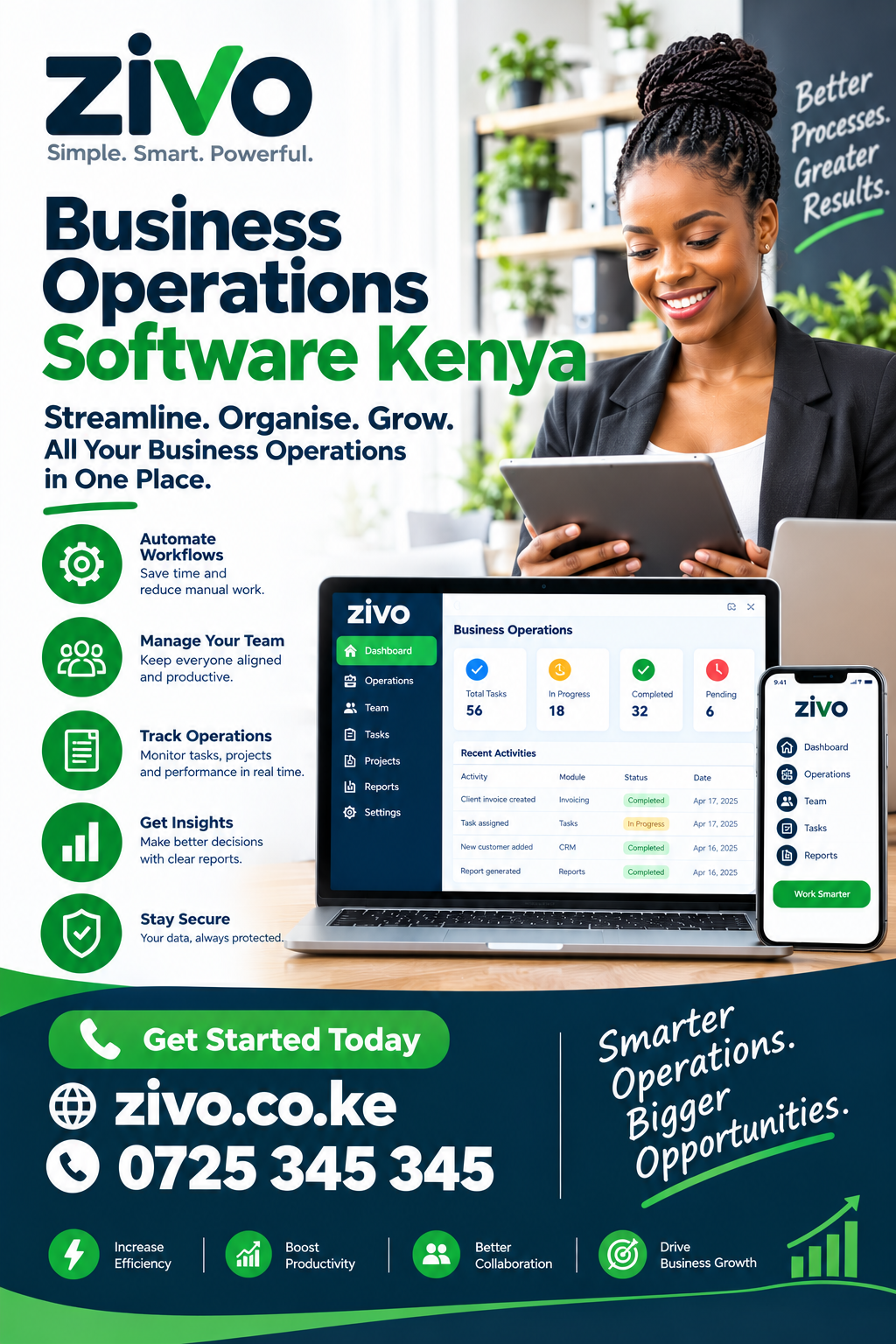
Business Operations Software Kenya: Complete Guide to Running a More Efficient Business
Running a growing business involves much more than making sales. Customers need to be managed, quotations prepared, invoices issued, payments confirmed, expenses recorded, employees coordinated, jobs completed and reports reviewed. Business Operations Software Kenya helps bring these activities into a more organized workflow so that business owners and teams do not have to depend on disconnected spreadsheets, notebooks, phone calls and WhatsApp conversations. This guide explains what business operations software does, why it matters to Kenyan SMEs, the features businesses should consider, how it can connect M-Pesa and WhatsApp workflows, and how to choose a practical solution.
For a small business, it is common for one person to handle almost everything. The owner may answer customer enquiries in the morning, prepare quotations at lunchtime, check M-Pesa payments in the afternoon and follow up employees in the evening. As the business grows, that approach becomes harder to maintain. Business Operations Software Kenya can give the team a shared operating record where customers, transactions, expenses and work can be organized around the same business process.
The objective is not to add technology for its own sake. The objective is to make everyday work easier to control.
What Is Business Operations Software?
Business Operations Software Kenya refers to software that helps a business manage the activities required to operate on a daily basis.
Depending on the business, this can include:
- Customer management
- Sales and quotations
- Invoicing
- Payment collection
- M-Pesa tracking
- Expense management
- Supplier management
- Job management
- Delivery management
- Staff coordination
- Inventory
- Purchasing
- Reporting
- Cashflow monitoring
- Customer communication
The exact combination depends on the company’s needs.
A retail shop may need stock, POS, purchasing and sales management. A service company may need customer records, quotations, invoices, payments and field jobs. A distributor may need sales orders, inventory, warehouses and delivery. A professional services firm may prioritize customer management, billing, expenses and staff assignments.
Business Operations Software Kenya becomes valuable when these activities are connected instead of being managed as isolated tasks.
For example, consider a Kenyan company that installs CCTV systems. A customer may begin with a WhatsApp enquiry. The salesperson creates a quotation. The customer approves it. An invoice is issued. The customer pays a deposit through M-Pesa. The installation is then assigned to a technician. After completion, the remaining balance is collected.
If every step exists in a different system, employees spend time transferring information.
A connected workflow can instead look like:
Customer → Quote → Invoice → Payment → Job → Completion → Report
That is the basic idea behind modern business operations management.
Why Kenyan Businesses Need Better Operational Systems
Many Kenyan SMEs grow by relying on practical tools that are available immediately.
WhatsApp is used for customer conversations.
M-Pesa is used for payments.
Excel or Google Sheets may be used for records.
Email may be used for documents.
A notebook may still be used for certain operational notes.
These tools are useful individually. The problem arises when the business becomes large enough that employees must constantly move information between them.
Business Operations Software Kenya can reduce this fragmentation by giving employees a shared system for important operational information.
A business owner should ideally be able to answer questions such as:
- How much money came in today?
- Which invoices remain unpaid?
- Which customers have outstanding balances?
- Which jobs are currently open?
- Which employees are assigned to those jobs?
- Which expenses are waiting for approval?
- Which orders have been paid but not delivered?
- Which suppliers are owed money?
- Which products are running low?
- What is the current cashflow position?
If these questions require calling several employees or opening multiple files, the business has an information-management problem.
Business Operations Software Kenya can create a central operating record that makes these questions easier to answer.
This is especially important for companies with multiple employees. Once several people interact with the same customers, information can easily become inconsistent. One employee may say an invoice has been paid while another still sees it as outstanding. A salesperson may know that an order is urgent while the delivery team has not received the information.
A connected system reduces these gaps.
The Difference Between Business Operations and Accounting
Business operations software and accounting software can overlap, but they are not necessarily the same thing.
Accounting focuses heavily on financial records and reporting.
Operations cover the wider process of getting work done.
For example, a service business may need to manage:
- Customer enquiry
- Sales opportunity
- Quotation
- Invoice
- Payment
- Employee assignment
- Appointment
- Job execution
- Materials used
- Completion
- Customer follow-up
Accounting is important throughout the process, but it does not necessarily manage every operational step.
Business Operations Software Kenya can therefore be useful as the layer connecting sales, finance and execution.
Zivo describes its platform as a connected workspace covering customers, sales, payments, expenses, operations and workforce workflows. Its solutions page specifically describes customer management, quotes and invoices, M-Pesa collections, expenses, jobs, delivery and business reporting as connected capabilities.
The distinction matters because a business can have accurate accounts while still having poor operational visibility.
A company may know exactly how much money it received last month but still struggle to answer which paid customers are waiting for delivery.
Operations software addresses that gap.
Core Features to Look For
When evaluating Business Operations Software Kenya, businesses should start with their daily workflow rather than a long list of technical features.
The right software should solve real operational problems.
Customer Management
The system should provide a reliable customer record containing relevant contact details and transaction history.
A useful customer record may connect:
- Contact information
- Quotes
- Invoices
- Payments
- Statements
- Previous jobs
- Notes
- Orders
- Outstanding balances
This gives employees context when dealing with customers.
Sales and Quotations
A quotation allows the business to define what it intends to supply and at what price.
A good operational workflow should allow a quotation to progress into an invoice without requiring staff to re-enter every detail.
Invoicing
Invoices turn agreed sales into formal payment requests.
The software should make it easy to create, send and track invoices.
Payment Tracking
The business needs to know whether invoices are unpaid, partially paid, paid or overdue.
Expense Management
Money going out needs to be controlled just as carefully as money coming in.
Job Management
Service companies need to turn customer requests into assigned work.
Reporting
Management needs information that supports decisions.
Business Operations Software Kenya should bring these functions together where the business requires them rather than forcing employees to maintain multiple disconnected records.
Managing Customers From One Workspace
Customers are at the centre of most businesses.
Yet customer information is often scattered across phones, email accounts, spreadsheets and WhatsApp chats.
Business Operations Software Kenya can create a central customer record that employees can use as a reference point.
Imagine a customer calling about an unpaid invoice.
Instead of asking:
“Which invoice are you talking about?”
the employee can search for the customer and review the account.
The employee may see:
Customer: ABC Enterprises
Invoice: KES 75,000
Payment received: KES 50,000
Balance: KES 25,000
Latest job: Equipment maintenance
Status: Scheduled
This provides context immediately.
It also reduces the possibility of giving the customer incorrect information.
Sales and Customer Conversations
For many Kenyan businesses, the sales process begins on WhatsApp.
A customer might send:
“How much do you charge for office cleaning?”
The salesperson responds.
The customer asks for a quotation.
The quotation is prepared.
The customer approves.
The invoice is sent.
The customer pays.
The business then needs to deliver the service.
Business Operations Software Kenya can help structure that journey.
Zivo’s current platform information describes a shared WhatsApp inbox where businesses can assign conversations to staff, retain conversation history, use saved replies and manage customer communication from one workspace.
This can be useful when several employees handle customer enquiries.
Instead of customers communicating with individual employees’ personal phones, the business can create a more controlled process.
The goal is not to eliminate human interaction.
It is to ensure that important customer information remains available to the business.
M-Pesa and Business Operations
M-Pesa plays an important role in many Kenyan business workflows.
A customer may receive an invoice and pay through M-Pesa within minutes.
The operational challenge is what happens next.
Business Operations Software Kenya can connect the payment event with the business process that follows it.
A practical workflow may look like:
Invoice → M-Pesa STK → Payment confirmation → Receipt → Job or delivery
Zivo’s M-Pesa documentation describes hosted checkout, M-Pesa STK requests, payment attempt history, receipts and payment status connected to invoices. It also states that a confirmed paid invoice can, when enabled, create a delivery or service job.
This is important because payment is often not the final step.
If the customer has paid for an installation, the business still needs to send someone to install the equipment.
If the customer has paid for a delivery, the product still needs to reach them.
If the customer has paid for a repair, the technician still needs to complete the work.
The operational system should help keep that obligation visible.
Managing Expenses and Business Spending
Business owners often focus heavily on revenue.
However, uncontrolled spending can reduce profitability even when sales are increasing.
Business Operations Software Kenya can help businesses record expenses and establish clearer approval processes.
Common business expenses include:
- Transport
- Fuel
- Office supplies
- Materials
- Supplier purchases
- Staff expenses
- Repairs
- Utilities
- Marketing
- Subscriptions
- Delivery costs
A useful expense workflow may include:
Expense request → approval → payment → receipt → financial record
This is stronger than relying on a WhatsApp message saying:
“Please send me KES 5,000 for fuel.”
The message may disappear among hundreds of conversations.
A structured expense record can retain the amount, employee, department, supplier, receipt and approval status.
Zivo’s solutions page describes expense and payout controls including suppliers and payees, receipts, departments, approval status, payment accounts and payment vouchers.
Managing Suppliers
Suppliers are another important part of business operations.
A business may purchase:
- Stock
- Raw materials
- Packaging
- Equipment
- Spare parts
- Office supplies
- Fuel
- Professional services
Business Operations Software Kenya can help maintain supplier records and connect purchasing activity with financial records.
This becomes increasingly important as the business grows.
A company with five suppliers can often manage relationships manually.
A company with fifty suppliers needs more structure.
The business may need to know:
- What was ordered?
- What was received?
- How much was paid?
- What remains outstanding?
- Which supplier supplied a particular product?
- Which purchases require approval?
A connected purchasing process can reduce confusion.
Job and Field Operations
Service businesses need more than invoices.
They need to deliver the work.
Business Operations Software Kenya can connect customer transactions with operational jobs.
For example, an electrical company may receive a request to install lighting at a commercial property.
The workflow could be:
Customer request
↓
Quotation
↓
Customer approval
↓
Invoice
↓
M-Pesa payment
↓
Job created
↓
Electrician assigned
↓
Work completed
↓
Job closed
This keeps the financial and operational sides connected.
Zivo’s Jobs and Delivery functionality describes turning paid orders, installations, repairs and service requests into visible jobs with customer and payment context, assigned staff and delivery status tracking.
Staff Management and Accountability
Employees are another major part of business operations.
As a business grows, the owner cannot personally supervise every activity.
Business Operations Software Kenya can help distribute responsibilities through assignments, roles and access controls.
For example:
| Responsibility | Person |
|---|---|
| Sales enquiries | Sales team |
| Invoices | Accounts |
| Payment reconciliation | Finance |
| Job assignment | Operations manager |
| Field work | Technicians |
| Delivery | Logistics |
| Reporting | Management |
This structure creates accountability.
If a customer complains that an installation has not been completed, management can check the job record rather than asking everyone who might have heard about it.
Zivo states that staff access is role-based within its business workspaces, allowing users to see areas relevant to their responsibilities.
Managing Paid but Undelivered Work
One of the most useful operational reports is a list of work that customers have already paid for but that has not yet been completed.
Business Operations Software Kenya can help businesses keep this work visible.
Consider a distributor.
A customer orders goods.
The invoice is issued.
The customer pays.
Finance records the payment.
But the delivery team does not dispatch the order.
From a finance perspective, everything looks good.
From an operations perspective, there is a problem.
The customer has paid but has not received the goods.
Zivo specifically highlights paid-but-undelivered reporting as part of its Jobs and Delivery workflow.
This is a good example of why operations software should connect money with fulfilment.
Business Operations and Cashflow
Cashflow is one of the most important concerns for an SME.
A business may have strong sales but still experience cash shortages if customers pay slowly or expenses are poorly controlled.
Business Operations Software Kenya can help management see money coming in and going out alongside the operational activity behind those transactions.
A simple view might include:
Cash in: KES 500,000
Cash out: KES 280,000
Outstanding invoices: KES 190,000
Pending expenses: KES 45,000
These figures provide more context than sales revenue alone.
Management can ask:
- Which invoices are overdue?
- Which customers owe the most?
- Which expenses are due?
- Which jobs have already been paid for?
- Which completed jobs are awaiting final payment?
Zivo’s current platform describes a finance control room covering payments, expenses, payment accounts, reconciliation, cashflow, profit, VAT, outstanding balances and accounting journals.
Reporting for Business Owners
Business owners need information that helps them make decisions.
Business Operations Software Kenya can provide reports around areas such as:
- Sales
- Payments
- Expenses
- Outstanding balances
- Jobs
- Delivery
- Customers
- Staff
- Cashflow
- Profit
A report should answer a business question.
For example:
Question: How much money is outstanding?
Report: Outstanding customer balances.
Question: Which work is still incomplete?
Report: Open jobs.
Question: Which customers have paid but are waiting?
Report: Paid-but-undelivered work.
Question: How much did the business spend?
Report: Expenses by category.
This makes reporting actionable rather than decorative.
Business Operations for Retailers
Retail businesses have a different operational structure from service businesses.
They may need:
- POS
- Stock management
- Sales orders
- Customer pricing
- Purchase orders
- Warehouses
- Stock transfers
- Picking
- Delivery
- Payment tracking
Business Operations Software Kenya can help retailers connect these activities.
For example, a hardware shop may receive an order through WhatsApp.
The salesperson confirms product availability.
An order is created.
The customer pays.
The warehouse prepares the goods.
The delivery team dispatches them.
The sale appears in the financial records.
Each stage depends on the previous one.
Zivo’s solutions page describes retail POS, stock receiving, warehouses, sales orders, picking, transfers and delivery for retail and distribution workflows.
Business Operations for Service Companies
Service companies have a different challenge.
They sell expertise, time, labour or completed work rather than only physical products.
Examples include:
- Cleaning companies
- Agencies
- Consultants
- Repair businesses
- Installers
- Contractors
- IT support providers
- Maintenance companies
- Security companies
- Professional service firms
Business Operations Software Kenya can connect the customer, invoice, payment and job.
A cleaning company, for example, may have recurring clients.
Each month, the customer receives an invoice.
Payment is collected.
The cleaning team receives the assignment.
The service is completed.
The customer record retains the history.
This is much easier to manage when recurring business activity follows a defined workflow.
Business Operations for Multi-Branch Companies
Multi-branch businesses have another layer of complexity.
The company may need to understand:
- Which branch made the sale?
- Which branch received the payment?
- Which branch incurred the expense?
- Which employee handled the customer?
- Which branch has outstanding jobs?
- What is the performance of each location?
Business Operations Software Kenya can provide a more structured way to organize this information when the chosen platform supports branches and appropriate permissions.
A central system can also reduce duplication.
Management can view the wider business while individual staff members work within their assigned responsibilities.
The Importance of Workflow Automation
Automation should not mean removing humans from every process.
Good automation removes repetitive work while keeping humans involved where judgment is required.
Business Operations Software Kenya can automate predictable steps such as:
- Sending invoices
- Sending payment requests
- Recording payment status
- Creating receipts
- Creating jobs after confirmed payment
- Sending reminders
- Updating operational statuses
- Generating reports
Human employees can then focus on:
- Negotiation
- Customer relationships
- Problem solving
- Approvals
- Exception handling
- Service delivery
The best automation is usually the kind employees barely notice because it removes repetitive administrative steps from their routine.
WhatsApp as a Business Operations Channel
WhatsApp has become an important business communication channel in Kenya.
Customers use it to ask questions, request quotations, send documents, confirm payments and arrange appointments.
Business Operations Software Kenya can help convert these conversations into structured business actions.
For example:
Customer message
“Can you install CCTV at our office?”
↓
Sales enquiry
↓
Quotation
↓
Invoice
↓
M-Pesa payment
↓
Job assignment
↓
Installation
This is more powerful than simply storing the conversation.
The business captures the commercial journey.
Zivo describes a shared customer inbox, customer profiles, team assignment, WhatsApp messaging and connected sales workflows.
The result is a more consistent customer experience.
M-Pesa Payment Reconciliation
Receiving a payment is only one part of financial control.
The business also needs to know what the payment relates to.
Business Operations Software Kenya can help connect payments with invoices and customer accounts.
For example, a business may receive several M-Pesa payments on the same day.
Without matching, the finance team may have to inspect individual messages and determine which invoice each payment belongs to.
Zivo’s M-Pesa documentation describes tracking payment attempts against the correct invoice and keeping statuses such as pending, paid, failed, cancelled and expired visible to staff.
This can reduce manual reconciliation work.
It also makes exceptions easier to identify.
If a payment does not match automatically, staff can investigate it instead of assuming that all payments are correctly allocated.
Inventory and Procurement
For businesses that sell physical products, operations include more than customer management.
Stock needs to be purchased, received, stored, sold and delivered.
Business Operations Software Kenya can connect purchasing and inventory activity to sales and fulfilment.
A basic workflow might be:
Low stock → Purchase order → Supplier delivery → Goods received → Stock updated → Customer order → Picking → Delivery
This provides greater visibility than maintaining separate spreadsheets for purchases and stock.
The business can also reduce situations where sales staff promise products that are not actually available.
Business Operations and Customer Experience
Operational efficiency affects customers directly.
When employees cannot find information, customers wait.
When jobs are not assigned, appointments are missed.
When payments are not matched, customers may be asked to prove that they paid.
When invoices are inconsistent, customers may request clarification.
Business Operations Software Kenya can help improve the internal processes behind the customer experience.
A well-organized system allows staff to answer questions faster.
A customer asking:
“Have you received my payment?”
should receive a clear answer.
A customer asking:
“When is the technician coming?”
should receive a clear answer.
A customer asking:
“Is my order ready?”
should receive a clear answer.
Operational visibility becomes customer-service visibility.
How to Know When Your Business Needs Operations Software
There is no universal employee count or revenue level that determines when a company should adopt operations software.
The stronger indicator is complexity.
Your business may be ready when:
- Customers repeatedly ask for updates.
- Employees forget assignments.
- Payments are difficult to reconcile.
- You use several spreadsheets.
- Sales information is scattered across phones.
- The owner must approve almost everything.
- Customers repeat information to different employees.
- Paid jobs remain incomplete.
- Reports take hours to prepare.
- Staff cannot easily see who owns a task.
- You are growing faster than your current administrative process.
Business Operations Software Kenya can provide structure when these problems become frequent.
The purpose is not to make a small business look like a large corporation.
The purpose is to create enough structure to keep growth manageable.
How to Choose the Right Software
Choosing Business Operations Software Kenya should begin with your most important workflow.
Ask:
What is currently difficult?
Maybe payment reconciliation takes too long.
Maybe jobs are missed.
Maybe customer information is scattered.
Maybe expenses are poorly controlled.
Which process creates the most manual work?
Identify where employees repeatedly copy information.
Which employees need access?
Sales, finance, operations and management may require different permissions.
Does the system support Kenyan payment methods?
If M-Pesa is central to your business, test the payment workflow carefully.
Can the software grow with the business?
You may need more users, branches, reports, integrations or operational modules later.
Can employees learn it quickly?
A powerful system that nobody uses consistently is not useful.
A Practical Buyer Checklist
Before selecting a platform, test a realistic scenario rather than simply watching a feature demonstration.
Ask the vendor to show you how the system handles:
- Creating a customer
- Creating a quotation
- Converting a quotation into an invoice
- Sending an invoice
- Collecting M-Pesa
- Confirming payment
- Issuing a receipt
- Creating a job
- Assigning an employee
- Tracking completion
- Recording an expense
- Generating a report
Business Operations Software Kenya should make these processes logical and connected where your business requires them.
Also test exceptions.
What happens when:
- A payment fails?
- A customer pays only part of an invoice?
- A job is delayed?
- An employee is unavailable?
- A customer requests a refund?
- A payment cannot be matched?
- An order is paid but not delivered?
The answers reveal how practical the system really is.
Implementation: Start With One Workflow
A common mistake is trying to digitize the entire business immediately.
Business Operations Software Kenya can be introduced gradually.
Start with one workflow.
For example:
Customer enquiry → quotation → invoice → payment
Once that process works consistently, add:
Payment → job assignment → completion
Then add:
Expenses → reconciliation → reporting
This approach gives employees time to learn.
It also makes problems easier to identify.
If the entire company is migrated simultaneously, it may be difficult to determine which part of the system caused a problem.
Clean Data Before You Start
Software cannot fix poor information automatically.
Before implementation, businesses should review:
- Duplicate customers
- Incorrect phone numbers
- Old invoices
- Duplicate products
- Inconsistent supplier names
- Unclear expense categories
- Old employee accounts
Business Operations Software Kenya works best when the underlying information is organized.
For example, if one customer appears three times, their payment history may be fragmented.
If one supplier has three different names, purchasing reports may become misleading.
Data cleanup may feel like administrative work, but it creates a stronger foundation.
Train Employees by Role
Employees do not need to learn every feature.
A salesperson needs to understand customers, quotations and invoices.
An accounts employee needs to understand payments, expenses and reconciliation.
An operations employee needs to understand jobs and assignments.
A manager needs to understand reports and approvals.
Business Operations Software Kenya should be introduced according to each employee’s responsibilities.
This makes training easier and reduces unnecessary complexity.
It also helps reinforce accountability.
If an employee knows exactly which records they are responsible for maintaining, data quality is more likely to improve.
Measure the Results
After implementing Business Operations Software Kenya, businesses should measure whether the process is actually improving.
Useful indicators include:
- Time spent preparing invoices
- Time spent reconciling payments
- Number of overdue invoices
- Number of missed jobs
- Number of paid-but-undelivered orders
- Time required to prepare reports
- Number of duplicate customer records
- Expense approval turnaround
- Customer response time
- Staff adoption rate
These metrics can reveal whether the software is solving the original problem.
If payment reconciliation used to take two days and now takes a few hours, that is a measurable improvement.
If customers used to wait several hours for an invoice and now receive it within minutes, that is another measurable result.
Zivo as a Connected Business Operations Platform
Zivo positions itself as a connected platform for sales, money, people and operations. Its current solutions information includes customer and CRM workflows, quotes and invoices, M-Pesa collections, expenses and suppliers, jobs and delivery, workforce tools and management reporting.
Business Operations Software Kenya is particularly relevant to businesses that want these activities to remain connected instead of maintaining separate tools.
Zivo’s current website describes a workflow where a customer can move from conversation to quotation, invoice and payment, with paid work then moving into delivery or a service job.
For Kenyan SMEs, this can be useful because WhatsApp and M-Pesa are already part of many business workflows.
Instead of asking employees to abandon those channels, the platform can organize the information generated through them.
Zivo for Different Types of Kenyan Businesses
The ideal operational setup depends on the business model.
Service Businesses
Need customers, quotations, invoices, payments, jobs and expenses.
Distributors
Need customers, sales orders, stock, purchasing, payments and delivery.
Retailers
Need POS, inventory, customer sales and payments.
Agencies
Need leads, customers, quotations, invoices, expenses and team coordination.
Contractors
Need quotations, deposits, jobs, expenses, staff and completion tracking.
Property Businesses
Need tenants, invoices, payments, maintenance and operational records.
Business Operations Software Kenya can be useful across different business models when the platform’s modules match the organization’s workflow.
Zivo’s business-type information describes a Standard Business workspace covering customers, invoices, M-Pesa collections, expenses, deliveries and management reporting.
Pricing and Total Cost
Price should be considered, but it should not be the only factor.
A business should calculate the cost of its current process.
How many hours are employees spending:
- Searching for customer information?
- Reconciling M-Pesa?
- Preparing reports?
- Following up jobs?
- Sending reminders?
- Correcting spreadsheets?
- Looking for receipts?
Business Operations Software Kenya should be evaluated against these operational costs.
Zivo currently lists Zivo Start at KES 0, ZivoPay at KES 3,500 per month, and Zivo Business starting from KES 5,500 per month, with different features and limits. Businesses should confirm current pricing and plan details before purchasing.
The right question is not simply:
“How much does the software cost?”
It is:
“What does the business gain or save by using it?”
Frequently Asked Questions
What is business operations software?
Business Operations Software Kenya is a digital platform that helps businesses organize daily activities such as customer management, sales, invoicing, payments, expenses, staff coordination, jobs, delivery and reporting.
Is business operations software useful for small businesses?
Yes. Small businesses can benefit when customer information, payments, invoices and daily tasks become difficult to manage manually. The system should be introduced according to the business’s actual needs rather than its size alone.
Can business operations software integrate with M-Pesa?
Depending on the platform, yes. Zivo’s published M-Pesa workflow includes STK requests, payment attempt tracking, receipts and invoice-linked payment records.
Can business operations software manage employees?
Some platforms include workforce features, while others focus mainly on customers and transactions. Zivo’s current solutions include workforce tools such as staff access, attendance and related operational functions.
Can it manage jobs and deliveries?
Yes, if the platform includes operational or field-service functionality. Zivo’s Jobs and Delivery workflow allows paid orders and service requests to become assigned jobs with progress and completion tracking.
Can it replace spreadsheets?
It can reduce reliance on spreadsheets for operational records, but spreadsheets can still be useful for analysis and specific tasks. The objective is to establish a dependable source of truth for daily business operations.
Is business operations software the same as ERP software?
Not necessarily. ERP systems often provide broad enterprise-level resource planning. Business operations platforms may focus on practical SME workflows such as customers, sales, payments, expenses, jobs and reporting.
How does operations software improve productivity?
Business Operations Software Kenya can reduce duplicate data entry, make responsibilities clearer, automate repetitive tasks and give managers faster access to operational information.
Should a business digitize everything at once?
Usually, it is more practical to begin with one important workflow and expand gradually. Start with the problem causing the greatest amount of administrative work.
Common Mistakes to Avoid
Implementing software does not automatically create efficient operations.
Businesses should avoid several common mistakes.
Mistake 1: Choosing software because it has the most features
More features do not necessarily mean better results.
Mistake 2: Ignoring employee adoption
The system must be practical enough for employees to use consistently.
Mistake 3: Keeping parallel records forever
If the business uses both software and several competing spreadsheets indefinitely, confusion can remain.
Mistake 4: Failing to define responsibilities
Employees should know who creates invoices, records payments, assigns jobs and approves expenses.
Mistake 5: Ignoring data quality
Incorrect customer information produces unreliable reports.
Mistake 6: Automating without controls
Automation should still provide visibility for exceptions and unusual transactions.
Mistake 7: Focusing only on finance
Operations also include customers, employees, delivery, service and fulfilment.
Business Operations Software Kenya should support the areas that actually determine whether the business keeps its promises.
The Future of Business Operations for Kenyan SMEs
Business software is moving toward connected workflows.
A customer does not think in terms of departments.
The customer thinks:
“I asked for a service.”
“I received a price.”
“I paid.”
“When will the work be done?”
The business, however, may traditionally divide that experience among sales, finance and operations.
Business Operations Software Kenya can connect these stages.
The future operational workflow may look like:
WhatsApp enquiry
↓
Customer record
↓
Quotation
↓
Invoice
↓
M-Pesa payment
↓
Payment confirmation
↓
Job assignment
↓
Service delivery
↓
Expense recording
↓
Customer statement
↓
Management report
This structure reduces the need to recreate information at every stage.
Zivo’s current platform is built around this connected model, with customer, payment, expense and operational records kept together rather than scattered across phones and spreadsheets.
Why Connected Data Matters
The biggest benefit of an integrated operational platform is not necessarily any individual feature.
It is the connection between records.
A payment becomes more useful when it is connected to an invoice.
An invoice becomes more useful when it is connected to a customer.
A customer record becomes more useful when it includes previous jobs.
A job becomes more useful when it includes payment and delivery information.
An expense becomes more useful when management can connect it to the work it supported.
Business Operations Software Kenya creates value by connecting these pieces into a larger business story.
This helps management move from isolated questions to operational understanding.
Instead of:
“How much did we collect?”
management can ask:
“Which customers paid, what did they purchase, has the work been completed, what did it cost us and what remains outstanding?”
That is a much more useful management question.
A Practical Example for a Kenyan SME
Imagine a Nairobi-based company that installs office networking equipment.
A customer sends a WhatsApp enquiry.
The salesperson creates a quotation.
The customer approves the quote.
The company creates an invoice.
The customer receives an M-Pesa payment request.
The customer pays a KES 30,000 deposit.
The payment is confirmed.
The work becomes an installation job.
The operations manager assigns the job to a technician.
The technician receives the customer information and job instructions.
The installation is completed.
The technician updates the job.
The company records KES 8,000 in installation-related expenses.
The customer pays the remaining balance.
Management can then review the revenue and expenses associated with the work.
This example demonstrates why connected workflows matter.
Business Operations Software Kenya is not simply about storing information. It is about making each stage of the business process visible.
Final Checklist for Choosing Business Operations Software
Before adopting a system, ask these questions:
Customers
Can we maintain accurate customer records?
Sales
Can we create quotations and invoices efficiently?
Payments
Can we track M-Pesa and other payment methods?
Expenses
Can we record and control spending?
Operations
Can we assign and track jobs?
Staff
Can we control access and responsibilities?
Delivery
Can we see paid work that has not yet been completed?
Reporting
Can management see cashflow, sales, expenses and outstanding balances?
Integration
Can the platform connect with the tools our customers and staff already use?
Scalability
Can the system grow with the business?
Business Operations Software Kenya should meet the business’s most important requirements without introducing unnecessary complexity.
Conclusion
A growing Kenyan business needs more than individual tools for individual tasks. It needs a dependable way to connect customers, sales, payments, expenses, employees and daily work.
Business Operations Software Kenya provides a structured approach to managing those activities from a shared operational record.
The biggest advantage comes from connecting workflows.
A customer enquiry can become a quotation.
A quotation can become an invoice.
An invoice can lead to an M-Pesa payment.
A confirmed payment can create a job.
The job can be assigned to an employee.
The employee can complete the work.
Expenses can be recorded against the business.
Management can then see the financial and operational results.
That structure can help reduce duplicated work and make it easier for business owners to understand what is happening across the company.
For Kenyan SMEs, the combination of WhatsApp communication, M-Pesa payments, customer management, invoicing, expenses and fulfilment makes connected operations particularly relevant.
Business Operations Software Kenya is therefore best understood not as another application to add to the business, but as an operating layer that can bring important daily workflows together.
The right approach is to begin with the biggest operational problem.
If payments are difficult to reconcile, start there.
If jobs are being missed, introduce job tracking.
If customers are difficult to manage, establish a central customer record.
If expenses are uncontrolled, introduce approval and expense tracking.
If management lacks visibility, build reliable reports.
Then connect these workflows as the business grows.
Zivo’s current platform is designed around this gradual approach. Businesses can start with core invoicing and expense workflows and add connected capabilities such as WhatsApp, M-Pesa collection, jobs, delivery and broader finance and operations as their needs increase.
For a Kenyan SME, the ultimate goal is straightforward: know what customers need, know what has been sold, know what has been paid, know what employees need to do, know what has been delivered and know where the money stands.
Business Operations Software Kenya can help turn that information into a structured daily workflow.
With the right implementation, businesses can spend less time searching for information and more time serving customers, completing work and making informed decisions.
The technology is only one part of the process. Clear responsibilities, accurate records and consistent employee usage are equally important. When those elements come together, business operations become easier to monitor, easier to improve and easier to scale.
Business Operations Software Kenya is ultimately most useful when it gives a business one dependable view of the work happening across sales, finance and operations—without forcing employees to constantly rebuild the same customer story in different systems.
Business Operations Software Kenya
Business Operations Software Kenya
Business Operations Software Kenya
Business Operations Software Kenya
Business Operations Software Kenya
Business Operations Software Kenya
Business Operations Software Kenya
Business Operations Software Kenya