
Table of Contents
ToggleSupplier Management Software Kenya: A Practical Guide for Smarter Procurement and Supplier Control
Managing suppliers becomes complicated when a business relies on notebooks, spreadsheets, WhatsApp conversations, email threads and separate payment records. Supplier Management Software Kenya gives businesses a structured way to organize supplier information, purchasing activities, approvals, expenses, receipts and payment records. This guide explains what supplier management software does, why it matters to Kenyan businesses, which features to look for, how it can improve procurement, and how businesses can evaluate a solution before adopting it.
For a small shop, supplier management may initially seem simple. An owner calls a wholesaler, places an order, receives the goods, pays through M-Pesa or a bank account, and keeps the receipt. But as sales increase, the number of suppliers grows. Different staff members begin placing orders, suppliers send invoices through different channels, payments are made at different times, and management needs to know exactly what was ordered, received, approved and paid.
That is where a connected system becomes useful.
Supplier Management Software Kenya can help businesses move supplier information and procurement activity from disconnected records into an organized workflow.
This is particularly relevant to Kenyan SMEs, distributors, retailers, wholesalers, service companies, contractors, schools, hospitality businesses, pharmacies, hardware stores and other organizations that regularly purchase goods or services.
What Is Supplier Management Software?
Supplier Management Software Kenya refers to software used to organize and control information and activities related to suppliers. Instead of maintaining supplier contacts, purchase information, receipts and payment records in different places, a business can centralize important information within a structured digital workflow.
Depending on the platform, supplier management can include:
- Supplier registration and profiles
- Supplier contact information
- Purchase orders
- Goods received
- Supplier invoices
- Expense records
- Approval workflows
- Payment records
- Supporting documents
- Supplier communication
- Supplier performance information
- Procurement reports
- Outstanding supplier balances
The exact capabilities vary between platforms. A business should therefore evaluate software according to its actual purchasing process rather than assuming that every supplier-management product offers the same functionality.
For a Kenyan business, Supplier Management Software Kenya should ideally fit into the way the organization already handles purchasing, payments, accounting and daily operations.
A useful supplier system is not simply a digital address book. It should help employees answer practical questions such as:
- Which suppliers do we currently use?
- What did we purchase from each supplier?
- Which purchase orders have been approved?
- Which goods have been received?
- Which supplier invoices are still awaiting approval?
- Which payments have been completed?
- What expenses are associated with each supplier?
- Who approved a particular purchase?
- Are there documents attached to the transaction?
When those questions can be answered quickly, procurement becomes easier to control.
Why Supplier Management Matters for Kenyan Businesses
Supplier Management Software Kenya becomes increasingly useful as a business moves beyond informal purchasing.
Many smaller businesses begin with a simple arrangement: the owner knows the suppliers personally and remembers what needs to be ordered. That approach may work when there are only a handful of suppliers.
Growth changes the situation.
A growing business may have:
- Dozens of suppliers
- Multiple branches
- Several employees purchasing goods
- Different approval levels
- Recurring purchases
- Multiple payment accounts
- Stock requirements
- Supplier invoices
- Delivery records
- Returns and adjustments
- Monthly expense reporting
The greater the volume, the harder it becomes to rely on memory.
Supplier Management Software Kenya can provide a central record that makes supplier-related activities easier to trace.
For example, imagine a Nairobi distributor purchasing stock from 15 different suppliers. The procurement officer may receive quotations by WhatsApp, purchase orders through email, invoices as PDFs and payment confirmations through M-Pesa.
Without a connected workflow, the same transaction can be represented in four or five different places.
With an organized system, the business can connect the supplier, purchase, supporting document, approval and payment information.
That creates better visibility.
The Main Problems Supplier Management Software Solves
1. Scattered supplier information
Supplier Management Software Kenya helps address one of the simplest but most common procurement problems: supplier information being scattered across different files and devices.
A spreadsheet may contain the supplier’s phone number while an employee’s WhatsApp account contains the latest quotation. An accounting file may contain payment information while physical folders contain invoices.
This fragmentation makes it difficult to establish one reliable supplier record.
A centralized system can organize information such as:
- Supplier name
- Contact person
- Telephone number
- Payment details
- Supplier category
- Purchase history
- Supporting documents
- Current transactions
This can save staff from searching through multiple sources whenever they need supplier information.
2. Poor purchase visibility
Supplier Management Software Kenya can help businesses follow purchases from request through approval and fulfillment.
A simple purchasing workflow may look like this:
- A department requests an item.
- The request is reviewed.
- A supplier is selected.
- A purchase order is created.
- The supplier receives the order.
- Goods or services are delivered.
- The delivery is checked.
- The invoice is reviewed.
- Payment is approved.
- The transaction is recorded.
When these steps are handled manually, managers may not know which stage a purchase has reached.
Digital procurement workflows make those stages more visible.
3. Difficulty tracking supplier payments
Supplier Management Software Kenya can help connect supplier information with expenses and payment records.
This matters because paying a supplier is only one part of the transaction.
Management also needs to know:
- What was purchased?
- Was the purchase approved?
- Was the order fulfilled?
- Was the invoice received?
- Was the amount correct?
- Has payment been made?
- Which payment account was used?
- Is there supporting documentation?
Connecting these records reduces uncertainty.
4. Too much manual reconciliation
Supplier Management Software Kenya can reduce the amount of repetitive work required to compare purchasing, expenses and payments.
Consider a business that receives 100 supplier invoices each month. If every invoice must be manually compared with purchase information and payment confirmations, administrative work can quickly become significant.
A structured workflow can make it easier to identify:
- Unpaid invoices
- Duplicate records
- Missing documentation
- Pending approvals
- Completed payments
- Outstanding supplier balances
Automation does not eliminate the need for human review. Instead, it can make the review process more organized.
Key Features to Look For
Supplier Profiles and Centralized Records
Supplier Management Software Kenya should make it easy to create and maintain supplier profiles.
A useful supplier record may contain:
| Information | Why it matters |
|---|---|
| Supplier name | Identifies the business |
| Contact person | Makes communication easier |
| Phone number | Supports quick communication |
| Useful for formal documents | |
| Payment details | Supports payment processing |
| Purchase history | Shows previous activity |
| Documents | Keeps evidence together |
| Supplier category | Helps organize vendors |
| Status | Shows active or inactive relationships |
The goal is not to collect unnecessary information. The goal is to maintain the information employees genuinely need.
Purchase Orders
Supplier Management Software Kenya should ideally support purchasing documents that clearly define what the business has ordered.
A purchase order can help establish:
- What was requested
- Quantity
- Agreed price
- Supplier
- Delivery expectations
- Approving employee
- Purchase date
Purchase orders are particularly useful where several employees have authority to purchase goods.
Approval Workflows
Supplier Management Software Kenya becomes more valuable when purchasing requires managerial approval.
For example, a business could establish a process where:
- Staff approve purchases below a defined internal threshold.
- Department managers review larger requests.
- Senior management approves major purchases.
The exact approval rules should be determined by the organization’s internal controls.
The important point is that approval should be visible and traceable rather than dependent on verbal instructions.
Expense Tracking
Supplier Management Software Kenya can connect suppliers with expense records, allowing management to see where business money is going.
Supplier expenses can be grouped by:
- Supplier
- Department
- Category
- Branch
- Date
- Payment account
- Purchase type
This can make monthly review much easier.
Document Attachments
Supplier Management Software Kenya can also support better record keeping when purchase-related documents are kept alongside transactions.
Relevant documents may include:
- Quotations
- Purchase orders
- Supplier invoices
- Delivery notes
- Receipts
- Contracts
- Payment confirmations
- Correspondence
Keeping documentation organized can help staff retrieve evidence when management needs to review a transaction.
M-Pesa and Supplier Payments in Kenya
For many Kenyan businesses, payment management is an important part of procurement.
Supplier Management Software Kenya can be particularly useful when supplier expenses need to be connected with broader financial records.
M-Pesa is deeply integrated into business activity in Kenya, but businesses may also use bank transfers, cards, cash and other payment methods.
The challenge is not simply making a payment.
The business needs to know which transaction the payment relates to.
For example:
Supplier invoice: KSh 48,500
Purchase order: PO-1048
Goods received: Yes
Approval: Completed
Payment: Completed
Payment method: M-Pesa
Supporting document: Attached
A connected record provides considerably more context than a standalone payment confirmation.
Zivo currently describes its platform as supporting M-Pesa collections, expenses, suppliers, payment accounts, reconciliation and financial reporting.
Supplier Management and eTIMS
Kenyan businesses also need to consider tax-related invoicing requirements.
Supplier Management Software Kenya can help organize purchasing records, but businesses should distinguish between supplier-management functionality and statutory tax systems.
The Kenya Revenue Authority states that persons engaged in business are required to onboard eTIMS and issue electronic tax invoices.
KRA also provides mechanisms such as Buyer Initiated Invoicing for situations where a registered buyer generates an invoice on behalf of a seller under the relevant eTIMS process.
That means procurement teams should ask software providers how their systems handle tax-related workflows and integrations.
Do not assume that ordinary supplier records automatically constitute tax compliance.
Instead, verify:
- Whether the software integrates with relevant tax systems
- Which invoicing processes it supports
- Whether the integration applies to your business
- What configuration is required
- Which responsibilities remain with the business
For specialized scenarios involving large numbers of small-scale suppliers, KRA specifically describes reverse invoicing through system-to-system integration as a relevant eTIMS approach in certain structured supply chains.
Supplier Communication
Keeping Supplier Conversations Organized
Supplier Management Software Kenya can help organizations think about supplier management as more than procurement paperwork.
Communication is part of the supplier relationship.
Businesses regularly need to ask suppliers:
- When will the order arrive?
- Is an item available?
- Has the price changed?
- Can the supplier provide a quotation?
- Has the invoice been corrected?
- Has a payment been received?
- When will replacement goods arrive?
When these conversations are handled across personal phones and different employee accounts, continuity becomes difficult.
A business should consider whether its chosen software allows relevant supplier communication, documents and transaction context to be connected.
Zivo’s broader platform currently includes a shared WhatsApp inbox for business conversations and workflows, although businesses should confirm which supplier-specific communication features apply to their chosen configuration.
Supplier Performance Management
Supplier Management Software Kenya can also be part of a broader supplier-performance process.
Supplier performance does not have to be complicated.
A business can monitor practical measures such as:
- Delivery reliability
- Product quality
- Price consistency
- Response time
- Order accuracy
- Availability
- Return frequency
- Invoice accuracy
For example, suppose two suppliers provide similar products.
Supplier A:
- Delivers within agreed timelines
- Rarely sends incorrect quantities
- Responds quickly
- Has consistent pricing
Supplier B:
- Frequently delivers late
- Requires repeated follow-up
- Sends incorrect quantities
- Changes prices frequently
Having historical purchasing records makes it easier for management to identify these patterns.
However, software should support decision-making rather than automatically determine which supplier a business must use.
How Supplier Software Helps Procurement Teams
Supplier Management Software Kenya can make procurement workflows more structured.
A procurement team can use a system to manage the process in stages.
Stage 1: Identify the requirement
The business determines what it needs.
Stage 2: Create a purchase request
The requesting department records the item, quantity and purpose.
Stage 3: Review the request
The responsible manager checks the request.
Stage 4: Select a supplier
The procurement team identifies an appropriate supplier based on the organization’s purchasing policies.
Stage 5: Issue the purchase order
The order is documented.
Stage 6: Receive the goods
The receiving employee confirms what arrived.
Stage 7: Review the supplier invoice
The invoice is checked against the purchase information.
Stage 8: Approve payment
The appropriate person authorizes payment.
Stage 9: Record payment
The transaction is connected to the relevant supplier and financial record.
Stage 10: Review the transaction
Management can later retrieve the complete history.
This type of workflow is more reliable than allowing every employee to develop their own purchasing process.
Supplier Management for Retail and Wholesale Businesses
Supplier Management Software Kenya can be particularly relevant to retailers and wholesalers that purchase inventory frequently.
A retail shop may need to track:
- Supplier prices
- Stock purchases
- Purchase orders
- Deliveries
- Supplier invoices
- Stock receipts
- Payments
- Product availability
Zivo currently positions its retail workspace around products, stock, warehouses, sales orders, M-Pesa payments and fulfillment, while its broader business platform includes suppliers and purchasing workflows.
For a wholesaler, procurement and sales are closely connected.
If stock is purchased but the receiving process is not recorded properly, the business can experience discrepancies between physical stock and system records.
Supplier management should therefore connect naturally with inventory and operations wherever possible.
Supplier Management for Service Businesses
Supplier Management Software Kenya is not only relevant to companies that sell physical products.
Service businesses also work with suppliers.
A cleaning company may purchase cleaning materials.
A construction company may purchase building materials.
An events company may work with equipment providers.
A marketing agency may purchase printing services.
A property-management company may use contractors for repairs.
In each case, the business needs to know who supplied the item or service, how much it cost, whether the expense was approved and whether payment was completed.
This makes supplier records useful even when the company does not maintain large quantities of stock.
Supplier Expenses and Cash-Flow Management
Supplier Management Software Kenya can contribute to better cash-flow visibility when supplier expenses are connected with the wider financial picture.
Cash-flow problems often arise when management knows how much money is currently available but does not have a clear view of upcoming commitments.
Suppose a company has KSh 700,000 in its accounts.
That sounds healthy until management discovers:
- KSh 180,000 supplier invoice pending
- KSh 95,000 rent due
- KSh 120,000 payroll commitment
- KSh 80,000 tax-related obligation
- KSh 150,000 stock purchase already approved
The available cash is not the same as genuinely available spending capacity.
Supplier records can help management understand upcoming obligations.
Zivo’s finance functionality currently includes expenses, suppliers, payment accounts, cashflow, profit, VAT summaries and journals.
Reducing Duplicate Supplier Records
Supplier Management Software Kenya can also help businesses maintain cleaner supplier data.
A common administrative problem occurs when the same supplier appears multiple times under slightly different names.
For example:
- ABC Traders
- ABC Traders Ltd
- ABC Trading
- ABC Traders Kenya
These may represent one supplier.
Duplicate records can make reporting confusing.
Before adopting software, businesses should determine whether the platform supports data cleanup, unique supplier records and controlled supplier creation.
It is also useful to define who is allowed to create new suppliers.
If every employee can create a supplier record without review, duplicate data can return quickly.
Security and Access Control
Supplier Management Software Kenya should also be evaluated from a security perspective.
Supplier records can contain commercially sensitive information, including:
- Pricing
- Contracts
- Bank information
- Purchase volumes
- Business contacts
- Invoices
- Payment records
Not every employee needs access to all of this information.
Role-based access can help businesses limit employees to the areas relevant to their responsibilities.
For example:
| Role | Possible access |
|---|---|
| Procurement officer | Suppliers and purchase orders |
| Finance officer | Invoices and payments |
| Department manager | Requests and approvals |
| Storekeeper | Goods received |
| Business owner | Full management reporting |
The exact access model should be configured according to the company’s internal controls.
Zivo states that business workspaces use role-based staff access and separate business workspaces.
What Makes a Good Supplier Management System?
Supplier Management Software Kenya should be evaluated according to usability as well as features.
A system may have dozens of features, but if employees find it difficult to use, adoption will suffer.
Look for a solution that offers:
- Clear supplier records
- Straightforward purchasing workflows
- Useful approval controls
- Expense tracking
- Payment visibility
- Document management
- Searchable records
- Relevant reports
- Appropriate user permissions
- Integration with existing business processes
The best fit depends on business size and complexity.
A five-person company does not necessarily need the same procurement environment as a national distributor.
Cloud-Based Supplier Management
Supplier Management Software Kenya may be delivered through a cloud-based platform, allowing authorized users to access information without relying on a single office computer.
For businesses with multiple locations, this can be useful.
For example, a company with branches in Nairobi, Mombasa and Kisumu may need managers at different locations to review purchasing activity.
Cloud-based access can make centralized records more practical.
However, businesses should still evaluate:
- User permissions
- Data security
- Backup practices
- Service availability
- Account recovery
- Support
- Data export
- Integration capabilities
Cloud software is not automatically secure simply because it is online. Security should be assessed as part of the purchasing decision.
Reporting and Supplier Analytics
Supplier Management Software Kenya should ideally make supplier information useful for management decisions.
Reports might answer questions such as:
- How much did we spend on suppliers this month?
- Which supplier received the highest purchasing volume?
- Which invoices remain unpaid?
- Which departments are spending the most?
- How much did each branch purchase?
- Which purchases are awaiting approval?
- How much was spent on a particular category?
These reports can help management move from assumptions to documented information.
A business can then investigate unusual spending rather than discovering it after a long delay.
Choosing Supplier Management Software in Kenya
Supplier Management Software Kenya should be selected using a practical checklist.
Step 1: Map your current process
Write down how purchasing currently works.
Do not begin with software features.
Begin with the business process.
Ask:
- Who requests purchases?
- Who approves them?
- Who orders?
- Who receives goods?
- Who checks invoices?
- Who makes payments?
- Who records the transaction?
Step 2: Identify the biggest problems
Maybe the main problem is lost invoices.
Maybe it is delayed approvals.
Maybe it is duplicate supplier information.
Maybe managers cannot see outstanding commitments.
The software should solve actual problems.
Step 3: Determine required integrations
Kenyan businesses may need connections involving:
- M-Pesa
- Accounting
- Tax systems
- Banking
- Inventory
- Point of sale
- APIs
Do not assume an integration exists. Ask the provider and confirm exactly what is supported.
Step 4: Review user permissions
Determine which employees should see, create, approve or modify supplier information.
Step 5: Test reporting
Ask for demonstrations of the reports managers will actually use.
Step 6: Consider implementation
Ask how existing supplier data will be imported.
Step 7: Review costs
Compare the total cost, not simply the advertised monthly subscription.
Common Mistakes When Implementing Supplier Software
Supplier Management Software Kenya cannot fix a poorly designed purchasing process on its own.
Several mistakes can reduce the value of implementation.
Giving everyone full access
Too much access can weaken internal controls.
Importing dirty data
Duplicate and incomplete supplier records should be cleaned before or during migration.
Ignoring employee training
Even intuitive software requires employees to understand the organization’s process.
Automating without approval controls
Automation should make good processes faster, not make poor processes harder to monitor.
Focusing only on price
A cheap system that does not fit the workflow can create additional administrative work.
Buying unnecessary features
A business should not pay for capabilities it will never use.
Zivo and Supplier Management
Supplier Management Software Kenya is particularly relevant to businesses that want supplier management connected to broader operations rather than treated as an isolated function.
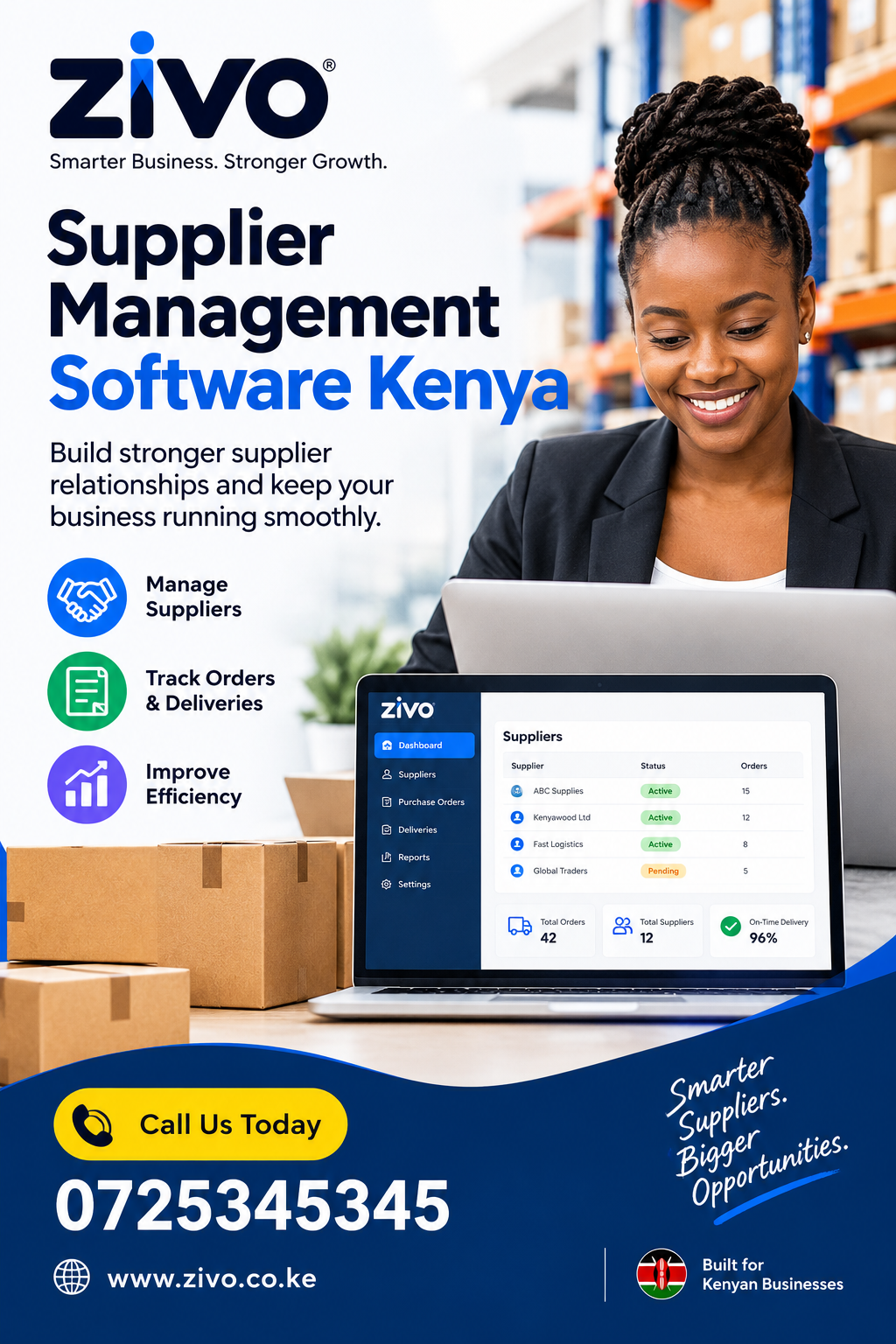
Zivo currently describes procurement and supplier control as including suppliers, purchase orders, goods receipt, attachments and approval trails behind business spending.
Its wider platform connects customers, invoices, M-Pesa collections, expenses, suppliers, jobs, delivery and financial reporting.
That connected approach can be useful for an SME because procurement rarely exists independently.
A retailer purchases stock, receives it, sells it and collects payment.
A service company purchases materials, completes a job and invoices a customer.
A distributor purchases products, stores them, sells them and arranges delivery.
The supplier transaction is therefore one part of a larger business workflow.
How a Kenyan SME Could Use Zivo for Supplier Control
Supplier Management Software Kenya can be considered within a broader operational workflow.
Imagine a Nairobi hardware business that purchases products from several wholesalers.
The workflow could involve:
Supplier setup: Supplier information is recorded centrally.
Purchase request: Staff identify stock that needs replenishment.
Purchase order: The order is documented.
Goods receipt: The business confirms what arrived.
Expense or invoice: The financial obligation is recorded.
Approval: The appropriate employee reviews the transaction.
Payment: Payment is processed.
Finance record: The expense and payment remain visible within the broader financial workflow.
Reporting: Management reviews purchasing and spending.
The benefit of this approach is not simply that each step is digital. The bigger advantage is that the records can remain connected.
Supplier Management for Multi-Branch Businesses
Supplier Management Software Kenya becomes increasingly important when a business operates multiple branches.
Without centralized controls, each branch may develop its own supplier list.
One branch may buy from Supplier A while another uses Supplier B for exactly the same item.
That is not automatically wrong. Different locations may have legitimate reasons for using different suppliers.
The problem is lack of visibility.
Centralized supplier information can help management compare:
- Purchase quantities
- Supplier prices
- Branch spending
- Order frequency
- Delivery performance
- Outstanding invoices
This information can support procurement discussions without forcing every branch into an identical process.
Supplier Management for Kenyan SMEs
Supplier Management Software Kenya does not have to be limited to large organizations.
An SME can begin with a small number of workflows and expand as the company grows.
For example:
Small business
Focus on:
- Supplier contacts
- Expenses
- Receipts
- Purchase records
- Payment tracking
Growing business
Add:
- Purchase orders
- Approval workflows
- Branch management
- Supplier reporting
- Inventory integration
Larger business
Consider:
- Advanced approvals
- Multiple locations
- API integrations
- Detailed supplier analytics
- Role-based controls
- Automated workflows
The right level of complexity should match the organization.
Measuring the Impact
Supplier Management Software Kenya should produce measurable operational improvements.
Businesses can establish a few indicators before implementation.
For example:
| Metric | Before software | After implementation |
|---|---|---|
| Time spent locating invoices | Measure | Compare |
| Pending approvals | Measure | Compare |
| Duplicate supplier records | Measure | Compare |
| Unmatched payments | Measure | Compare |
| Purchase processing time | Measure | Compare |
| Missing documents | Measure | Compare |
The actual results will vary by organization.
The point is to measure whether the software is solving the problems that justified the purchase.
Supplier Relationships and Business Growth
Supplier Management Software Kenya can also support more professional supplier relationships.
Suppliers are more likely to receive consistent communication when the business has clear processes.
A structured system can help staff know:
- What was ordered
- What was received
- What remains outstanding
- What has been approved
- What has been paid
That reduces unnecessary back-and-forth.
Good supplier relationships still depend on communication, negotiation and reliability. Software supports the administrative side; it does not replace relationship management.
Procurement Automation Without Losing Control
Supplier Management Software Kenya can automate repetitive parts of procurement while retaining human approval where it matters.
Useful automation may include:
- Notifications for pending approvals
- Expense reminders
- Document organization
- Payment-status updates
- Recurring purchase workflows
- Reports
- Reconciliation support
Businesses should be careful about automating decisions that require judgment.
For example, software can flag an unusually large purchase. A manager can then investigate it.
That is often more practical than attempting to make every procurement decision automatically.
What Should You Ask a Software Provider?
Supplier Management Software Kenya should be evaluated through practical questions before purchase.
Ask the provider:
- Can we create and manage supplier profiles?
- Can suppliers be linked to expenses?
- Can we create purchase orders?
- Can goods received be recorded?
- Can documents be attached?
- Are approvals supported?
- Can we track supplier payments?
- Does it integrate with M-Pesa?
- Does it support relevant tax workflows?
- Can different employees have different permissions?
- Can we export our data?
- What reports are available?
- How does onboarding work?
- What support is included?
- What happens if we need to change plans?
The answers should be specific rather than generic sales promises.
Supplier Management Software vs Spreadsheets
Supplier Management Software Kenya does not necessarily make spreadsheets useless.
Spreadsheets can work for simple businesses with limited purchasing activity.
The difference appears when a spreadsheet becomes the foundation for a complex workflow.
A spreadsheet may record supplier names and prices, but it may not provide the same connected workflow for:
- Approvals
- Purchase orders
- Goods receipt
- Expenses
- Payments
- User permissions
- Notifications
- Transaction history
If employees are constantly emailing updated spreadsheet versions, correcting duplicate information and manually reconciling records, it may be time to consider a dedicated system.
Supplier Management Software vs Accounting Software
Supplier Management Software Kenya and accounting software can overlap, but they are not necessarily identical.
Accounting software primarily focuses on financial records.
Supplier management focuses more broadly on the relationship and purchasing process.
A connected business platform may bring both areas together.
For example:
Procurement: What did we request?
Approval: Who authorized it?
Purchasing: What did we order?
Receiving: What arrived?
Invoice: What are we expected to pay?
Payment: What did we pay?
Accounting: How does the transaction affect the financial records?
This is why integration matters.
Cost Considerations
Supplier Management Software Kenya should be assessed according to the total value it provides rather than subscription cost alone.
Consider:
- Monthly subscription
- Number of users
- Number of branches
- Setup costs
- Data migration
- Training
- Integrations
- Support
- Additional modules
- Payment-related charges
- Future upgrades
Zivo currently lists a free starting plan and paid plans with progressively broader functionality, but businesses should verify current pricing and included features before making a purchase decision.
A useful question is:
How much administrative work, error risk and lost visibility could this system reasonably reduce?
That provides more context than comparing monthly prices alone.
Implementation Checklist
Supplier Management Software Kenya works best when implementation is planned rather than rushed.
Before implementation
- List all suppliers.
- Remove duplicate records.
- Gather important documents.
- Define purchasing roles.
- Identify approval levels.
- Decide which reports management needs.
- Review payment methods.
- Identify required integrations.
During implementation
- Import clean supplier data.
- Configure user roles.
- Set up expense categories.
- Create purchasing workflows.
- Test approvals.
- Test document attachments.
- Test payment records.
- Train employees.
After implementation
- Monitor adoption.
- Review incomplete records.
- Check approval delays.
- Compare supplier spending.
- Review reports.
- Gather employee feedback.
- Adjust workflows where necessary.
Implementation should be treated as an operational project rather than simply installing an application.
The Future of Supplier Management for Kenyan Businesses
Supplier Management Software Kenya is likely to become more connected to other business functions as organizations digitize their workflows.
Businesses increasingly expect software to connect:
- Sales
- Procurement
- Inventory
- Payments
- Expenses
- Finance
- Customer service
- Delivery
- Staff activity
The objective is not to create more software.
It is to reduce the number of disconnected systems employees have to manage.
For Kenyan SMEs, this can be especially relevant where WhatsApp and mobile payments are already important parts of daily business activity.
Zivo’s current platform reflects this connected approach by bringing together invoicing, M-Pesa, expenses, suppliers, stock, delivery and financial reporting within its broader workspace.
Why Supplier Data Should Be Treated as a Business Asset
Supplier Management Software Kenya can help turn supplier information from scattered contacts into structured business data.
Supplier records can reveal patterns that are useful to management.
For example, purchasing data can show:
- Which products cost the most
- Which suppliers receive the most business
- Which departments purchase frequently
- Which suppliers deliver consistently
- Which purchases are recurring
- Which invoices remain unpaid
This information becomes more useful as the business accumulates transaction history.
Instead of asking employees what happened six months ago, management can retrieve the relevant record.
That is one of the most practical benefits of digital record keeping.
Frequently Asked Questions
What is Supplier Management Software Kenya?
Supplier Management Software Kenya refers to software that helps businesses organize supplier information, purchases, purchase orders, approvals, invoices, expenses, payments and related records. The exact functionality differs between providers, so businesses should check which features are included before choosing a system.
Who needs supplier management software?
Supplier Management Software Kenya can be useful for retailers, wholesalers, distributors, manufacturers, contractors, schools, hospitality businesses, professional services firms and other organizations that regularly purchase goods or services.
A very small business with only a few suppliers may manage adequately with simpler tools. The need for dedicated software generally increases as purchasing volume, supplier numbers and staff involvement increase.
Can supplier software track M-Pesa payments?
Supplier Management Software Kenya may support M-Pesa-related payment workflows, depending on the provider and configuration. Zivo currently provides M-Pesa payment functionality and financial workflows, but businesses should confirm the exact supplier-payment and reconciliation features available under the plan they intend to use.
Can supplier management software help with eTIMS?
Supplier Management Software Kenya can help organize supplier and purchasing information, but eTIMS compliance should be assessed separately. KRA states that persons engaged in business are required to onboard eTIMS and issue electronic tax invoices.
Businesses should confirm whether their chosen platform provides the specific eTIMS integration or workflow they require.
Is supplier management software suitable for SMEs?
Supplier Management Software Kenya can be suitable for SMEs when the system matches the company’s size and processes. A growing SME may benefit from centralized supplier records, expense tracking, purchase orders, approvals and payment visibility without adopting an unnecessarily complex enterprise procurement system.
Can supplier management software replace accounting software?
Supplier Management Software Kenya does not automatically replace accounting software. Some platforms combine procurement, expenses and accounting functionality, while others focus primarily on supplier workflows. Businesses should compare their financial reporting and statutory requirements with the actual capabilities of the product.
What should I check before choosing a supplier system?
Supplier Management Software Kenya should be evaluated according to supplier records, purchase orders, approvals, document management, expenses, payments, reports, permissions, integrations, security, support and scalability. It is also important to test the actual workflow before committing.
Can supplier management software work for businesses with several branches?
Supplier Management Software Kenya can support centralized visibility for multi-branch businesses when the platform provides suitable branch, user and reporting controls. Management should confirm how the software separates branch activity while still providing consolidated reporting.
Does every supplier need to be managed through software?
Supplier Management Software Kenya does not mean every informal purchase must go through a complicated process. Businesses should design workflows according to the significance and frequency of purchases. Regular suppliers and material business expenses generally benefit most from structured records.
Final Thoughts
Supplier Management Software Kenya can help Kenyan businesses bring greater structure to procurement, supplier records, expenses, approvals and payments. The biggest benefit is not simply replacing paper or spreadsheets. It is creating a connected record that shows what the business ordered, received, approved and paid.
For a growing SME, that visibility can make daily operations easier to manage.
Before choosing a platform, start with the business process. Identify where supplier information is currently lost, where approvals are delayed, where payments are difficult to reconcile and where management lacks visibility.
Then compare software based on those needs.
Zivo is designed as a broader Kenyan business workspace that connects suppliers and purchasing with expenses, payments, invoices, operations and financial reporting. Its current procurement functionality includes supplier records, purchase orders, goods receipt, attachments and approval trails, while its wider platform includes M-Pesa, expenses, stock, delivery and finance workflows.
For businesses considering Supplier Management Software Kenya, the practical next step is to map the current supplier process and compare it against the workflows the software can actually support.
A good implementation should make it easier to answer simple questions quickly: Who supplied it? What did we order? What did we receive? Who approved it? How much did it cost? Has it been paid?
When those answers are available in one organized workflow, supplier management becomes less of an administrative burden and more of a reliable part of business operations.