
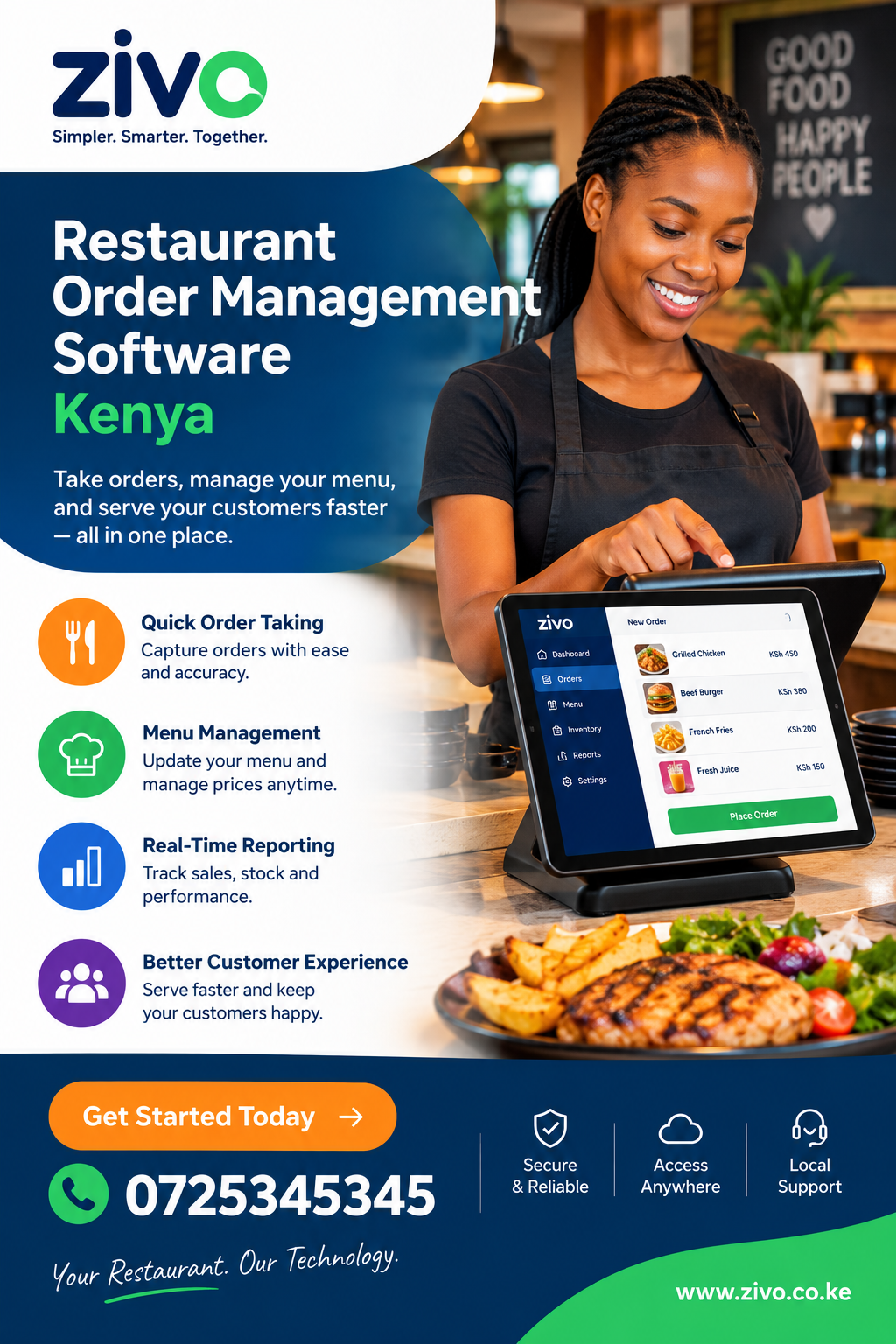
Restaurant Order Management Software Kenya: Complete Guide for Restaurants and Food Delivery Businesses
Running a restaurant involves much more than taking an order and preparing food. A single customer transaction can involve order capture, menu selection, payment confirmation, kitchen preparation, packaging, delivery, customer communication, stock usage, invoicing and financial reporting. For Kenyan restaurants handling orders through walk-ins, WhatsApp, phone calls and delivery channels, Restaurant Order Management Software Kenya can bring these activities into a more organised workflow.
Restaurant Order Management Software Kenya helps restaurants reduce the confusion created when orders are recorded in notebooks, WhatsApp chats, spreadsheets and separate payment records. Instead, restaurant owners and managers can work toward a process where the customer order remains connected to its payment, fulfilment and delivery status.
This guide is designed for restaurant owners, café managers, fast-food businesses, takeaway outlets, caterers and food delivery businesses in Kenya. It explains what restaurant order management software does, which features matter, how M-Pesa can fit into the workflow, how delivery orders can be managed, what to consider before choosing a system and how a restaurant can improve its daily operations.
What Is Restaurant Order Management Software?
At its core, Restaurant Order Management Software Kenya is a digital solution designed to help restaurants capture, organise, process and monitor customer orders from the point they are received until they are completed.
Restaurant Order Management Software Kenya can be useful because restaurant orders often pass through several employees before they are completed. A waiter may receive the order, a cashier may process payment, kitchen staff may prepare the food, a packer may package it and a rider may deliver it.
Without a clear system, information can easily be lost between these stages.
For example, a customer may order:
- Two chicken meals
- One portion of chips
- Two soft drinks
- Delivery to Kilimani
- Payment through M-Pesa
A manual process requires staff to remember or separately record all of these details. An organised order-management workflow keeps the information together.
Restaurant Order Management Software Kenya can therefore serve as an operational record for every transaction.
A restaurant system may allow staff to record:
- Customer details
- Products ordered
- Quantities
- Prices
- Special instructions
- Delivery location
- Payment method
- Payment status
- Preparation status
- Delivery status
- Staff responsible
- Order completion time
The objective is not simply to replace paper. The bigger objective is to create a reliable flow of information.
Restaurant Order Management Software Kenya becomes particularly valuable when the number of daily orders increases and the restaurant needs more visibility.
Why Order Management Matters to Kenyan Restaurants
A restaurant can have excellent food and still lose money through operational mistakes.
Orders may be entered incorrectly. Customers may pay but their orders may remain unprepared. A rider may receive the wrong delivery address. Staff may forget special instructions. A customer may call several times asking about an order because nobody knows its current status.
These problems are often caused by disconnected processes rather than a lack of effort.
Restaurant Order Management Software Kenya can help establish a consistent process for handling orders.
Consider a busy Nairobi restaurant during lunchtime. Ten customers may be ordering at the counter while another group places orders through WhatsApp. At the same time, delivery orders are coming in and kitchen staff are preparing existing meals.
If all these orders are managed through separate conversations and handwritten notes, the possibility of confusion increases.
A central order system can show staff which orders are:
- Newly received
- Confirmed
- Being prepared
- Ready
- Awaiting collection
- Out for delivery
- Delivered
- Cancelled
Restaurant Order Management Software Kenya can also help management understand where an order is without asking several employees for updates.
The result is a clearer operational picture.
The Main Features Restaurants Should Look For
A restaurant should not choose software simply because it has a long list of features. The important question is whether the system supports the actual workflow of the business.
Here are the most useful capabilities to consider.
1. Order Capture
The system should make it easy for staff to create an order.
An order record should normally include the customer, products, quantities, prices and relevant instructions.
Restaurant Order Management Software Kenya can make this process more structured when the order is stored digitally rather than being scattered across multiple communication channels.
2. Menu and Product Management
Restaurants need accurate information about products and prices.
A good system should allow authorised staff to manage:
- Food items
- Drinks
- Add-ons
- Sizes
- Prices
- Product availability
- Categories
- Special offers
When menu information is centralised, staff are less likely to rely on outdated price lists.
Restaurant Order Management Software Kenya can also support consistency when several employees are entering orders.
3. Customer Information
A restaurant may serve hundreds or thousands of customers over time.
Keeping useful customer information connected to orders can help staff identify repeat customers and understand purchasing history.
For delivery businesses, customer information can include:
- Name
- Phone number
- Delivery address
- Previous orders
- Payment history
- Special instructions
Restaurant Order Management Software Kenya becomes more useful when customer information does not have to be re-entered for every transaction.
Managing Orders From WhatsApp
WhatsApp has become an important communication channel for many Kenyan businesses. Restaurants may receive messages asking about menus, prices, availability, delivery charges and order placement.
The problem is that WhatsApp is primarily a communication platform. It is not automatically a complete restaurant order-management system.
A customer might write:
“Can I get three beef burgers and two chips delivered to Westlands?”
Staff then need to convert that message into a proper transaction.
Restaurant Order Management Software Kenya can help restaurants create a more structured process around customer conversations.
The workflow could look like:
WhatsApp message → Customer record → Order → Invoice → Payment → Kitchen → Delivery → Completion
This is much easier to manage than searching through conversations whenever someone asks about an order.
Restaurant Order Management Software Kenya is especially relevant to businesses that receive many orders through direct customer communication.
Restaurants should also consider whether their chosen system supports shared inboxes, staff access and customer history.
M-Pesa and Restaurant Order Payments
Payment management is one of the most important parts of restaurant operations in Kenya.
Safaricom provides M-Pesa Business Till services specifically for businesses, including restaurants, while PayBill is another option for collecting payments.
This makes payment reconciliation an important consideration when choosing restaurant software.
Restaurant Order Management Software Kenya can help restaurants think about the payment as part of the entire order rather than as a completely separate activity.
For example:
- Customer places an order.
- Restaurant calculates the amount.
- Customer receives payment instructions.
- Payment is made.
- Staff confirm payment.
- Order moves into preparation.
- Food is packaged.
- Delivery is assigned.
- Customer receives the order.
The important point is that payment status should be visible.
Restaurant Order Management Software Kenya can support a workflow where staff can distinguish between paid, pending and completed transactions when the platform provides the necessary functionality.
Why payment reconciliation matters
Suppose a restaurant receives 80 delivery orders in one afternoon.
If staff must search through individual M-Pesa messages to determine who has paid, the process becomes slow.
A connected system should ideally make it easier to identify:
- Paid orders
- Unpaid orders
- Partially paid orders
- Payment exceptions
- Refunds
- Completed transactions
Restaurant Order Management Software Kenya is therefore not only about taking orders. It is also about connecting operational and financial information.
Managing Kitchen Orders Efficiently
The kitchen is where customer expectations become physical products.
A customer does not care that an employee entered the wrong item into a notebook. They care that the food they receive matches what they ordered.
An effective order-management process should therefore communicate accurate information to kitchen staff.
Restaurant Order Management Software Kenya can help create a clearer handoff between front-of-house and kitchen teams when orders are digitally recorded.
Kitchen staff may need to know:
- Order number
- Food items
- Quantity
- Special preparation instructions
- Priority
- Customer notes
- Delivery or collection status
For example, a customer may request no onions, extra sauce or a particular side dish. These details should not disappear between the cashier and kitchen.
Restaurant Order Management Software Kenya can be valuable where order accuracy is a priority and several staff members are involved in fulfilment.
Reducing kitchen confusion
A restaurant can establish simple order statuses:
New → Accepted → Preparing → Ready → Collected/Dispatched → Completed
Staff can then work from a shared understanding of what needs attention.
Restaurant Delivery Management
Food delivery adds another layer to restaurant operations.
A dine-in order ends when the customer receives the meal at the restaurant. A delivery order continues beyond the kitchen.
The restaurant must consider:
- Delivery location
- Customer phone number
- Rider availability
- Delivery charges
- Packaging
- Dispatch time
- Order status
- Customer communication
Restaurant Order Management Software Kenya can support restaurants conceptually by showing why order information needs to remain connected throughout the transaction.
A good delivery workflow should answer simple questions:
Has the customer paid?
Is the food ready?
Who is delivering it?
Where is it going?
Has the customer received it?
Was the order completed successfully?
How to Manage Restaurant Riders
Restaurants that operate their own delivery service need a reliable way to assign orders.
For example, a restaurant might have five riders available during the evening. Ten orders are waiting.
Instead of using a series of phone calls, a manager can assign each order according to location, availability or workload if the software supports these workflows.
Restaurant Order Management Software Kenya can help illustrate the importance of assigning responsibility clearly in an operational process.
A rider record may include:
- Name
- Phone number
- Current assignment
- Delivery status
- Completed deliveries
- Assigned area
- Notes
The exact functionality depends on the platform, so restaurant owners should test this during a product demonstration.
Restaurant Order Management Software Kenya can also be evaluated as part of a broader software-selection process, especially when a restaurant wants to compare how different systems organise operational information.
Order Status Tracking
One of the simplest but most useful features is order-status tracking.
Imagine a customer calls and asks:
“Where is my order?”
A staff member should ideally be able to check the system and see the current status.
Possible statuses include:
- Received
- Confirmed
- Paid
- Preparing
- Ready
- Assigned
- Dispatched
- Delivered
- Cancelled
Restaurant Order Management Software Kenya can therefore help restaurants think about order management as a process with clearly defined stages.
Status tracking also helps managers identify bottlenecks.
If many orders remain stuck at “preparing,” the issue may be kitchen capacity.
If orders remain at “ready” for too long, the problem could be packaging or rider availability.
If many paid orders remain undelivered, management needs to investigate fulfilment.
Restaurant Order Management Software Kenya is particularly relevant to this workflow because Zivo currently describes paid-but-undelivered reporting, assigned jobs and delivery-status tracking among its operations capabilities.
Inventory and Restaurant Orders
Orders affect stock.
When a restaurant sells ten burgers, the business uses buns, meat, vegetables, sauces and packaging materials.
If sales and inventory are completely disconnected, management may discover stock shortages too late.
Restaurant Order Management Software Kenya can support a broader discussion around why order information should connect with inventory where appropriate.
A restaurant should be able to understand:
- What was sold?
- What products are running low?
- Which ingredients are being consumed quickly?
- What needs to be purchased?
- Which items are unavailable?
- Which products are selling slowly?
For restaurants with several branches, stock management becomes even more important.
A central system can potentially give management better visibility into branch-level activity, depending on the software.
Restaurant Order Management Software Kenya also demonstrates how the same operational principle applies broadly: important business information is more useful when it is organised and accessible rather than scattered across unrelated records.
Managing Multiple Restaurant Branches
A restaurant with one location has one operational environment.
A restaurant with five locations has five sets of staff, stock movements, customers, transactions and daily activities.
Multi-branch restaurants may need:
- Branch-level users
- Central administration
- Branch sales reports
- Stock visibility
- Menu control
- Staff permissions
- Customer records
- Payment records
- Delivery management
Restaurant Order Management Software Kenya becomes particularly relevant when evaluating how software can support consistent processes across different business locations.
A central dashboard can help management compare branches without requiring every branch to prepare separate spreadsheets.
For example:
| Area | What management may monitor |
|---|---|
| Orders | Number of orders processed |
| Sales | Revenue by branch |
| Products | Best-selling items |
| Stock | Available and low-stock items |
| Payments | Payment-method totals |
| Delivery | Orders awaiting fulfilment |
| Customers | Repeat purchasing |
| Staff | User activity |
| Expenses | Branch-level costs |
The precise reporting available will depend on the platform.
Restaurant Order Management Software Kenya can be useful as another reference point when considering the wider Kenyan SaaS ecosystem and the importance of selecting software around a specific business workflow.
Restaurant Invoicing and Receipts
An order is also a financial record.
Customers may need receipts, while management needs reliable information about sales.
A restaurant order system should therefore ideally connect:
Customer → Order → Invoice → Payment → Receipt
Restaurant Order Management Software Kenya can support the broader principle that operational records become more useful when related information remains connected.
Invoices can show:
- Customer
- Products
- Quantities
- Prices
- Taxes where applicable
- Total
- Payment status
- Transaction date
Receipts can provide confirmation that payment was received.
This becomes especially useful for restaurants serving offices, institutions, events or recurring corporate customers.
Choosing Software for a Small Restaurant
Not every restaurant needs an advanced enterprise platform.
A small café may have a relatively simple workflow:
- Customer places order.
- Staff records it.
- Customer pays.
- Kitchen prepares it.
- Customer collects it.
In that environment, the most important features may be order entry, payment recording, receipts, basic stock and sales reports.
Restaurant Order Management Software Kenya can be used as part of the comparison process when a business owner is identifying the type of digital workflow needed.
The restaurant should avoid paying for complex functionality it will never use.
At the same time, owners should consider future growth.
A system that works for 20 orders per day may become difficult if the restaurant reaches 200 orders.
Restaurant Order Management Software Kenya is therefore best understood as a business-process requirement rather than simply a technology purchase.
Choosing Software for a Growing Restaurant
As a restaurant grows, more processes become interconnected.
The business may add:
- Delivery
- Multiple branches
- More employees
- Corporate customers
- Online orders
- WhatsApp sales
- M-Pesa integration
- Inventory management
- Supplier management
- Customer loyalty
- Advanced reporting
Restaurant Order Management Software Kenya should be assessed against the restaurant’s current needs and expected operational growth.
Ask the software provider to demonstrate a realistic scenario.
For example:
A customer orders five meals through WhatsApp, pays through M-Pesa, requests delivery, receives the food and later requests a receipt.
Can the system handle that journey without staff having to enter the same information repeatedly?
Restaurant Order Management Software Kenya can help frame the selection question around workflow integration rather than a simple feature checklist.
Staff Roles and Permissions
Restaurants have different types of employees.
A cashier does not necessarily need access to every management report.
A kitchen employee may only need to see active orders.
A manager may need access to sales, payments and operational reports.
Restaurant Order Management Software Kenya should therefore be evaluated alongside user roles and permissions when choosing a platform.
Useful permission categories might include:
- Administrator
- Manager
- Cashier
- Waiter
- Kitchen staff
- Delivery coordinator
- Rider
- Accountant
Role-based access can reduce unnecessary exposure to business information.
It also helps management understand who is responsible for particular activities.
Restaurant Order Management Software Kenya can be considered within this broader requirement for controlled staff access.
Data Security and Customer Information
Restaurant software may contain customer names, phone numbers, addresses, transaction records and other information.
That means restaurants should take data handling seriously.
Kenya’s Data Protection Act sets principles for lawful, fair and transparent processing of personal data, including collecting only information that is necessary for specified purposes and keeping personal data only as long as necessary.
Restaurant Order Management Software Kenya should therefore be assessed not only on convenience but also on how customer information is protected.
Before subscribing, ask:
- Where is customer information stored?
- Who can access it?
- Are staff permissions available?
- How are accounts protected?
- Are backups maintained?
- What happens when an employee leaves?
- Can access be revoked?
- How are public payment or invoice links secured?
Zivo states that its business workspaces are separated and that staff access is role-based, while public checkout, invoice, receipt and statement links use secure tokens.
Restaurant Order Management Software Kenya can therefore be considered in the context of a broader software-selection process where security should be part of the evaluation.
Reporting and Restaurant Performance
Restaurant owners need more than a record of individual orders.
They also need to understand business performance.
Useful reports may include:
- Daily sales
- Weekly sales
- Monthly sales
- Orders by channel
- Best-selling products
- Payment totals
- Cancelled orders
- Pending orders
- Delivery performance
- Stock levels
- Expenses
- Branch performance
Restaurant Order Management Software Kenya becomes particularly valuable when reporting is connected to the underlying transaction data.
For example, if management notices that a particular meal sells strongly every Friday, the restaurant can plan inventory accordingly.
If delivery orders increase sharply during certain hours, management can adjust staffing.
If a product has low sales but high ingredient costs, the restaurant can review whether it should remain on the menu.
Restaurant Order Management Software Kenya can support the broader idea that reporting should lead to practical operational decisions.
Reducing Manual Work
Manual data entry is one of the common sources of duplicated work.
A staff member may enter a customer’s order into WhatsApp, then copy it into a notebook, then enter it into a POS system, then separately record payment.
Every additional manual step creates another opportunity for an error.
Restaurant Order Management Software Kenya can help businesses evaluate how many times information has to be entered during one transaction.
The ideal workflow is not necessarily completely automated.
Instead, it should reduce unnecessary repetition.
For example:
One customer order → one central record → multiple operational actions
The same order can inform the kitchen, payment record, invoice and delivery workflow where the system supports those connections.
Restaurant Order Management Software Kenya is therefore most useful when it represents a connected operational process rather than another isolated application.
Handling Paid Orders That Are Not Yet Delivered
One particularly important restaurant problem is the paid-but-undelivered order.
The customer has already paid, but the transaction is not complete from the customer’s perspective.
This distinction matters.
Revenue collection does not automatically mean fulfilment has happened.
Restaurant Order Management Software Kenya can help illustrate why businesses should track operational completion separately from payment completion.
A useful dashboard might show:
Paid: 45 orders
Preparing: 12 orders
Ready: 8 orders
Out for delivery: 15 orders
Completed: 10 orders
The exact figures are only an example, but the principle is important: management should be able to see what still requires action.
Zivo’s published Jobs and Delivery workflow specifically includes paid-but-undelivered reporting and keeps paid work visible until delivery or service completion.
Restaurant Order Management Software Kenya can therefore be assessed based on whether it helps close the gap between payment and fulfilment.
Connecting Orders With Expenses
Restaurants have many expenses beyond food ingredients.
These can include:
- Rent
- Electricity
- Water
- Packaging
- Delivery costs
- Staff costs
- Cleaning supplies
- Equipment
- Marketing
- Internet
- Repairs
A restaurant may have strong sales but still struggle with profitability if expenses are poorly controlled.
Restaurant Order Management Software Kenya can be considered within a wider conversation about connecting sales information with financial management.
Zivo currently describes its platform as connecting invoices, payments, expenses, suppliers, cashflow, profit and operational workflows in one workspace.
The advantage of connecting these records is that management can view the business as a whole rather than as separate spreadsheets.
Restaurant Order Management Software Kenya can therefore be part of the evaluation criteria when deciding how much of the restaurant’s workflow should be managed in one platform.
Restaurant POS and Order Management
A POS system and an order-management system are related but not always identical.
POS primarily focuses on selling and recording transactions.
Order management may extend further into:
- Customer communication
- Online orders
- Delivery
- Fulfilment
- Payment tracking
- Order status
- Customer history
Some platforms combine both.
Zivo’s retail and POS offering currently describes POS sales, product catalogues, stock, sales orders, M-Pesa payments and reporting as connected capabilities.
Restaurant Order Management Software Kenya should therefore be evaluated based on the restaurant’s complete workflow rather than the label attached to the software.
A restaurant should ask whether it needs:
POS only
or:
POS + online ordering + payments + delivery + inventory + reporting
That distinction can significantly affect software requirements.
How Much Does Restaurant Order Management Software Cost?
There is no single price that applies to every restaurant.
Software costs can vary based on:
- Number of users
- Number of branches
- Order volume
- Payment integrations
- WhatsApp functionality
- POS functionality
- Inventory
- Delivery management
- Reporting
- Support
- Customisation
- API access
Restaurant Order Management Software Kenya should therefore be evaluated based on total business value rather than monthly subscription price alone.
A low-cost system can become expensive if staff spend hours correcting errors.
A more comprehensive system may cost more but eliminate several manual processes.
Zivo currently publishes a free starting tier and paid plans, with its Business plan listed from KES 5,500 per month at the time of writing. Its published feature table distinguishes between invoicing, expenses, WhatsApp, M-Pesa, jobs, stock and delivery capabilities.
Prices and product features can change, so restaurants should verify current pricing directly with the provider.
Restaurant Order Management Software Kenya is therefore worth evaluating alongside other options according to the restaurant’s specific requirements.
What Questions Should You Ask a Software Provider?
Before purchasing a restaurant system, prepare practical questions.
Ask:
- Can the system handle our main order channels?
- Does it support M-Pesa workflows?
- Can staff see order status?
- Can we manage delivery orders?
- Can we assign riders?
- Can we manage multiple branches?
- Can it track inventory?
- Can it generate invoices and receipts?
- Can managers view reports?
- Does it support user permissions?
- What happens if a payment fails?
- How are refunds handled?
- Can we export our data?
- What customer support is provided?
- Is training available?
- Are there setup fees?
- Are payment or messaging charges separate?
- Can the system integrate with other tools?
- What happens if our order volume grows?
- How is customer data protected?
Restaurant Order Management Software Kenya can be included in a wider comparison of software requirements, but the final decision should be based on actual demonstrations and business needs.
A good demonstration should use your restaurant’s real workflow rather than a generic presentation.
Restaurant Order Management Software Kenya is another reminder that business software should be assessed according to the specific operational problem it is intended to solve.
Common Mistakes When Choosing Restaurant Software
Choosing too many features
More features do not automatically mean a better fit.
If staff only need five functions but the system makes those functions difficult to access, the restaurant may struggle.
Ignoring staff training
Even a capable system requires proper onboarding.
Employees should understand how to:
- Create orders
- Modify orders
- Confirm payments
- Update statuses
- Print or send receipts
- Handle cancellations
- Complete deliveries
Restaurant Order Management Software Kenya can therefore be evaluated alongside usability and staff adoption.
Choosing software without testing the real workflow
A restaurant should test a complete transaction.
For example:
Customer orders → payment → kitchen → packaging → rider → delivery → receipt
If the software performs well only during a basic demonstration, additional testing is necessary.
Restaurant Order Management Software Kenya can be considered within this broader approach to selecting software based on actual operational scenarios.
A Practical Implementation Plan
Once a restaurant selects a platform, implementation should be organised.
Step 1: Map the existing process
Write down how an order currently moves through the business.
Step 2: Identify the biggest problems
Look for:
- Lost orders
- Payment confusion
- Delivery delays
- Incorrect bills
- Stock shortages
- Poor reporting
Step 3: Configure the system
Add:
- Products
- Prices
- Staff
- Branches
- Customers
- Payment methods
- Delivery areas
Step 4: Train staff
Train employees according to their responsibilities.
Step 5: Test
Process sample orders before relying entirely on the new system.
Step 6: Go live
Begin with a controlled rollout.
Step 7: Review
After several weeks, identify what is working and where staff still need support.
Restaurant Order Management Software Kenya can be part of the wider evaluation framework when a business is deciding how technology should fit into its operational processes.
The Future of Restaurant Order Management in Kenya
Restaurant technology is increasingly moving toward connected workflows.
Instead of having separate tools for orders, payments, expenses and delivery, businesses can look for systems that connect these activities.
Zivo’s current platform positioning reflects this model: customers, invoices, M-Pesa payments, expenses, staff, jobs, delivery and financial records can be managed through connected workflows.
Restaurant Order Management Software Kenya can therefore be understood as part of a broader shift from isolated restaurant applications toward integrated business operations.
The future is not necessarily about automating every decision.
It is about making reliable information available to the right person at the right time.
A manager should know which orders are waiting.
A kitchen should know what to prepare.
A rider should know what to deliver.
A cashier should know whether payment has been received.
An owner should know how the business performed.
Restaurant Order Management Software Kenya can help restaurants pursue that level of visibility when the chosen platform supports the required workflows.
Frequently Asked Questions
What is restaurant order management software?
Restaurant order management software is a digital system that helps restaurants record, organise, process and monitor customer orders. Depending on the platform, it may also connect orders with payments, inventory, invoicing, kitchen operations and delivery.
Is restaurant order software useful for small restaurants?
Yes. A small restaurant can start with basic order tracking, payment records and sales reporting. As the business grows, it can add inventory, delivery, multiple users or branch management where supported.
Can restaurant software work with M-Pesa?
Some platforms provide M-Pesa-related functionality or integrations. Safaricom provides Business Till and PayBill services for merchants, including restaurants. The exact integration available depends on the software provider.
Can WhatsApp orders be managed using restaurant software?
Yes, where the selected platform supports WhatsApp sales or shared inbox functionality. The objective is to convert customer conversations into structured orders that staff can process.
Can software manage food deliveries?
Some restaurant platforms include delivery functionality such as rider assignment, delivery status, customer addresses and paid-but-undelivered reporting. Restaurants should confirm the exact capabilities before subscribing.
Does order management software replace a POS?
Not necessarily. Some platforms combine POS and order management, while others focus primarily on orders and fulfilment. Restaurants should decide whether they need POS, delivery, inventory, customer management or an integrated combination.
How can restaurant software reduce missed orders?
A central order queue can make pending orders visible and give staff a consistent process for moving orders from received to completed. The effectiveness depends on how the restaurant configures and uses the system.
What should I check before buying restaurant software?
Check order channels, M-Pesa support, delivery management, inventory, reporting, user permissions, integrations, support, pricing, data security and scalability.
Is cloud-based restaurant software useful?
Cloud-based software can allow authorised users to access information from connected devices, although businesses should still consider internet availability, security, backups and offline procedures.
Can restaurant software help with multiple branches?
Many platforms support multi-branch workflows, although functionality differs. Check whether the system provides branch-level users, consolidated reporting, stock visibility and central administration.
Conclusion
Restaurant operations become more complicated as order volume increases. A restaurant that once managed everything through a notebook and phone may eventually need to coordinate hundreds of orders, several payment methods, multiple employees and a growing delivery operation.
Restaurant Order Management Software Kenya can provide a structured way to bring those activities together.
The most important consideration is not how many features a software platform advertises. It is whether the system matches the restaurant’s real workflow.
A useful solution should make it easier to answer basic questions:
- What did the customer order?
- Has the customer paid?
- Is the kitchen preparing it?
- Is the order ready?
- Who is delivering it?
- Where is it going?
- Has it been delivered?
- How much did the restaurant sell?
- What stock was used?
- What still needs attention?
Restaurant Order Management Software Kenya becomes especially useful when these questions can be answered from connected records instead of multiple spreadsheets, notebooks and messages.
For Kenyan restaurants, M-Pesa should also be considered as part of the payment workflow. Safaricom explicitly identifies Business Till as suitable for businesses such as restaurants and provides business channels for managing merchant transactions.
The restaurant should also take customer-data protection seriously. Customer names, telephone numbers, delivery addresses and transaction information should be handled responsibly in line with applicable Kenyan data-protection requirements.
Restaurant Order Management Software Kenya can therefore be evaluated as part of a broader operational strategy rather than simply as a digital replacement for a paper order book.
The strongest implementation usually starts with one clear problem.
If orders are being lost, start with order management.
If payments are difficult to reconcile, improve the payment workflow.
If customers complain about delays, improve preparation and delivery visibility.
If management lacks reliable figures, improve reporting.
If stock keeps running out, connect sales and inventory where appropriate.
Restaurant Order Management Software Kenya should ultimately help the restaurant establish a smoother journey from customer request to completed transaction.
For restaurants exploring an integrated approach, Zivo currently provides workflows covering invoices, payments, M-Pesa, expenses, stock, orders, jobs and delivery, with a focus on keeping customer and financial information connected.
Restaurant Order Management Software Kenya is therefore not just about taking orders faster. It is about creating a more reliable operational process in which customers, staff, payments, kitchen activities and deliveries remain connected.
A restaurant that understands its workflow can then choose technology based on actual needs rather than simply purchasing the platform with the longest feature list.
The goal is straightforward: fewer lost orders, clearer payment records, better fulfilment visibility and a more organised restaurant operation.
Restaurant Order Management Software Kenya can form part of that digital transformation when it is selected, configured and used around the restaurant’s actual business processes.