
Quotation Software Kenya: How to Create, Send and Manage Professional Quotes
A customer asking for a price should not have to wait hours while a business searches through spreadsheets, old WhatsApp messages and handwritten notes. Quotation Software Kenya gives Kenyan businesses a more organised way to prepare quotations, communicate prices, track customer decisions and move accepted quotes toward invoicing and payment. This guide explains what quotation software does, why it matters, which features businesses should look for, how it can work with WhatsApp and M-Pesa, and how to choose a solution that fits the way a Kenyan business actually sells.
For many small and medium-sized businesses, a quotation is more than a document containing prices. It is part of the sales process. A customer may make an enquiry through WhatsApp, ask for several options, request a discount, approve a revised quotation and then expect an invoice immediately. If each stage is handled separately, sales information can easily become scattered.
A structured quotation workflow creates a better connection between the customer enquiry, the products or services being offered, the agreed price, the payment request and the eventual delivery of the work.
That is especially valuable for Kenyan businesses where WhatsApp, mobile payments and informal customer conversations are already part of everyday commerce.
This article looks at how businesses can turn quotations from simple documents into a controlled sales workflow.
What Is Quotation Software?
At its simplest, Quotation Software Kenya refers to software designed to help businesses prepare, send, organise and monitor customer quotations.
Instead of creating every quotation manually in Microsoft Word or Excel, a business can maintain customer records, product or service information, prices, quantities, discounts, taxes and payment terms in a central system.
A quotation can then be prepared using information that has already been recorded.
For example, consider a Nairobi-based CCTV installation company. A customer contacts the business and requests a quotation for cameras, cabling, installation and configuration.
The salesperson may need to calculate:
- Number of cameras
- Camera unit prices
- Digital video recorder cost
- Storage requirements
- Cabling
- Labour
- Transport
- Installation
- Configuration
- Applicable taxes
- Payment terms
With Quotation Software Kenya, those details can be organised into a professional quotation instead of being calculated repeatedly from different spreadsheets.
The important point is that quotation software is not simply about making a document look attractive. The bigger benefit is creating a repeatable sales process.
Why Quotations Matter to Kenyan Businesses
A quotation often forms the bridge between an enquiry and a sale.
A customer may not be ready to buy when they first contact a business. They may be comparing suppliers, checking their budget, asking a colleague for approval or deciding between different service packages.
That means the quotation needs to be accurate and easy to understand.
Businesses using Quotation Software Kenya can create a more consistent process for handling these opportunities.
A professional quotation can help communicate:
- The business name and contact information
- Customer information
- Products or services being offered
- Quantities
- Unit prices
- Discounts
- Taxes where applicable
- Total amount
- Payment terms
- Validity period
- Delivery expectations
- Additional conditions
The document should make it easy for the customer to understand what they are paying for.
Poor quotations can create unnecessary questions. A customer may ask whether installation is included, whether transport is charged separately, whether the price includes tax or how long the quotation remains valid.
Clear quotations reduce these misunderstandings.
The Problem With Manual Quotation Processes
Many small businesses start with spreadsheets because spreadsheets are inexpensive and familiar.
That approach can work when quotation volumes are low.
Problems begin when the business handles more customers, products, staff or branches.
A salesperson might save one quotation on a laptop, another in Google Drive and another as a PDF inside a WhatsApp conversation.
Another employee may maintain a separate spreadsheet showing which customers accepted their quotations.
The finance team may only discover that a quotation became a sale when someone sends them a message.
A business using Quotation Software Kenya can reduce this fragmentation by keeping quotation information in a central workflow.
Common manual quotation problems
Some of the most common problems include:
- Wrong prices — Old spreadsheets may contain outdated prices.
- Duplicate work — Employees repeatedly enter the same customer and product information.
- Lost quotations — A quotation can disappear inside an email or WhatsApp conversation.
- Poor follow-up — Nobody remembers which customers are waiting for a response.
- Version confusion — Salespeople may not know which quotation was the latest.
- Slow approvals — Managers may need to review quotations manually.
- Weak reporting — Management cannot easily see how many quotations became sales.
- Delayed invoicing — Accepted quotations may need to be recreated as invoices.
The more quotations a company creates, the more expensive these inefficiencies become.
How Quotation Software Improves the Sales Process
A quotation system becomes more valuable when it connects different steps of the customer journey.
With Quotation Software Kenya, a business can establish a repeatable process such as:
Customer enquiry → quotation → follow-up → acceptance → invoice → payment → delivery
This creates continuity.
The salesperson knows what was offered.
The customer knows what they agreed to.
The finance team knows what should be invoiced.
The operations team knows what needs to be delivered.
Management can see the commercial history.
This is much stronger than having separate documents for every stage.
Creating Professional Quotations Faster
Speed matters in sales.
If three businesses receive the same customer enquiry and one responds professionally within minutes while another responds the following day, the faster business may have an advantage.
Quotation Software Kenya can help businesses standardise quotation creation so staff do not have to rebuild documents from scratch.
A quotation template can contain standard information such as:
- Company details
- Logo
- Customer information
- Product descriptions
- Service descriptions
- Standard terms
- Payment instructions
- Validity period
- Contact details
The salesperson then adds the customer-specific information.
This saves time without making quotations look generic.
Product and service catalogues
A product or service catalogue is particularly useful for businesses selling repeatable items.
A hardware supplier may have hundreds of products.
A cleaning company may offer different packages.
A digital agency may have standard website, social media and advertising packages.
An electrical contractor may repeatedly quote similar materials and labour categories.
With Quotation Software Kenya, these items can be structured so employees can select them rather than retyping descriptions and prices.
This can also reduce spelling errors and inconsistent descriptions.
Managing Different Types of Quotations
Not every quotation is the same.
Some businesses need simple one-page quotes. Others require detailed proposals with multiple sections.
A good quotation workflow should be flexible enough to handle different sales situations.
For example:
| Business | Typical quotation |
|---|---|
| CCTV installer | Equipment + installation |
| Contractor | Materials + labour |
| Cleaning company | Service package |
| Advertising agency | Campaign package |
| Hardware shop | Product list |
| Solar installer | Equipment + installation |
| Consultant | Professional services |
| Furniture maker | Custom production |
| IT company | Hardware + support |
| Repair company | Parts + labour |
A system such as Quotation Software Kenya becomes more useful when it supports the different products, services and pricing structures used by the business.
Quotation Status Tracking
Creating a quotation is only the beginning.
A business should also know what happened after the quotation was sent.
Useful statuses include:
- Draft
- Sent
- Viewed
- Pending
- Accepted
- Rejected
- Expired
- Converted to invoice
With Quotation Software Kenya, these statuses can provide a clearer picture of the sales pipeline.
Imagine a business has 80 quotations issued during a month.
Without tracking, management may only know that 80 documents were created.
With quotation status reporting, the business might discover that:
- 25 were accepted
- 15 are still pending
- 10 were rejected
- 20 expired
- 10 are awaiting follow-up
That information is commercially useful.
It tells the owner where attention is needed.
Following Up on Unanswered Quotations
Many sales opportunities are lost not because the customer rejected the quotation, but because nobody followed up.
A customer may have been busy.
They may have forgotten.
They may still be comparing suppliers.
They may need a small clarification before approving.
Quotation Software Kenya can support a more structured follow-up process by helping the team see quotations that remain pending.
A salesperson can then prioritise opportunities rather than randomly contacting customers.
A simple follow-up workflow could be:
Day 0: Send quotation.
Day 1–2: Confirm that the customer received it.
Day 3–5: Ask whether clarification is required.
Day 7: Send a final useful follow-up.
The exact timing should depend on the type of product or service.
A KES 2,000 purchase may require a different follow-up process from a KES 500,000 installation project.
WhatsApp and Quotation Management
WhatsApp is an important customer communication channel for many Kenyan businesses.
Customers may ask:
“Can you send me a quotation?”
They may attach photos, describe their requirements or send a list of products.
That creates an opportunity for businesses to connect customer communication with sales administration.
Quotation Software Kenya can support this kind of structured workflow when quotation management is connected to the communication process.
Zivo, for example, currently positions quotes and invoices as part of a broader workflow that can start from WhatsApp conversations and continue through M-Pesa payment and delivery.
The benefit is not simply sending a quotation through WhatsApp.
The real advantage is keeping the customer request, quotation and subsequent transaction connected.
M-Pesa and Quotation-to-Payment Workflows
A quotation normally comes before payment.
Once a customer accepts, the business may need to issue an invoice or request a deposit.
This is where Quotation Software Kenya can become part of a wider sales and finance workflow.
For Kenyan businesses, M-Pesa is especially relevant.
A typical customer journey might look like this:
- Customer sends an enquiry through WhatsApp.
- Business prepares a quotation.
- Customer accepts the quotation.
- Business creates an invoice.
- Customer receives a payment request.
- Customer pays using M-Pesa.
- Payment is matched to the correct transaction.
- Receipt is issued.
- Work is scheduled or goods are prepared.
Zivo currently supports quotation and invoice workflows alongside M-Pesa STK, receipts and payment tracking.
That connection helps reduce the need to ask customers to send payment screenshots.
Converting Accepted Quotes Into Invoices
One of the biggest weaknesses of manual processes is duplicated data entry.
A salesperson creates a quotation.
The customer accepts.
Someone in accounts then creates another document using the same information.
This creates an unnecessary opportunity for errors.
With Quotation Software Kenya, businesses can structure the process so an accepted quotation becomes the basis for invoicing.
The customer name, items, quantities and agreed amount can remain connected.
That improves continuity.
It can also reduce mistakes such as:
- Changing a quantity accidentally
- Using the wrong customer
- Forgetting an item
- Applying a different price
- Entering the wrong total
- Losing agreed payment terms
The exact capabilities depend on the software selected, so businesses should confirm the workflow during a demonstration.
Quotation Software and Customer Records
A quotation is connected to a customer.
That means quotation management becomes more useful when customer information is organised as well.
Quotation Software Kenya can form part of a broader customer record where the business can understand previous interactions.
Depending on the platform, useful customer information may include:
- Customer name
- Phone number
- Business name
- Previous quotations
- Previous invoices
- Payments
- Outstanding balances
- Orders
- Service history
- Notes
This context can improve customer service.
Suppose a repeat customer asks for another quotation.
Instead of starting from nothing, the salesperson can review previous purchases and understand what the customer normally buys.
That makes the conversation more informed.
Managing Discounts and Pricing
Discounts need control.
A salesperson may have authority to offer a five percent discount, while a larger discount requires manager approval.
Without controls, employees may offer inconsistent prices.
Quotation Software Kenya can help businesses establish more structured pricing processes where supported by the platform.
Businesses should decide:
- Which products have fixed prices
- Which products can be discounted
- Maximum salesperson discount
- When management approval is required
- Whether discounts apply before or after tax
- How discounts should appear on the quotation
This is particularly important for businesses where margins are tight.
A quotation that wins the sale but destroys the margin is not necessarily a successful quotation.
Tax Information and Kenyan Compliance
Quotation software should also be considered alongside the business’s invoicing and tax requirements.
A quotation is not necessarily the same thing as a tax invoice. Businesses should distinguish between the commercial quotation sent before agreement and the appropriate tax documentation issued when required.
The Kenya Revenue Authority states that eTIMS is an electronic Tax Invoice Management System and that persons engaged in business are required to onboard eTIMS and issue electronic tax invoices, subject to applicable rules and exceptions.
KRA has also stated that from 1 January 2026 it would validate declared income and expenses against data sources including TIMS/eTIMS.
For that reason, Quotation Software Kenya should be evaluated as part of the wider sales-to-invoice process rather than as an isolated document generator.
Businesses should verify current compliance requirements and confirm whether their chosen invoicing platform supports the tax workflow they require.
Quotation Reporting and Sales Visibility
A quotation system can generate useful business information.
Instead of only asking, “How many quotations did we send?”, management can ask more meaningful questions.
For example:
- What is our quotation acceptance rate?
- Which salesperson generates the most accepted quotations?
- Which services have the highest demand?
- Which customers are still considering proposals?
- How much potential revenue is sitting in pending quotations?
- How long does it take to convert a quotation into a sale?
- Which quotations are repeatedly rejected?
- Which products generate the highest quoted value?
With Quotation Software Kenya, businesses can think about quotations as sales data rather than isolated documents.
Example quotation dashboard
| Metric | Example |
|---|---|
| Quotations issued | 120 |
| Accepted | 54 |
| Pending | 28 |
| Rejected | 21 |
| Expired | 17 |
| Total quoted value | KES 4,850,000 |
| Accepted value | KES 2,140,000 |
These figures can help management understand the health of the sales pipeline.
The numbers above are illustrative rather than a claim about any particular business.
Quotation Approval Workflows
Some quotations are straightforward.
Others involve significant amounts of money.
A business may want a manager to approve quotations above a certain value.
For example:
- Under KES 25,000 — salesperson approval
- KES 25,000–100,000 — supervisor review
- Above KES 100,000 — management approval
The actual limits should be determined by the business.
Quotation Software Kenya can be considered where approval workflows are important.
The purpose is not to slow sales down.
The purpose is to balance speed with commercial control.
A good approval process should make it clear:
- Who created the quotation
- Who approved it
- When it was approved
- What amount was approved
- Whether the quotation was later changed
This creates accountability.
Quotation Version Control
Customers sometimes request changes.
They might say:
“Remove installation.”
“Add two more cameras.”
“Give me a discount.”
“Change the payment terms.”
“Quote both options.”
If every revision is saved as a separate file, staff can easily become confused.
Quotation Software Kenya can be useful when businesses need a more controlled way to manage quotation changes, depending on the platform’s versioning features.
A clear revision process helps answer:
- What was originally offered?
- What changed?
- Who changed it?
- Which quotation did the customer accept?
This becomes increasingly important for larger projects.
Quotation Templates for Kenyan Businesses
A quotation template should be professional without being unnecessarily complicated.
A useful template may contain:
Business information
Include:
- Business name
- Physical or postal information where appropriate
- Telephone
- Website
- Tax information where applicable
Customer information
Include:
- Customer name
- Business name where relevant
- Contact details
- Delivery or service location where necessary
Quotation details
Include:
- Quotation number
- Date
- Validity period
- Salesperson
- Customer reference where applicable
Pricing
Include:
- Item
- Description
- Quantity
- Unit price
- Discount
- Tax where applicable
- Total
Terms
Include:
- Payment terms
- Delivery conditions
- Installation conditions
- Warranty information where applicable
- Quotation validity
- Any exclusions
Using Quotation Software Kenya can help businesses standardise these details and reduce the amount of repetitive document preparation.
How Zivo Fits Into a Quotation Workflow
Zivo positions its quotation capability as part of a broader operating workflow rather than a standalone quotation generator.
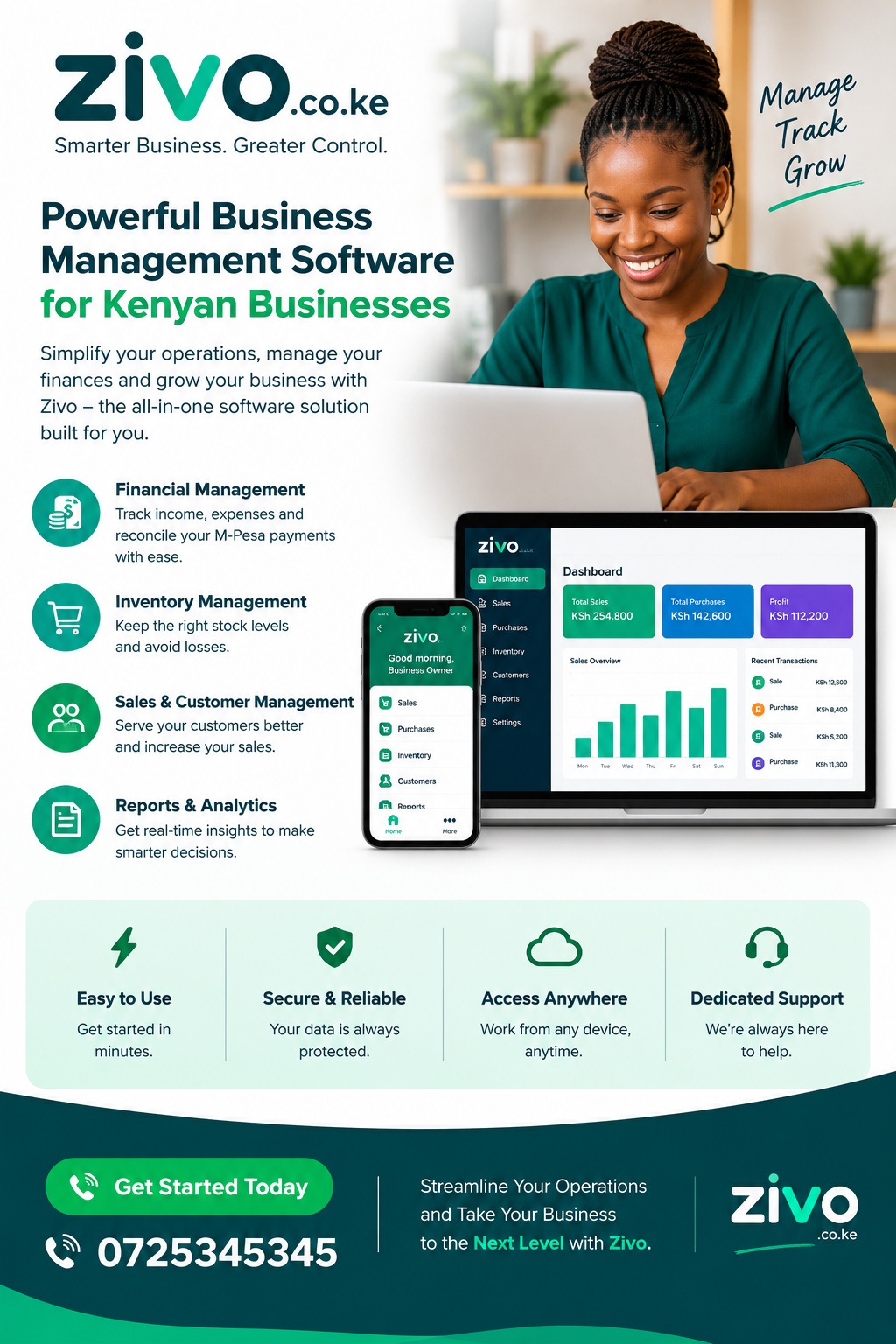
Its current platform includes quotes and invoices, customer records, M-Pesa collection, expenses, jobs, delivery and finance reporting.
For a service business, a practical workflow could be:
WhatsApp enquiry → quote → invoice → M-Pesa payment → receipt → assigned job → completion → financial record
That approach is useful because the customer does not disappear from the system after accepting the quote.
The quotation can remain connected to what happens next.
For example, a CCTV installer might receive an enquiry through WhatsApp, prepare a quote for KES 24,500, receive acceptance, request payment, record the payment and then assign the installation to a technician.
Zivo currently illustrates this type of quote-to-payment-to-job workflow on its website.
Businesses should still test the exact workflow against their own requirements before selecting any system.
Free and Paid Quotation Software Options
Price matters when selecting software.
Some businesses only need basic quotation creation.
Others require customer management, WhatsApp integration, M-Pesa collection, invoicing, reporting, staff access and operational workflows.
Quotation Software Kenya should therefore be evaluated according to the actual business problem rather than simply comparing subscription prices.
A low-cost tool may be appropriate if a business creates only a few quotations every month.
A growing business may save more money with a system that connects quotations to invoicing and payment because employees spend less time duplicating information.
For example, Zivo currently offers a free Start plan that includes manual quotes and invoices, expenses, customer balances and essential reports, while paid plans add capabilities such as WhatsApp quotations, M-Pesa STK and higher-volume workflows.
Always confirm current pricing and feature limits before making a purchasing decision.
What Should You Look For Before Buying?
Choosing Quotation Software Kenya should not be based solely on screenshots or a long feature list.
Ask practical questions.
1. Can it create quotations quickly?
A quotation tool should make quoting easier rather than adding administrative work.
2. Can it store customers?
Customer information should not have to be typed repeatedly.
3. Can it handle products and services?
The system should support the way your business sells.
4. Can quotations be tracked?
You should know whether a quotation is pending, accepted, rejected or expired.
5. Can accepted quotations move into invoicing?
This can reduce duplicate data entry.
6. Does it support Kenyan payment workflows?
For many businesses, M-Pesa integration can be highly relevant.
7. Can it connect to WhatsApp?
If customers already communicate through WhatsApp, consider whether the software fits that workflow.
8. Does it provide reports?
Managers need to understand quotation performance.
9. Are staff permissions available?
Not every employee should necessarily have access to every financial function.
10. Can you export your data?
Businesses should understand how their information can be exported or recovered.
Mobile Access Matters
Kenyan businesses are not always operated from a traditional office.
Salespeople may be visiting customers.
Technicians may be working on sites.
Business owners may be travelling between branches.
A quotation system that works well on appropriate mobile devices can therefore be useful.
Quotation Software Kenya should ideally fit the way employees actually work rather than forcing every action to happen from one office computer.
A salesperson standing at a customer site may need to check a previous quotation.
A business owner may need to approve a revised price.
A customer may want the quotation immediately.
Mobile-friendly workflows can reduce unnecessary delays.
Security and User Permissions
Quotation data can contain commercially sensitive information.
It may show:
- Customer contact information
- Pricing
- Discounts
- Profit-sensitive information
- Supplier information
- Payment terms
- Sales opportunities
A business should therefore ask how access is controlled.
Quotation Software Kenya should be evaluated alongside questions about user roles, passwords, access permissions, backups and data exports.
A good system should make it possible to determine which staff members can create, edit, approve or view quotations.
This is particularly important as a company grows.
A business with two employees may operate informally.
A business with 20 or 50 employees needs stronger controls.
Quotation Software for Different Kenyan Industries
Different industries have different quotation requirements.
Construction
Construction businesses may quote:
- Materials
- Labour
- Transport
- Equipment
- Subcontractors
- Site preparation
Solar installation
Solar companies may quote:
- Panels
- Batteries
- Inverters
- Mounting systems
- Cabling
- Installation
ICT services
Technology companies may quote:
- Hardware
- Software
- Installation
- Configuration
- Support
- Maintenance
Cleaning companies
Cleaning businesses may quote:
- One-off cleaning
- Recurring contracts
- Materials
- Labour
- Specialised services
Advertising agencies
Agencies may quote:
- Campaign management
- Design
- Content
- Advertising management
- Photography
- Video production
For these businesses, Quotation Software Kenya can be relevant because quotations often need to combine several products, services and cost components.
Moving Beyond Spreadsheets
Spreadsheets are useful tools.
The problem is not that spreadsheets are inherently bad.
The problem appears when a spreadsheet becomes the central operating system for sales, payments, customer management and delivery.
At that point, employees may create multiple versions.
A quotation may be edited without anyone knowing.
A customer record may be duplicated.
A payment may not be linked to the correct invoice.
A salesperson may not know whether another employee already followed up.
Quotation Software Kenya can provide a more structured alternative when quotation volume and operational complexity have grown beyond what spreadsheets handle comfortably.
The goal should not be “replace Excel because software is better.”
The goal should be:
Reduce duplicated work, improve visibility and create a reliable commercial record.
Measuring Quotation Performance
Once quotations are organised, businesses can measure performance.
One useful metric is the quotation conversion rate.
A simple formula is:
Accepted quotations ÷ total quotations × 100
For example, if a company sends 100 quotations and 35 are accepted:
35 ÷ 100 × 100 = 35%
The percentage alone does not tell the whole story.
A business should also consider:
- Quoted value
- Accepted value
- Average quotation size
- Sales cycle length
- Industry
- Customer type
- Product
- Salesperson
- Discount levels
A high acceptance rate is not automatically good if the business is heavily discounting.
Similarly, a lower acceptance rate may be acceptable for a business selling expensive specialised services.
With Quotation Software Kenya, reporting should ideally help management understand these relationships.
Reducing Sales Leakage
Sales leakage happens when potential revenue is lost through poor processes.
Examples include:
- A quotation is never followed up.
- A customer accepts but nobody creates the invoice.
- An invoice is created with the wrong amount.
- Payment is received but not matched correctly.
- A paid job is forgotten.
- A quotation expires without contact.
- A salesperson gives an unauthorised discount.
A connected system can help expose these gaps.
Quotation Software Kenya can be part of a wider process for reducing the distance between customer interest and completed revenue.
The objective is simple: fewer opportunities should disappear because of administrative mistakes.
A Practical Example: CCTV Installation Company
Consider a hypothetical CCTV company operating in Nairobi.
A customer contacts the company through WhatsApp and asks for eight cameras.
The salesperson collects the site requirements.
The company prepares a quotation containing equipment and installation.
The customer asks for a revised version with four cameras instead.
The salesperson updates the quotation.
The customer accepts.
The company creates an invoice and requests a deposit.
The customer pays through M-Pesa.
The finance record is updated.
The installation is assigned to a technician.
After completion, the job is marked complete.
This workflow is stronger than storing:
- Customer enquiry in WhatsApp
- Quotation in Word
- Payment screenshot in WhatsApp
- Invoice in Excel
- Technician assignment in a notebook
- Completion status in another spreadsheet
Quotation Software Kenya can be considered when a business wants the commercial information to remain connected across these stages.
A Practical Example: Furniture Business
Imagine a custom furniture workshop.
A customer requests a quotation for:
- Dining table
- Eight chairs
- Delivery
- Custom finishing
The customer then requests a different wood finish.
The quotation needs to be revised.
After approval, the workshop needs to collect a deposit and schedule production.
The quotation should therefore provide a clear commercial reference for what the customer actually ordered.
Quotation Software Kenya can support the broader principle of maintaining a consistent record, although businesses should select a system based on the exact functions required by their workflow.
Common Mistakes When Choosing Quotation Software
Businesses can make mistakes even after deciding to automate.
Choosing based only on price
The cheapest option may not provide the workflow the business actually needs.
Buying too many features
A small business may not need an enormous enterprise system.
Ignoring payment integration
For Kenyan businesses, payment collection can be an important part of the sales workflow.
Ignoring reporting
If management cannot measure quotation performance, the software may not deliver its full value.
Failing to test with real examples
A demo should include real business scenarios.
Not considering staff adoption
A system that employees find difficult to use may create new problems.
Ignoring data ownership
Understand how business records can be exported.
A structured evaluation of Quotation Software Kenya should therefore include both features and usability.
How to Implement Quotation Software Successfully
Buying software is only the first step.
The business also needs a practical implementation process.
Step 1: Review the current quotation process
Document how quotations are currently created, approved, sent, followed up and converted into sales.
Step 2: Standardise products and services
Clean up product names, descriptions and prices.
Step 3: Define quotation rules
Decide who can create, approve and discount quotations.
Step 4: Create templates
Prepare professional quotation formats.
Step 5: Train employees
Show employees how to create, revise and follow up quotations.
Step 6: Test the workflow
Use realistic examples before fully switching over.
Step 7: Monitor adoption
Check whether staff are actually using the system.
Step 8: Review performance
Measure quotation volume, conversion and outstanding opportunities.
A business adopting Quotation Software Kenya should treat implementation as a business-process project rather than simply a technology purchase.
Quotation Software and Customer Experience
Customers notice how businesses handle quotations.
A professional quotation can create confidence.
An unclear quotation can create uncertainty.
A delayed quotation can cause the customer to move elsewhere.
A quotation that is difficult to understand creates more questions.
Quotation Software Kenya can contribute to a better customer experience when it helps the business respond consistently and accurately.
The customer should be able to understand:
- What they are buying
- How much it costs
- What is included
- What is excluded
- How long the price remains valid
- How to proceed
The objective is clarity.
From Quotation to Delivery
The best sales systems do not stop when the customer accepts.
The accepted quotation should help establish what needs to happen next.
For service businesses, this could mean creating a job.
For retailers, it could mean preparing an order.
For contractors, it could mean scheduling work.
For installers, it could mean assigning a technician.
For distributors, it could mean preparing goods for delivery.
Quotation Software Kenya becomes more valuable when the quotation remains connected to operational activity.
Zivo’s current jobs workflow, for example, describes moving from paid work to assigned jobs and delivery status while keeping customer and payment context connected.
Why Connected Business Software Is Becoming More Useful
Businesses often start with separate tools:
- WhatsApp for communication
- Excel for quotations
- Word for documents
- M-Pesa for payment
- Notebook for delivery
- Spreadsheet for expenses
- Accounting package for finance
Each tool may work reasonably well by itself.
The difficulty comes from moving information between them.
Quotation Software Kenya can be evaluated as one part of a connected business environment where sales, payments and financial records are brought closer together.
Connected workflows reduce the number of times staff need to copy information manually.
That can save time and reduce errors.
The Role of Automation
Automation should remove repetitive work, not remove human judgement.
A business might automate:
- Quotation numbering
- Customer information
- Product descriptions
- Calculations
- Follow-up reminders
- Invoice creation
- Payment notifications
- Receipt generation
- Sales reports
But employees should still review unusual discounts, large projects and special terms.
Quotation Software Kenya should therefore be selected based on the balance between automation and control.
Automation is most useful when it makes routine work faster while keeping important decisions visible to responsible employees.
What Does Good Quotation Software Look Like?
A strong quotation platform should make the sales process easier to understand.
At minimum, businesses should look for:
| Capability | Why it matters |
|---|---|
| Customer records | Reduces repeated data entry |
| Product/service catalogue | Speeds up quotation creation |
| Professional templates | Improves presentation |
| Automatic calculations | Reduces arithmetic errors |
| Quotation numbering | Makes documents easier to track |
| Status tracking | Shows what happened after sending |
| Follow-up tools | Reduces forgotten opportunities |
| Invoice conversion | Reduces duplicate entry |
| Payment integration | Connects sales to collections |
| Reporting | Helps management measure performance |
| User permissions | Improves control |
| Data export | Supports business continuity |
Quotation Software Kenya should be judged against this type of practical checklist rather than against marketing claims alone.
Frequently Asked Questions
What is quotation software?
Quotation software helps businesses create, send, organise and track customer quotations. Depending on the platform, it may also connect quotations to customer records, invoices, payments and operational workflows.
Why should a Kenyan SME use quotation software?
A Kenyan SME may benefit from faster quotation preparation, better customer records, more consistent pricing, easier follow-up and improved visibility over pending sales opportunities. Quotation Software Kenya can be particularly useful when quotation volumes have grown beyond simple manual processes.
Can quotation software work with M-Pesa?
Some business platforms connect quotations and invoices with M-Pesa payment workflows. For example, Zivo currently supports M-Pesa STK requests, payment tracking, receipts and statements as part of its broader quotation and invoicing workflow.
Can quotations be sent through WhatsApp?
Some platforms support WhatsApp-based sales workflows. Zivo currently describes a workflow where businesses can create and send quotes and invoices from customer conversations.
Can an accepted quotation become an invoice?
Many business management platforms support a quotation-to-invoice workflow, although the exact process differs between providers. Businesses should test the conversion process using a real quotation before choosing software.
Is quotation software useful for service businesses?
Yes. Service companies such as installers, repair businesses, agencies, consultants and contractors often need to quote labour, materials, services and additional costs. A structured system can help keep these details organised.
What should a quotation include?
A professional quotation normally includes business details, customer details, quotation number, date, products or services, quantities, prices, applicable taxes, total amount, payment terms, validity period and relevant conditions.
Is a quotation the same as a tax invoice?
No. A quotation is generally a commercial offer made before the customer agrees to purchase. A tax invoice serves a different purpose. Kenyan businesses should follow current KRA requirements regarding electronic tax invoicing and eTIMS.
How much does quotation software cost?
Pricing varies widely. Some tools have free plans while others charge monthly or annual subscriptions based on users, invoices, integrations or advanced features. Businesses should compare the total value and workflow rather than price alone.
Can quotation software help track sales performance?
Yes. Depending on the platform, businesses can monitor quotations issued, accepted, rejected or pending, as well as quoted and converted values. These reports can help management identify bottlenecks and sales opportunities.
How to Choose the Right Quotation Solution
Before making a final decision, create a short checklist based on the way your business operates.
Ask:
- How many quotations do we create every month?
- How many employees create quotations?
- Do customers mainly contact us through WhatsApp, email, phone or walk-ins?
- Do we need M-Pesa collection?
- Do quotations need approval?
- Do customers frequently request revisions?
- Do we need to convert quotations into invoices?
- Do we need sales reports?
- Do we need customer statements?
- Do we need job or delivery tracking?
- Do we need multiple users?
- Can the system export our data?
The answers will help narrow the choices.
A business looking for Quotation Software Kenya should focus on its actual workflow instead of buying features that will never be used.
A Simple Quotation Workflow for a Growing SME
A practical process can be as simple as:
Stage 1: Capture the enquiry
Record the customer’s name, contact details and requirements.
Stage 2: Prepare the quotation
Select products or services, quantities, prices and terms.
Stage 3: Review
Check calculations, discounts and special conditions.
Stage 4: Send
Deliver the quotation through the customer’s preferred communication channel.
Stage 5: Follow up
Track whether the customer has responded.
Stage 6: Approve
Record customer acceptance.
Stage 7: Invoice
Create the relevant invoice using the accepted quotation details.
Stage 8: Collect
Request and record payment.
Stage 9: Deliver
Assign the job or fulfil the order.
Stage 10: Report
Review the commercial and financial outcome.
Quotation Software Kenya can be part of this process when the software supports the required quotation, invoicing and operational functions.
Final Checklist Before Going Live
Before implementing a quotation system, test these scenarios:
- Create a new customer.
- Create a quotation.
- Add several products.
- Add labour or services.
- Apply a discount.
- Check the total.
- Send the quotation.
- Revise the quotation.
- Record acceptance.
- Convert it to an invoice.
- Record payment.
- Generate a receipt.
- Review the customer statement.
- Check the sales report.
- Confirm user permissions.
- Export a business record.
If possible, use actual examples from your business rather than generic test data.
This helps reveal problems before employees begin relying on the system.
Why Zivo Is Worth Considering for Kenyan SMEs
Zivo is positioned around a broader problem than quotation creation alone.
Its current product combines customers and CRM, quotes and invoices, M-Pesa collections, expenses, suppliers, jobs, delivery and business reporting.
That matters because a quotation normally represents only one stage in a larger commercial process.
A customer does not contact a business because they want a quotation document.
They want a product or service.
The quotation helps them understand the offer.
The invoice records what they need to pay.
The payment confirms the transaction.
The job or order helps the business fulfil the commitment.
The financial records show what happened to the money.
Keeping these steps connected can make the business easier to manage.
For businesses considering Quotation Software Kenya, the right approach is to test the entire workflow rather than only the quotation screen.
Conclusion
A quotation is often the beginning of a customer relationship rather than the end of a sales conversation. Businesses that create quotations manually can eventually face problems with outdated prices, duplicated data, forgotten follow-ups, inconsistent discounts and disconnected payment records.
A structured quotation workflow helps solve these problems.
Quotation Software Kenya can help businesses organise quotation creation, customer information, pricing, follow-ups and sales records, while a connected business platform can take the process further into invoicing, payment collection and delivery.
For Kenyan SMEs, the most useful system is one that fits the way customers actually buy.
If customers use WhatsApp, the quotation workflow should accommodate that communication channel.
If customers pay through M-Pesa, payment collection should be considered.
If salespeople work outside the office, mobile access matters.
If quotations need management approval, the system should provide appropriate controls.
If accepted quotations become invoices and paid work becomes jobs, those transitions should be as straightforward as possible.
Zivo’s current platform is designed around this connected approach, combining quotes and invoices with WhatsApp workflows, M-Pesa payment collection, receipts, expenses, jobs and financial reporting.
Before choosing any platform, businesses should test realistic scenarios and compare the software against their actual processes.
The goal is not simply to produce prettier quotations.
The goal is to create a reliable path from customer enquiry → quotation → acceptance → invoice → payment → delivery → financial record.
When that process is organised, sales teams can respond faster, managers can see what is happening, finance teams can reduce duplicate work, and customers receive a more consistent experience.
For a growing Kenyan business, that is the real value of Quotation Software Kenya.
Quotation Software Kenya
Quotation Software Kenya
Quotation Software Kenya
Quotation Software Kenya
Quotation Software Kenya
Quotation Software Kenya
Quotation Software Kenya
Quotation Software Kenya
Quotation Software Kenya
Quotation Software Kenya
Quotation Software Kenya
Quotation Software Kenya
Quotation Software Kenya
Quotation Software Kenya
Quotation Software Kenya
Quotation Software Kenya
Quotation Software Kenya
Quotation Software Kenya