
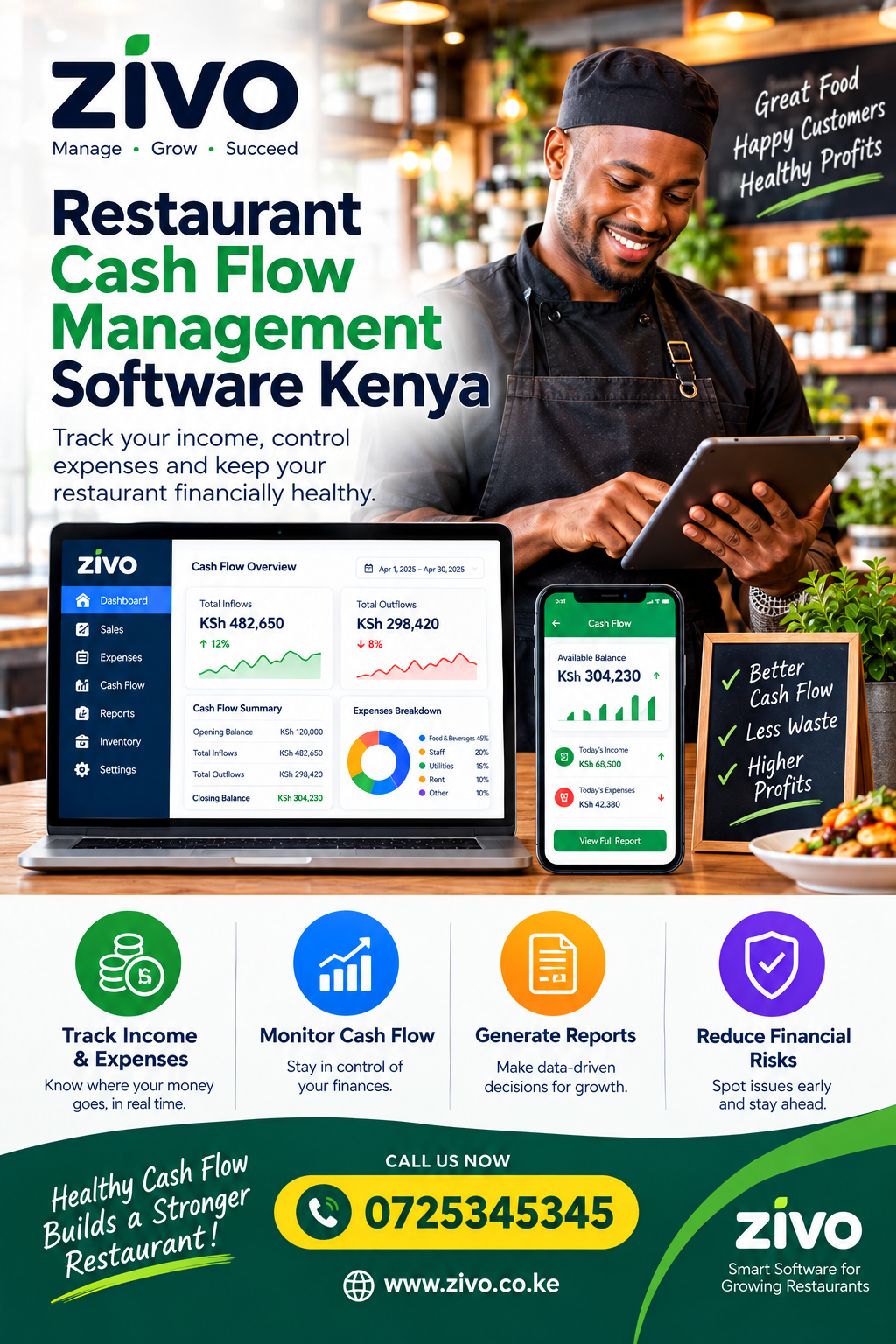
How Restaurant Cash Flow Management Software Kenya Helps Restaurants Control Money and Grow
Running a restaurant in Kenya involves much more than serving good food. Owners and managers must know what customers have paid, what suppliers are owed, how much stock has been purchased, which expenses are rising, and how much money is actually available for the next day of operations. Restaurant Cash Flow Management Software Kenya brings these activities into a more organized financial workflow, helping restaurant owners monitor money coming in and going out instead of relying on scattered notebooks, WhatsApp messages, receipts, and spreadsheets. This guide explains how cash flow management works for restaurants, the problems it solves, the features to prioritize, and how Kenyan restaurants can use connected financial records to make better decisions.
Cash flow is one of the most important financial measures for a restaurant. A business can record strong sales and still struggle to pay suppliers, staff, rent, utilities, delivery partners, or other bills if money is not properly timed and controlled.
That is why restaurant owners should look beyond daily sales totals. Revenue tells you what the business sold. Cash flow tells you what money is actually available, where it came from, where it went, and what commitments are approaching.
For a restaurant, this distinction matters every day.
A busy Friday can produce significant sales, but if most of the money is immediately committed to supplier payments, wages, rent, delivery costs, refunds, and other expenses, the business may have less usable cash than expected.
A good financial workflow gives management a clearer picture.
What Cash Flow Means for a Restaurant
Cash flow refers to the movement of money into and out of a business.
For a restaurant, cash inflows can include:
- Cash sales
- M-Pesa payments
- Card payments
- Bank transfers
- Online orders
- Corporate catering payments
- Deposits for events
- Customer invoice payments
Cash outflows can include:
- Food purchases
- Beverage purchases
- Packaging
- Salaries and wages
- Rent
- Electricity
- Water
- Internet
- Delivery expenses
- Repairs
- Marketing
- Cleaning supplies
- Licences and business expenses
- Supplier payments
A restaurant therefore needs to monitor both sides of the equation.
Restaurant Cash Flow Management Software Kenya can help restaurant teams organize these financial movements so that managers are not making decisions based only on the amount of sales recorded at the till.
The basic calculation is simple:
Cash flow = cash received − cash paid out
However, the real challenge is maintaining accurate records.
A restaurant might receive money through several payment channels while making purchases through multiple suppliers and paying expenses from different accounts. If these transactions are recorded separately, the owner may struggle to determine the actual cash position.
That is where connected financial management becomes valuable.
Why Cash Flow Is a Major Challenge for Kenyan Restaurants
Restaurants operate in an environment where costs can change frequently. Food prices may fluctuate, utilities can vary, customer demand changes throughout the week, and unexpected repairs can consume money that was originally intended for another purpose.
Restaurant Cash Flow Management Software Kenya gives restaurant owners a way to organize these transactions and create a clearer financial picture.
Consider a small restaurant in Nairobi.
The restaurant records KSh 80,000 in sales during a busy week. At first glance, that may look encouraging. But during the same period, it may have spent KSh 30,000 on food supplies, KSh 12,000 on wages, KSh 8,000 on delivery and packaging, KSh 5,000 on utilities and KSh 10,000 on other operating costs.
The remaining amount cannot simply be treated as free profit.
The restaurant may still have supplier invoices due, rent approaching, taxes to account for, equipment requiring maintenance, and other commitments.
Cash flow management helps separate sales performance from actual available cash.
Restaurant Cash Flow Management Software Kenya can also help management identify when cash is being consumed faster than expected.
Common causes of restaurant cash flow problems
Some of the most common causes include:
- Poor expense tracking
- Delayed customer payments
- Excessive food purchases
- High levels of wastage
- Uncontrolled staff expenses
- Weak supplier management
- Mixing personal and business spending
- Failure to reconcile payments
- Poor stock planning
- Lack of regular financial reporting
None of these problems necessarily means that the restaurant has poor sales.
The issue is often that management lacks a timely view of where money is going.
Why Restaurant Owners Should Track Cash Daily
Restaurants have a high transaction frequency. A café, takeaway outlet, fast-food restaurant, hotel restaurant, or food delivery business may process hundreds of individual transactions within a day.
Restaurant Cash Flow Management Software Kenya can support daily financial visibility by bringing sales, invoices, payments, expenses, and other records into a more organized workflow.
Daily monitoring makes it easier to answer questions such as:
- How much did we collect today?
- How much was collected through M-Pesa?
- How much remains unpaid?
- Which expenses were approved?
- Which supplier bills are due?
- Did actual sales match expectations?
- Are expenses increasing?
- How much cash should remain available?
These questions should not require several hours of spreadsheet work.
A restaurant manager should be able to review the business position quickly and investigate unusual transactions when necessary.
Restaurant Cash Flow Management Software Kenya can help establish this habit by making financial information easier to review.
The goal is not to turn every restaurant manager into an accountant.
The goal is to make important financial information easier to understand.
M-Pesa and Restaurant Cash Flow
Mobile money is an important part of Kenya’s payment environment. The Central Bank of Kenya identifies mobile money transfers as part of Kenya’s retail payment systems and describes retail payment systems as important to commercial activity.
For restaurants, this creates a practical financial management requirement.
A customer may pay an order through M-Pesa while the restaurant also accepts cash, cards, bank transfers, and other payment methods.
Restaurant Cash Flow Management Software Kenya can help businesses organize payment records so managers can compare recorded sales against received payments.
The important issue is reconciliation.
Suppose a restaurant records KSh 45,000 worth of customer payments in a day. If the payment records are spread across different systems, the owner may need to manually determine whether every transaction was actually received.
A connected workflow can reduce this administrative burden.
Zivo, for example, positions its business platform around invoicing, M-Pesa collection, payment reconciliation, expenses, and financial reporting. Its website states that the platform can match M-Pesa exceptions and provide visibility into cash in, expenses, unpaid invoices, and other financial information.
Restaurant Cash Flow Management Software Kenya can therefore be particularly useful when a restaurant wants to move away from manually checking payment messages against separate sales records.
What good payment reconciliation should achieve
A useful payment workflow should help a restaurant:
- Record the expected amount
- Record the amount actually received
- Identify payment channel
- Match payments to invoices or orders
- Highlight exceptions
- Track unpaid balances
- Maintain an audit trail
This is especially important for restaurants with multiple branches or several employees handling payments.
Managing Restaurant Expenses More Effectively
Sales are only one side of the financial picture.
A restaurant can increase sales and still experience financial pressure if expenses rise faster than revenue.
Restaurant Cash Flow Management Software Kenya helps put expenses into a structured context by making it easier to record and review money leaving the business.
Restaurant expenses can be grouped into categories such as:
| Expense Category | Examples |
|---|---|
| Food | Meat, vegetables, flour, cooking oil |
| Beverages | Soda, juice, water, coffee |
| Packaging | Containers, bags, cups |
| Staff | Salaries, wages, overtime |
| Premises | Rent, electricity, water |
| Operations | Cleaning and maintenance |
| Delivery | Riders, fuel, logistics |
| Marketing | Advertising and promotions |
| Technology | POS, internet and software |
Categorization matters because restaurant owners need to understand which costs are consuming the largest share of revenue.
Restaurant Cash Flow Management Software Kenya can make expense records more useful by helping management move from a list of transactions to a clearer understanding of spending patterns.
Avoiding undocumented spending
One of the most dangerous financial habits is spending without recording it immediately.
An employee may purchase cleaning materials and keep the receipt in a drawer. A manager may pay a supplier from a personal account. Someone may purchase packaging materials using cash without entering the transaction into the restaurant records.
These small gaps accumulate.
At the end of the month, the owner may see that cash has disappeared without being able to explain why.
A structured expense process creates accountability.
Restaurant Cash Flow Management Software Kenya can help restaurants establish better expense recording practices and connect expenses to suppliers, receipts, departments, or other useful categories.
Supplier Management and Cash Flow
Suppliers have a major influence on restaurant cash flow.
Restaurants regularly purchase food, beverages, packaging, cleaning supplies, cooking gas, equipment, and other items. Some suppliers require immediate payment while others allow short payment periods.
Restaurant Cash Flow Management Software Kenya can help management keep track of supplier-related obligations and understand which payments are approaching.
Supplier records should ideally answer:
- Who supplied the item?
- What was purchased?
- How much did it cost?
- When was it purchased?
- Has it been paid?
- What remains outstanding?
- Which supplier provides the best value?
This information can support better purchasing decisions.
Avoiding unnecessary supplier payments
Suppose two suppliers provide similar products. One offers a lower price but requires immediate payment. The other charges slightly more but provides a reasonable payment period.
The correct decision depends on the restaurant’s circumstances.
A lower purchase price is not always the best cash-flow decision if it creates a short-term liquidity problem.
Restaurant Cash Flow Management Software Kenya can help restaurant owners consider both cost and payment timing when reviewing purchasing decisions.
The objective is not to delay legitimate supplier payments unnecessarily.
It is to know what is owed and plan accordingly.
Restaurant Stock and Cash Flow Are Connected
Food inventory represents money that has already been spent.
If a restaurant purchases excessive stock, cash leaves the business before the ingredients are converted into sales.
Restaurant Cash Flow Management Software Kenya can help restaurant operators connect purchasing and operational records with financial visibility.
Stock problems can affect cash flow in several ways.
Overstocking
Buying too much food can tie up cash in inventory.
Waste
Spoiled or expired ingredients represent money that was spent but never converted into revenue.
Theft and unexplained shortages
Stock discrepancies can create financial losses that are difficult to detect without proper records.
Poor menu planning
A restaurant may purchase ingredients for meals that customers rarely order.
Stock management therefore supports cash flow management.
The question is not simply, “How much stock do we have?”
It is also:
“How much money is currently tied up in stock, and how quickly can that stock become revenue?”
Restaurant Cash Flow Management Software Kenya can be part of a broader connected approach where financial and operational records are reviewed together.
Monitoring Sales Without Confusing Revenue With Profit
Restaurant owners sometimes focus heavily on daily sales.
Sales are important, but they do not automatically equal profit.
Consider a restaurant that sells KSh 200,000 worth of meals during a month.
If the business spends KSh 90,000 on food, KSh 35,000 on staff, KSh 20,000 on rent and utilities, KSh 15,000 on delivery and packaging, and KSh 20,000 on other operating costs, the amount remaining is very different from the original sales figure.
Restaurant Cash Flow Management Software Kenya can help businesses organize the financial information needed to understand this difference.
A useful dashboard should help owners distinguish between:
- Revenue
- Cash received
- Expenses
- Outstanding customer payments
- Supplier obligations
- Operating costs
- Profit indicators
- Available cash
This distinction helps prevent poor decisions.
For example, a restaurant may have strong revenue but weak cash availability because several customer invoices are unpaid.
Another restaurant may have moderate revenue but healthy cash flow because customers pay immediately and expenses are well controlled.
Understanding Customer Payments and Outstanding Balances
Most restaurants collect payment immediately, but some businesses operate differently.
Catering companies, corporate meal providers, event businesses, schools, institutions, and restaurants serving regular corporate customers may invoice customers and receive payment later.
Restaurant Cash Flow Management Software Kenya can help businesses keep customer balances visible so that outstanding invoices are not forgotten.
A restaurant should know:
- Which customers owe money
- How much each customer owes
- When the invoice was issued
- When payment is expected
- Whether a payment reminder has been sent
- Which invoices are overdue
Delayed collection can create unnecessary cash-flow pressure.
The restaurant may have already purchased ingredients, paid workers, delivered the service, and issued the invoice, but still be waiting for the customer’s payment.
That is why receivables management is part of cash-flow management.
Restaurant Cash Flow Management Software Kenya can support more organized payment follow-up by giving the business a clearer view of outstanding amounts.
Using Invoices to Improve Financial Control
Invoices create a financial record of what customers owe.
A proper invoicing workflow can include:
- Customer details
- Products or services
- Quantity
- Prices
- Taxes where applicable
- Total amount
- Payment status
- Payment date
- Outstanding balance
For Kenyan businesses, electronic invoicing also has compliance implications. KRA states that persons engaged in business are required to onboard eTIMS and issue electronic tax invoices, subject to the applicable rules and exceptions.
Restaurant Cash Flow Management Software Kenya should therefore be evaluated not only for convenience but also for how it fits into the restaurant’s broader invoicing and record-keeping processes.
KRA provides several eTIMS options, including online, client, mobile, USSD and system-to-system approaches. KRA also provides system-to-system integration options for businesses whose invoicing systems need to connect with eTIMS.
Restaurants should confirm the exact compliance and integration requirements applicable to their business before selecting or configuring software.
Cash Flow Forecasting for Restaurants
Cash-flow forecasting means estimating how much money the restaurant expects to receive and spend over a future period.
A simple weekly forecast can include:
| Item | Expected Amount |
|---|---|
| Customer collections | KSh 120,000 |
| Supplier payments | KSh 45,000 |
| Staff costs | KSh 25,000 |
| Rent and utilities | KSh 15,000 |
| Delivery and packaging | KSh 10,000 |
| Other expenses | KSh 8,000 |
| Expected remaining cash | KSh 17,000 |
The figures above are only an example. Every restaurant should use its own actual records.
Restaurant Cash Flow Management Software Kenya can make forecasting easier when historical transactions are already organized.
Forecasting helps management prepare for future obligations.
If a restaurant expects a major supplier payment next week, it may decide to postpone a non-essential purchase.
If customer collections are expected to increase during a holiday period, management can prepare additional stock and staff capacity.
Cash forecasting turns financial management from a reactive activity into a planning process.
Managing Cash Flow During Slow Periods
Restaurants rarely experience perfectly consistent sales every day.
Demand can change because of:
- Weekends
- Public holidays
- Weather
- School calendars
- Local events
- Tourism
- Seasonal demand
- Economic conditions
- Promotions
- Competition
Restaurant Cash Flow Management Software Kenya can help management compare financial activity across different periods and identify patterns worth investigating.
A restaurant might discover that Mondays consistently produce lower sales but similar staffing costs.
Another may find that weekends generate strong revenue but also unusually high food and delivery expenses.
These insights can lead to practical adjustments.
For example, management might:
- Change staffing levels
- Adjust purchasing quantities
- Promote specific menu items
- Negotiate supplier terms
- Reduce unnecessary operating expenses
- Schedule maintenance during quieter periods
The objective is not to cut costs blindly.
It is to understand which costs generate value and which ones can be controlled.
Cash Flow and Restaurant Profitability
Cash flow and profitability are related but different.
Profit generally reflects revenue minus expenses under the applicable accounting approach.
Cash flow focuses on when money actually moves.
A restaurant can be profitable on paper and still experience cash pressure.
For example, imagine a catering company completes a KSh 300,000 corporate order but allows the customer to pay after 30 days. The restaurant may record the sale, but the money is not yet available to pay today’s expenses.
Restaurant Cash Flow Management Software Kenya can help management monitor the distinction between amounts earned, amounts invoiced, amounts received, and amounts still outstanding.
This is particularly useful for restaurants that combine walk-in sales with catering, delivery, corporate accounts, or event services.
Using Reports to Make Better Restaurant Decisions
Reports should answer management questions rather than simply display numbers.
Useful restaurant financial reports can include:
- Daily sales
- Sales by payment method
- Expense summary
- Supplier balances
- Customer balances
- Cash-flow summary
- Profit reports
- Tax summaries
- Invoice aging
- Branch performance
- Product performance
Restaurant Cash Flow Management Software Kenya can be valuable when these reports are available in an accessible format.
A restaurant owner should be able to look at a report and identify what requires attention.
For example:
Problem: Supplier expenses increased by 20%.
Question: Did food prices increase, did purchasing volume increase, or is there more wastage?
Action: Review supplier invoices, stock movement and sales.
Good reporting supports this type of investigation.
Multi-Branch Restaurant Cash Flow Management
Managing one restaurant is different from managing five branches.
With multiple outlets, management needs to know:
- Which branch generated the most sales?
- Which branch spent the most?
- Which branch has the highest supplier obligations?
- Are payment records being reconciled?
- Which branch has unusual expense patterns?
- Are stock transfers properly recorded?
Restaurant Cash Flow Management Software Kenya can support a centralized view where appropriate.
The value of centralized reporting is visibility.
Without it, management may have separate spreadsheets for every location.
That increases the possibility of inconsistent formats, missing records, duplicated entries, and delayed reporting.
A connected system can make branch comparison easier.
Restaurant Staff and Financial Accountability
Employees interact with money in many ways.
Cashiers collect payments. Managers approve expenses. Purchasing staff order stock. Delivery staff handle customer orders. Supervisors may authorize refunds or discounts.
Restaurant Cash Flow Management Software Kenya can support financial accountability when different activities are assigned to appropriate users or workflows.
A good system should help management determine:
- Who created a transaction?
- Who approved an expense?
- Who recorded a payment?
- When was the transaction entered?
- Was the transaction edited?
- What was changed?
The exact capabilities depend on the software selected.
The principle is straightforward: financial records become more useful when responsibilities are clear.
Why Restaurants Should Reduce Spreadsheet Dependence
Spreadsheets can be useful for small businesses.
They are flexible, familiar and inexpensive.
The problem starts when a restaurant uses multiple spreadsheets to manage sales, expenses, supplier invoices, customer balances, stock, staff costs and cash-flow forecasts without a reliable connection between them.
Restaurant Cash Flow Management Software Kenya can help businesses consider a more integrated approach.
Common spreadsheet problems include:
- Duplicate data entry
- Incorrect formulas
- Missing transactions
- Outdated versions
- Poor access control
- Manual reconciliation
- Difficult collaboration
- Delayed reporting
The issue is not that spreadsheets are inherently bad.
The issue is that restaurant operations can eventually become too transaction-heavy for disconnected spreadsheets to provide reliable real-time visibility.
Choosing the Right Cash Flow Solution for a Restaurant
Not every restaurant needs the same software.
A small takeaway may have different needs from a large hotel restaurant or multi-branch food business.
Restaurant Cash Flow Management Software Kenya should be assessed according to the restaurant’s actual workflow.
Before choosing a solution, ask:
Does it handle the restaurant’s payment methods?
The system should fit the payment channels customers actually use.
Can it track expenses?
Expense recording should be straightforward enough for staff to use consistently.
Can it manage invoices?
If the restaurant serves corporate customers, invoicing and receivables become especially important.
Does it provide reports?
Reports should be useful for decision-making rather than merely decorative.
Can it support growth?
A restaurant may start with one outlet and later add branches, delivery services or additional revenue streams.
Can it integrate with relevant systems?
Restaurants should investigate available integrations for payments, accounting, invoicing, POS, eTIMS and other systems relevant to their workflow.
Restaurant Cash Flow Management Software Kenya becomes more valuable when it reduces duplication between these activities.
Features to Look for in Restaurant Cash Flow Software
A strong solution should ideally provide several connected capabilities.
Restaurant Cash Flow Management Software Kenya can be evaluated using the following checklist:
- Sales tracking
- Expense management
- Invoice management
- Payment tracking
- M-Pesa reconciliation
- Supplier records
- Customer balances
- Cash-flow reporting
- Profit reporting
- Receipt management
- Tax-related records
- User permissions
- Multi-branch support
- Exportable reports
- Mobile or web access
- Audit trails
- Integration options
Not every feature needs to be activated on day one.
A restaurant can start with its biggest financial problem and expand its workflow as the business grows.
How Zivo Fits Into Restaurant Financial Management
Zivo presents itself as a connected business workspace for Kenyan SMEs, with workflows covering invoices, payments, expenses, M-Pesa reconciliation, stock, delivery and financial reports.
Restaurant Cash Flow Management Software Kenya can be especially useful when a restaurant wants to connect financial records with the operational activity that creates those financial transactions.
For example, an order can lead to a sale.
The sale can lead to an invoice or receipt.
The payment can be recorded.
The payment can then be reconciled.
The expense associated with purchasing ingredients can be recorded separately.
Reports can bring these records together to provide a clearer picture of the business.
This connected approach is more useful than looking at each transaction in isolation.
A Practical Daily Cash Flow Routine for Restaurants
Software works best when combined with good management habits.
A restaurant can create a daily financial routine.
Morning
Review:
- Opening cash
- Expected payments
- Supplier obligations
- Pending orders
- Stock requirements
During operations
Record:
- Sales
- Payments
- Expenses
- Purchases
- Discounts
- Refunds
- Supplier deliveries
Evening
Review:
- Total sales
- Payment channels
- Cash received
- M-Pesa collections
- Expenses
- Outstanding balances
- Unusual transactions
Restaurant Cash Flow Management Software Kenya can help make this routine more structured when the relevant information is recorded consistently.
The key is consistency.
A perfect report generated once a month is less useful than a simple, accurate financial review performed every day.
Weekly Cash Flow Review
The weekly review should go deeper.
Management can compare:
- This week’s sales against last week’s
- Food costs against sales
- Expenses against budget
- Customer collections
- Supplier payments
- Available cash
- Outstanding invoices
Restaurant Cash Flow Management Software Kenya can help make these comparisons easier when transaction records are centralized.
Managers should pay attention to trends rather than individual transactions.
One large expense may be reasonable.
A pattern of rising expenses requires investigation.
Monthly Restaurant Financial Review
At the end of each month, restaurant owners should review the bigger picture.
Questions can include:
- Did revenue increase?
- Did expenses increase faster than revenue?
- Which products sold best?
- Which costs increased?
- How much is owed by customers?
- How much is owed to suppliers?
- How much cash is available?
- What expenses are expected next month?
- Did any branch underperform?
- Are there recurring costs that should be reviewed?
Restaurant Cash Flow Management Software Kenya can support this monthly process when records have been maintained throughout the month.
The quality of the monthly report depends heavily on the quality of daily records.
Restaurant Cash Flow Mistakes to Avoid
Many cash-flow problems are caused by basic process failures rather than complicated financial issues.
Restaurant Cash Flow Management Software Kenya can help reduce some administrative problems, but management still needs good financial discipline.
Avoid these mistakes:
1. Mixing personal and business money
This makes it difficult to understand actual business performance.
2. Recording sales but ignoring expenses
Revenue without expense information gives an incomplete picture.
3. Failing to reconcile payments
A payment recorded as received should be matched against the actual payment record.
4. Buying too much stock
Excess inventory ties up cash and increases the risk of waste.
5. Ignoring outstanding invoices
Delayed collections can create unnecessary financial pressure.
6. Paying suppliers without records
Every payment should be traceable to an obligation.
7. Reviewing finances only at month-end
Problems can become much harder to correct if they are discovered weeks later.
8. Treating revenue as profit
Sales figures do not show the full financial position.
Improving Restaurant Cash Flow Step by Step
A restaurant does not need to transform every process overnight.
A practical implementation can follow these stages.
Restaurant Cash Flow Management Software Kenya can support a gradual transition from disconnected records to more organized financial workflows.
Step 1: Identify every money-in channel
List cash, M-Pesa, card, bank, online ordering and invoiced sales.
Step 2: Identify every major expense category
Include food, wages, rent, utilities, packaging, delivery and other operating costs.
Step 3: Standardize transaction recording
Decide where every transaction should be entered.
Step 4: Reconcile payments regularly
Do not allow unexplained differences to accumulate.
Step 5: Review supplier balances
Know what is due and when.
Step 6: Monitor customer balances
Follow up overdue invoices.
Step 7: Create weekly reports
Review trends before they become major problems.
Step 8: Forecast upcoming obligations
Prepare for large expenses rather than reacting when they arrive.
Using Technology Without Making Operations Complicated
Restaurant technology should simplify work, not create additional bureaucracy.
Restaurant Cash Flow Management Software Kenya should therefore be judged by how easily employees can use it during real restaurant operations.
A system may have dozens of features, but if staff find the interface confusing, important transactions may never be recorded.
The best workflow is usually one that fits naturally into existing operations.
For example:
Customer orders → sale recorded → payment captured → receipt issued → payment reconciled → financial report updated.
Similarly:
Supplier order → stock received → supplier expense recorded → payment tracked → supplier balance updated.
Connecting these steps reduces duplicate work.
Security and Financial Records
Financial records should be protected.
Restaurants handle information about customers, suppliers, employees, payments and business performance.
Restaurant Cash Flow Management Software Kenya should therefore be assessed for security features, user permissions, backup practices and access controls.
Managers should also ensure employees only have access to information necessary for their roles.
For example, a cashier may need to process sales but should not necessarily have unrestricted access to financial reports or administrative settings.
Security is not only about technology.
It is also about internal controls.
Restaurant Cash Flow and Compliance
Financial management should support proper business record keeping.
For Kenyan businesses, eTIMS is an important consideration. KRA says businesses are required to onboard eTIMS and issue electronic tax invoices under the applicable requirements.
Restaurant Cash Flow Management Software Kenya should therefore be considered as part of a wider financial and compliance workflow rather than as an isolated accounting tool.
Restaurants should verify their current tax obligations and applicable eTIMS requirements directly through KRA.
KRA also provides system-to-system integration options for businesses that want invoicing systems connected to eTIMS through supported integration methods.
This can be important for restaurants with larger transaction volumes or more complex invoicing requirements.
How Cash Flow Data Supports Better Business Decisions
Financial data becomes valuable when it changes decisions.
Suppose a restaurant discovers that one menu category generates strong sales but has poor margins.
Management can investigate ingredient costs.
Another restaurant might discover that delivery orders produce substantial revenue but also generate high packaging and delivery expenses.
Management can then evaluate pricing, delivery charges or minimum order values.
Restaurant Cash Flow Management Software Kenya can provide the financial visibility needed to ask these questions more confidently.
Good data does not make decisions automatically.
It gives the owner better information on which to base decisions.
Restaurant Cash Flow During Expansion
Expansion requires careful cash planning.
Opening another branch involves costs such as:
- Premises
- Renovation
- Equipment
- Licences
- Initial stock
- Staffing
- Marketing
- Technology
- Working capital
A restaurant should not expand simply because the existing branch is busy.
Management should understand whether the business has enough cash to support the expansion without creating unnecessary pressure.
Restaurant Cash Flow Management Software Kenya can help owners monitor financial performance before committing to major investments.
A cash-flow forecast should include both existing operations and expected expansion costs.
Why Real-Time Financial Visibility Matters
The faster an owner identifies a financial problem, the easier it can be to correct.
If food costs suddenly increase, management can investigate quickly.
If customer payments are not being reconciled, the issue can be resolved before balances become confusing.
If expenses rise unexpectedly, management can identify the category responsible.
Restaurant Cash Flow Management Software Kenya can help make this information easier to access when the business has a connected financial workflow.
The purpose of real-time visibility is not to watch every transaction obsessively.
It is to avoid running the restaurant financially blind.
Questions to Ask Before Buying Restaurant Software
Before choosing a platform, restaurant owners should ask vendors practical questions.
Restaurant Cash Flow Management Software Kenya should be assessed against the restaurant’s actual requirements.
Ask:
- Can it track different payment methods?
- Can it handle M-Pesa-related records?
- Can it record expenses?
- Can it track suppliers?
- Can it manage customer balances?
- Can it generate cash-flow reports?
- Can it support multiple users?
- Can it support multiple branches?
- Can it integrate with relevant systems?
- Does it support the restaurant’s invoicing requirements?
- How is data backed up?
- What happens if an employee leaves?
- Can reports be exported?
- How easy is it for staff to learn?
These questions help prevent restaurants from purchasing software based solely on a long feature list.
The Role of Management Discipline
Software is not a substitute for good management.
Restaurant Cash Flow Management Software Kenya can provide useful tools, but the restaurant still needs clear policies for spending, approvals, stock purchases, refunds, discounts and payment reconciliation.
Management should define:
- Who approves expenses
- Who can issue refunds
- Who can edit transactions
- Who reviews supplier balances
- Who performs reconciliation
- Who reviews reports
- Who manages user permissions
Clear responsibilities reduce confusion.
Building a Cash-Conscious Restaurant Culture
Every employee does not need to understand financial statements in detail.
However, employees should understand that waste, unrecorded discounts, missing stock, unnecessary purchases and payment errors affect the restaurant’s finances.
Restaurant Cash Flow Management Software Kenya can make financial information more visible to the people responsible for different processes.
A cash-conscious culture means employees ask practical questions.
Do we need this purchase?
Was this payment recorded?
Was the correct quantity delivered?
Was the customer’s payment matched?
Was the expense supported by a receipt?
These habits can protect the business over time.
The Future of Restaurant Financial Management in Kenya
Kenya’s payment ecosystem continues to develop, with digital payments, mobile money and financial technology playing an important role in commerce. The Central Bank of Kenya’s current payment-system work emphasizes safe, efficient, accessible and interoperable payment infrastructure.
Restaurant Cash Flow Management Software Kenya fits into this broader shift toward connected business records.
Restaurants increasingly need systems that do more than record sales.
They need connected workflows covering:
- Orders
- Payments
- Invoices
- Expenses
- Suppliers
- Stock
- Delivery
- Customer balances
- Financial reports
The more connected these processes become, the easier it is for management to understand the financial consequences of daily operational decisions.
FAQ: Restaurant Cash Flow Management Software
1. What does restaurant cash flow software do?
Restaurant Cash Flow Management Software Kenya helps restaurant businesses organize and monitor money coming into and leaving the business. Depending on the platform, this can include sales, invoices, payments, expenses, supplier balances, customer balances, M-Pesa reconciliation and financial reporting.
2. Why is cash flow important for a restaurant?
Restaurant Cash Flow Management Software Kenya helps address a major management need: knowing whether the business has enough available money to meet current and upcoming obligations. A restaurant can have strong sales while still experiencing cash shortages if payments are delayed or expenses are poorly controlled.
3. Can restaurant software track M-Pesa payments?
Restaurant Cash Flow Management Software Kenya can support M-Pesa-related payment tracking where the selected platform provides the relevant functionality or integration. Restaurants should confirm exactly how payment collection, reconciliation and exception handling work before implementation.
4. Can this type of software help with expenses?
Restaurant Cash Flow Management Software Kenya can provide expense recording and reporting features, depending on the platform. This can help restaurants categorize purchases, track supplier expenses and understand where operating money is being spent.
5. Can restaurant software help with eTIMS?
Restaurant Cash Flow Management Software Kenya may support invoicing workflows that connect with eTIMS where the software offers the appropriate integration. KRA provides system-to-system eTIMS integration options for businesses with invoicing systems, including OSCU and VSCU approaches. Restaurants should verify the current compliance and integration requirements directly with KRA.
6. Is cash flow software useful for small restaurants?
Restaurant Cash Flow Management Software Kenya can be useful even for a small restaurant because good financial records become increasingly difficult to maintain as transaction volumes grow. A small restaurant can start with essential invoicing, payment and expense workflows before adding more advanced functionality.
7. What reports should a restaurant monitor?
Restaurant Cash Flow Management Software Kenya can support reports covering sales, expenses, customer balances, supplier obligations, payments, cash flow and profitability. The most useful reports are those that help management identify problems and make decisions.
8. Should restaurants still use spreadsheets?
Restaurant Cash Flow Management Software Kenya does not necessarily make spreadsheets useless. Spreadsheets can still be helpful for analysis and planning. However, restaurants with high transaction volumes may benefit from connected systems that reduce duplicate entry, manual reconciliation and version-control problems.
9. What should a restaurant consider when choosing software?
Restaurant Cash Flow Management Software Kenya should be evaluated based on payment processing, expense management, invoicing, reporting, supplier management, user permissions, integrations, ease of use, scalability and the restaurant’s actual workflow.
10. How often should a restaurant review cash flow?
Restaurant Cash Flow Management Software Kenya should ideally be part of a routine that includes daily transaction checks, weekly cash-flow reviews and a deeper monthly financial review. The exact schedule can vary according to the restaurant’s size and transaction volume.
Final Thoughts
Restaurant cash flow is not simply an accounting issue. It affects purchasing, staffing, supplier relationships, customer service, expansion, pricing and the ability of the restaurant to keep operating smoothly.
Restaurant Cash Flow Management Software Kenya can help restaurant owners create a clearer connection between sales, payments, expenses, suppliers, customers and financial reports.
The most important objective is visibility.
A restaurant owner should know how much money has come in, how much has gone out, what remains available, who still owes the business money, which suppliers need to be paid, and what major expenses are approaching.
For Kenyan restaurants, payment reconciliation is particularly important when the business accepts M-Pesa alongside other payment methods. Electronic invoicing and eTIMS requirements also make organized transaction records increasingly important. KRA provides multiple eTIMS solutions and integration options, so businesses should confirm the current requirements that apply to their operations.
Restaurant Cash Flow Management Software Kenya can support this broader financial discipline when it is connected to the restaurant’s actual operating processes.
The best system is not necessarily the one with the longest list of features. It is the one that makes accurate financial management easier for the people who actually run the restaurant.
For a small café, that may mean simple invoicing, expense tracking and payment reconciliation.
For a growing restaurant, it may mean supplier management, customer balances, stock control, delivery workflows, branch reporting and deeper financial analysis.
For a multi-branch operation, centralized reporting and user controls may become essential.
The important step is to stop treating sales, expenses, payments and supplier records as separate activities.
They are all part of the same financial picture.
Restaurant Cash Flow Management Software Kenya can help restaurants move toward a more connected approach in which financial information is recorded as part of everyday operations rather than reconstructed at the end of the week or month.
When restaurant owners can see their cash position clearly, they can make decisions earlier.
They can identify unnecessary expenses, improve collections, manage supplier obligations, reduce waste, plan purchases, evaluate branch performance and prepare for future costs.
Restaurant Cash Flow Management Software Kenya ultimately supports a simple but important goal: helping restaurant owners understand their money well enough to manage the business with greater confidence.
For restaurants operating in Kenya’s competitive food and hospitality sector, that visibility can make financial management more practical, timely and sustainable.