
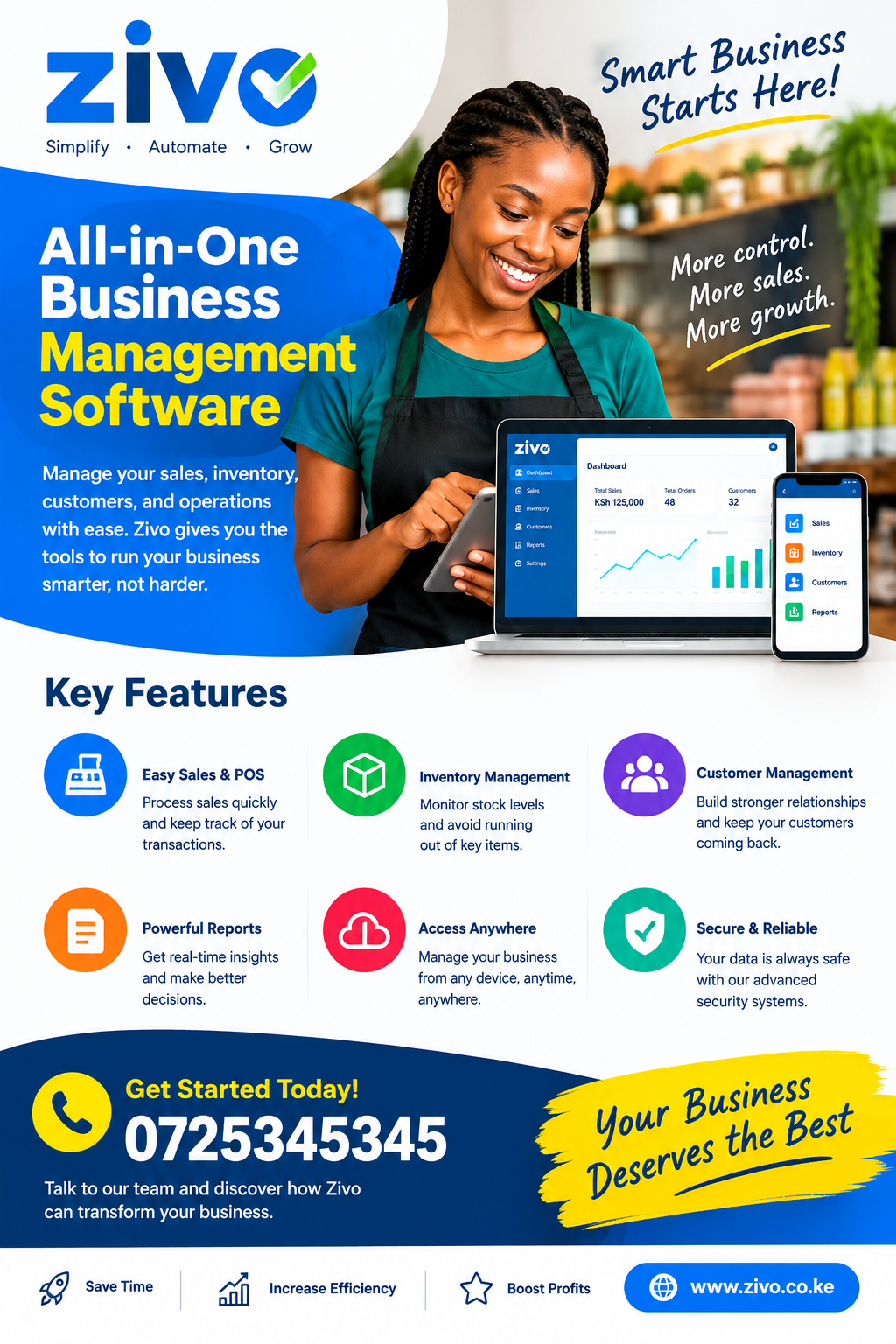
Business Workflow Automation Software Kenya: A Practical Guide to Streamlining Business Operations
Running a business involves more than selling products or providing services. Owners and managers must coordinate employees, approve requests, track orders, manage invoices, follow up on customers, and ensure that important tasks are completed on time. When these activities depend entirely on manual work, delays and mistakes can quickly affect profitability. Business Workflow Automation Software Kenya helps businesses organise recurring processes, reduce unnecessary paperwork, and create a more reliable way to manage everyday operations.
For Kenyan small and medium-sized enterprises, workflow automation can make a meaningful difference without requiring a large technology budget. A retail shop can organise purchase approvals, a service company can assign customer requests, and a distribution business can track orders from receipt to delivery. The objective is not to remove people from business operations. It is to give employees clearer processes and reduce the time they spend on repetitive administrative work.
This guide explains how workflow automation works, which processes Kenyan businesses can automate, the features worth considering, and how to select and implement a suitable system. It also explores practical examples, implementation challenges, security considerations, and frequently asked questions to help business owners make informed decisions.
1. What Is Business Workflow Automation?
A business workflow is a sequence of tasks that moves work from its starting point to completion. For example, when a customer places an order, someone records it, checks stock, confirms payment, prepares the goods, arranges delivery, and updates the customer. Every step depends on information being passed to the right person at the right time.
Manual workflows often rely on notebooks, phone calls, spreadsheets, emails, and messaging applications. These methods can work for a small operation, but they become harder to coordinate as transaction volumes and employee numbers increase.
Business Workflow Automation Software Kenya provides tools for organising these processes through defined steps, task assignments, notifications, approvals, and status updates. Depending on the platform, some tasks can happen automatically when a specified event occurs.
For example, a business could configure its system to notify a manager whenever a purchase request exceeds an internal spending limit. Once the manager approves the request, the next task can be assigned to the procurement employee.
How an automated workflow operates
A typical workflow contains five elements:
- Trigger: An event starts the process, such as a new order or submitted request.
- Information: The system captures the relevant details.
- Rules: The process determines what should happen next.
- Action: A task, notification, approval, or status change occurs.
- Completion: The process records its outcome and maintains a history where supported.
Business Workflow Automation Software Kenya can help businesses apply these steps consistently instead of relying on employees to remember every action. However, the exact capabilities depend on the chosen product and its configuration.
Automation versus digitisation
Digitisation converts paper records or manual information into digital form. Automation goes further by making parts of the process happen according to defined rules.
A spreadsheet containing customer orders is digital, but employees may still need to contact the warehouse manually. An automated workflow could assign the order to the warehouse when the payment status meets the business’s requirements.
Business Workflow Automation Software Kenya is therefore most valuable when it connects information with action. Businesses should look beyond whether a platform stores data and assess whether it reduces the work required to move each process forward.
2. Why Kenyan Businesses Need Better Workflows
Businesses in Kenya operate across different sectors, from retail and hospitality to professional services, logistics, manufacturing, construction, and wholesale distribution. Their daily activities vary, but many face similar operational difficulties.
One common challenge is fragmented information. Sales records may be stored in one spreadsheet, invoices in another application, and customer requests in WhatsApp conversations. Employees must switch between these sources to establish what has happened and what needs attention.
A second challenge is delayed decision-making. When a manager is away from the office, a purchase request or customer refund may remain pending because nobody knows who has authority to approve it.
A third challenge is limited visibility. Business owners may struggle to determine which orders are delayed, which invoices remain unpaid, or which tasks are consuming too much staff time.
Business Workflow Automation Software Kenya can help address these problems by establishing defined processes and making task progress easier to monitor. It can also reduce dependence on individual employees remembering every detail.
Common operational problems
| Business problem | Possible operational effect | Workflow improvement |
|---|---|---|
| Repeated manual data entry | Wasted time and inconsistent records | Capture information once and reuse it where supported |
| Unclear approval responsibilities | Delayed purchases and decisions | Assign approvals to designated roles |
| Forgotten customer follow-ups | Missed sales opportunities | Schedule reminders and follow-up tasks |
| Disconnected order records | Confusion over fulfilment | Track orders through defined stages |
| Missing invoice updates | Slow payment follow-up | Maintain invoice statuses and reminders |
| Incomplete task handovers | Work stalls when staff are absent | Record assignments and outstanding actions |
The benefits are not automatic. A business must first understand its processes, define responsibilities, and select tools that fit its actual needs.
Business Workflow Automation Software Kenya can be particularly useful for businesses that have outgrown informal coordination but are not ready to build a complex enterprise system.
For example, a growing Nairobi distributor might initially manage ten orders per day through calls and spreadsheets. As order volumes increase, staff may struggle to track stock, confirm payments, and organise deliveries. A defined workflow makes each order’s status visible and reduces the chance of overlooking a step.
3. Business Processes That Can Be Automated
Not every activity needs automation. The best starting points are usually repetitive processes with clear rules, frequent handovers, predictable inputs, or a high risk of human error.
Sales and customer enquiries
When a potential customer contacts a business, employees need to record the enquiry, determine the customer’s requirements, assign responsibility, and follow up. If these steps are informal, promising leads can be forgotten.
Business Workflow Automation Software Kenya can support structured enquiry handling when the selected platform provides suitable customer-management features. A new enquiry could create a task, assign it to a sales representative, and generate a reminder if the customer has not received a response within the business’s chosen timeframe.
Order processing
Order processing often involves several departments. Sales records the request, finance checks payment, stores confirms stock, and dispatch arranges delivery.
Business Workflow Automation Software Kenya can help coordinate these stages by recording the current status and notifying the next responsible person. Employees can then see whether an order is awaiting payment verification, stock preparation, dispatch, or confirmation of delivery.
Purchasing and supplier management
Procurement workflows begin when a department needs goods or services. The request may require a budget check, management approval, supplier selection, and purchase order creation.
Business Workflow Automation Software Kenya can make the process more consistent by recording who submitted the request, who approved it, and what action remains outstanding. Businesses should ensure that financial limits and approval rules reflect their actual policies.
Employee task management
Managers frequently assign work through meetings or informal messages. Without a central record, employees may be unsure about deadlines or priorities.
An automated task workflow can assign owners, set due dates, notify employees, and record completion. This is especially useful for service teams, marketing departments, field operations, and businesses handling many simultaneous projects.
Customer complaints and support
A complaint should have an owner, a priority, a response deadline, and a recorded outcome. A structured process helps ensure that urgent problems are not buried beneath routine requests.
The important principle is consistency: every request should enter a recognised process, reach the appropriate employee, and remain visible until it is resolved.
4. Essential Features to Look For
The right automation platform should solve operational problems rather than simply offer a long list of technical features.
Workflow design and task assignment
A visual workflow builder can make it easier to define stages, responsibilities, and actions. Some platforms offer templates, while others require administrators to configure each process.
Business Workflow Automation Software Kenya should be assessed for how easily users can create workflows, modify task assignments, and manage changes when responsibilities shift.
Approval management
Approval functionality is important for purchase requests, discounts, refunds, expenses, contracts, and other decisions that require authorisation.
Business Workflow Automation Software Kenya may support approval rules based on roles, amounts, departments, or other conditions. Confirm the available options before selecting a product.
Notifications and reminders
Notifications help employees act before a deadline passes. Depending on the system, these may appear in an application or be delivered through supported communication channels.
Business Workflow Automation Software Kenya should make it possible to configure useful reminders without overwhelming employees with unnecessary messages.
Reporting and dashboards
Reports help managers identify bottlenecks, overdue tasks, recurring problems, and changes in workload. A dashboard may show how many requests are pending, completed, rejected, or awaiting approval.
Integration capabilities
Integration allows compatible applications to exchange information. Depending on the available connections, a business may link its workflow tools with accounting systems, customer databases, payment records, email, or inventory applications.
Businesses should verify that the integrations they need actually exist. A platform’s general claim that it supports integrations does not guarantee compatibility with every application.
5. Automating Financial and Administrative Work
Financial administration is one of the areas where consistent workflows can improve control. Invoices, expense claims, purchase requests, payment confirmations, and customer statements all involve information that must be captured and checked.
Invoice preparation and approval
An invoice process may begin when a service is completed or goods are delivered. The business then checks the relevant order details, prepares the invoice, sends it to the customer, and tracks the payment.
Business Workflow Automation Software Kenya can help organise invoice preparation and approval where the system supports these functions. Staff can work from consistent records instead of recreating invoice information from separate documents.
Expense claims
Employees may submit expenses for travel, transport, supplies, or other approved business activities. A clear workflow captures the amount, supporting documents, business purpose, and relevant authorisation.
Business Workflow Automation Software Kenya can support this process if it offers suitable expense-management features. Businesses should define which expenses need approval and what evidence must accompany each claim.
Payment follow-ups
Unpaid invoices can affect cash flow, particularly for small businesses that need working capital to purchase stock or pay employees. A structured process can flag overdue accounts and assign follow-up tasks.
Business Workflow Automation Software Kenya can be considered when evaluating how workflow systems handle recurring administrative tasks, although businesses should verify that any chosen product actually provides the required financial functions.
M-Pesa and digital payment processes
M-Pesa is widely used for business transactions in Kenya. A business may need to reconcile incoming payments against invoices, orders, or customer accounts.
Automation can reduce manual reconciliation when a system has a supported integration or imports the necessary transaction data. However, businesses should not assume that every workflow platform connects directly to M-Pesa.
Before implementation, confirm how payment information enters the system, how unmatched transactions are flagged, and who reviews exceptions. Financial records should be checked carefully before payment statuses are changed automatically.
6. Improving Inventory, Procurement, and Delivery
Businesses that buy, store, sell, or distribute goods often depend on accurate coordination between sales, procurement, stores, and delivery teams.
Inventory alerts
Stock shortages can interrupt sales, while excessive stock ties up cash. A suitable inventory system may generate alerts when stock reaches a defined threshold.
Business Workflow Automation Software Kenya can form part of an automation strategy where it supports the relevant inventory or operational workflow. The business should confirm whether stock alerts, stock adjustments, and purchasing workflows are available.
Supplier orders
Supplier purchasing can follow a repeatable sequence: identify the requirement, check available stock, confirm the budget, obtain approval, issue the purchase order, and record delivery.
Business Workflow Automation Software Kenya can help structure the administrative stages when its capabilities match the intended process. Clear rules reduce confusion about who may authorise purchases and which records must be retained.
Delivery coordination
Delivery workflows may include address confirmation, route assignment, dispatch documentation, customer notification, and proof of delivery. A central status record helps staff respond to customer enquiries without contacting several colleagues.
Handling exceptions
Automation must account for unusual situations. A supplier may deliver only part of an order, a payment may fail to match an invoice, or a customer may request a change after dispatch.
Good workflows provide a route for exceptions rather than assuming every transaction proceeds perfectly. Staff should be able to pause, correct, escalate, or manually review an item where necessary.
7. Benefits for Small and Medium-Sized Enterprises
SMEs often operate with limited staff and tight budgets. An owner may manage sales, purchasing, customer service, and finance while supervising employees. Administrative inefficiencies can therefore take attention away from revenue-generating activities.
Reduced repetitive work
Employees can spend less time copying information, sending routine reminders, and checking the status of every request manually.
Business Workflow Automation Software Kenya can help standardise these recurring activities where appropriate functionality is available. The time saved can be redirected towards customer service, sales, planning, and quality improvement.
Better accountability
Defined workflows show who is responsible for each stage. If a task remains incomplete, a manager can investigate the cause instead of relying on assumptions.
More consistent service
Customers expect accurate information and timely responses. A structured process helps staff handle requests consistently, even when several employees share responsibility.
Easier growth
As a business grows, informal processes can become difficult to maintain. Written workflows provide a foundation for onboarding new employees and managing higher transaction volumes.
Better operational visibility
Managers can use status information and reports to identify recurring delays. For example, if purchase approvals regularly take several days, the business can examine approval limits, workload distribution, or unnecessary steps.
Business Workflow Automation Software Kenya can contribute to these improvements when the chosen system addresses genuine bottlenecks and employees use it consistently.
Automation does not guarantee higher profits. Results depend on implementation quality, process design, staff adoption, operating costs, and the suitability of the selected software.
8. Choosing a Suitable Platform in Kenya
The best platform is the one that fits the business’s processes, budget, users, and technical requirements. Selecting software solely because it has many features can lead to unnecessary costs and low adoption.
Define the problem first
Write down the process that currently causes the greatest difficulty. It may be delayed approvals, lost enquiries, incomplete orders, poor invoice follow-up, or repeated data entry.
Measure the problem where possible. For example, estimate how many hours employees spend preparing reports each week or how frequently requests miss their deadlines.
Check ease of use
Employees should be able to understand the system without excessive training. Ask for a demonstration of the actual workflow your business wants to automate.
Business Workflow Automation Software Kenya should be evaluated against everyday user needs, including the ability to create tasks, check progress, submit approvals, and locate records.
Evaluate flexibility
Business procedures change. A platform should allow authorised users to update assignments, workflow stages, or approval rules without rebuilding the entire system, where such configuration is supported.
Review local operating needs
Consider the availability of reliable internet, mobile access, local support, payment requirements, and the applications already used by your business. For a Kenyan SME with employees working outside the office, mobile usability may be especially important.
Confirm data access and ownership
Before signing a contract, ask how records can be exported, what happens if the subscription ends, and whether the provider supports migration to another platform.
Business Workflow Automation Software Kenya should be considered as part of a broader operational assessment, with the final decision based on verified product features, transparent costs, and the business’s specific requirements.
9. Understanding the Cost of Workflow Automation
Software costs vary according to the provider, number of users, included features, implementation needs, and support arrangements. There is no single price that applies to every Kenyan business.
Some providers charge a monthly or annual subscription. Others may offer different plans based on usage, users, modules, or transaction volumes. Custom solutions can involve additional development and maintenance expenses.
Costs to investigate
Ask providers about:
- Subscription or licensing fees.
- Setup and configuration charges.
- Staff training.
- Data migration.
- Integration costs.
- Support and maintenance.
- Additional user or usage charges.
- Backup, storage, or premium security features.
- Contract renewal and cancellation terms.
Business Workflow Automation Software Kenya should be assessed according to its total cost of ownership rather than the advertised subscription alone. A low entry price may not include the integrations or support that the business requires.
Calculate the potential return
Suppose a business spends 12 employee-hours each week on repetitive administrative work. If a new system reduces that time by a measurable amount, the business can estimate the value of the time recovered.
A basic calculation is:
Estimated monthly time value = Hours saved per week × 4.33 × Cost per employee-hour
This is an estimate, not guaranteed financial savings. The business must also account for implementation expenses, subscription fees, maintenance, and the fact that saved time only creates financial value when it is used productively.
Other potential benefits include fewer missed follow-ups, improved record accuracy, and faster processing. These should be measured rather than assumed.
10. Data Security, Privacy, and Access Control
Automated workflows may process customer details, supplier information, employee records, invoices, contracts, and other confidential business information. Security must therefore be part of the selection and implementation process.
Role-based access
Employees should receive access appropriate to their responsibilities. A sales representative may need customer and order information, while access to payroll or sensitive financial records should be restricted to authorised personnel.
Business Workflow Automation Software Kenya should be reviewed for available access controls, user permissions, and administrative oversight before sensitive records are introduced.
Authentication and account security
Use strong passwords, multi-factor authentication where available, and prompt removal of access when employees leave or change roles. Shared accounts make it harder to establish who performed an action.
Backups and recovery
Businesses should understand how data is backed up, how long backups are retained, and how records can be restored after an incident. Do not assume that every provider offers the same recovery arrangements.
Kenyan data protection requirements
Businesses handling personal data should assess their responsibilities under Kenya’s Data Protection Act, 2019, and relevant guidance from the Office of the Data Protection Commissioner. Requirements depend on the organisation’s activities and circumstances.
Automation does not remove legal obligations. Organisations should consider lawful processing, appropriate access, retention, security, and any applicable requirements relating to data processors or cross-border transfers.
Audit trails
Where supported, audit logs help establish when a record was created, changed, approved, or deleted. These records can assist with internal reviews and investigations.
Business Workflow Automation Software Kenya should be evaluated for the security controls that matter to the organisation, rather than relying only on general claims that a platform is secure.
11. Common Workflow Automation Mistakes
Automation can introduce new problems when businesses digitise poorly designed processes or overlook how employees actually work.
Automating an inefficient process
If a business requires five unnecessary approvals, automating all five may make the process more consistent without making it efficient.
Start by reviewing which steps are necessary, which controls must remain, and which activities can be simplified.
Choosing too many tools
Using separate platforms for every activity can create disconnected records and extra subscriptions. Businesses should consider whether existing systems already provide suitable workflow capabilities before purchasing additional software.
Failing to define ownership
A task can remain stuck even in an automated system if nobody is responsible for acting on it. Every stage needs an owner or a clear escalation path.
Ignoring staff training
Employees may avoid a new system if they do not understand its purpose or find it difficult to use. Explain the problem the system is intended to solve and provide practical training based on real tasks.
Automating every decision
Some cases require human judgement. A customer dispute, unusual refund, suspicious payment, or complex supplier problem may need review rather than automatic approval.
Failing to monitor performance
A workflow that worked for a small team may become unsuitable when volumes increase. Managers should review processing times, failure rates, overdue tasks, and staff feedback after implementation.
Business Workflow Automation Software Kenya is most useful when technology supports a well-designed process rather than being treated as a substitute for management and clear operating procedures.
12. A Practical Implementation Plan
A gradual rollout helps a business test automation before relying on it for critical operations.
Step 1: Map the current process
Document how work currently moves from the initial request to completion. Identify the people involved, the information required, the approval points, and the common reasons for delays.
Step 2: Choose one priority workflow
Select a process that occurs regularly and has a measurable problem. Customer enquiry follow-up, purchase approvals, or invoice tracking may be suitable starting points.
Step 3: Define success measures
Decide what improvement should look like. Measures could include average processing time, percentage of tasks completed on time, number of incomplete records, or staff hours spent on administration.
Step 4: Configure and test
Create the workflow using realistic examples. Test normal cases as well as rejected requests, missing information, failed payments, and other exceptions.
Step 5: Train users
Explain who owns each stage, how tasks are completed, and how to report errors. Provide simple written instructions for recurring activities.
Step 6: Run a controlled pilot
Start with a small team or limited set of transactions. Compare performance with the original process and collect feedback from the people using the system.
Step 7: Improve and expand
Correct confusing steps, adjust notifications, and resolve integration problems before extending the workflow to more departments.
Business Workflow Automation Software Kenya can be part of a wider operational improvement strategy when the chosen platform is suitable for the business’s intended workflows. The implementation plan should still be tailored to verified capabilities.
13. Measuring Automation Success
Buying software is not the same as achieving operational improvement. Businesses should monitor whether the new process actually saves time, reduces errors, or improves service.
Processing time
Measure how long a task takes from submission to completion. Compare the average before and after implementation while accounting for differences in workload.
Task completion rates
Track the proportion of tasks completed by their deadlines. Investigate recurring delays rather than simply increasing reminders.
Error and rework rates
Record how often employees need to correct invoices, amend orders, repeat data entry, or resolve incomplete requests.
Customer response times
For customer-facing workflows, measure the time between receiving an enquiry and providing a meaningful response. Faster replies are valuable only if their accuracy and usefulness are maintained.
Cost per process
Estimate the labour and technology costs associated with completing a transaction. Review whether automation changes the total cost rather than looking only at the number of clicks or minutes saved.
Business Workflow Automation Software Kenya should be evaluated using practical performance indicators that reflect the business’s goals. A dashboard full of numbers is not useful unless managers can interpret the results and act on them.
A simple monthly review can ask four questions:
- Which workflows improved the most?
- Where do tasks still become delayed?
- What problems are employees reporting?
- Which changes should be tested next?
14. Industry Applications and Practical Examples
Workflow automation is not limited to large corporations. Its value depends on the nature of the work and how frequently the same process occurs.
Retail and wholesale
A retailer may automate supplier requests, stock alerts, sales handovers, and customer order updates. A wholesaler may coordinate quotations, credit checks, picking lists, and dispatch.
Professional services
Consultancies, repair companies, marketing agencies, and other service providers can use workflows to assign jobs, track deadlines, review deliverables, and send invoices after work is approved.
Restaurants and hospitality
Restaurants may benefit from structured supplier approvals, stock replenishment, equipment maintenance requests, customer complaint handling, and expense reviews. Integration with a point-of-sale system must be verified if sales data is expected to trigger other actions.
Transport and distribution
Transport businesses can organise vehicle maintenance requests, driver document checks, dispatch preparation, delivery confirmations, and incident reporting. Some processes may also require specialised fleet-management or tracking systems.
Construction and facilities services
A construction company may automate purchase approvals, work assignments, site inspection reports, and defect resolution. A facilities company may track maintenance requests from initial reporting through assignment, repair, and closure.
Business Workflow Automation Software Kenya may be relevant to an organisation evaluating operational automation, but the business should confirm that the selected platform supports its particular industry requirements.
Example: A Nairobi distribution business
Imagine a distributor that receives orders through telephone calls, email, and messaging applications. Staff manually enter orders into a spreadsheet and contact the warehouse to confirm availability.
This creates several risks: an order may be entered twice, payment verification may be delayed, or the warehouse may prepare the wrong quantity.
A redesigned workflow could standardise order entry, check required information, assign payment verification, notify the warehouse when the order is cleared, and record dispatch confirmation. Exceptions would go to an employee for review.
The business could then compare order-processing time and error rates before and after the change. This approach gives management evidence of whether the system is producing worthwhile results.
15. Frequently Asked Questions
1. What is workflow automation software?
Workflow automation software helps businesses coordinate recurring tasks through defined rules, assignments, notifications, approvals, and status updates. Its purpose is to reduce unnecessary manual coordination and make processes more consistent.
2. Which businesses can benefit from workflow automation in Kenya?
Retailers, wholesalers, service companies, restaurants, distributors, professional firms, and other organisations may benefit. The strongest opportunities usually involve repetitive work, frequent handovers, recurring approvals, or tasks that are difficult to track manually.
3. Is workflow automation suitable for small businesses?
Yes. A small business can begin with one manageable process, such as enquiry follow-up or expense approval. It does not need to automate every department immediately. The chosen solution should match the business’s budget, staff capacity, and actual operational needs.
4. Can workflow automation work with M-Pesa?
It can support payment-related workflows if the selected platform offers an appropriate integration or accepts transaction data through a supported method. Businesses should verify the connection, reconciliation process, error handling, and security arrangements before relying on automated payment updates.
5. How much does workflow automation software cost in Kenya?
Prices depend on the provider, user numbers, features, implementation, support, and integrations. Ask for a complete quotation covering recurring fees and additional costs. Compare the total cost with measurable improvements rather than choosing solely on the lowest advertised price.
6. Does workflow automation replace employees?
Its main purpose is to improve how work is organised. It can reduce repetitive administration, but employees are still needed for judgement, customer relationships, exception handling, approvals, and supervision. Some roles may change as routine responsibilities become automated.
7. How long does implementation take?
The timeframe depends on workflow complexity, data quality, integrations, user numbers, and staff readiness. A straightforward process may be introduced relatively quickly, while a multi-department system can require more planning, testing, and training. Obtain a realistic implementation plan from the provider.
8. Is cloud-based workflow software secure?
Security depends on the provider’s controls and the customer’s configuration. Review authentication, access permissions, encryption practices, backup arrangements, incident handling, data export options, and applicable privacy obligations. No system should be considered secure solely because it is cloud-based.
9. How can a business know whether automation is working?
Measure relevant outcomes before and after implementation. Useful indicators include processing time, task completion rates, error frequency, customer response time, and administrative costs. Review the results regularly and improve workflows when problems persist.
10. How should a business choose the right solution?
Start by documenting the problem, identifying the process to improve, and defining measurable objectives. Compare usability, available features, integration requirements, support, security, data ownership, and total costs. Test the workflow with real examples before committing to a wider rollout.
Conclusion: Building More Efficient Business Operations
Efficient business operations depend on clear responsibilities, reliable information, consistent procedures, and timely decisions. When employees spend too much time searching for records, following up on approvals, copying data, or checking task statuses, important customer-facing and revenue-generating activities can suffer.
Workflow automation gives businesses a way to organise these recurring activities. From customer enquiries and purchase requests to invoice follow-ups, inventory coordination, and service delivery, a well-designed process can improve visibility and reduce avoidable administrative work.
The most effective approach is gradual. Begin with a specific operational problem, document the current process, define success measures, and test a suitable solution. Train employees, monitor the results, and make improvements before expanding automation to other departments.
For Kenyan SMEs, the objective should be practical value rather than automation for its own sake. A suitable platform should fit the organisation’s processes, support its users, protect business information, and provide benefits that can be evaluated over time.
By focusing on real operational needs and choosing technology carefully, businesses can build more consistent workflows, respond to customers more effectively, and establish a stronger foundation for sustainable growth.
Business Workflow Automation Software Kenya
Business Workflow Automation Software Kenya
Business Workflow Automation Software Kenya
Business Workflow Automation Software Kenya
Business Workflow Automation Software Kenya
Business Workflow Automation Software Kenya
Business Workflow Automation Software Kenya
Business Workflow Automation Software Kenya
Business Workflow Automation Software Kenya
Business Workflow Automation Software Kenya
Business Workflow Automation Software Kenya
Business Workflow Automation Software Kenya
Business Workflow Automation Software Kenya
Business Workflow Automation Software Kenya
Business Workflow Automation Software Kenya
Business Workflow Automation Software Kenya
Business Workflow Automation Software Kenya
Business Workflow Automation Software Kenya
Business Workflow Automation Software Kenya
Business Workflow Automation Software Kenya
Business Workflow Automation Software Kenya
Business Workflow Automation Software Kenya
Business Workflow Automation Software Kenya
Business Workflow Automation Software Kenya
Business Workflow Automation Software Kenya