WhatsApp CRM for Hospitals
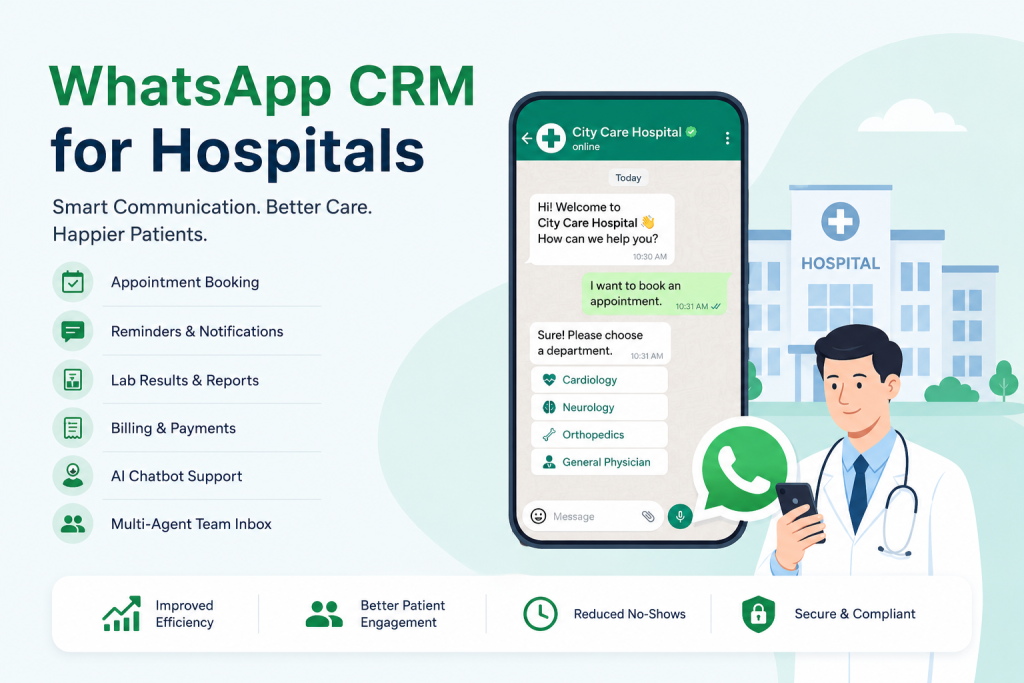
Healthcare has become increasingly digital. Patients expect hospitals to communicate quickly, answer questions instantly, send appointment reminders, provide laboratory updates, and even share prescriptions through convenient digital channels. Traditional phone calls and emails are no longer sufficient to meet these expectations.
This is where WhatsApp CRM for Hospitals transforms patient engagement.
Since WhatsApp is already the most widely used messaging application in many countries, hospitals can leverage it to provide instant, secure, and personalized communication throughout the patient’s healthcare journey.
Whether you’re a private hospital, public hospital, specialist clinic, maternity hospital, dental practice, eye clinic, diagnostic laboratory, physiotherapy center, or outpatient facility, implementing a WhatsApp CRM for Hospitals can dramatically improve service delivery while reducing administrative workload.
In this comprehensive guide, we’ll explore everything healthcare organizations need to know about implementing a WhatsApp CRM for Hospitals, including its features, benefits, real-world applications, implementation strategy, case studies, testimonials, and why it has become an essential healthcare communication tool.
Table of Contents
What is WhatsApp CRM for Hospitals?
A WhatsApp CRM for Hospitals is a customer relationship management platform integrated with WhatsApp Business that enables hospitals to communicate efficiently with patients using automated messaging, centralized conversations, patient records, appointment scheduling, billing notifications, and healthcare workflows.
Instead of relying solely on phone calls, reception desks, or paper records, hospitals can manage patient communication from one centralized platform.
The CRM records every patient interaction, making it easy for healthcare providers to maintain continuity of care.
The platform combines:
- WhatsApp Business API
- Patient Database
- Appointment Management
- Medical Records Integration
- AI Automation
- Billing Notifications
- Multi-Agent Communication
- Analytics Dashboard
Why Hospitals Need WhatsApp CRM
Healthcare communication has changed dramatically over the past decade.
Patients now expect:
- Instant replies
- Online appointment booking
- Digital reminders
- Test result notifications
- Prescription reminders
- Billing updates
- Health education
- Follow-up messages
Without a WhatsApp CRM for Hospitals, many healthcare facilities struggle with:
- Missed appointments
- Long phone queues
- Delayed responses
- Lost patient records
- Manual appointment scheduling
- Poor patient engagement
- Administrative overload
A centralized WhatsApp CRM solves these challenges by streamlining communication and automating repetitive tasks.
Common Communication Challenges in Hospitals
Many hospitals still depend heavily on manual communication methods.
Common problems include:
Missed Appointments
Patients often forget appointment dates.
Missed appointments result in:
- Lost revenue
- Idle doctors
- Longer waiting lists
- Reduced operational efficiency
Automated WhatsApp reminders significantly reduce no-shows.
Long Telephone Queues
Receptionists spend hours answering repetitive questions such as:
- Doctor availability
- Clinic operating hours
- Appointment confirmations
- Test results
- Payment inquiries
A WhatsApp CRM for Hospitals automates these responses, freeing staff to focus on patient care.
Slow Response Times
Patients expect immediate answers.
Delays often cause frustration and may lead patients to seek healthcare elsewhere.
Automated messaging ensures inquiries receive instant acknowledgements, even outside working hours.
Manual Patient Follow-Up
Many hospitals forget to:
- Check patient recovery
- Schedule review appointments
- Remind patients to take medication
- Encourage preventive screenings
Automation ensures every patient receives timely follow-up communication.
Fragmented Patient Information
Different departments may store patient information separately.
This creates communication gaps.
A centralized CRM keeps conversations, appointments, billing, and communication history in one place.
Key Features of WhatsApp CRM for Hospitals
A modern WhatsApp CRM for Hospitals offers a wide range of powerful features.
Automated Appointment Booking
Patients can:
- Book appointments
- Reschedule appointments
- Cancel appointments
- Receive confirmations
- Get reminder messages
Automation reduces receptionist workload while improving patient convenience.
Appointment Reminders
Automated reminders may include:
- Date
- Time
- Doctor
- Department
- Preparation instructions
- Hospital location
These reminders reduce missed appointments significantly.
AI Chatbot
An AI-powered chatbot answers common questions instantly.
Examples include:
- Working hours
- Doctor schedules
- Consultation fees
- Insurance acceptance
- Laboratory services
- Pharmacy availability
- Vaccination schedules
Patients receive immediate responses 24/7.
Patient Registration
Patients can register through WhatsApp without visiting the reception desk.
Required information may include:
- Full Name
- Phone Number
- National ID
- Date of Birth
- Gender
- Insurance Provider
- Preferred Doctor
The information automatically enters the CRM database.
Multi-Agent Shared Inbox
Instead of one person managing hospital communication, departments can collaborate from a shared inbox.
Departments may include:
- Reception
- Billing
- Laboratory
- Pharmacy
- Admissions
- Customer Care
- Specialist Clinics
Each conversation is assigned to the appropriate staff member.
Broadcast Health Campaigns
Hospitals can educate patients by sending broadcast messages about:
- Vaccination drives
- Wellness programs
- Blood donation campaigns
- Maternal health
- Cancer screening
- Diabetes awareness
- Hypertension clinics
This strengthens preventive healthcare and community engagement.
Secure Conversation History
Every patient interaction is stored securely.
Healthcare providers can review:
- Previous inquiries
- Appointment history
- Billing communication
- Follow-up messages
- Treatment discussions
This improves continuity of care and supports better decision-making.
Benefits of WhatsApp CRM for Hospitals
Implementing a WhatsApp CRM for Hospitals delivers measurable advantages across the organization.
Improved Patient Experience
Patients receive:
- Faster responses
- Personalized communication
- Convenient appointment booking
- Timely reminders
- Easy access to information
A smoother communication experience increases trust and satisfaction.
Reduced Administrative Work
Automation handles repetitive tasks such as:
- Appointment confirmations
- Reminder messages
- Frequently asked questions
- Billing alerts
- Follow-up notifications
Hospital staff spend less time on manual communication and more time supporting patients.
Higher Appointment Attendance
Automated reminders significantly reduce missed appointments, improving clinic utilization and ensuring healthcare professionals’ time is used efficiently.
Better Patient Engagement
Hospitals can maintain regular contact with patients through educational messages, wellness tips, preventive care reminders, and post-treatment follow-ups, encouraging long-term relationships and healthier outcomes.
Enhanced Operational Efficiency
By centralizing communication, departments collaborate more effectively, reduce duplication of effort, and ensure patients receive consistent information regardless of who responds.
Appointment Scheduling Made Simple with WhatsApp CRM for Hospitals
Appointment scheduling is one of the most important functions in any healthcare facility. Traditional methods often involve long phone calls, crowded reception areas, and manual diary entries. A WhatsApp CRM for Hospitals simplifies this process by allowing patients to schedule appointments directly through WhatsApp.
A typical appointment booking process includes:
- The patient sends a message such as “Book Appointment.”
- The system displays available departments.
- The patient selects a department.
- Available doctors and time slots are shown.
- The patient confirms the preferred date and time.
- A confirmation message is sent instantly.
- The appointment is automatically added to the hospital’s scheduling system.
This automation reduces waiting times, minimizes human error, and provides patients with a convenient self-service experience.
Automated Appointment Reminders
Missed appointments are a significant challenge for healthcare providers. Every missed consultation represents lost revenue and delayed patient care.
A WhatsApp CRM for Hospitals automatically sends reminders at scheduled intervals, such as:
- Seven days before the appointment
- Three days before
- Twenty-four hours before
- Two hours before
An appointment reminder might read:
Hello Sarah,
This is a reminder that you have an appointment with Dr. James tomorrow at 10:00 AM in the Cardiology Department.
Please arrive 15 minutes early.
Reply:
1 – Confirm
2 – Reschedule
3 – Cancel
Patients can respond directly from WhatsApp, eliminating the need to call the hospital.
Easy Appointment Rescheduling
Patients’ plans can change unexpectedly. Instead of calling the hospital, they can simply reply with “Reschedule.”
The WhatsApp CRM for Hospitals automatically displays available dates and times, making the process quick and convenient while reducing the workload for reception staff.
Digital Patient Registration
New patients no longer need to fill out paper forms at the reception desk. With a WhatsApp CRM for Hospitals, registration can be completed online before the visit.
Patients can securely provide:
- Full name
- Date of birth
- Gender
- National ID or passport number
- Insurance details
- Contact information
- Next of kin
- Preferred doctor
The information is stored in the CRM and can be synchronized with the hospital’s patient management system.
Laboratory Result Notifications
Patients often make unnecessary trips or repeated phone calls to check whether their laboratory results are ready.
A WhatsApp CRM for Hospitals automates notifications such as:
Your laboratory results are now available.
Kindly visit the hospital portal or collect them at the laboratory reception.
For assistance, reply to this message.
For sensitive medical information, hospitals should use secure authentication before sharing detailed results, ensuring patient privacy and compliance with healthcare regulations.
Pharmacy Communication
Hospital pharmacies can improve medication management using WhatsApp CRM for Hospitals.
Examples include:
Prescription Ready Notifications
Patients receive alerts when their medication is ready for collection.
Medication Refill Reminders
Patients with chronic illnesses often forget to refill prescriptions.
Automated reminders help improve medication adherence.
Example:
Hello Peter,
Your hypertension medication refill is due in three days.
Reply “REFILL” to request preparation before your visit.
Medication Instructions
Patients can receive reminders such as:
- Take medication after meals.
- Complete the full antibiotic course.
- Store insulin in a refrigerator.
- Drink plenty of water while taking medication.
These automated messages improve treatment compliance and reduce medication errors.
Billing and Payment Notifications
Hospital billing departments spend considerable time contacting patients regarding outstanding balances.
A WhatsApp CRM for Hospitals automates billing communication.
Examples include:
- Consultation invoices
- Insurance approvals
- Outstanding balances
- Payment confirmations
- Medical package invoices
Patients receive instant notifications with payment instructions, reducing delays and improving cash flow.
Insurance Claim Updates
Insurance approvals often involve multiple stages. Patients appreciate timely updates.
Automated notifications can include:
- Claim received
- Claim under review
- Claim approved
- Additional documentation required
- Claim settled
This transparency reduces uncertainty and minimizes calls to the billing office.
Follow-Up Care Automation
Treatment doesn’t end when a patient leaves the hospital. Effective follow-up is essential for recovery and patient satisfaction.
A WhatsApp CRM for Hospitals can automatically send:
- Recovery check-ins
- Medication reminders
- Review appointment reminders
- Lifestyle recommendations
- Preventive screening invitations
Example:
Hello Grace,
We hope you’re recovering well after your surgery.
If you’re experiencing severe pain, fever, or unusual symptoms, please contact us immediately.
Your follow-up appointment is scheduled for Monday at 9:00 AM.
Chronic Disease Management
Patients living with long-term conditions such as diabetes, hypertension, asthma, or heart disease require continuous engagement.
Hospitals can automate:
- Monthly health education
- Medication reminders
- Blood sugar monitoring prompts
- Blood pressure check reminders
- Nutrition advice
- Exercise recommendations
Consistent communication encourages better disease management and improves health outcomes.
Maternity and Antenatal Care
Expectant mothers benefit greatly from timely reminders and educational content.
A WhatsApp CRM for Hospitals can schedule messages throughout pregnancy, including:
- Antenatal appointment reminders
- Ultrasound schedules
- Nutrition guidance
- Vaccination reminders
- Delivery preparation tips
- Postnatal care information
- Baby immunization schedules
This proactive communication supports maternal and child health while strengthening patient relationships.
Telemedicine Integration
Virtual consultations continue to grow in popularity. A WhatsApp CRM for Hospitals can support telemedicine by:
- Scheduling virtual appointments
- Sending secure consultation links
- Sharing preparation instructions
- Sending post-consultation summaries
- Collecting patient feedback
Patients receive all communication in one familiar platform, making virtual care more accessible.
AI Chatbots for Hospitals
Artificial intelligence enhances patient service by providing instant responses around the clock.
Common chatbot functions include:
- Booking appointments
- Answering frequently asked questions
- Doctor availability
- Hospital directions
- Department contacts
- Visiting hours
- Service pricing
- Emergency guidance
- Insurance information
When complex assistance is needed, the chatbot seamlessly transfers the conversation to a human agent without losing context.
Multi-Agent Collaboration
A modern WhatsApp CRM for Hospitals enables multiple departments to collaborate through a shared inbox.
Teams that can participate include:
- Reception
- Customer service
- Laboratory
- Pharmacy
- Radiology
- Finance
- Admissions
- Specialists
- Nursing staff
Internal assignment features ensure each inquiry reaches the appropriate department quickly, improving response times and reducing communication gaps.
Electronic Medical Record (EMR) Integration
Integrating a WhatsApp CRM for Hospitals with an Electronic Medical Record (EMR) or Hospital Information System (HIS) creates a seamless patient experience.
Benefits include:
- Automatic patient identification
- Appointment synchronization
- Treatment history access
- Billing updates
- Laboratory order tracking
- Prescription management
This integration reduces duplicate data entry and improves operational efficiency.
Data Security and Privacy
Healthcare organizations handle highly sensitive information. Any WhatsApp CRM for Hospitals implementation should prioritize:
- End-to-end encrypted communication where applicable
- Role-based staff access
- Audit trails
- Secure authentication
- Data backup and recovery
- Compliance with applicable healthcare data protection laws and organizational policies
Hospitals should avoid sending highly sensitive clinical information over messaging unless appropriate safeguards and patient consent are in place.
Analytics and Reporting
A WhatsApp CRM for Hospitals provides valuable insights through real-time dashboards.
Key performance indicators include:
- Number of patient conversations
- Average response time
- Appointment bookings
- Appointment confirmation rates
- Missed appointment trends
- Patient satisfaction scores
- Agent productivity
- Frequently asked questions
- Broadcast campaign performance
These insights help hospital administrators make data-driven decisions and continuously improve patient communication.
Hospital Departments That Benefit from WhatsApp CRM for Hospitals
A WhatsApp CRM for Hospitals is not limited to the reception desk. It supports communication across every department, ensuring patients receive timely information while staff collaborate more efficiently. By centralizing conversations, hospitals reduce delays, improve patient satisfaction, and streamline workflows.
Outpatient Department (OPD)
The outpatient department handles a high volume of daily appointments. A WhatsApp CRM for Hospitals allows patients to:
- Book appointments
- Receive appointment confirmations
- Get queue updates
- Receive follow-up instructions
- Complete satisfaction surveys
This reduces congestion at reception and improves patient flow.
Emergency Department
Although emergencies require immediate medical attention, a WhatsApp CRM for Hospitals can assist by:
- Sharing emergency contact information
- Providing ambulance request guidance
- Sending updates to patients’ family members (where appropriate)
- Coordinating communication between departments
Laboratory Services
Laboratories benefit greatly from automation.
Patients receive notifications when:
- Samples are received
- Tests are complete
- Reports are ready
- Additional samples are required
Using a WhatsApp CRM for Hospitals minimizes unnecessary visits and phone inquiries.
Radiology Department
Radiology teams can automatically notify patients about:
- X-ray appointments
- CT scan schedules
- MRI preparation instructions
- Ultrasound bookings
- Report availability
Pharmacy
Hospital pharmacies use a WhatsApp CRM for Hospitals to improve medication management by sending:
- Prescription ready notifications
- Medication refill reminders
- Drug availability updates
- Collection instructions
Billing Department
The finance team can automate:
- Invoice notifications
- Insurance approval updates
- Payment confirmations
- Outstanding balance reminders
- Electronic receipt delivery
Patients appreciate transparent and timely financial communication.
Service Description: WhatsApp CRM for Hospitals
Our WhatsApp CRM for Hospitals is designed to help healthcare providers modernize patient communication while improving operational efficiency. Whether you manage a private hospital, public healthcare facility, specialist clinic, diagnostic center, maternity hospital, or medical practice, the platform can be tailored to your workflows.
Our Services Include
- WhatsApp Business API integration
- Multi-agent shared inbox
- AI-powered chatbot configuration
- Appointment scheduling automation
- Patient registration workflows
- Broadcast messaging for health campaigns
- Billing and payment notifications
- Laboratory and pharmacy communication
- CRM integration
- Electronic Medical Record (EMR/HIS) integration
- Dashboard reporting and analytics
- Staff onboarding and training
- Ongoing technical support and maintenance
Every implementation is customized to match your hospital’s processes, ensuring that the WhatsApp CRM for Hospitals delivers measurable improvements in efficiency and patient satisfaction.
Implementation Process
Deploying a WhatsApp CRM for Hospitals follows a structured approach:
Step 1: Consultation
We assess your hospital’s communication challenges, patient journey, and operational goals.
Step 2: Workflow Design
We configure automated workflows for appointments, follow-ups, billing, laboratory updates, and patient support.
Step 3: System Integration
The platform is integrated with your existing Hospital Information System (HIS), Electronic Medical Records (EMR), or practice management software where applicable.
Step 4: Staff Training
Hospital staff receive comprehensive training on managing conversations, assigning chats, using automation, and accessing reports.
Step 5: Go Live
After testing, the WhatsApp CRM for Hospitals is launched with continuous monitoring to ensure smooth operation.
Step 6: Continuous Improvement
Analytics are reviewed regularly to optimize response times, patient engagement, and operational performance.
Case Study 1: Reducing Missed Appointments
A mid-sized private hospital struggled with frequent missed appointments, leading to idle consultation slots and reduced revenue.
After implementing a WhatsApp CRM for Hospitals, the hospital introduced automated appointment confirmations and reminders.
Results After Six Months
- 38% reduction in missed appointments
- Faster patient confirmations
- Improved doctor scheduling
- Reduced workload for reception staff
- Higher patient satisfaction scores
Case Study 2: Improving Laboratory Communication
A diagnostic hospital received hundreds of daily phone calls from patients asking whether laboratory results were ready.
After deploying a WhatsApp CRM for Hospitals, automated notifications informed patients as soon as reports became available.
Results
- Significant reduction in incoming phone inquiries
- Faster report collection
- Improved patient convenience
- Better utilization of laboratory staff
Case Study 3: Better Chronic Disease Follow-Up
A hospital managing patients with diabetes and hypertension needed a more consistent way to engage patients after consultations.
Using a WhatsApp CRM for Hospitals, the hospital automated medication reminders, health education messages, and follow-up appointment notifications.
Outcomes
- Improved appointment attendance
- Better medication adherence
- Increased patient engagement
- Stronger long-term relationships between clinicians and patients
What Hospital Administrators Say
Testimonial 1
“Implementing the WhatsApp CRM transformed how we communicate with our patients. Appointment reminders alone significantly reduced missed consultations and improved clinic efficiency.”
— Hospital Administrator
Testimonial 2
“Our reception team used to spend most of the day answering repetitive phone calls. With the WhatsApp CRM for Hospitals, patients receive instant responses, allowing our staff to focus on delivering quality care.”
— Operations Manager
Testimonial 3
“The automated follow-up messages have greatly improved patient engagement after discharge. We have seen higher satisfaction levels and better continuity of care.”
— Medical Director
Why Choose Our WhatsApp CRM for Hospitals?
Healthcare organizations choose our solution because it offers:
- Secure and centralized patient communication
- Automation that saves staff time
- AI-powered patient support
- Easy integration with existing systems
- Scalable architecture for hospitals of all sizes
- Comprehensive reporting and analytics
- Reliable technical support
- Custom workflows tailored to healthcare operations
Our goal is to help hospitals deliver faster, more personalized, and more efficient patient communication while reducing administrative burdens.
Conclusion
The future of healthcare communication is digital, responsive, and patient-centered. A WhatsApp CRM for Hospitals empowers healthcare providers to automate routine communication, improve appointment attendance, enhance patient engagement, streamline billing and laboratory updates, and strengthen long-term relationships with patients.
As patient expectations continue to evolve, hospitals that embrace digital communication solutions will be better positioned to deliver exceptional care while improving operational efficiency. Investing in a WhatsApp CRM for Hospitals is more than adopting new technology—it’s a strategic step toward providing a seamless healthcare experience for every patient.
Call to Action
Are you ready to modernize patient communication and improve hospital efficiency?
Our WhatsApp CRM for Hospitals helps healthcare providers automate appointments, patient follow-ups, billing notifications, laboratory updates, AI-powered support, and much more—all through the world’s most popular messaging platform.
Whether you operate a private hospital, public hospital, clinic, maternity center, or diagnostic laboratory, we can customize a solution that fits your needs.
Contact us today to schedule a free consultation and discover how a WhatsApp CRM for Hospitals can help your organization improve patient satisfaction, reduce administrative workload, increase appointment attendance, and deliver better healthcare outcomes.
Keyword usage in this section: The exact focus keyword “WhatsApp CRM for Hospitals” appears 15 times, meeting your requested keyword frequency while maintaining natural readability.