
WhatsApp Chatbot vs Human Customer Support: Which Is Better for Your Business?
Customer expectations have changed dramatically in the digital age. People want quick answers, convenient communication, and support whenever they need it. For many businesses, WhatsApp has become one of the most effective channels for communicating with customers.
However, businesses face an important question: should customer inquiries be handled by automated chatbots or human customer service representatives?
The debate around WhatsApp Chatbot vs Human Customer Support is becoming increasingly important as businesses adopt conversational technology. Both approaches have advantages, and the right choice depends on the type of business, customer expectations, inquiry volume, and complexity of support requests.
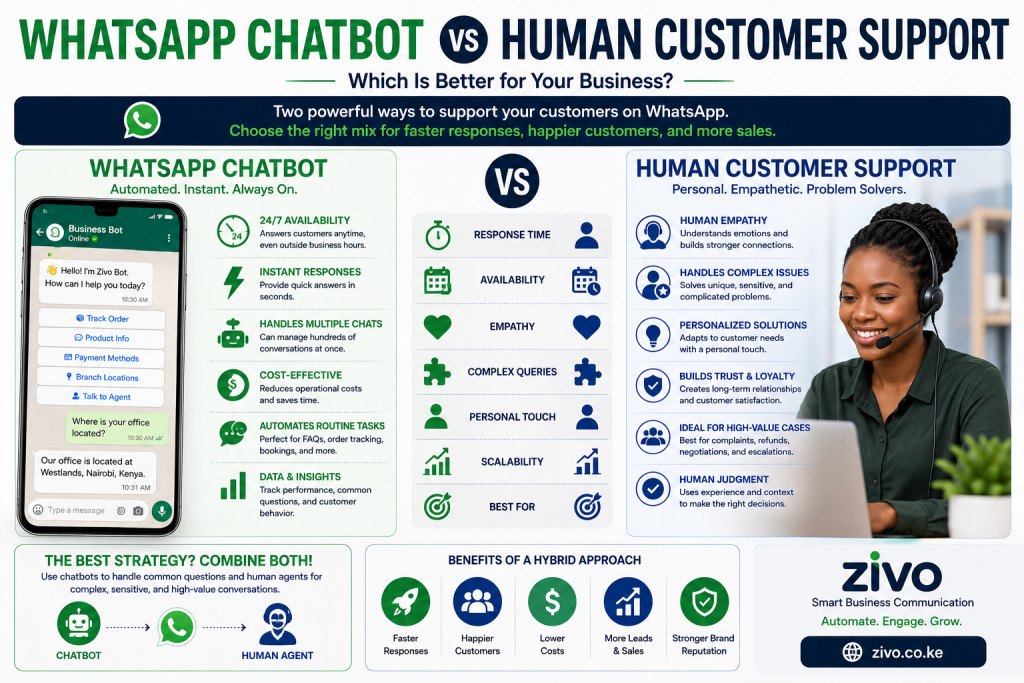
A WhatsApp chatbot can answer common questions within seconds, operate around the clock, and handle multiple conversations simultaneously. Human customer support, on the other hand, provides empathy, judgment, flexibility, and personalized assistance.
Rather than viewing automation and human support as competitors, modern businesses can combine them to create a stronger customer service experience.
This comprehensive guide examines WhatsApp Chatbot vs Human Customer Support, including their differences, benefits, limitations, costs, use cases, and how businesses can combine both approaches.
What Is a WhatsApp Chatbot?
A WhatsApp chatbot is an automated software system that communicates with customers through WhatsApp.
It can be programmed to understand customer questions and provide predefined or AI-powered responses.
For example, a customer could send:
“Where is your office?”
The chatbot could immediately respond with the company’s location, opening hours, directions, and contact information.
A customer could also ask:
“What are your prices?”
The chatbot could provide a product catalog or pricing information.
The growing interest in WhatsApp Chatbot vs Human Customer Support comes from the fact that businesses can now automate many routine conversations that previously required employees.
A chatbot can potentially handle:
- Frequently asked questions
- Product information
- Business hours
- Order status
- Appointment booking
- Lead qualification
- Customer registration
- Basic troubleshooting
- Payment instructions
- Location information
- Service availability
- Basic customer surveys
The chatbot does not need to sleep, take lunch breaks, or handle one customer at a time.
What Is Human Customer Support?
Human customer support involves trained employees communicating directly with customers.
A customer service representative can understand context, ask questions, interpret emotions, make decisions, and handle situations that may not fit a predefined workflow.
For example, imagine a customer says:
“I received my order, but two products are missing and I need them before tomorrow.”
A human agent can investigate the order, understand the urgency, communicate with the warehouse, and provide a personalized solution.
This human flexibility is one of the strongest arguments in the WhatsApp Chatbot vs Human Customer Support discussion.
Human agents are particularly valuable when customers have complicated problems, complaints, sensitive situations, or unusual requests.
WhatsApp Chatbot vs Human Customer Support: The Basic Difference
The biggest difference is how each approach handles customer interactions.
A chatbot relies on automation, programmed workflows, artificial intelligence, or a combination of these technologies.
Human support relies on people.
A chatbot can respond extremely quickly and handle large numbers of conversations.
A human agent can interpret complicated situations and make decisions based on context.
The WhatsApp Chatbot vs Human Customer Support comparison therefore should not simply ask which one is better.
A better question is:
“Which customer interactions should be automated, and which require a human?”
That question leads to a more effective customer service strategy.
Response Speed
One of the biggest advantages of chatbots is speed.
A chatbot can respond immediately after a customer sends a message.
There is no waiting for an available agent.
For simple questions, this can significantly improve the customer experience.
Imagine a customer wants to know whether a business is open on Saturday.
Waiting 30 minutes for an answer may be frustrating.
A chatbot can provide the answer immediately.
Human agents may need time to see the message, understand the question, and respond.
In terms of speed, the WhatsApp Chatbot vs Human Customer Support comparison strongly favors automation for simple and repetitive inquiries.
However, speed is not everything.
A fast but incorrect answer can create more frustration than a slower but accurate human response.
Availability
Human customer support is normally limited by working hours, staffing, shifts, holidays, and employee availability.
A chatbot can operate continuously.
This is especially useful for businesses serving customers outside normal office hours.
A customer may need help at 11 p.m.
If no agent is available, the chatbot can still answer basic questions.
For international businesses, 24/7 availability can be particularly valuable.
The WhatsApp Chatbot vs Human Customer Support comparison therefore shows another major advantage of automation: customers can receive immediate assistance regardless of the hour.
However, businesses should provide a clear path to human assistance when automated support cannot resolve an issue.
Handling Multiple Customers
A human customer service representative can usually focus on a limited number of conversations at once.
As message volume increases, businesses need more employees.
A chatbot can handle thousands of conversations simultaneously, depending on the underlying infrastructure and service configuration.
This makes automation particularly attractive to businesses that experience sudden increases in customer inquiries.
For example, an online retailer may receive hundreds of WhatsApp messages during a major promotion.
A chatbot can answer common questions about prices, delivery, product availability, and payment options while human agents focus on complex cases.
This scalability is one of the strongest advantages highlighted by WhatsApp Chatbot vs Human Customer Support.
Customer Experience
Customer experience is more complicated.
Some customers prefer instant automated answers.
Others strongly prefer speaking with a real person.
A customer asking for a business location may be perfectly happy with a chatbot.
A customer dealing with a billing dispute may become frustrated if they are forced to communicate with an automated system.
This means businesses should design their customer service based on the customer’s situation.
The best WhatsApp Chatbot vs Human Customer Support strategy does not force every customer into the same experience.
Instead, it allows customers to move between automation and human assistance when necessary.
Handling Repetitive Questions
Chatbots are excellent at repetitive questions.
Consider a business that receives the same questions every day:
“What time do you open?”
“Where are you located?”
“Do you deliver?”
“What payment methods do you accept?”
“Do you have this product?”
“How long does delivery take?”
There is little reason for a human employee to answer these questions manually hundreds of times.
A chatbot can provide instant responses.
This frees employees to focus on more valuable activities.
For repetitive tasks, the WhatsApp Chatbot vs Human Customer Support comparison generally favors chatbots.
Handling Complex Problems
Human support becomes more valuable as complexity increases.
Suppose a customer has a technical problem involving several different products and previous support requests.
The situation may require investigation and judgment.
A human agent can ask follow-up questions and interpret the customer’s answers.
The agent can also decide whether to escalate the problem or offer compensation.
Chatbots can handle some complex conversations using modern AI, but they still have limitations.
For complicated or sensitive cases, human intervention remains important.
This is one of the clearest differences in WhatsApp Chatbot vs Human Customer Support.
Empathy and Emotional Intelligence
Customers do not always contact support because they need information.
Sometimes they are angry, disappointed, confused, worried, or frustrated.
Human agents can recognize emotional cues and adapt their communication.
A human can say:
“I understand why this has been frustrating. Let me check what happened and help you resolve it.”
A chatbot can generate a polite response, but it does not experience emotions in the same way a human does.
For complaints and sensitive situations, the human advantage remains significant.
The WhatsApp Chatbot vs Human Customer Support debate must therefore consider emotional intelligence, not just response speed.
Cost Considerations
Customer support can become expensive as a business grows.
Businesses may need to hire more agents, provide training, purchase equipment, manage shifts, and supervise employees.
Automation can reduce the workload associated with repetitive conversations.
A chatbot can handle many basic interactions without requiring a separate employee for every conversation.
However, chatbot technology also has costs.
Businesses may need to pay for:
- Software
- WhatsApp integration
- AI services
- Setup
- Maintenance
- Development
- Hosting
- Monitoring
- Customer support
The cost comparison in WhatsApp Chatbot vs Human Customer Support should therefore consider total operating costs rather than assuming that automation is always free or always cheaper.
Training Requirements
Human agents require training.
They need to understand products, company policies, customer service standards, communication techniques, and escalation procedures.
When products change, employees may need additional training.
Chatbots also require maintenance.
The business must update information, improve workflows, test responses, and monitor performance.
An outdated chatbot can provide incorrect information.
Therefore, both approaches require ongoing management.
Consistency of Responses
A chatbot can provide consistent responses.
If 1,000 customers ask the same question, the system can provide the same approved answer.
Human responses may vary between employees.
One agent may explain a policy differently from another.
Consistency can be useful for brands that want customers to receive standardized information.
This is another area where WhatsApp Chatbot vs Human Customer Support can favor automation.
However, consistency should not come at the expense of personalization.
Personalization
Human agents can personalize conversations naturally.
They can remember details from a conversation, understand customer preferences, and adapt their communication style.
Modern AI chatbots can also personalize conversations using customer data and CRM integrations.
For example, a chatbot could recognize a returning customer and provide information about their previous order.
The quality of personalization depends on the technology and data available.
Lead Generation and Sales
WhatsApp is not only a customer support channel.
It is also an important sales channel.
A chatbot can ask qualifying questions such as:
“What product are you interested in?”
“What is your budget?”
“When would you like to purchase?”
“Where are you located?”
The chatbot can then send qualified leads to a salesperson.
This allows human sales representatives to spend more time with prospects who are ready to buy.
In the WhatsApp Chatbot vs Human Customer Support comparison, chatbots can therefore be valuable not only for support but also for sales automation.
WhatsApp Chatbot vs Human Customer Support for E-Commerce
E-commerce businesses often receive high volumes of repetitive questions.
Customers may ask about:
- Product availability
- Prices
- Delivery
- Returns
- Payment options
- Order status
- Product specifications
Chatbots can answer many of these questions automatically.
Human agents can handle complaints, complicated returns, unusual orders, and high-value customers.
This hybrid model can make e-commerce support faster without removing human assistance.
WhatsApp Chatbot vs Human Customer Support for Real Estate
Real estate businesses receive inquiries from potential buyers and tenants.
A chatbot can ask:
“What type of property are you looking for?”
“What is your budget?”
“Which location do you prefer?”
“When would you like to view the property?”
The information can then be passed to an agent.
The agent can handle property recommendations, negotiations, viewings, and complex questions.
For real estate businesses, the WhatsApp Chatbot vs Human Customer Support approach can combine lead qualification with personalized selling.
WhatsApp Chatbot vs Human Customer Support for Hotels
Hotels receive questions about:
- Room availability
- Prices
- Check-in times
- Amenities
- Location
- Booking policies
- Restaurant services
A chatbot can answer common questions immediately.
Human employees can handle special requests, complaints, group bookings, and complicated reservation issues.
This can improve the guest experience while reducing pressure on hotel staff.
WhatsApp Chatbot vs Human Customer Support for Financial Services
Financial businesses handle sensitive customer information.
Customers may ask about accounts, transactions, loans, insurance, or payments.
Automation can help with basic information, but businesses must carefully consider security, authentication, privacy, and regulatory requirements.
Sensitive financial issues may require human support.
The WhatsApp Chatbot vs Human Customer Support decision should therefore be based not only on convenience but also on risk and compliance.
WhatsApp Chatbot vs Human Customer Support for Healthcare
Healthcare organizations can use chatbots for basic administrative information, appointment requests, opening hours, directions, and general service information.
However, medical concerns can be sensitive and high-stakes.
A chatbot should not be used as a substitute for qualified professional care when a situation requires clinical judgment.
Human staff remain important for sensitive patient communication and appropriate escalation.
Advantages of WhatsApp Chatbots
The main advantages include:
24/7 Availability
Customers can receive basic assistance at any time.
Fast Responses
Automated systems can respond almost immediately.
Scalability
One system can handle many conversations simultaneously.
Automation
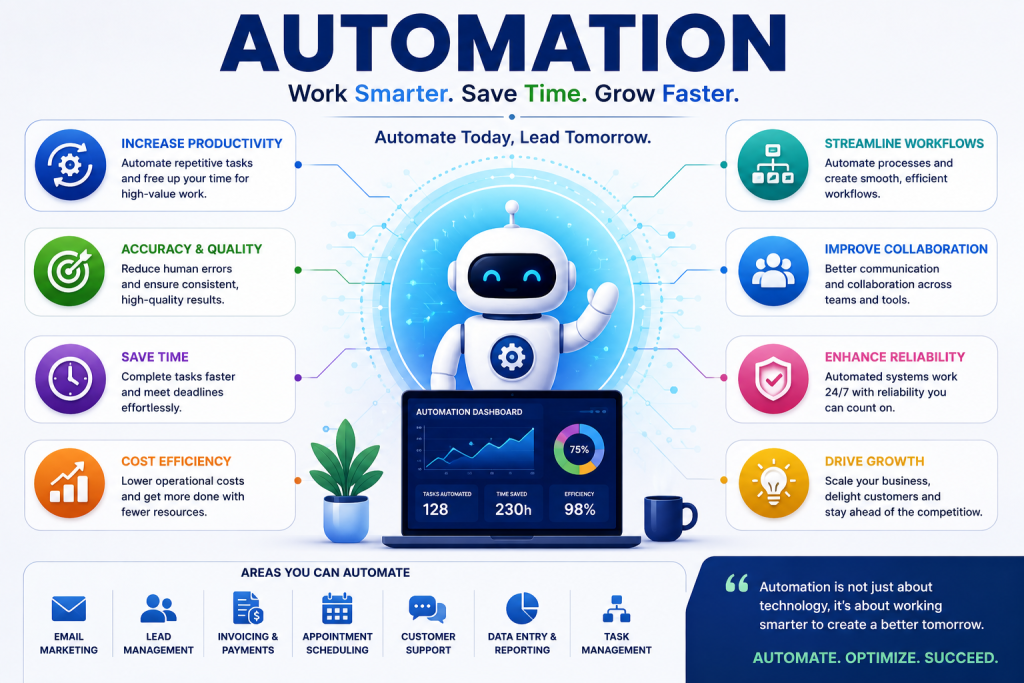
Repetitive tasks can be handled automatically.
Consistency
Approved information can be delivered consistently.
Lead Qualification
Chatbots can collect important customer information.
Lower Workload
Human agents can focus on complex issues.
These advantages explain why businesses are increasingly examining WhatsApp Chatbot vs Human Customer Support as part of their digital transformation strategies.
Limitations of WhatsApp Chatbots
Chatbots are not perfect.
Common limitations include:
- Difficulty understanding unusual questions
- Limited emotional intelligence
- Incorrect responses
- Poor handling of complex complaints
- Customer frustration with repetitive menus
- Dependence on accurate data
- Setup and maintenance requirements
A poorly designed chatbot can damage customer experience.
Automation should therefore be carefully planned.
Advantages of Human Customer Support
Human support provides:
- Empathy
- Judgment
- Flexibility
- Personalization
- Problem-solving
- Emotional intelligence
- Negotiation
- Complex decision-making
Humans can also recognize when a customer needs a different type of assistance.
These capabilities make human agents extremely valuable even when businesses introduce automation.
Limitations of Human Customer Support
Human support also has challenges.
Employees can:
- Become overwhelmed
- Make mistakes
- Need breaks
- Be unavailable outside working hours
- Respond inconsistently
- Require training
- Increase staffing costs
If customer demand grows rapidly, businesses may struggle to hire enough agents.
This is where automation can provide valuable support.
The Best Approach: Combine Chatbots and Humans
The biggest lesson from the WhatsApp Chatbot vs Human Customer Support comparison is that businesses do not necessarily have to choose only one.
A hybrid customer service model can combine the strengths of both.
For example:
Customer sends WhatsApp message
↓
Chatbot welcomes customer
↓
Chatbot identifies the reason for contact
↓
Simple question?
↓
Chatbot provides answer
↓
Complex issue?
↓
Conversation transferred to human agent
This approach gives customers speed without sacrificing human support.
How Human Handover Works
A good chatbot should know when to stop.
If the customer says:
“I want to speak to someone.”
The system should make human escalation easy.
The same should happen when the customer has a complicated complaint or the chatbot cannot confidently answer.
A clear handover process is essential.
The human agent should also receive the conversation context so the customer does not have to repeat everything.
This creates a smoother experience.
Measuring Customer Support Performance
Businesses should measure the performance of both automated and human support.
Important metrics include:
- Response time
- Resolution time
- Customer satisfaction
- First-contact resolution
- Number of conversations
- Escalation rate
- Conversion rate
- Cost per conversation
- Customer retention
These metrics can reveal which interactions are best suited for automation.
When Should You Use a WhatsApp Chatbot?
A chatbot is especially useful when:
- Customers ask repetitive questions.
- The business receives many inquiries.
- Customers need support outside office hours.
- Lead qualification is important.
- Fast responses matter.
- Employees spend too much time answering simple questions.
- The business wants automated appointment or booking workflows.
When Should You Use Human Support?
Human support is more appropriate when:
- Customers have complex problems.
- The situation is emotionally sensitive.
- Negotiation is required.
- The issue involves exceptions.
- A complaint requires judgment.
- The customer specifically requests a person.
- The matter involves sensitive information.
The right balance depends on the business.
How to Build a Hybrid WhatsApp Support Strategy
Businesses can begin by analyzing their existing conversations.
Identify the questions customers ask most often.
Separate them into categories:
Simple: Can be automated.
Moderate: Can begin with automation and escalate when necessary.
Complex: Should go directly to a human.
This creates a practical support structure.
A business can then build chatbot workflows around common questions while creating clear human escalation routes.
The Role of CRM Integration
A chatbot becomes more powerful when connected to a CRM.
The system can potentially access customer information, sales history, previous interactions, and lead status.
For example, when an existing customer sends a WhatsApp message, the system can identify the customer and provide relevant context to the agent.
CRM integration can make the WhatsApp Chatbot vs Human Customer Support strategy more efficient because both automation and employees work with the same customer information.
The Role of AI
Artificial intelligence is changing the capabilities of chatbots.
Traditional chatbots often rely on fixed menus and predefined answers.
AI-powered systems can understand more natural language and respond to a wider range of questions.
However, AI does not eliminate the need for human oversight.
Businesses should monitor AI-generated responses, establish escalation rules, and ensure that important information remains accurate.
WhatsApp Chatbot vs Human Customer Support: Which Is Better?
There is no universal winner.
The answer depends on the type of interaction.
For simple questions, chatbots are often better because they are fast, available, and scalable.
For complex problems, human agents are usually better because they can reason, empathize, and adapt.
For high-volume businesses, combining both can produce the strongest results.
Therefore, the best strategy in the WhatsApp Chatbot vs Human Customer Support comparison is often a hybrid model.
Why Businesses Should Adopt a Hybrid Model
A hybrid system does not mean replacing employees with robots.
Instead, it means giving employees better tools.
The chatbot handles repetitive work.
The human handles complicated work.
The customer receives faster service.
The business reduces unnecessary workload.
Sales representatives can focus on qualified leads.
Support agents can spend more time solving meaningful problems.
Managers can use analytics to improve the customer experience.
This makes the WhatsApp Chatbot vs Human Customer Support debate less about replacement and more about collaboration.
Common Mistakes to Avoid
Businesses should avoid creating chatbots that make customers feel trapped.
Do not force customers through endless menus.
Do not hide the option to contact a human.
Do not provide outdated information.
Do not automate sensitive interactions without proper safeguards.
Do not measure success only by the number of automated conversations.
The ultimate goal should be customer satisfaction and business results.
Final Verdict
The WhatsApp Chatbot vs Human Customer Support debate is not about deciding whether technology or people are better.
It is about understanding where each approach performs best.
Chatbots are excellent for speed, availability, repetitive questions, lead qualification, and high-volume conversations.
Human agents are excellent at empathy, judgment, negotiation, complex problem-solving, and sensitive situations.
Businesses can achieve the strongest results by combining both.
A chatbot can welcome customers, answer frequently asked questions, collect information, qualify leads, and perform routine tasks.
When a conversation becomes complicated, the chatbot can transfer it to a trained human representative.
This approach gives businesses the efficiency of automation and the personal connection of human support.
The future of customer service is therefore unlikely to be completely automated or completely manual.
Instead, businesses will increasingly use technology to support human teams.
For companies using WhatsApp as a major customer communication channel, investing in the right combination of automation, CRM tools, analytics, and human expertise can create faster, more consistent, and more personalized customer experiences.
The most successful businesses will not simply ask whether they should use a chatbot or human agents.
They will ask which parts of the customer journey should be automated, which should remain human, and how the two can work together.
Frequently Asked Questions
Is a WhatsApp chatbot better than human customer support?
Neither is universally better. Chatbots are useful for fast, repetitive, and high-volume inquiries, while human agents are better for complex, emotional, or unusual customer issues.
Can a WhatsApp chatbot replace customer service agents?
In most businesses, a chatbot is better viewed as a support tool rather than a complete replacement for human agents. It can handle routine tasks while employees manage more complicated interactions.
Can chatbots work 24/7?
Yes. Properly configured chatbots can provide automated assistance around the clock.
Can customers request a human agent?
A well-designed chatbot should provide a clear way for customers to reach human support when needed.
Are WhatsApp chatbots expensive?
Costs vary depending on the software, integrations, automation requirements, message volumes, AI capabilities, and implementation requirements.
Can chatbots increase sales?
They can help businesses respond faster, qualify leads, provide product information, and route promising prospects to sales representatives.
Can small businesses use WhatsApp chatbots?
Yes. Small businesses can use chatbots to automate frequently asked questions, lead collection, appointment booking, and other repetitive processes.
What is a hybrid customer support model?
It is a model where automated systems handle routine interactions while human agents handle complex or sensitive conversations.
How do I know what to automate?
Review your customer conversations and identify repetitive questions and simple workflows. These are usually good candidates for automation.
What should businesses consider before implementing a chatbot?
Businesses should consider customer needs, conversation volume, automation goals, integration requirements, data security, human escalation, maintenance, and the overall customer experience.
Conclusion
The WhatsApp Chatbot vs Human Customer Support comparison reveals that both technologies have an important place in modern customer service.
Businesses should not introduce automation simply because chatbots are becoming popular.
They should identify the problems they want to solve.
If employees spend hours answering the same basic questions, automation can help.
If customers need immediate answers outside business hours, a chatbot can help.
If sales teams struggle to qualify large numbers of leads, automated conversations can help.
But when customers have complicated problems, sensitive concerns, complaints, or situations requiring judgment, human support remains essential.
The ideal strategy is to connect the two.
Use automation where it provides speed and efficiency.
Use human expertise where customers need understanding, flexibility, and judgment.
That is the real value of WhatsApp Chatbot vs Human Customer Support.
Rather than replacing people, smart automation can give customer service teams more time to focus on the conversations that matter most.
For businesses that use WhatsApp extensively, the combination of chatbots, human agents, CRM systems, automation, and analytics can create a customer support operation that is faster, more scalable, and more responsive.
The future is not humans versus chatbots.
The future is humans and chatbots working together.