
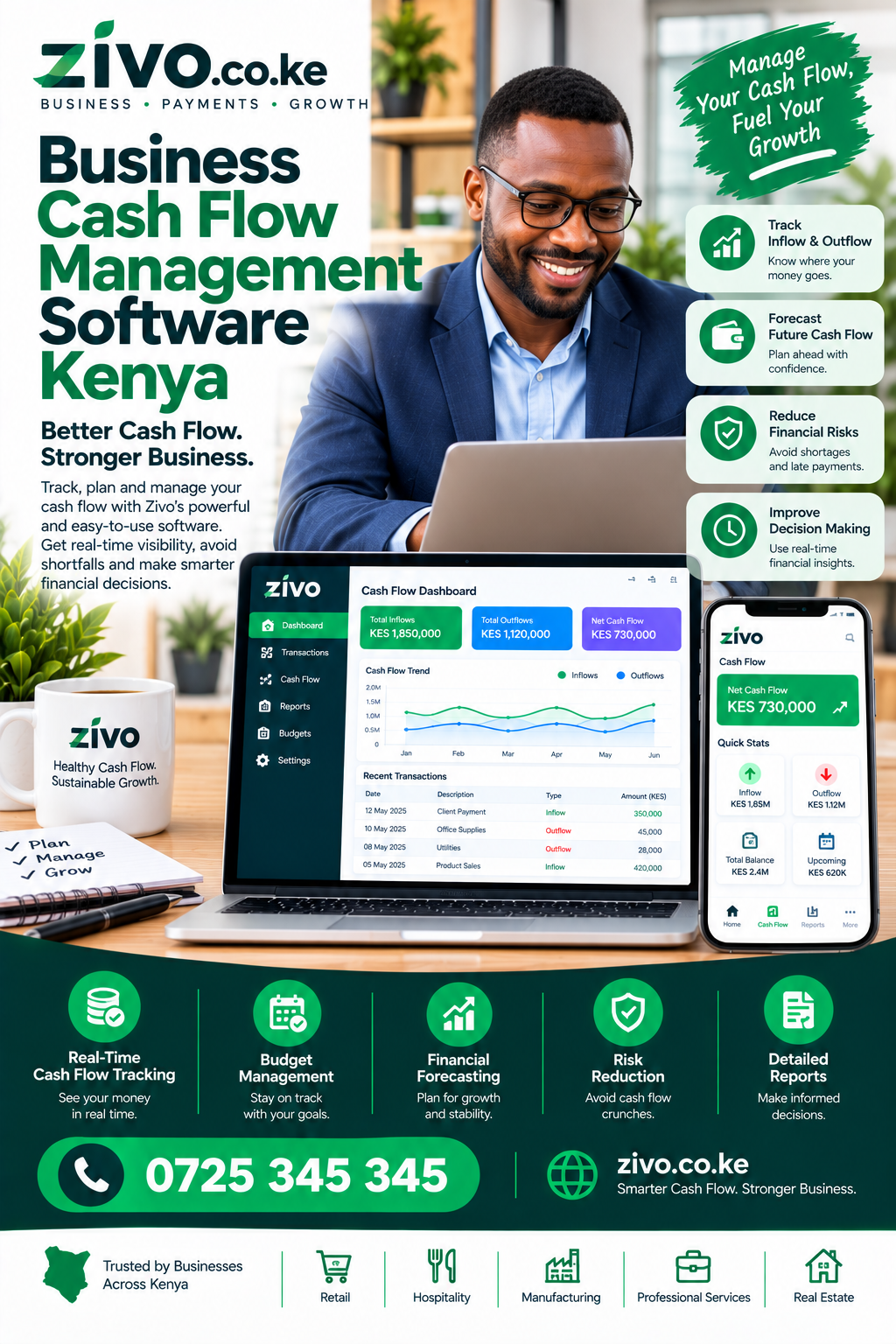
Business Cash Flow Management Software Kenya: Complete Guide for Better Financial Control
Cash flow is one of the most important financial concerns for any growing business. A company can make sales, issue invoices and report profits while still experiencing difficulty paying suppliers, employees or other operating expenses when money is not available at the right time. For Kenyan SMEs, keeping track of collections, expenses, M-Pesa payments, supplier obligations and customer balances can become increasingly difficult as transaction volumes grow. This is where Business Cash Flow Management Software Kenya can provide a more organized way to understand the movement of money.
Cash flow is fundamentally about timing. A business needs to know how much money has come in, how much has gone out, what customers still owe, which expenses are due and what funds remain available. When this information is scattered across spreadsheets, notebooks, bank statements, M-Pesa messages and separate accounting records, it becomes harder for an owner to make timely decisions.
The purpose of Business Cash Flow Management Software Kenya is therefore not simply to produce another financial report. A useful system should help businesses maintain connected records of invoices, payments, expenses, suppliers, customer balances and other financial activity so that management can understand the current position.
For a Kenyan business, this can be particularly important when customers use different payment methods, invoices are paid at different times, expenses occur throughout the month and the owner needs to make decisions quickly.
This guide explains what cash flow management means, why it matters, how software can help, the features businesses should evaluate, common mistakes to avoid, how M-Pesa can fit into the process and what to consider before adopting a digital cash-flow management system.
What Is Cash Flow?
Cash flow refers to the movement of money into and out of a business.
Money can come into the business through:
- Customer payments
- M-Pesa collections
- Bank transfers
- Cash sales
- Other operating receipts
- Financing activities
- Other legitimate business sources
Money can leave through:
- Supplier payments
- Rent
- Salaries
- Utilities
- Transport
- Marketing
- Stock purchases
- Operating expenses
- Taxes and other obligations
- Loan or financing payments
The difference between money coming in and money going out over a particular period helps management understand the cash position.
A Business Cash Flow Management Software Kenya solution can organize this information into a more accessible financial picture.
However, businesses should understand that cash flow is not the same thing as profit.
A business may make a sale today but receive the customer’s payment later. The sale may contribute to revenue and profit, but the cash is not available until payment is actually received.
This distinction is essential when planning day-to-day business operations.
Cash Flow vs Profit
One of the most common financial misunderstandings among small businesses is treating profit and cash as the same thing.
Imagine that a company invoices customers KSh 500,000 during a month. The company may consider those invoices as sales, but if customers have not yet paid, the business does not have KSh 500,000 available in its bank or M-Pesa account.
At the same time, the company may have to pay suppliers, staff and other expenses.
A Business Cash Flow Management Software Kenya system can help management distinguish between amounts invoiced, amounts collected and amounts still outstanding.
This distinction makes financial planning more practical.
A business owner asking, “How much did we sell?” is asking a different question from an owner asking, “How much cash do we have available today?”
Both questions matter.
Why Cash Flow Matters for Kenyan SMEs
Cash flow affects the ability of a business to operate every day.
Even a profitable business can experience pressure when customer payments arrive later than expected while expenses remain due.
For example, a service business may complete several projects during the month but allow customers to pay after 30 days. Meanwhile, the business may need to pay employees, transport providers, suppliers and rent before those customer payments arrive.
A Business Cash Flow Management Software Kenya platform can help create a clearer record of when money is expected, received and spent.
This visibility can support better decisions about purchasing, collections and spending.
Cash-flow management does not guarantee that a business will always have enough cash. Instead, it gives management better information with which to plan.
The Problem With Manual Cash-Flow Tracking
Many small businesses begin with simple methods.
An owner may use:
- Excel
- Google Sheets
- Paper notebooks
- M-Pesa messages
- Bank statements
- WhatsApp conversations
- Receipts
- Separate accounting files
These tools can work when transaction volumes are low.
The challenge appears when the business grows.
There may be hundreds of invoices, dozens of expenses, multiple suppliers, several employees and different payment channels.
A Business Cash Flow Management Software Kenya solution can help centralize financial information instead of requiring the owner to reconstruct the position manually.
The goal is not necessarily to eliminate spreadsheets immediately. It is to reduce dependence on disconnected records when they no longer provide sufficient visibility.
What Should Cash Flow Software Track?
A useful cash-flow system should help businesses understand several categories of financial activity.
Money coming in
This may include:
- Customer payments
- M-Pesa collections
- Bank payments
- Cash sales
- Other receipts
Money going out
This may include:
- Supplier payments
- Expenses
- Operating costs
- Payroll-related payments
- Other business disbursements
Money expected
This includes amounts that have been invoiced but not yet collected.
Money committed
These are financial obligations the business expects to pay.
A Business Cash Flow Management Software Kenya platform can bring these records together to provide a more useful financial picture.
Invoicing and Cash Flow
Invoicing is closely connected to cash flow because an invoice creates an amount that a customer is expected to pay.
A good invoicing process should make it easy to identify:
- Customer
- Invoice number
- Amount
- Date
- Due date
- Payment status
- Amount received
- Outstanding balance
A Business Cash Flow Management Software Kenya solution can help businesses monitor outstanding customer balances alongside payment information.
The objective is to prevent invoices from disappearing into folders after they have been issued.
When management can see which customers owe money, collections can become more structured.
Accounts Receivable and Cash Flow
Accounts receivable represents money customers owe the business.
If accounts receivable grows faster than collections, the business may experience cash pressure.
For example, sales could increase while cash availability decreases because customers are taking longer to pay.
A Business Cash Flow Management Software Kenya system can help owners review outstanding customer balances and identify which invoices remain unpaid.
This makes the collections process more evidence-based.
Instead of asking, “Who owes us money?” the owner can review the actual outstanding records.
Managing Customer Payment Follow-Ups
Following up unpaid invoices is an important part of cash-flow management.
A business should have a process for:
- Identifying overdue invoices.
- Confirming the customer balance.
- Contacting the customer.
- Recording payment promises where appropriate.
- Confirming payment.
- Updating the financial record.
A Business Cash Flow Management Software Kenya platform can make the first part of this process easier by providing visibility into unpaid or outstanding invoices.
The human relationship with the customer still matters, but the business has better information before making the follow-up.
M-Pesa and Cash Flow Management
M-Pesa is an important payment channel for many Kenyan businesses.
The challenge is not only receiving money through M-Pesa. The business also needs to know which customer, invoice or transaction the payment belongs to.
A Business Cash Flow Management Software Kenya system can be useful when payment records remain connected to the underlying customer transaction.
Zivo’s current public product information describes M-Pesa collection, payment matching and cash-flow reporting as part of its connected business workflow.
This can reduce the need to compare individual payment messages against invoices manually.
M-Pesa Reconciliation and Cash Flow
Reconciliation is important because payment records need to agree with the business records.
Suppose an M-Pesa account receives several payments in a day.
The business should be able to determine:
- Which customer paid
- Which invoice was settled
- Whether the amount was correct
- Whether a payment remains unmatched
- Whether there was an exception
A Business Cash Flow Management Software Kenya solution that supports payment reconciliation can make this process more structured.
Zivo’s current platform specifically describes automatic matching and exception reconciliation for M-Pesa payments on applicable plans.
Businesses should nevertheless confirm the exact reconciliation workflow during implementation.
Expense Management and Cash Flow
Cash-flow management is incomplete without understanding expenses.
Every business has costs.
These can include:
- Rent
- Utilities
- Transport
- Supplier purchases
- Marketing
- Equipment
- Software
- Repairs
- Office supplies
- Professional services
A Business Cash Flow Management Software Kenya platform can help organize expenses and connect them to the broader financial record.
The purpose is not merely to create a list of costs.
Management needs to understand where money is going and whether spending is aligned with business priorities.
Fixed and Variable Expenses
Expenses can often be considered in terms of how they behave.
Fixed expenses may include:
- Rent
- Certain subscriptions
- Some salaries
- Insurance
Variable expenses may include:
- Delivery costs
- Packaging
- Materials
- Sales commissions
- Transaction-related costs
A Business Cash Flow Management Software Kenya system can make expense information easier to organize and review.
Understanding the difference between fixed and variable expenses can help businesses prepare more realistic cash-flow expectations.
Supplier Payments
Suppliers are another important part of cash flow.
A business may purchase goods or services on credit and receive payment terms.
Management needs to know:
- Which suppliers need payment
- How much is outstanding
- When payments are expected
- Which purchases have already been settled
A Business Cash Flow Management Software Kenya platform can help organize supplier and expense information where these features are available.
This is especially important for wholesalers, retailers and other businesses with frequent purchasing activity.
Purchase Decisions and Cash Flow
A business should consider cash availability before committing to major purchases.
A large stock purchase may appear attractive because of a supplier discount, but the decision should also consider:
- Current cash balance
- Expected customer collections
- Existing supplier obligations
- Operating expenses
- Demand for the products
- Available working capital
A Business Cash Flow Management Software Kenya system can provide financial information that contributes to this decision-making process.
Software does not decide whether a purchase is wise. It helps the owner see the numbers needed to make the decision.
Cash Flow Forecasting
Cash-flow forecasting involves estimating expected money coming in and going out over a future period.
A simple forecast might consider:
Opening cash + expected receipts − expected payments = projected closing cash
Businesses can use forecasts to consider upcoming obligations.
For example:
- Customer payments expected this week
- Supplier payments due next week
- Rent due at month-end
- Salaries
- Planned stock purchases
- Other known expenses
A Business Cash Flow Management Software Kenya platform can support forecasting when the relevant data and reporting functions are available.
The quality of the forecast depends on the quality of the assumptions.
Why Accurate Records Matter for Forecasting
A forecast is only as useful as the information behind it.
If customer balances are wrong, expected receipts may be overstated.
If expenses are missing, expected cash outflows may be understated.
If payments have not been reconciled, the current balance may be inaccurate.
A Business Cash Flow Management Software Kenya solution can help businesses maintain more organized records that can support financial planning.
Businesses should still review assumptions regularly.
Cash Flow and Working Capital
Working capital relates to the resources a business uses to operate its everyday activities.
A business may have stock, unpaid invoices and supplier obligations at the same time.
The challenge is ensuring that sufficient liquid resources are available to meet immediate commitments.
A Business Cash Flow Management Software Kenya platform can help management review customer balances, expenses, payments and cash-flow information together.
This creates better context for working-capital decisions.
Cash Flow and Inventory
Inventory can affect cash flow significantly.
When a business purchases stock, cash may leave before the stock is sold.
If products sell quickly, the business can recover that investment through customer payments.
If products move slowly, cash may remain tied up in inventory.
A Business Cash Flow Management Software Kenya system connected to stock and financial records can give management a more complete picture of the relationship between inventory and cash.
Zivo’s current business solutions include stock, purchasing, sales and financial workflows in its broader platform.
Cash Flow and Jobs
Service businesses may have another challenge.
They may receive payment for work before the work is delivered, or they may complete work before receiving payment.
Both situations affect cash flow and operations differently.
A Business Cash Flow Management Software Kenya platform can help connect invoices, payments, jobs and financial records where those workflows are available.
Zivo’s current public product information describes paid work remaining visible until delivery or service completion.
This provides useful operational context alongside the financial record.
Understanding Daily Cash Position
Business owners should not have to wait until the end of the month to understand the financial position.
A useful daily view can answer:
- How much cash came in?
- How much went out?
- What customers still owe?
- What expenses were recorded?
- What payments remain unmatched?
- What obligations are approaching?
A Business Cash Flow Management Software Kenya solution can provide a central place to review these questions when the relevant records are maintained.
Zivo’s accounting information describes cash-flow and profit reports alongside invoices, payments, expenses and customer statements.
Cash Flow Dashboards
A dashboard can summarize financial information in a way that is easier to review than a long spreadsheet.
Useful indicators might include:
- Cash received
- Cash spent
- Outstanding invoices
- Expenses
- Current balances
- Net cash movement
- Profit information
A Business Cash Flow Management Software Kenya system should be judged by whether its dashboard helps management make decisions.
A dashboard that looks attractive but does not answer practical questions is less useful than a simple report that clearly shows what needs attention.
The Importance of Customer Balances
Customer balances are a key part of cash-flow management.
If the business has issued invoices but has not received payment, those balances represent potential future cash.
A Business Cash Flow Management Software Kenya platform can help management distinguish between paid and unpaid customer transactions.
This is particularly useful when customers have different payment terms.
A business should know not only how much customers owe in total but also which invoices are overdue and which are still within their agreed payment period.
Payment Accounts
Businesses may use more than one payment account.
They may receive money through:
- M-Pesa
- Bank accounts
- Cash
- Other business payment channels
A Business Cash Flow Management Software Kenya system should make it clear which account received or paid a transaction where that information is relevant.
Zivo’s current finance and accounting information includes payment accounts as part of its financial workflow.
This can help management avoid treating all money as though it sits in one account.
Managing Business Expenses Before Payment
Cash-flow control should begin before money leaves the business.
A business can establish a process such as:
Request → Review → Approval → Payment → Record → Report
A Business Cash Flow Management Software Kenya platform can support this type of expense-control workflow when the relevant capabilities are available.
Zivo’s current solutions describe itemized expense requests, suppliers and payees, receipts, departments, approval status, payment accounts, vouchers and M-Pesa payouts.
This approach provides greater visibility than discovering expenses only after reviewing a statement at the end of the month.
Approval Controls
Approval controls can help businesses manage spending.
For example, a business might require management approval before certain expenses are paid.
The approval process should make it clear:
- Who requested the expense
- Why it was needed
- Amount
- Supplier or payee
- Who approved it
- Whether payment has occurred
A Business Cash Flow Management Software Kenya system can help create a more structured approval trail.
The exact approval rules should be determined by the business.
Receipts and Supporting Documents
Financial records are stronger when transactions have supporting evidence.
For expenses, this might include:
- Supplier receipt
- Invoice
- Payment confirmation
- Supporting document
A Business Cash Flow Management Software Kenya platform can help businesses associate supporting documents with expense records when document capture is available.
Zivo’s current expense-management materials describe supplier receipts, expense records and supporting details as part of the workflow.
Cash Flow and Profit Reporting
Cash flow and profit answer different questions.
Profit reporting can help explain business performance.
Cash-flow reporting helps explain money movement and liquidity.
A Business Cash Flow Management Software Kenya system that provides both can give management more context.
For example, a business might report a profit but still have limited available cash because customers have not paid.
That distinction can affect purchasing, hiring and payment decisions.
Cash Flow for Retail Businesses
Retail businesses often receive many payments throughout the day.
Cash flow may come through:
- M-Pesa
- Bank payments
- Cash
- Card or other supported channels
At the same time, the business pays suppliers, staff and operating expenses.
A Business Cash Flow Management Software Kenya platform can help retailers organize financial transactions and review money movement alongside sales.
The more transactions a business handles, the more valuable consistent records become.
Cash Flow for Wholesalers
Wholesalers may have significant amounts of money tied up in inventory and customer credit.
They need to balance:
- Stock purchases
- Supplier payments
- Customer collections
- Operating expenses
- Credit terms
A Business Cash Flow Management Software Kenya solution can help wholesalers review financial information in a structured way.
The business should also consider whether the system connects sales, inventory, customers and supplier records.
Cash Flow for Service Businesses
Service businesses often have different cash-flow patterns.
A consultant may invoice after completing work.
A contractor may receive a deposit before starting.
A maintenance company may have recurring monthly payments.
A Business Cash Flow Management Software Kenya system should therefore be evaluated using the business’s actual payment cycle.
The right workflow for a service business may be different from the right workflow for a retailer.
Cash Flow for Multi-Branch Businesses
Multi-branch businesses need additional visibility.
Management may want to understand:
- Money received by branch
- Expenses by branch
- Outstanding customer balances
- Supplier payments
- Branch profitability
- Overall cash position
A Business Cash Flow Management Software Kenya platform should be tested against the business’s branch structure.
If the system cannot represent the way the business operates, reporting may become confusing.
Cash Flow and Business Growth
Growth can create cash-flow pressure.
A business may need to:
- Buy more inventory
- Hire employees
- Rent additional space
- Increase marketing
- Expand delivery
- Purchase equipment
These activities may require cash before the additional revenue arrives.
A Business Cash Flow Management Software Kenya system can help management monitor current financial activity while planning expansion.
Growth should be funded responsibly rather than based solely on optimistic sales expectations.
Cash Flow and Emergency Planning
Unexpected events can affect cash.
Examples include:
- Major equipment repair
- Customer payment delays
- Supplier price changes
- Unexpected operating expenses
- Temporary decline in sales
A Business Cash Flow Management Software Kenya platform can help management maintain visibility over the financial position so that unexpected changes are easier to evaluate.
A cash-flow system cannot prevent every financial problem, but better visibility can improve preparation.
Cash Flow and Budgeting
A budget estimates how a business expects to use money over a particular period.
Cash-flow management provides actual information about what is happening.
Comparing budgeted and actual spending can help management identify differences.
A Business Cash Flow Management Software Kenya system can support this review where appropriate reporting is available.
For example, if transport expenses are consistently higher than expected, management can investigate why.
Using Historical Data
Historical records can help businesses understand patterns.
Management may review:
- Monthly collections
- Monthly expenses
- Seasonal sales
- Supplier payments
- Customer payment behavior
- Operating costs
A Business Cash Flow Management Software Kenya platform can make historical records easier to organize and review.
Historical data should not be treated as a guarantee of future performance, but it can provide useful context.
Cash Flow and Decision-Making
Business decisions often have financial consequences.
Before hiring another employee, management should consider the recurring cost.
Before purchasing inventory, management should consider how much cash will be tied up.
Before offering longer customer payment terms, management should consider the effect on collections.
A Business Cash Flow Management Software Kenya solution can provide financial information that supports these decisions.
The software provides information; management remains responsible for the decision.
How to Improve Cash Flow
There are several practical areas a business can review.
Improve collections
Follow up outstanding invoices consistently.
Review expenses
Identify unnecessary or poorly controlled spending.
Negotiate supplier terms where appropriate
Payment terms can affect cash timing.
Monitor inventory
Avoid tying excessive cash into slow-moving products.
Invoice promptly
Delaying invoices can delay collections.
Reconcile payments
Make sure received money is correctly associated with business records.
A Business Cash Flow Management Software Kenya system can support these processes by providing better financial visibility.
Common Cash-Flow Management Mistakes
Mistake 1: Confusing sales with cash
An invoice is not the same as money received.
Mistake 2: Ignoring unpaid invoices
Outstanding balances can become a major source of cash pressure.
Mistake 3: Recording expenses late
Delayed expense records can make the cash position look better than it really is.
Mistake 4: Ignoring payment reconciliation
Unmatched payments create uncertainty.
Mistake 5: Making large purchases without checking cash
A profitable business can still experience liquidity pressure.
Mistake 6: Relying entirely on one spreadsheet
Spreadsheets can become difficult to maintain as transaction volumes grow.
A Business Cash Flow Management Software Kenya solution can help reduce these information gaps when implemented properly.
How to Choose Cash Flow Management Software
Businesses should begin by documenting their financial workflow.
Ask:
- How are invoices created?
- How are payments received?
- How are M-Pesa transactions matched?
- How are expenses recorded?
- How are suppliers managed?
- How are customer balances reviewed?
- How are reports prepared?
- Who approves expenses?
- Who can access financial information?
A Business Cash Flow Management Software Kenya platform should be evaluated against these actual processes.
Do not select software simply because it contains a long list of features.
Questions to Ask a Software Provider
Invoicing
- Can invoices be created easily?
- Can payment status be tracked?
- Can customer balances be reviewed?
Payments
- Can M-Pesa payments be recorded?
- Can payments be matched to invoices?
- Can exceptions be identified?
Expenses
- Can expenses be categorized?
- Can suppliers be recorded?
- Can receipts be attached?
- Can approvals be tracked?
Reporting
- Can management see cash flow?
- Can profit be reviewed?
- Can outstanding invoices be identified?
- Can expenses be analyzed?
Access
- Can different users have different permissions?
- Can business workspaces remain separate?
- Can managers control access?
A Business Cash Flow Management Software Kenya provider should demonstrate these workflows using realistic business examples rather than relying entirely on a presentation.
Implementing Cash-Flow Software
Implementation should begin with clean records.
Step 1: Review existing records
Identify:
- Customers
- Invoices
- Payments
- Expenses
- Suppliers
- Payment accounts
Step 2: Clean duplicate records
Remove duplicate customers, suppliers and transactions where appropriate.
Step 3: Confirm opening balances
Make sure the starting financial information is understood.
Step 4: Define responsibilities
Decide who records invoices, payments, expenses and approvals.
Step 5: Establish reconciliation routines
Determine when M-Pesa and other payment records will be reviewed.
Step 6: Train staff
Employees should understand how their actions affect the wider financial record.
A Business Cash Flow Management Software Kenya implementation should focus on creating consistent habits rather than simply installing software.
Security and Financial Information
Cash-flow records can contain sensitive business information.
They may reveal:
- Customer balances
- Supplier costs
- Revenue
- Expenses
- Payment accounts
- Profitability
Businesses should therefore understand user permissions and access controls.
Zivo’s current public security information says business workspaces are separate and staff access is role-based.
A Business Cash Flow Management Software Kenya platform should be evaluated not only for financial features but also for how access to those records is controlled.
Businesses should maintain strong passwords, appropriate user permissions and clear internal procedures.
Mobile and Cloud Access
Business owners are not always in the office.
They may be visiting customers, suppliers, branches or project locations.
Access to financial information through suitable devices can make management more flexible.
A Business Cash Flow Management Software Kenya solution should be tested on the devices your team actually uses.
Do not assume that a system that works well on a desktop will automatically provide the same experience on every mobile device.
Cash Flow Reporting for Management Meetings
Cash-flow reports can become part of regular management meetings.
A weekly or monthly review might include:
- Cash received
- Cash spent
- Outstanding invoices
- Supplier obligations
- Major expenses
- Unmatched payments
- Projected obligations
A Business Cash Flow Management Software Kenya system can make this review more structured when the relevant data is available.
The purpose is not to create reports for their own sake.
The purpose is to identify actions.
A Practical Cash-Flow Checklist
Before choosing a solution, confirm that it supports the financial activities your business needs.
Money in
- Customer invoices
- Customer payments
- M-Pesa collections
- Bank payments
- Receipts
Money out
- Expenses
- Supplier payments
- Operating costs
- Other business disbursements
Customer balances
- Outstanding invoices
- Payment status
- Statements
- Follow-ups
Financial reporting
- Cash flow
- Profit
- Expenses
- Outstanding balances
- Payment records
Controls
- User permissions
- Approval workflows
- Payment reconciliation
- Supporting documents
- Audit information
A Business Cash Flow Management Software Kenya solution should be tested against this checklist using actual transactions from the business.
Frequently Asked Questions
What is business cash-flow management software?
It is software that helps businesses record and understand money coming in, money going out, customer balances, expenses and related financial information.
A Business Cash Flow Management Software Kenya platform can provide a more organized alternative to maintaining separate spreadsheets and payment records.
Is cash flow the same as profit?
No. Profit and cash flow measure different things.
A business can report profit while having limited available cash if customers have not yet paid their invoices.
Can small businesses use cash-flow software?
Yes. Small businesses can benefit when manual financial tracking becomes difficult or when the owner needs more consistent visibility.
Can M-Pesa payments be included?
Depending on the software, M-Pesa payments can be incorporated into the financial workflow.
Zivo’s current product information describes M-Pesa collection, matching and reconciliation capabilities on applicable plans.
Can expenses be tracked?
Yes. Expense tracking is a core component of cash-flow management because expenses represent money leaving the business.
Can the system show unpaid invoices?
A suitable system can maintain invoice and payment status so management can identify outstanding customer balances.
Can cash-flow software replace an accountant?
Not necessarily.
Software can organize records and reports, but businesses may still require accountants or other qualified professionals for accounting policies, tax matters, statutory requirements, reconciliation review and financial advice.
How often should cash flow be reviewed?
The appropriate frequency depends on the business.
Businesses with frequent transactions or tight cash positions may benefit from more frequent reviews, while others may use weekly or monthly management reviews.
What should I look for in a cash-flow system?
Look for accurate transaction records, invoice tracking, payment visibility, expense management, reconciliation, customer balances and useful financial reports.
Zivo and Cash-Flow Management
Zivo’s current platform is positioned around helping Kenyan SMEs invoice customers, track expenses and see cash clearly. Its public finance and accounting information includes invoices, receipts, customer statements, expenses, suppliers, payment accounts, cash-flow reports, profit reports, VAT summaries and journals.
The platform also describes connected workflows between customer invoices, M-Pesa payments, expenses, jobs and financial reports.
This approach is useful because cash flow rarely exists as an isolated business activity.
A customer payment may originate from an invoice.
The payment may arrive through M-Pesa.
The business may then have to fulfil the customer’s order.
The business may purchase materials to complete the work.
The associated expenses affect the financial result.
A connected record makes it easier to understand these relationships.
When Should a Business Move Beyond Spreadsheets?
There is no universal revenue figure or employee count that determines when a business should adopt software.
Instead, consider the problems caused by the current process.
You may need a more structured system when:
- Financial records are duplicated.
- Payments take too long to reconcile.
- Customer balances are difficult to confirm.
- Expenses are recorded late.
- Management cannot see the current cash position.
- Reports take hours to prepare.
- M-Pesa records are difficult to match.
- Supplier obligations are unclear.
- Several people maintain different financial files.
A Business Cash Flow Management Software Kenya solution can address some of these issues by bringing financial records into one workflow.
The Future of Cash-Flow Management
Business finance is increasingly becoming connected to everyday operations.
A customer may send an enquiry through WhatsApp.
The business may issue a quotation.
The customer may receive an invoice.
Payment may be collected through M-Pesa.
The payment may be matched to the invoice.
The business may then deliver the product or service.
Expenses may be recorded.
Management may review the resulting cash-flow and profit information.
A Business Cash Flow Management Software Kenya platform can form part of this connected operating model.
The future is not simply about producing more financial reports.
It is about maintaining a reliable business record that explains what happened to the money and why.
Final Thoughts
Cash flow deserves daily attention because businesses need money at the right time, not only profit on paper.
A business may have strong sales but weak collections.
It may have healthy revenue but excessive expenses.
It may have plenty of inventory but limited available cash.
It may receive M-Pesa payments but struggle to match them with customer transactions.
These are all reasons why financial visibility matters.
A Business Cash Flow Management Software Kenya solution can help businesses organize invoices, payments, expenses, customer balances and financial reports in a more structured way.
The most important step is to understand the business’s current workflow before choosing software.
Document how money comes in.
Document how money goes out.
Identify where payment records are stored.
Identify how expenses are approved.
Determine how unpaid invoices are followed up.
Determine how M-Pesa transactions are reconciled.
Then choose a system that can support those processes without creating unnecessary complexity.
For Kenyan SMEs, better cash-flow management is ultimately about better visibility.
When owners can clearly see what customers owe, what has been received, what has been spent and what obligations are approaching, they can make more informed decisions.
A Business Cash Flow Management Software Kenya platform should therefore become more than a reporting tool. It should support the everyday financial discipline of the business.
The right system can help reduce manual reconciliation, improve expense visibility, organize customer balances and make financial information easier to understand.
Most importantly, it can help business owners spend less time rebuilding financial information from scattered records and more time using that information to run the business.
When cash-flow records are accurate, timely and connected to the transactions that create them, financial management becomes much more practical.
For a growing Kenyan business, that visibility can provide a stronger foundation for responsible spending, better collections, informed purchasing and sustainable growth.