
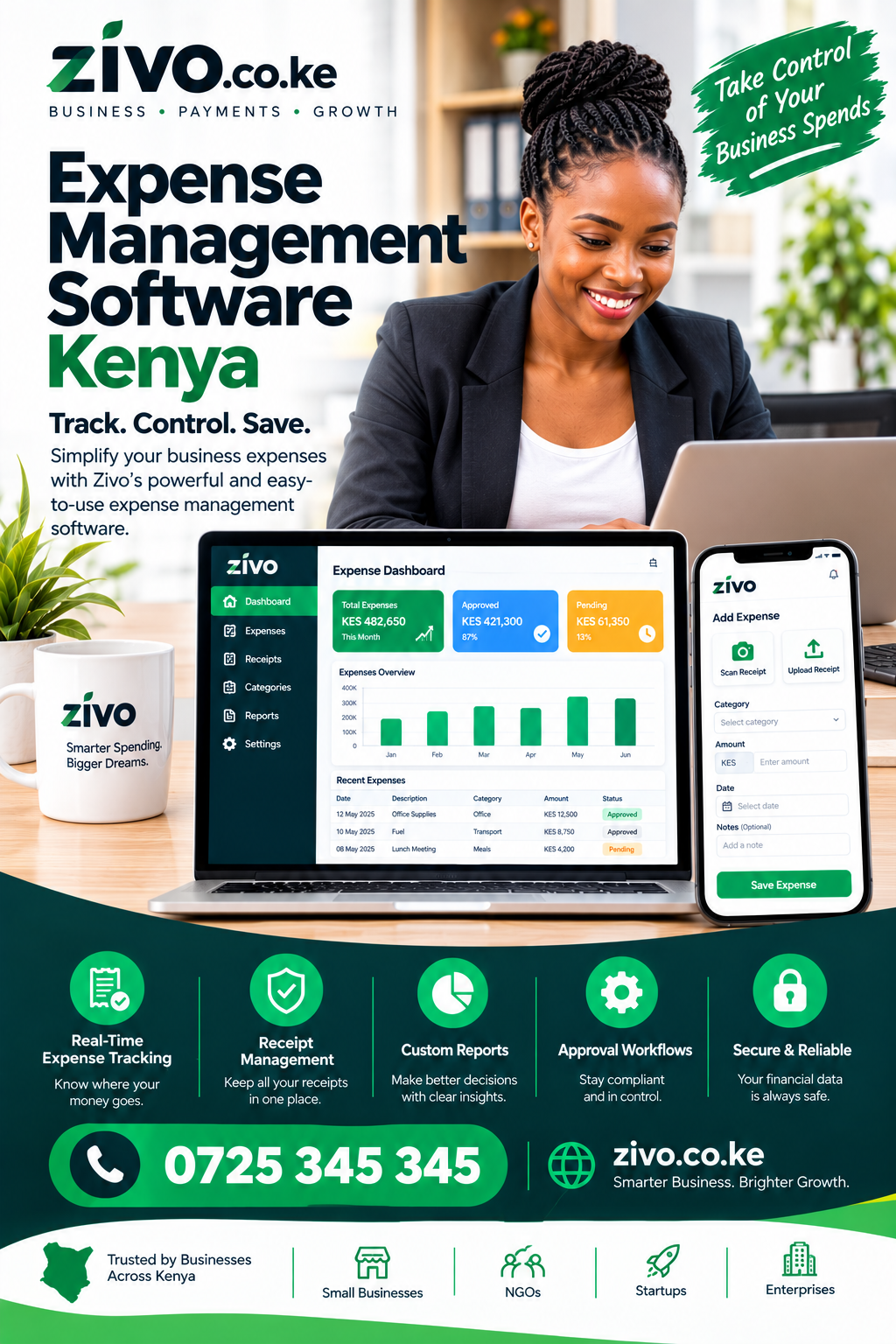
Expense Management Software Kenya: A Complete Guide for Growing Businesses
Business expenses are easy to record when a company is small. A few receipts, supplier payments and staff purchases can be tracked in a notebook or spreadsheet without creating too much confusion. As the business grows, however, spending becomes harder to control. More employees request money, more suppliers need to be paid, receipts arrive through different channels, and managers need better visibility into where cash is going. This is where Expense Management Software Kenya becomes valuable for businesses that want a structured way to request, approve, record and review expenses.
The challenge is not simply knowing how much money the business spent. A business owner also needs to know why money was spent, who requested it, who approved it, which supplier or payee received it, which department incurred the cost, and whether supporting documentation is available. Without those connections, expense tracking can quickly become a collection of receipts, WhatsApp messages, spreadsheets and payment confirmations that are difficult to reconcile.
This guide explains how modern expense management works, why Kenyan businesses need better spending controls, which features matter when choosing software, how to move away from manual processes, and how to build a practical expense-management workflow that supports better financial decisions.
What Is Expense Management Software?
Expense Management Software Kenya refers to digital tools designed to help businesses record, organise, approve, monitor and report on their expenses. Instead of keeping expenditure information in several disconnected places, businesses can use a central workflow for capturing expense requests, documenting transactions, attaching receipts, assigning costs and monitoring approvals.
Expense management is broader than simply entering figures into an accounting system. A complete expense process begins before money is spent. An employee may request funds for transport, equipment, supplies, travel or another business need. The request may then require approval before payment is made. Once the purchase occurs, a receipt or other supporting document may need to be attached to the transaction.
This creates a chain of accountability:
- An expense is requested.
- The purpose and expected amount are recorded.
- The appropriate person reviews the request.
- The request is approved or rejected.
- Payment is made.
- Supporting documents are attached.
- The expense is assigned to the appropriate supplier, payee or department.
- Finance records the transaction.
- Management can review the spending later.
Expense Management Software Kenya helps businesses organise these stages so that expenses do not disappear into informal conversations or scattered files.
For Kenyan SMEs, this can be particularly useful because many businesses combine mobile payments, bank transfers, cash purchases, supplier invoices and staff reimbursements. The more payment methods a company uses, the more important it becomes to have a consistent process for documenting expenditure.
Why Expense Management Matters for Kenyan Businesses
Expense Management Software Kenya becomes increasingly important as a business moves from owner-managed operations into a team-based organisation.
When the owner personally approves every purchase, there may be little need for a formal approval system. The owner knows who made the purchase and why it was necessary. Once several employees, branches or departments become involved, that visibility can disappear.
A staff member may purchase office supplies and send the receipt through WhatsApp. Another employee may request money by phone. A manager may approve a payment verbally. Finance may later receive a bank statement without the original request. By the end of the month, someone has to reconstruct what happened.
That process creates several risks.
Unclear spending responsibility
If an expense does not have an identifiable requester or department, it can be difficult to determine who should explain it.
Missing receipts
Receipts may remain in employees’ phones, get lost, or be uploaded without enough information to identify the related transaction.
Duplicate payments
When different people do not share the same expense records, a supplier may accidentally be paid twice.
Unapproved spending
Employees may make purchases without following the company’s approval rules.
Delayed reporting
Finance teams may spend days collecting information before management can see an accurate picture of expenditure.
Poor cash-flow visibility
A company may know how much money is in its bank or M-Pesa account but still lack a clear understanding of upcoming expenses and committed spending.
Expense Management Software Kenya can address these problems by creating a consistent digital process for spending.
The Difference Between Expense Tracking and Expense Management
Expense tracking and expense management are related, but they are not exactly the same.
Expense tracking usually means recording money that has already been spent. For example, a company might enter a KSh 8,000 office-supplies purchase into a spreadsheet.
Expense management starts earlier.
The business may first record a request for KSh 8,000, identify the person requesting it, specify the reason, obtain approval, make the payment, attach the receipt and then record the final expense.
This distinction matters because effective financial control begins before money leaves the business.
Expense Management Software Kenya allows businesses to think about spending as a complete workflow rather than a collection of historical transactions.
For example, consider a company that receives a request for KSh 50,000 to purchase equipment. A good expense process should allow the manager to understand:
- What equipment is being purchased?
- Why is it required?
- Which supplier is involved?
- Who requested the purchase?
- Which department needs it?
- Has the purchase already been approved?
- What payment method will be used?
- What documentation will be provided?
- Has the payment already been made?
The more of these questions that can be answered from one organised record, the easier it becomes to manage expenditure.
How an Expense Management Workflow Works
Expense Management Software Kenya can help businesses build a workflow that connects expense requests with final financial records.
Step 1: Create the expense request
The process starts when an employee or manager identifies a business expense.
The request should contain enough information for another person to understand the purpose of the spending. Depending on the business, this might include the item, expected amount, supplier, department and reason for the purchase.
Avoid vague descriptions such as “urgent payment” or “office issue.” A useful description explains what the money is intended for.
Step 2: Identify the payee
The system should identify who will receive the money.
This might be:
- A supplier
- An employee
- A contractor
- A service provider
- A landlord
- A government agency
- Another business partner
Expense Management Software Kenya becomes more useful when supplier and payee information remains connected to the expense rather than being maintained in a separate spreadsheet.
Step 3: Assign the department
Departments provide another layer of accountability.
For example, a business may have:
- Sales
- Operations
- Finance
- Human resources
- Marketing
- Procurement
- Delivery
- Customer service
A marketing expense should not simply appear as “business expense.” It should be associated with the appropriate department so management can understand where spending is occurring.
Step 4: Submit supporting documents
Receipts, quotations, invoices and other supporting documents provide evidence for the transaction.
A good process keeps these documents connected to the expense record.
Expense Management Software Kenya can help businesses move away from situations where employees store receipts in personal phone galleries and finance staff have to request them repeatedly.
Step 5: Approve the expense
Approval rules depend on the organisation.
A small purchase may require one manager’s approval. A larger purchase may require additional review.
The important principle is consistency.
Every employee should understand which expenses require approval and who has authority to approve them.
Step 6: Make the payment
Once an expense is approved, payment can be made using the appropriate business payment account.
Depending on the organisation, this could include bank payments, M-Pesa, cash or another approved payment method.
Step 7: Record the completed expense
After payment, the final amount and supporting documentation should remain attached to the expense.
This creates a complete record from request to payment.
Step 8: Include the expense in financial reporting
The final step is visibility.
Management should be able to understand how expenses affect cash flow, profitability and overall business performance.
Expense Management Software Kenya supports this broader objective by bringing spending information into a structured financial workflow.
Key Features to Look For
When evaluating expense-management platforms, businesses should focus on features that solve real operational problems rather than simply choosing the platform with the longest feature list.
Expense requests
The system should allow employees to submit clear requests.
A good request process should capture:
- Purpose
- Amount
- Supplier or payee
- Department
- Requester
- Supporting documents
- Required date
- Approval status
Approval workflows
Approvals are central to spending control.
The platform should make it easy to identify:
- Pending expenses
- Approved expenses
- Rejected expenses
- Paid expenses
- Expenses requiring additional information
Expense Management Software Kenya can help create a more transparent approval process by giving employees and managers a shared record of expense status.
Receipt management
Receipts are important evidence.
Businesses should avoid depending on physical receipts that can easily be lost. Digital receipt storage makes it easier to retrieve documentation during internal reviews, accounting work or audits.
Supplier management
A business with many suppliers needs accurate supplier information.
A supplier record can help connect expenses with the organisation receiving the payment.
Department tracking
Department-level expense tracking makes it easier to understand where money is being used.
A company may discover, for example, that delivery expenses are increasing faster than sales or that a particular branch is spending more on supplies than expected.
Payment account tracking
Expense records should indicate which account or payment method was used.
This becomes especially important when a business operates multiple bank accounts, M-Pesa accounts or other payment channels.
Payment vouchers
Payment vouchers can provide additional documentation around approved spending.
They can be useful when finance teams need a clear record of how a payment was authorised and completed.
M-Pesa payouts
For Kenyan businesses, M-Pesa can form part of everyday business payments.
Expense Management Software Kenya should therefore be evaluated based on how well the expense workflow handles mobile-money payments alongside other payment methods.
Reporting
Management reports should make it easier to answer questions such as:
- How much did we spend this month?
- Which departments spent the most?
- Which suppliers received the most payments?
- How much remains pending approval?
- Which expenses are still missing documentation?
- How much has been spent compared with previous periods?
Why Spreadsheets Become Difficult to Manage
Spreadsheets are not inherently bad.
For a very small business, a spreadsheet may be enough to track a limited number of expenses.
The problem begins when the business grows and the spreadsheet becomes the centre of an increasingly complicated workflow.
Expense Management Software Kenya can provide a more structured alternative when businesses find themselves dealing with multiple expense files, approval conversations and manual reconciliation.
Common spreadsheet problems include:
Multiple versions
Different employees may have different copies of the same expense file.
Formula errors
A changed formula can affect totals without anyone noticing immediately.
Limited approval history
A spreadsheet may show that an expense was approved but not provide a reliable record of who approved it and when.
Missing documents
Receipts may be stored somewhere else.
Manual duplication
The same expense may need to be entered into several systems.
Weak visibility
Management may need to ask finance staff to prepare a new report every time they want to analyse spending from a different perspective.
The goal of expense software is not simply to make a spreadsheet digital. It is to create a more connected process.
Expense Management for Kenyan SMEs
Small and medium-sized enterprises often operate with limited finance staff.
The owner may also be responsible for sales, procurement, staff management and financial decisions.
That makes simplicity important.
Expense Management Software Kenya should help reduce administrative work rather than introduce another complicated system for employees to maintain.
A growing SME may have expenses such as:
- Office rent
- Internet
- Electricity
- Transport
- Fuel
- Marketing
- Staff meals
- Equipment
- Software subscriptions
- Supplier purchases
- Repairs
- Professional services
- Delivery costs
- Travel
- Employee reimbursements
Without proper categorisation, all of these expenses can end up as one large monthly figure.
Categorisation allows management to see what is driving expenditure.
For example, if fuel costs increase significantly, management can investigate whether the increase is caused by more deliveries, higher activity, inefficient routes or another operational change.
Expense Approval Controls
Approval controls are particularly important when multiple employees can spend company money.
The company should define clear rules.
For example:
Small expenses: Department manager approval.
Medium expenses: Department manager plus finance review.
Large expenses: Senior management approval.
The exact limits should be determined by the organisation.
Expense Management Software Kenya can help businesses formalise these processes so employees know what is expected before spending occurs.
Approval controls should also avoid unnecessary bureaucracy.
If every KSh 500 purchase requires three approvals, employees may avoid the official process altogether.
A practical policy should balance control with efficiency.
Managing Employee Reimbursements
Employee reimbursements can become difficult to manage when there is no standard process.
An employee might pay for:
- Taxi or transport
- Business meals
- Small office purchases
- Emergency repairs
- Travel expenses
- Client-related costs
The employee then submits a receipt and expects reimbursement.
Without a structured system, finance staff may have difficulty determining whether the purchase was approved, whether the receipt is valid, whether the employee has already been reimbursed and which department should bear the cost.
Expense Management Software Kenya can support a more organised approach by keeping the request, documentation and payment information together.
Managing Supplier Expenses
Supplier spending is another major area where expense controls matter.
A business may work with dozens or hundreds of suppliers.
If supplier payments are recorded inconsistently, management may struggle to understand total spending with each supplier.
For example, a company could make several payments to the same supplier under slightly different descriptions.
A central supplier record makes it easier to analyse spending.
Expense Management Software Kenya can be assessed according to how well supplier information connects with individual expense records.
Businesses should also consider whether suppliers need supporting documentation such as quotations, invoices or purchase records.
Departmental Expense Tracking
Departmental tracking is particularly useful for growing companies.
Suppose a company spends KSh 500,000 in one month.
That number alone does not explain much.
Management may want to know:
- Sales: KSh 80,000
- Marketing: KSh 120,000
- Operations: KSh 180,000
- Administration: KSh 70,000
- Other: KSh 50,000
The categories provide context.
Expense Management Software Kenya can help businesses structure expenditure around departments and other internal categories where this information is important.
This makes management meetings more productive because discussions can focus on actual spending patterns rather than estimates.
Expense Management and Cash Flow
Expense management is closely connected to cash flow.
A business can be profitable on paper and still experience cash-flow pressure if significant payments leave the business before customer collections arrive.
Understanding upcoming and completed expenses helps management plan.
Expense Management Software Kenya can form part of a broader cash-flow process where business owners can see money coming in, money going out and outstanding obligations.
For example, imagine a company expects KSh 1 million in customer payments during the month.
At the same time, it has:
- KSh 250,000 supplier obligations
- KSh 150,000 payroll-related costs
- KSh 100,000 rent and utilities
- KSh 100,000 operational expenses
Management needs more than a sales report to understand the real cash position.
Expense information provides part of that picture.
Expense Management and Profitability
Revenue is only one side of profitability.
If sales increase while expenses increase even faster, the business may not actually be improving financially.
This is why management should monitor both income and expenditure.
Expense Management Software Kenya can help create better visibility into spending categories and financial performance when expense information is consistently captured.
Managers can then ask:
- Are expenses growing faster than revenue?
- Which expense categories are increasing?
- Which costs are fixed?
- Which costs are variable?
- Are some expenses no longer necessary?
- Are departments staying within their budgets?
These questions are difficult to answer when expense information is incomplete.
Building an Expense Policy
Software works best when it supports clear business policies.
Before implementing a system, create an expense policy covering:
- Which expenses employees may claim.
- Which expenses require prior approval.
- Who can approve different amounts.
- What documentation is required.
- How quickly expenses must be submitted.
- Which payment methods are allowed.
- How reimbursements are handled.
- How exceptions are escalated.
Expense Management Software Kenya can then be configured around these rules and workflows.
A policy should be understandable to employees.
Avoid creating a document that nobody reads.
Use examples wherever possible.
How Zivo Fits Into Expense Management
For Kenyan SMEs, Zivo positions expense management as part of a connected business-finance workflow rather than an isolated expense spreadsheet. Its published capabilities include expenses, suppliers, payment accounts, receipts, departments and finance reporting, while its broader expense-control workflow includes itemised requests, approval status, payment vouchers and M-Pesa payouts.
Expense Management Software Kenya can therefore be considered when a business wants to connect expense activity with broader financial records.
Zivo also describes its finance workspace around invoices, payments, expenses, suppliers, payment accounts, customer statements, cash flow, profit, VAT summaries and journals.
This type of connected workflow can be useful because expenses rarely exist independently from the rest of the business.
An expense affects cash.
A supplier payment affects accounts.
A payment account affects reconciliation.
A department affects management reporting.
A receipt provides supporting evidence.
The more connected these records are, the easier it becomes to understand the complete financial picture.
What to Consider Before Choosing Software
Not every business needs the same expense-management system.
Before selecting a platform, document your current process.
Ask:
- How many expenses do we process each month?
- How many people can request spending?
- How many people approve expenses?
- Do we operate multiple departments?
- Do we have multiple branches?
- How many suppliers do we use?
- How are receipts stored?
- How are employees reimbursed?
- Which payment methods do we use?
- Do we use M-Pesa for business payments?
- How often does management review expenses?
- Which reports are required?
Expense Management Software Kenya should be evaluated against these actual requirements rather than simply against a generic feature checklist.
Questions to Ask a Software Provider
When requesting a demonstration, ask the provider to demonstrate a real expense from beginning to end.
For example:
- Create a request.
- Add a supplier.
- Assign a department.
- Attach a receipt or supporting document.
- Submit the request.
- Approve it.
- Record payment.
- Review the completed expense.
- Show how it appears in reports.
This is much more useful than watching a generic product presentation.
Expense Management Software Kenya should be tested against the real workflow your employees will use every day.
Also ask about:
- User permissions
- Approval levels
- Reporting
- Receipt storage
- Supplier management
- Payment accounts
- M-Pesa workflows
- Audit trails
- Data security
- Backups
- Support
- Pricing
- User limits
- Implementation
Common Expense Management Mistakes
Businesses can still experience problems even after adopting software if the underlying process is poorly designed.
Mistake 1: No approval policy
Software cannot compensate for unclear responsibilities.
Mistake 2: Allowing employees to bypass the system
If some expenses are recorded in the system and others remain in WhatsApp messages, management will still lack a complete picture.
Mistake 3: Not requiring supporting documents
A transaction without evidence is harder to verify.
Mistake 4: Poor categorisation
If every transaction is simply labelled “expense,” reporting becomes less useful.
Mistake 5: Too many approval levels
Excessive bureaucracy can encourage employees to avoid the formal process.
Mistake 6: Not reviewing exceptions
An unresolved expense should have an owner and a next action.
Mistake 7: Ignoring small expenses
Small transactions can become significant when repeated over time.
Expense Management Software Kenya is most effective when combined with consistent business policies and employee adoption.
How to Implement Expense Software Successfully
Implementation does not have to happen all at once.
Start with the most important expense workflows.
Phase One: Map current processes
Write down how expenses currently move through the business.
Phase Two: Identify weaknesses
Find where receipts are lost, approvals are delayed or payments are duplicated.
Phase Three: Define categories
Create practical expense categories and departments.
Phase Four: Define approval rules
Decide who approves different types and amounts of spending.
Phase Five: Configure users
Give employees only the access they need.
Phase Six: Test real transactions
Use actual examples from the business.
Phase Seven: Train employees
Show staff how to request, approve, document and complete expenses.
Phase Eight: Monitor adoption
Check whether employees are using the system consistently.
Expense Management Software Kenya can support this transition when the software is introduced as part of a clear process rather than simply installed and left to employees to figure out.
Measuring Expense Management Performance
After implementation, businesses should measure whether the process is actually improving.
Useful indicators include:
- Average approval time
- Number of pending requests
- Number of expenses missing receipts
- Number of rejected requests
- Duplicate payments identified
- Expense processing time
- Reimbursement turnaround time
- Spending by department
- Spending by supplier
- Monthly expense growth
Expense Management Software Kenya becomes more valuable when management can compare these indicators over time.
For example, if the average approval time falls from three days to one day, the process is becoming faster.
If missing receipts decline, documentation is improving.
If duplicate payments fall, financial controls may be becoming stronger.
Expense Management for Multi-Branch Businesses
Multi-branch organisations have additional challenges.
A company might operate offices in Nairobi, Mombasa, Kisumu, Nakuru or other locations.
Each branch may have its own employees, suppliers and operating costs.
Without central visibility, head office may struggle to understand total expenditure.
Expense Management Software Kenya can help businesses think about expense control at both branch and company level.
Managers can then review questions such as:
- Which branch spends the most?
- Which branch has the highest transport costs?
- Which suppliers serve each branch?
- Which branches have pending approvals?
- Which departments are exceeding expected spending?
The ability to compare locations can improve accountability.
Expense Management for Growing Teams
As employee numbers increase, informal spending processes become increasingly difficult to maintain.
A business with five employees may manage approvals through direct conversations.
A business with fifty employees needs more structure.
Expense Management Software Kenya can provide a central workflow where staff know where to submit requests and managers know where to review them.
This also reduces dependence on individual employees.
If the finance officer is away, another authorised team member should still be able to understand the status of pending expenses.
The Role of Receipts and Supporting Evidence
Supporting documentation is one of the most important components of expense management.
A receipt tells the business what was purchased and how much was paid.
A quotation can explain why a supplier was selected.
An approval record can show who authorised the expenditure.
A payment record can show how the money was transferred.
Together, these documents create a stronger transaction history.
Expense Management Software Kenya should therefore be evaluated based on how easily supporting evidence can be attached, reviewed and retrieved.
Businesses should avoid treating documentation as an administrative burden.
Good documentation protects the company.
Expense Management and M-Pesa
M-Pesa is an important consideration for Kenyan businesses because many organisations use mobile payments in their daily operations.
M-Pesa may be used for customer collections, supplier payments, employee reimbursements, transport expenses and other business transactions.
The challenge is ensuring that mobile-money transactions remain connected to the appropriate business records.
Expense Management Software Kenya can be considered as part of a workflow where expenses and payment information are organised together.
Businesses should ask whether the software can clearly distinguish:
- Requested expenses
- Approved expenses
- Paid expenses
- Unpaid expenses
- M-Pesa transactions
- Bank transactions
- Reimbursements
This distinction can make reconciliation easier.
Why Connected Finance Matters
An expense system becomes more valuable when it connects with other business records.
Imagine that an invoice, customer payment, supplier expense and cash-flow report all exist in separate systems.
Finance staff may spend considerable time transferring information between them.
A connected platform can reduce some of that duplication.
Expense Management Software Kenya should therefore be assessed as part of the wider business workflow.
Ask how expenses relate to:
- Cash flow
- Profit reporting
- Suppliers
- Payment accounts
- Customer records
- Invoices
- Receipts
- Accounting records
The goal is not simply to digitise expense forms.
The goal is to create a reliable financial record.
Security and Access Controls
Expense information is sensitive business information.
Not every employee should be able to view every financial record.
For example, a staff member who submits expenses may not need access to company-wide profit reports.
An approver may need to view requests from a particular department.
A finance manager may need broader access.
Expense Management Software Kenya should be evaluated based on how users, roles and permissions are managed.
Businesses should also ask about data protection, backups, secure access and audit history.
Security should be considered alongside usability.
A system that is secure but impossible for employees to use correctly may create operational problems.
Cost Considerations
Price matters when choosing software, but it should not be the only consideration.
Businesses should calculate the current cost of manual expense management.
For example:
- How many hours does finance spend collecting receipts?
- How much time is spent preparing monthly expense reports?
- How often do duplicate payments occur?
- How long do approvals take?
- How much time is spent correcting spreadsheet errors?
- How much money is lost because managers lack spending visibility?
Expense Management Software Kenya should be evaluated against these costs.
A system may have a monthly subscription, but the business should consider whether it saves staff time and improves financial control.
When Should a Business Move From Manual Tracking?
There is no universal transaction number at which a business must adopt expense software.
Instead, look for warning signs.
You may need a more structured system when:
- Receipts are frequently missing.
- Managers cannot see pending expenses.
- Staff use multiple WhatsApp groups for approvals.
- Finance spends too much time collecting documents.
- Expense spreadsheets have become complicated.
- Multiple people edit the same files.
- Supplier payments are difficult to track.
- Employees are reimbursed inconsistently.
- Management lacks timely expense reports.
Expense Management Software Kenya can be particularly useful when these issues begin affecting daily operations.
A Simple Expense Management Checklist
Before implementing software, make sure your business can answer the following questions:
Spending
What types of expenses does the business have?
Responsibility
Who can request spending?
Approval
Who approves each type of expense?
Documentation
What evidence must be provided?
Payment
Which payment channels are permitted?
Suppliers
How are supplier records maintained?
Departments
How are expenses assigned internally?
Reporting
Which reports does management need?
Exceptions
What happens when something goes wrong?
Review
Who checks expenses regularly?
Expense Management Software Kenya should make these processes easier to execute and monitor.
Frequently Asked Questions
What is expense management software?
Expense management software is a digital system that helps businesses record, submit, approve, pay, document and report business expenses. It provides a more structured alternative to relying entirely on paper receipts, spreadsheets and informal approval messages.
Is expense management software useful for small businesses?
Yes. Small businesses can benefit from better visibility even when transaction volumes are modest. The main advantage is creating good processes early so that spending does not become difficult to control as the business grows.
Can expense software manage employee reimbursements?
A suitable platform can support reimbursement workflows by connecting the employee request, supporting documentation, approval and payment information. Businesses should confirm the exact reimbursement functionality offered by their chosen platform.
Can expenses be assigned to departments?
Yes, department-level tracking is an important capability for organisations that need to understand where spending occurs. It can help managers compare costs across teams, branches or operating areas.
Why are receipts important?
Receipts provide evidence supporting an expense. Keeping receipts connected to expense records makes transactions easier to review and reduces the risk of losing important documentation.
Can expense management software work with M-Pesa?
Expense platforms designed for the Kenyan market may support workflows involving M-Pesa. Businesses should confirm exactly how M-Pesa payments and payouts are handled, including authorisation, transaction records and reconciliation.
Does expense management replace accounting software?
Not necessarily. Expense management focuses on controlling and documenting spending. Some platforms connect expense management with broader accounting and finance functions, while others integrate with separate accounting systems.
How can expense software reduce fraud?
No software can eliminate fraud completely. However, approval workflows, user permissions, documentation requirements, payment records and audit trails can make unusual activity easier to identify and investigate.
What should I check before buying expense software?
Check the approval workflow, receipt management, supplier records, departments, payment accounts, reporting, user permissions, integrations, security, support and pricing. Most importantly, test the platform using real business scenarios.
Is expense management important for businesses using M-Pesa?
Yes. When businesses use M-Pesa alongside bank accounts, cash and other payment methods, maintaining a consistent expense record becomes important. The business should be able to understand which payment was made, for what purpose, to whom and under which expense category.
The Future of Expense Management for Kenyan SMEs
Kenyan SMEs are becoming increasingly digital, but many businesses still operate with a mixture of spreadsheets, paper receipts, mobile-money messages, bank statements and informal communication.
The next step is not necessarily to replace every tool immediately.
Instead, businesses can start by connecting the processes that create the most administrative work.
Expense management is a strong place to begin because spending affects nearly every part of the organisation.
When a business controls its expenses, it gains better visibility into cash flow.
When receipts are organised, financial records become easier to verify.
When approvals are clear, managers gain better control.
When departments are tracked, management can identify spending patterns.
When suppliers are organised, purchasing becomes easier to analyse.
When payment information is connected, reconciliation becomes more straightforward.
Expense Management Software Kenya can form part of that transition toward a more organised financial workflow.
Final Thoughts
Expense management is not simply about recording what a business has already spent. It is about creating accountability from the moment an employee requests money to the moment the final expense appears in the company’s financial records.
For a small business, this may initially seem unnecessary. But as the organisation grows, informal processes become increasingly difficult to manage.
Receipts disappear.
Approvals get lost in messages.
Payments are duplicated.
Departments lose visibility.
Suppliers become difficult to track.
Management reports take longer to prepare.
These problems can all make financial management more difficult than it needs to be.
Expense Management Software Kenya provides a structured approach that businesses can evaluate for managing expense requests, approvals, suppliers, receipts, departments, payment accounts and financial reporting.
The right system should not simply create another place for employees to enter information. It should make the entire expense process clearer.
Start by documenting how your business currently handles expenses. Identify where requests are made, where approvals happen, where receipts are stored, how payments are recorded and how management eventually receives the information.
Then identify the biggest gaps.
If your team spends too much time collecting receipts, focus on documentation.
If approvals are unclear, focus on workflow.
If management cannot see departmental spending, focus on categorisation and reporting.
If payment records are difficult to match, focus on connecting expenses with payment accounts.
If your business is growing rapidly, focus on scalability and user controls.
Expense Management Software Kenya should ultimately be judged by whether it makes these everyday processes easier, more transparent and more accountable.
The goal is simple: know where the business money is going, understand why it is being spent, maintain the supporting evidence, and give authorised people enough visibility to make better decisions.
For Kenyan SMEs looking to move away from scattered expense records and manual spreadsheets, a structured expense-management workflow can provide a stronger foundation for financial control and sustainable growth.
Expense Management Software Kenya
Expense Management Software Kenya
Expense Management Software Kenya
Expense Management Software Kenya
Expense Management Software Kenya
Expense Management Software Kenya
Expense Management Software Kenya
Expense Management Software Kenya
Expense Management Software Kenya
Expense Management Software Kenya
Expense Management Software Kenya
Expense Management Software Kenya
Expense Management Software Kenya
Expense Management Software Kenya
Expense Management Software Kenya