
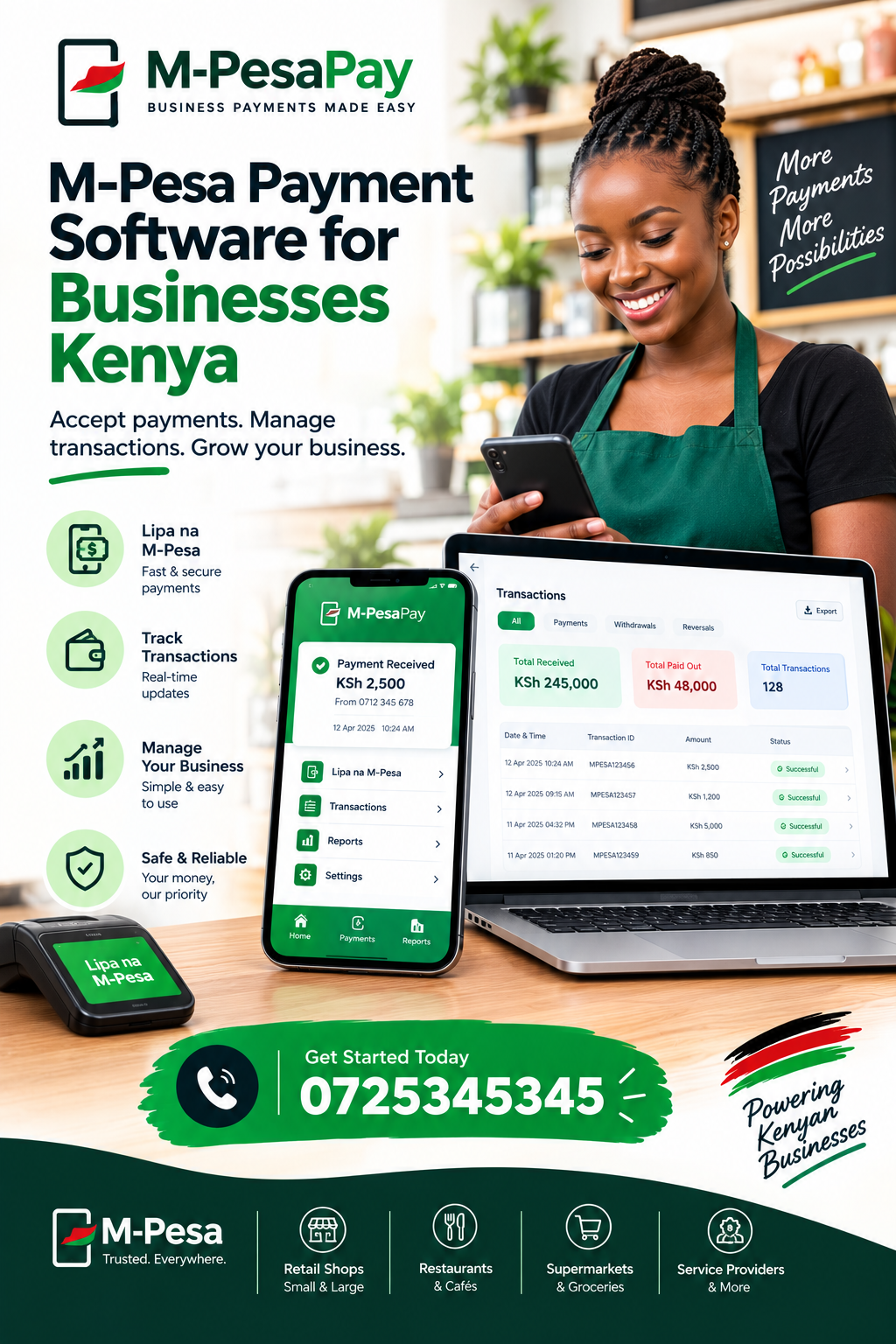
M-Pesa Payment Software for Businesses Kenya rarely gets a second thought until the day someone has to scroll through four hundred M-Pesa messages trying to match one missing payment to one specific customer.
That moment reframes everything. The till number that felt like enough infrastructure for years suddenly looks like the reason nobody can say, with confidence, exactly what came in today, from whom, and for what.
M-Pesa is the default way most Kenyan customers pay, which makes it the artery through which nearly all of a business’s cash actually flows. Everything else — stock, payroll, growth — depends on that artery being tracked properly rather than trusted to memory and a phone screen.
Yet for most businesses, M-Pesa reconciliation is still manual — a paybill number, a phone kept nearby for confirmation messages, and a mental tally that falls apart the moment volume increases past what one person can hold in their head.
M-Pesa Payment Software for Businesses Kenya is what turns that into something reliable, and the payoff isn’t administrative tidiness. It’s knowing, in real time, exactly what has been paid, by whom, and what still hasn’t.
This guide covers why manual M-Pesa tracking breaks down, what a proper system should do, Paybill versus Till versus API integration, cost, security, common mistakes, industry-specific use, and how to actually get this working without disrupting how customers already pay you.
If you take one thing from it: automatic reconciliation is the single highest-return feature you can use. M-Pesa Payment Software for Businesses Kenya that matches a payment to an invoice the instant it lands prevents more losses, disputes, and wasted hours than any manual process ever will.
Kenya’s mobile money ecosystem has matured to the point where, for many businesses, M-Pesa isn’t just one payment option among several — it’s the primary or only way most customers ever pay. That concentration of transaction volume through a single channel makes the quality of your M-Pesa handling disproportionately important compared to almost any other operational system in the business.
It’s worth being honest about why this gets neglected for so long. Unlike a broken invoice or a stockout, a reconciliation gap doesn’t announce itself loudly. It shows up as a slightly-off till balance here, a customer complaint there, an hour lost cross-checking messages on a slow Tuesday — never dramatic enough on its own to prompt urgent action, but compounding steadily until the business either fixes it or simply absorbs the ongoing cost as background noise.
Why M-Pesa tracking breaks down at scale
The arithmetic is unforgiving and most owners have never actually sat down and calculated it.
A single till or paybill number receiving payments from dozens or hundreds of customers a day produces a stream of nearly identical-looking messages — a name, an amount, a transaction code — with almost nothing to visually distinguish one from another at a glance.
Matching those payments to the right invoice, order, or customer becomes harder exactly as the business grows, which is precisely the moment the business can least afford to get it wrong.
Missed payments are the most direct cost. A customer who paid but whose payment was never matched to their order gets chased for money they’ve already sent, which damages trust in a way that’s hard to repair with an apology.
Unrecorded payments are the reverse problem — money that arrived and was never properly logged against anything, effectively invisible until someone happens to notice the till balance doesn’t match the sales log.
Duplicate or fraudulent claims are the third risk. Without a system cross-checking transaction codes, a customer claiming they paid when they didn’t — or paid less than owed — is very difficult to disprove using nothing but scrollback through SMS messages.
Staff time is the quieter cost. Someone, somewhere, is spending real hours every week manually cross-referencing M-Pesa messages against a sales book or spreadsheet, and that time is rarely counted as a genuine business expense even though it clearly is one.
None of this is visible without proper records, which is the practical case for software here. A business relying on SMS confirmations and memory is, in effect, running its core cash function on the least structured system available to it.
Most Kenyan business owners can tell you their daily M-Pesa float and cannot tell you, without manually checking, which of yesterday’s ten payments is still unmatched to an order. M-Pesa Payment Software for Businesses Kenya closes that gap.
There’s also a scaling problem specific to manual tracking that’s easy to underestimate. A person can reasonably keep track of ten M-Pesa payments a day in their head or on a notepad. At fifty a day, that same approach starts producing errors. At two hundred a day, across multiple staff members possibly handling the same till, manual tracking isn’t just inefficient — it becomes structurally impossible to do reliably, no matter how careful or diligent the person doing it is. The failure at that point isn’t a people problem; it’s a systems problem, and it needs a systems solution.
What proper M-Pesa payment software actually does
At its core, M-Pesa Payment Software for Businesses Kenya connects directly to your Paybill, Till, or API account and automatically captures every incoming payment as structured, searchable data — rather than as a string of SMS messages sitting in a phone’s inbox.
A properly built system should match each payment automatically to an invoice, order, or customer record, using the transaction reference, account number, or phone number provided at the point of payment, rather than requiring a person to read and interpret each message manually.
It should flag unmatched payments immediately, rather than letting them sit unreconciled for days or weeks until someone happens to notice the gap between what came in and what was recorded.
It should give you a live, real-time view of what has been received today, this week, and this month, broken down by customer, product, or branch — not a total you have to reconstruct from a paper till roll at closing time.
And it should keep a permanent, searchable record of every transaction, so that a customer dispute about whether they paid, and how much, can be resolved in seconds by pulling up the actual transaction code, rather than becoming a drawn-out argument based on conflicting memories.
Beyond the basics, better platforms also connect this payment data to the rest of your operations — updating an invoice as paid, reducing outstanding balances, and feeding directly into your accounting records, without anyone needing to retype a single figure.
Paybill, Till, and API: understanding your options
Choosing the right integration matters as much as choosing the right software, since the payment method itself shapes what data you actually receive.
Till Number is the simplest and most common setup for retail businesses, ideal for walk-in customers paying at a counter. The tradeoff is that Till payments carry less structured information by default, which makes automatic matching to a specific order somewhat harder without additional configuration.
Paybill Number is generally better suited to businesses that need customers to enter an account number alongside the payment — landlords collecting rent, schools collecting fees, or any business invoicing by account. M-Pesa Payment Software for Businesses Kenya built around Paybill can use that account number to match payments automatically with far greater accuracy than a Till setup alone.
Direct API integration, via Safaricom’s M-Pesa Daraja API, is the most powerful option and the one serious platforms are built on. It allows software to receive payment confirmations instantly and programmatically, trigger automatic invoice updates, and even initiate payments such as refunds or supplier disbursements, rather than relying on parsing SMS text after the fact.
Businesses processing meaningful volume should push for direct API integration wherever possible, since SMS-parsing workarounds are inherently less reliable — a missed message, a full inbox, or a phone left uncharged can silently break the entire reconciliation chain.
There’s a middle path worth knowing about too. Some providers offer a hybrid approach — SMS parsing as a fallback layer alongside a primary API connection — so that if the API connection ever drops momentarily, transactions aren’t lost entirely, just delayed slightly in processing. This kind of redundancy matters more than it might initially seem, since even a well-configured API integration can occasionally experience brief outages, and a business processing significant volume cannot afford to lose transaction records during that window.
It’s also worth thinking ahead rather than only solving for the business as it exists today. A business currently on a single Till number might reasonably expect to add a second branch, a Paybill for invoiced clients, or direct API access within a year or two of real growth. Choosing M-Pesa Payment Software for Businesses Kenya that can grow with that trajectory, rather than one built narrowly around a single Till, avoids a second disruptive migration down the line.
Comparing manual tracking against proper software
It’s worth laying the comparison out directly, since the gap is often larger than owners assume until they see it side by side.
Manual tracking depends entirely on someone reading and interpreting SMS messages correctly, every single time, with no system checking their work. Proper software captures the transaction programmatically, with no room for a human to misread a name or transpose a number.
Manual tracking has no memory beyond what’s written down. If nobody wrote down a particular payment, it’s effectively gone until someone happens to notice the shortfall. Proper software retains a permanent, searchable record of every transaction from the moment it lands.
Manual tracking scales badly — the more transactions, the more error-prone the process becomes. Proper software scales cleanly, since matching a thousand transactions automatically is no harder than matching ten.
Manual tracking makes disputes a matter of memory and trust. Proper software makes disputes a matter of pulling up the actual transaction code in seconds, which tends to end most disagreements immediately rather than prolonging them.
Core features worth prioritising
Automatic matching — the single most important feature. M-Pesa Payment Software for Businesses Kenya that matches payments to invoices without manual intervention removes the majority of the reconciliation workload in one step.
Real-time notifications — beyond the standard SMS, a proper system should surface payments on a dashboard the moment they land, ideally with the matched customer or order already attached.
Multi-till and multi-branch support — for businesses running several outlets, each with its own Till or Paybill, consolidated reporting across all of them in one place is essential. Chasing separate totals from separate tills defeats much of the purpose.
Refund and reversal handling — customers occasionally overpay, pay the wrong amount, or need a refund. M-Pesa Payment Software for Businesses Kenya that can initiate and track these directly, rather than requiring a manual trip to an agent, saves considerable time.
Reconciliation reports — a clear daily or weekly reconciliation report, matched against bank statements or accounting records, is what actually closes the loop between “payment received” and “books balanced.”
Customer payment history — being able to pull up a specific customer’s full M-Pesa payment history in seconds is invaluable for resolving disputes and understanding payment patterns over time.
Integration with invoicing and accounting — M-Pesa Payment Software for Businesses Kenya that updates an invoice as paid automatically, rather than requiring a second manual step, closes the gap between payment and record-keeping entirely.
Cost considerations
Pricing for M-Pesa Payment Software for Businesses Kenya varies depending on transaction volume, whether the integration is API-based or SMS-based, and what other features — invoicing, accounting, multi-branch reporting — are bundled in.
Some providers charge a flat monthly subscription regardless of volume; others charge a small per-transaction fee on top of Safaricom’s own charges. It’s worth modelling both against your actual monthly transaction count before committing, since the cheaper-looking option on paper isn’t always cheaper at your specific volume.
Don’t evaluate cost in isolation from what it replaces. The staff hours currently spent manually reconciling M-Pesa messages, and the losses from unmatched or disputed payments, are real costs that rarely get counted explicitly — and they are usually larger than the subscription fee for M-Pesa Payment Software for Businesses Kenya that eliminates them.
Factor in the cost of Safaricom’s own API access and any setup fees for direct Daraja integration, which some vendors include in their pricing and others charge separately. Ask explicitly rather than assuming.
Security and fraud prevention
Any business adopting M-Pesa Payment Software for Businesses Kenya is handling live financial transaction data, and that comes with real responsibility, not just convenience.
A reputable platform should use encrypted connections for all API communication, secure credential storage for your Paybill or Till API keys, and role-based access so not every staff member can see or export the full transaction history.
Fraud prevention is a genuine concern with any payment system. M-Pesa Payment Software for Businesses Kenya that cross-checks transaction codes against Safaricom’s own records, rather than trusting a screenshot or a verbally reported confirmation, protects the business from a customer falsely claiming payment.
Kenya’s Data Protection Act, 2019 applies to the customer phone numbers and transaction data these systems store, so confirm your vendor’s compliance posture rather than assuming it. I’m not a lawyer, so take specific advice if you’re unsure how the Act applies to your particular setup.
Keep transaction records for at least the period required for tax and audit purposes. Most M-Pesa Payment Software for Businesses Kenya retains this automatically, which is one less thing to manage manually, but confirm the retention period explicitly with your provider.
It’s also worth considering what happens if a staff member with access to the system leaves the business. A proper system should let you revoke individual access immediately, without needing to change shared credentials that everyone else also relies on. Shared logins are convenient in the short term and a genuine liability the moment someone with access departs on bad terms.
Two-factor authentication for anyone with administrative access is worth insisting on, particularly for the account controlling API credentials or the ability to initiate refunds. A compromised login at that level isn’t just a data risk — it’s a direct financial one.
Common mistakes businesses make
Sticking with SMS-only tracking well past the point where volume justifies proper software is the most common mistake. Owners often wait until reconciliation errors become a visible, painful problem rather than switching proactively while the cost is still manageable.
Choosing Till over Paybill without considering the matching implications is a second mistake. A business that genuinely needs account-level matching — rent collection, school fees, subscription billing — often defaults to a Till number simply because it was the first option offered, then struggles with matching indefinitely afterward.
Not integrating payment data with invoicing is a third mistake. M-Pesa Payment Software for Businesses Kenya that sits as a standalone reporting tool, disconnected from the invoices it’s supposed to be settling, still leaves someone updating invoice status manually — which defeats much of the point.
Ignoring unmatched payments is a fourth and particularly costly mistake. A small number of unmatched transactions each week seems harmless in isolation, but left unaddressed for months, they represent real, uncollected clarity about the business’s actual cash position.
Overlooking refund and reversal tracking is a fifth mistake. Businesses that can initiate a payment but not cleanly track a refund often end up with a parallel manual process for exactly the transactions that most need clean records — the disputed ones.
A sixth mistake, common among fast-growing businesses, is failing to revisit the setup as volume grows. A configuration that worked well at ten transactions a day can become a genuine bottleneck at two hundred, and the business that never re-evaluates its M-Pesa Payment Software for Businesses Kenya against its current volume is likely operating with unnecessary friction it has simply gotten used to.
Industry snapshots
Retail and small shops — high transaction volume with many small payments makes automatic matching essential. M-Pesa Payment Software for Businesses Kenya with strong Till support keeps queues moving while still producing a clean daily reconciliation.
Landlords and property managers — rent collection via Paybill, matched automatically to specific tenant accounts, removes the monthly scramble of matching who has and hasn’t paid. M-Pesa Payment Software for Businesses Kenya built for this use case flags arrears the same day rather than at month-end.
Schools and training institutions — fee collection across many students, often in instalments, benefits enormously from account-number matching. Reconciling this manually across a full student roll is one of the more error-prone administrative tasks a school can face without proper tools.
Service businesses and consultants — invoicing clients and matching M-Pesa payments to specific invoices, rather than a general pool of income, keeps accounts receivable accurate and disputes rare.
Transport and logistics — operators collecting fares or delivery payments via Till benefit from consolidated daily reporting across multiple vehicles or routes, rather than reconciling each one separately at the end of a long day.
Reporting and cash flow visibility
Beyond day-to-day reconciliation, the reporting layer of M-Pesa Payment Software for Businesses Kenya is often where the real strategic value sits.
A daily summary showing total received, number of transactions, and average transaction size gives an owner a quick read on how the day actually went, without needing to open a spreadsheet or count till slips by hand.
Weekly and monthly trends matter even more. Seeing that Thursday and Friday consistently bring in significantly more M-Pesa revenue than Monday and Tuesday, for example, is the kind of pattern that should directly inform staffing, stock ordering, and promotional timing — but it only becomes visible once the data is captured systematically rather than scattered across individual SMS threads.
Customer-level reporting adds another layer. Being able to see a specific customer’s full payment history — how often they pay, how much, whether they’ve ever disputed a transaction — turns M-Pesa data from a simple ledger into an actual relationship-management tool.
For businesses with multiple staff members or branches handling payments, reporting by staff member or location adds accountability that manual tracking simply cannot provide. If one till consistently shows more unmatched transactions than another, that’s a signal worth investigating, and it’s only visible with proper software in place.
This kind of granular visibility also supports better conversations with staff. Rather than a vague sense that “the till doesn’t seem to balance sometimes,” a manager can point to specific dates, specific shifts, and specific unmatched amounts, turning a fuzzy suspicion into a concrete, addressable issue.
Implementation: getting it running without disrupting customers
The good news is that switching to proper M-Pesa Payment Software for Businesses Kenya rarely requires customers to change how they pay. The Paybill or Till number usually stays the same; what changes is what happens to the payment data behind the scenes.
Start by confirming your existing Paybill or Till setup with Safaricom, and whether direct API access is already enabled or needs to be requested. This is often the longest lead-time item, so start it early rather than assuming it will be instant.
Map your existing manual reconciliation process before switching, so you know exactly what the new system needs to replicate or improve on — which fields matter, which reports get checked, and by whom.
Run a parallel period where both the old manual process and the new system are used side by side for a week or two, comparing totals daily. This catches configuration issues before they become live disputes with real money at stake.
Train whoever currently handles reconciliation manually on the new dashboard specifically, since they are the ones best placed to spot whether something looks wrong early on.
Communicate any changes to customers only if the payment number itself changes — otherwise, this is an entirely back-end improvement that customers never need to notice.
Once live, resist the temptation to abandon the old manual log immediately. Keep it running in a reduced form for the first month as a sanity check, comparing totals weekly against what the new system reports. Any discrepancy at this stage is far easier to trace and fix than one discovered months later, once the manual process has already been fully retired and the institutional knowledge of how it worked has started to fade.
Frequently asked questions
Do I need Safaricom’s API access, or can software work with just SMS?
SMS-based tracking can work for lower volumes, but it’s inherently less reliable than direct API integration, which receives payment confirmations instantly and programmatically rather than relying on parsing text messages.
Will switching software change my Paybill or Till number?
No, in most cases your existing number stays exactly the same. The software changes what happens to the payment data behind the scenes, not how customers pay you.
Can it handle both Till and Paybill payments in one place?
Good M-Pesa Payment Software for Businesses Kenya can consolidate reporting across multiple Till and Paybill numbers, which matters for any business running more than one branch or income stream.
How does it handle refunds?
Better platforms allow refunds to be initiated and tracked directly from the same system, rather than requiring a manual trip to an M-Pesa agent and a separate record of what was refunded and why.
What happens with an unmatched payment?
A properly built system flags it immediately for manual review, rather than letting it sit unreconciled for days. This is usually the single biggest improvement over SMS-only tracking.
Is my transaction data secure?
Reputable providers use encrypted connections and secure credential storage for your API keys. Confirm this specifically before signing up, rather than assuming it by default.
Do I need technical staff to set this up?
Initial API setup with Safaricom can involve some technical steps, which most vendors handle on your behalf. Day-to-day use of the dashboard itself is designed for regular business staff, not developers.
What’s the single highest-return feature?
Automatic reconciliation. M-Pesa Payment Software for Businesses Kenya that matches a payment to an invoice or order the instant it arrives removes the majority of the manual workload and the majority of the disputes in one step.
How long does a typical implementation take?
For a business with a single Till or Paybill and moderate transaction volume, most implementations, including a parallel testing period, can be completed within two to four weeks. Businesses with multiple branches or more complex integration needs should expect a longer, more phased rollout.
Conclusion
Adopting the right M-Pesa Payment Software for Businesses Kenya changes something fundamental about how a business handles its most important payment channel — not just tidier records, but a genuinely clearer picture of cash as it actually moves. Every payment matched automatically, every dispute resolved in seconds rather than an afternoon, and every reconciliation report that closes cleanly is a small advantage that compounds every single day.
Kenyan businesses that treat M-Pesa reconciliation as a proper operational function, rather than a background task handled by memory and a phone, tend to have clearer cash positions and far fewer disputes with customers. There has never been a better time to move away from scrolling through SMS messages, and toward M-Pesa Payment Software for Businesses Kenya that does the matching so you don’t have to.
The businesses that get the most value from this shift tend to be the ones that treat it as more than a technical upgrade. Properly implemented, M-Pesa Payment Software for Businesses Kenya doesn’t just save time — it changes the quality of decisions an owner can make, because those decisions are finally based on complete, accurate, real-time data rather than a partial picture reconstructed from memory and a scroll through old messages. That shift, from guessing to knowing, is ultimately what the investment is buying, and it tends to matter more the longer a business relies on it. Few operational changes offer this much clarity for this modest a cost, which is exactly why it belongs near the top of the list for any Kenyan business still reconciling M-Pesa by hand.
M-Pesa Payment Software for Businesses Kenya
M-Pesa Payment Software for Businesses Kenya
M-Pesa Payment Software for Businesses Kenya
M-Pesa Payment Software for Businesses Kenya
M-Pesa Payment Software for Businesses Kenya
M-Pesa Payment Software for Businesses Kenya
M-Pesa Payment Software for Businesses Kenya
M-Pesa Payment Software for Businesses Kenya
M-Pesa Payment Software for Businesses Kenya
M-Pesa Payment Software for Businesses Kenya
M-Pesa Payment Software for Businesses Kenya
M-Pesa Payment Software for Businesses Kenya
M-Pesa Payment Software for Businesses Kenya
M-Pesa Payment Software for Businesses Kenya
M-Pesa Payment Software for Businesses Kenya