
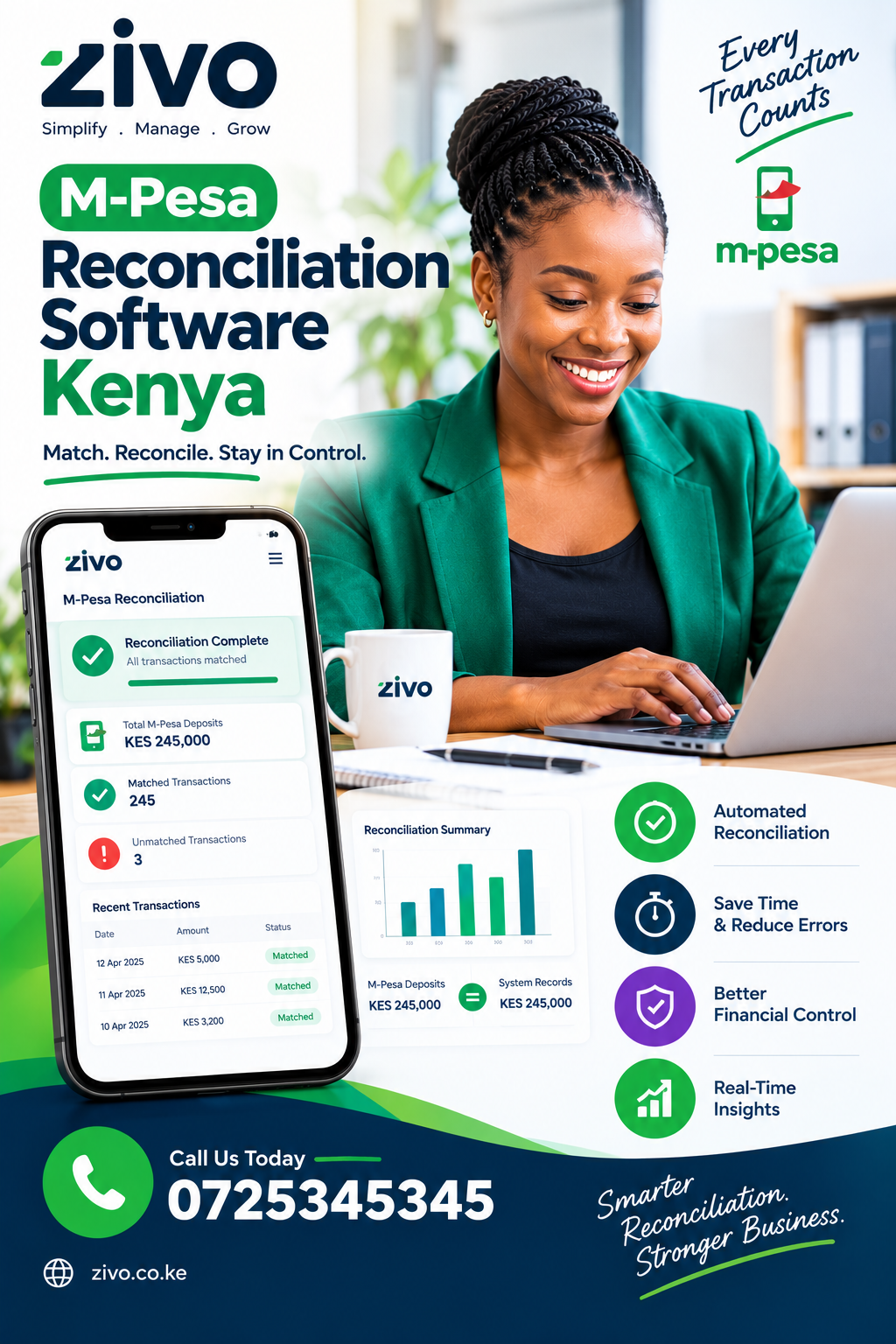
M-Pesa Reconciliation Software Kenya: How Businesses Can Simplify Payment Reconciliation
For a Kenyan business receiving dozens or hundreds of customer payments through M-Pesa, keeping financial records accurate can become a daily challenge. Payments may arrive at different times, customers may use different references, and finance teams may have to compare transaction records against invoices, sales, receipts, and bank information. M-Pesa Reconciliation Software Kenya helps businesses organize this process by making it easier to identify payments, match transactions, investigate differences, and maintain reliable financial records.
Payment reconciliation is especially important for SMEs, retailers, service providers, schools, property businesses, professional firms, distributors, contractors, and other organizations that receive money electronically. When reconciliation is handled manually, finance teams can spend significant amounts of time checking transaction lists and determining which customer or invoice a particular payment belongs to.
A structured reconciliation process changes that. M-Pesa Reconciliation Software Kenya can help businesses bring payment information into a more organized workflow, allowing financial records to reflect actual transactions more consistently.
This guide explains what M-Pesa reconciliation means, why it matters in Kenya, how reconciliation works, which features businesses should look for, common problems to avoid, and how a business can introduce a more reliable payment-matching process.
What Is M-Pesa Reconciliation?
M-Pesa Reconciliation Software Kenya refers to software designed to help businesses compare M-Pesa payment transactions against their internal financial records.
The basic objective is simple: the business wants to know whether the money recorded as received corresponds with the money that actually came through its payment channel.
For example, imagine a customer has an invoice for KES 25,000. The customer sends the amount through M-Pesa. The business needs to identify the transaction, confirm the amount, associate it with the correct customer or invoice, and update its records.
When there are only a few transactions, this may be easy to do manually. As transaction volumes increase, however, the process becomes more demanding.
M-Pesa Reconciliation Software Kenya can provide a structured environment for managing those payment records and reducing the amount of manual matching required.
Reconciliation is more than checking a total
A business might receive KES 500,000 through M-Pesa during a month. Knowing the total is useful, but it does not necessarily tell the business which invoices were paid.
Good reconciliation goes further.
The business may need to determine:
- Who made each payment?
- Which invoice does it relate to?
- Was the amount correct?
- Was the payment duplicated?
- Is the payment still unmatched?
- Was the transaction recorded correctly?
- Does the internal record agree with the payment record?
M-Pesa Reconciliation Software Kenya can help organize these questions into a manageable financial process.
Why M-Pesa Reconciliation Matters in Kenya
M-Pesa is deeply integrated into many Kenyan business operations. Customers use mobile payments to pay for goods and services, settle invoices, transfer money, and make other transactions.
That convenience creates a corresponding accounting requirement.
Businesses need reliable ways to identify incoming payments and associate them with the correct financial records.
M-Pesa Reconciliation Software Kenya can help organizations create better visibility over incoming mobile payments.
Without proper reconciliation, several issues can arise. A payment might be received but remain marked as unpaid in the accounting records. A customer might be contacted unnecessarily about an invoice that has already been settled. Finance staff may spend time investigating transactions that could have been matched automatically or systematically.
The problem grows with transaction volume
Consider a business receiving 20 M-Pesa payments per month.
Manual reconciliation may be manageable.
Now consider 2,000 payments.
The basic task remains the same, but the number of possible mismatches increases significantly.
M-Pesa Reconciliation Software Kenya can become particularly valuable when transaction volumes make manual reconciliation difficult to maintain.
How M-Pesa Reconciliation Works
The reconciliation process generally involves comparing two sets of information.
The first is the payment information from the M-Pesa channel or related financial account.
The second is the business’s internal records, such as invoices, sales, receipts, customer balances, or accounts receivable.
M-Pesa Reconciliation Software Kenya can help bring these records together so that transactions can be reviewed and matched.
A simplified process may look like this:
Payment received → Transaction identified → Customer or invoice matched → Amount verified → Record updated → Exceptions reviewed
The exact workflow depends on the software and available integrations.
Example of a payment match
Suppose a customer has an invoice of KES 18,500.
The customer makes an M-Pesa payment of KES 18,500.
The payment contains information that allows the business to identify the customer or reference.
A reconciliation system can use the available information to determine whether the payment corresponds to the outstanding invoice.
M-Pesa Reconciliation Software Kenya can help finance staff manage these matching activities more systematically.
Common M-Pesa Reconciliation Problems
Businesses often encounter similar issues when reconciliation is handled manually.
1. Unmatched payments
Money arrives, but finance staff cannot immediately determine who sent it or which invoice it belongs to.
2. Duplicate records
The same payment may accidentally be entered more than once.
3. Wrong customer allocation
A payment may be assigned to the wrong customer account.
4. Incorrect amounts
The amount received may differ from the amount expected.
5. Delayed updates
A customer may have paid, but the internal account still shows the invoice as outstanding.
M-Pesa Reconciliation Software Kenya can help businesses establish a more consistent process for identifying and resolving these issues.
Matching Payments to Invoices
One of the most useful reconciliation functions is payment-to-invoice matching.
Businesses that issue many invoices need to know which invoices have been settled and which remain outstanding.
M-Pesa Reconciliation Software Kenya can support this process where invoice and payment records are connected.
For example:
| Invoice | Customer | Amount | Payment | Status |
|---|---|---|---|---|
| INV-001 | Customer A | KES 15,000 | KES 15,000 | Paid |
| INV-002 | Customer B | KES 20,000 | KES 10,000 | Part-paid |
| INV-003 | Customer C | KES 12,500 | — | Unpaid |
| INV-004 | Customer D | KES 8,000 | KES 8,000 | Paid |
This kind of information helps finance teams understand the actual position of customer accounts.
Handling Partial Payments
Not every customer pays an invoice in full.
A customer may owe KES 50,000 but send KES 20,000.
The business needs to record the payment correctly and leave the remaining KES 30,000 outstanding.
M-Pesa Reconciliation Software Kenya can be useful where the reconciliation workflow supports partial payments and outstanding balances.
This is important because treating a partial payment as a fully settled invoice can distort accounts receivable.
A reliable system should make it clear that the customer has paid something without incorrectly closing the entire balance.
Handling Overpayments
Customers may sometimes send more money than the amount requested.
For example, an invoice may be KES 9,500 while the customer sends KES 10,000.
The business needs to determine how the additional KES 500 should be treated according to its financial policy.
M-Pesa Reconciliation Software Kenya can help flag differences so that finance staff can investigate them instead of silently treating every transaction as an exact match.
An overpayment may need to remain as a customer credit, be allocated to another approved balance, or be handled through another process.
The important thing is that the difference should be visible.
Managing Unmatched Transactions
Not every payment will match automatically.
A customer may enter an incomplete reference. Multiple customers may pay similar amounts. A payment may arrive before the corresponding invoice has been created.
M-Pesa Reconciliation Software Kenya can help businesses maintain a list of unmatched transactions that require human review.
This is an important feature.
Automation should not mean that uncertain transactions disappear into the system. Instead, uncertain transactions should be identified and presented for investigation.
An effective exception process
Finance staff can review:
- Payment amount
- Transaction date
- Customer details
- Reference information
- Outstanding invoices
- Previous payment history
- Possible duplicate transactions
Once the correct match is identified, the record can be updated.
M-Pesa Reconciliation and Cash Flow
Cash flow management depends on knowing how much money has actually entered and left the business.
M-Pesa Reconciliation Software Kenya can contribute to cash-flow visibility by helping businesses maintain more accurate payment records.
For example, if a business expects KES 1 million in customer payments during a month, management needs to know how much has actually been received.
But even that number needs context.
A payment could be:
- A new sale
- Settlement of an old invoice
- A partial payment
- A customer credit
- A duplicate
- An unidentified transaction
Reconciliation adds that context.
M-Pesa and Accounts Receivable
Accounts receivable refers to money customers owe a business.
A company may have hundreds of outstanding invoices at different stages.
M-Pesa Reconciliation Software Kenya can help businesses connect incoming payments with customer balances when the necessary functionality is available.
This can reduce situations where an invoice remains marked as unpaid even though the customer has already paid.
Accurate accounts receivable information is useful for both finance teams and business owners.
Owners can see which customers have outstanding balances, while finance staff can concentrate on genuinely unpaid invoices rather than payments that simply have not been reconciled.
Customer Statements
Customers sometimes ask for statements showing their transactions.
A statement may include:
- Opening balance
- Invoices
- Payments
- Credits
- Adjustments
- Closing balance
M-Pesa Reconciliation Software Kenya can help businesses maintain more accurate customer account information when payment records are properly matched.
This can also improve customer communication.
If a customer says, “I paid this invoice last week,” finance staff can investigate the payment record instead of relying only on a spreadsheet or memory.
Reducing Manual Data Entry
Manual data entry consumes time and creates opportunities for mistakes.
A finance officer may need to copy transaction details from one system into another, search for the correct customer, identify the corresponding invoice, and update the payment status.
M-Pesa Reconciliation Software Kenya can reduce some of this repetitive work where integrations and automation are available.
The objective is not to eliminate human oversight.
Finance teams still need to investigate exceptions and verify unusual transactions.
The advantage is that employees can spend less time on routine matching and more time on transactions that actually require judgment.
Detecting Duplicate Payments
Duplicate payment records can create misleading financial information.
Suppose a customer pays KES 30,000 once, but the transaction is accidentally recorded twice internally.
The business may appear to have received KES 60,000.
M-Pesa Reconciliation Software Kenya can help businesses identify possible duplicates by comparing transaction details.
Potential duplicate indicators can include:
- Same amount
- Same customer
- Similar transaction time
- Same reference
- Same invoice
- Repeated transaction identifiers
The exact detection capabilities vary by software.
Businesses should confirm how duplicate transactions are handled before implementation.
Identifying Payment Differences
Reconciliation becomes particularly important when the amount received differs from the amount expected.
Imagine an invoice for KES 75,000.
The customer pays KES 70,000.
The business needs to determine whether:
- The customer intentionally made a partial payment.
- A bank or transaction issue occurred.
- The customer used the wrong amount.
- Another adjustment applies.
- The payment belongs to a different invoice.
M-Pesa Reconciliation Software Kenya can help surface such discrepancies instead of allowing them to remain hidden.
Payment References and Identification
Payment references can make reconciliation easier.
A business may provide customers with invoice numbers or other references that help finance teams identify payments.
However, businesses should not assume that every customer will enter information perfectly.
M-Pesa Reconciliation Software Kenya can provide additional structure around payment matching when supported by the platform’s available workflows.
A strong reconciliation process should be able to handle both straightforward matches and transactions that require investigation.
Reconciliation for Retail Businesses
Retail businesses may process many payments throughout the day.
Depending on their operations, they may receive money through M-Pesa, cash, bank transfers, cards, or other methods.
M-Pesa Reconciliation Software Kenya can help organize mobile-payment records alongside other financial information where the relevant features are supported.
For retailers, reconciliation can help answer practical questions:
- How much did customers pay?
- Which payments have been recorded?
- Are there unexplained differences?
- Were sales recorded correctly?
- Are payment balances accurate?
The more transactions a business processes, the more important consistency becomes.
Reconciliation for Service Businesses
Service businesses often invoice customers and receive payment after the service has been delivered.
Examples include:
- Consultants
- Agencies
- Repair businesses
- Professional firms
- Contractors
- Training providers
- Maintenance companies
M-Pesa Reconciliation Software Kenya can help service businesses connect incoming payments with customer invoices where appropriate.
For a consultancy with 100 active customers, knowing which customers have paid is essential to effective accounts receivable management.
Reconciliation for Subscription Businesses
Subscription businesses may receive recurring payments.
Customers might pay monthly, quarterly, or annually.
The challenge is making sure each payment is assigned correctly to the customer’s account and billing period.
M-Pesa Reconciliation Software Kenya can support this process when recurring customer records and payment information can be connected.
For example, if a customer has a monthly subscription of KES 5,000, the business needs to know whether the payment for each billing period has been received.
Unmatched transactions should not simply remain in a general account.
Reconciliation for Property and Estate Businesses
Property managers may receive many payments from tenants, landlords, or property owners.
These payments may relate to:
- Rent
- Service charges
- Utilities
- Deposits
- Penalties
- Other approved charges
M-Pesa Reconciliation Software Kenya can help businesses organize payment records where the relevant customer, tenant, invoice, and payment information can be connected.
Accurate reconciliation is particularly useful when multiple units have similar payment amounts.
A payment of KES 20,000 needs to be associated with the correct account rather than simply counted as general income.
Reconciliation for Schools and Institutions
Schools and other institutions may receive many payments from parents, students, or other stakeholders.
Payments may relate to different charges.
M-Pesa Reconciliation Software Kenya can help organize payment records when the platform supports the necessary account and transaction structures.
The business or institution should establish clear payment references and procedures so that finance staff can identify transactions efficiently.
Reconciliation Reports
Reports turn transaction records into information management can use.
Useful reports may include:
| Report | Purpose |
|---|---|
| Daily payment report | Reviews transactions received |
| Unmatched payment report | Identifies transactions requiring review |
| Reconciliation report | Shows matched and unmatched records |
| Customer payment report | Reviews payments by customer |
| Invoice settlement report | Shows paid and outstanding invoices |
| Difference report | Highlights amount mismatches |
| Monthly collection report | Summarizes incoming payments |
M-Pesa Reconciliation Software Kenya can be evaluated based on whether it provides the reports the organization actually needs.
A system with many reports is not automatically better. Reports should answer practical business questions.
Reconciliation and Financial Accuracy
Financial information is only useful when it is reasonably accurate.
If payment records are incomplete, customer balances may be wrong.
If customer balances are wrong, collection decisions may also be affected.
M-Pesa Reconciliation Software Kenya can help improve the consistency of payment records by providing a structured reconciliation process.
However, software cannot compensate for poor procedures.
Businesses still need clear policies around payment references, customer records, invoice creation, transaction review, and exception handling.
Security and Access Control
Payment information should be handled carefully.
When evaluating M-Pesa Reconciliation Software Kenya, businesses should consider user permissions, authentication, data security, backups, access controls, and audit capabilities.
Not every employee needs access to financial reports.
A sensible structure might allow:
- Sales staff to view relevant customer payment status.
- Finance staff to reconcile transactions.
- Managers to review reports.
- Administrators to manage system configuration.
Restricting access according to responsibility can help reduce unnecessary exposure of financial information.
Choosing M-Pesa Reconciliation Software
Businesses should choose software based on their actual reconciliation problems.
Start by identifying the current process.
Ask:
- How are M-Pesa payments currently recorded?
- How many transactions are received?
- How are payments matched to invoices?
- How are unmatched payments handled?
- How are partial payments recorded?
- How are customer balances updated?
- How much time does reconciliation take?
- Which reports does management require?
M-Pesa Reconciliation Software Kenya should be evaluated against these requirements.
Important evaluation criteria
| Feature | Why it matters |
|---|---|
| Payment matching | Connects transactions to records |
| Invoice integration | Helps identify settled invoices |
| Customer records | Maintains accurate balances |
| Exception handling | Makes unmatched payments visible |
| Reporting | Supports management review |
| User permissions | Controls financial access |
| Payment integration | Reduces manual imports |
| Audit history | Helps investigate changes |
| Scalability | Supports transaction growth |
| Ease of use | Encourages employee adoption |
Questions to Ask a Software Provider
Before purchasing, ask the provider detailed questions.
- How does the system receive M-Pesa transaction information?
- Can payments be matched to invoices?
- How are unmatched payments handled?
- Can partial payments be recorded?
- Can overpayments be identified?
- Can duplicate transactions be detected?
- Can users manually override matches?
- Is there an audit trail?
- Can reports be exported?
- Can multiple payment accounts be managed?
- Can users have different permissions?
- What happens when a transaction cannot be matched?
- How is data backed up?
- What support is available?
- What does the subscription include?
These questions help a business understand what the software actually does rather than relying on marketing language.
The Importance of M-Pesa Integration
Integration can reduce the need for repeated manual entry.
M-Pesa Reconciliation Software Kenya becomes more useful when payment information can move into the business’s financial workflow efficiently.
However, integration should be tested rather than assumed.
Businesses should confirm:
- Which M-Pesa services are supported?
- Whether transactions are imported automatically.
- How frequently information is updated.
- Whether transaction references are retained.
- How failed imports are handled.
- Whether historical transactions can be accessed.
- Whether reconciliation can be automated.
The exact capabilities depend on the software and integration arrangement.
Automating Routine Reconciliation
Automation is most useful when the rules are clear.
Suppose the business receives a payment whose amount, reference, and customer information correspond exactly with an outstanding invoice.
That transaction may be a strong candidate for automatic matching.
M-Pesa Reconciliation Software Kenya can help reduce manual effort when the system supports automated matching rules.
But unusual transactions should be treated differently.
If the payment amount does not match, the system should flag the transaction rather than blindly allocating it.
Good automation knows when to proceed and when to request human review.
Handling Exceptions
Exception management is one of the most important parts of reconciliation.
A business should have a clear process for transactions that do not match.
M-Pesa Reconciliation Software Kenya can support this process by helping finance teams identify transactions requiring attention.
A finance officer might investigate:
Unmatched payment → Search customer → Review outstanding invoices → Check reference → Confirm payment → Allocate correctly
If no match can be found, the transaction can remain flagged until sufficient information is available.
This is better than forcing an incorrect allocation simply to make the reconciliation screen appear complete.
How Reconciliation Saves Time
Manual reconciliation becomes expensive primarily because of repetitive work.
Employees may spend hours:
- Downloading payment records
- Copying information
- Searching customer accounts
- Checking invoice numbers
- Comparing amounts
- Updating spreadsheets
- Preparing reports
M-Pesa Reconciliation Software Kenya can reduce some of these tasks when appropriate automation and integrations are available.
The time saved can then be redirected toward higher-value activities such as financial analysis, customer support, collections, budgeting, and cash-flow planning.
Improving Customer Service
Accurate payment records can also improve the customer experience.
Imagine a customer has paid an invoice but receives a message saying that payment is overdue.
That can happen when payment information has not been reconciled promptly.
M-Pesa Reconciliation Software Kenya can help businesses maintain more current payment records where the relevant workflows are configured correctly.
This reduces unnecessary payment disputes and allows staff to respond to customer questions using actual transaction information.
Reconciliation and Business Growth
A reconciliation process that works for a small business may become difficult as the organization grows.
More customers mean more invoices.
More invoices mean more payments.
More payments mean more transactions that need to be matched and reviewed.
M-Pesa Reconciliation Software Kenya can provide a foundation for more structured payment administration as transaction volumes increase.
Businesses should therefore consider scalability when selecting software.
The right system should not only solve today’s problem. It should be capable of supporting the organization’s expected growth.
Common Implementation Mistakes
Businesses sometimes purchase financial software but fail to establish a good process around it.
One mistake is failing to clean customer records before implementation.
Another is using inconsistent invoice numbers.
A third is allowing employees to create duplicate customer accounts.
M-Pesa Reconciliation Software Kenya works best when the underlying customer and invoice information is organized.
Other mistakes to avoid
- Failing to train finance staff
- Ignoring unmatched transactions
- Allowing too many manual overrides
- Not reviewing reconciliation reports
- Giving excessive user permissions
- Failing to test real scenarios
- Assuming every payment will match automatically
- Not establishing clear exception procedures
Technology should support financial discipline rather than replace it.
Practical Example: A Nairobi Service Business
Consider a Nairobi-based service company with 200 active customers.
The business issues invoices every month and receives many customer payments through M-Pesa.
Previously, finance staff downloaded payment information and manually searched for matching invoices.
At the end of each week, several payments remained unidentified.
M-Pesa Reconciliation Software Kenya can provide a more structured process for handling this type of workflow.
The company could organize customer accounts, invoices, payment information, and reconciliation statuses.
Straightforward payments could be matched quickly, while unusual transactions could be placed into an exception queue for review.
Management could then review outstanding balances and collection activity using more current information.
Practical Example: A Retail Business
Imagine a retailer receiving hundreds of M-Pesa payments each week.
Customers may use different references or payment descriptions.
The finance team needs to determine which payments correspond with sales.
M-Pesa Reconciliation Software Kenya can help organize the transaction information and make discrepancies easier to identify when appropriate integrations are available.
The retailer could then review daily payment reports instead of waiting until the end of the month to discover differences.
Practical Example: A Property Business
A property business may receive rent payments from many tenants.
Some tenants pay exact amounts while others make partial payments or pay several charges together.
M-Pesa Reconciliation Software Kenya can help structure these payment records around tenant accounts and outstanding balances when the system supports those relationships.
This can make it easier to determine which units have paid and which balances still require attention.
Reconciliation and Management Reporting
Business owners need financial information they can understand quickly.
A good reconciliation system should make it possible to answer questions such as:
- How much money was received today?
- How much remains unmatched?
- Which invoices were settled?
- Which customers still owe money?
- Are there unusual payment differences?
- Are there duplicate transactions?
- How much was received through M-Pesa during a period?
M-Pesa Reconciliation Software Kenya can support this type of visibility when the necessary reports are available.
Management reporting should focus on decisions rather than producing information for its own sake.
M-Pesa Reconciliation and Cash Flow Forecasting
Cash-flow forecasting becomes easier when historical payment records are reliable.
If a business knows when customers normally pay and how much remains outstanding, management can make better-informed expectations about incoming cash.
M-Pesa Reconciliation Software Kenya can support the quality of the underlying payment information used in these decisions.
Reconciliation alone does not predict future cash flow.
It provides cleaner historical and current payment information that can contribute to broader financial analysis.
Reconciliation for Multiple Payment Accounts
Some businesses use several payment channels.
They may receive money through:
- M-Pesa
- Bank accounts
- Cards
- Cash
- Other digital payment channels
A business should ideally understand how money moves through each channel.
M-Pesa Reconciliation Software Kenya can be evaluated for how well it fits into the organization’s wider payment reconciliation process.
The goal is to avoid having one set of records for M-Pesa, another for bank transactions, and another for customer invoices without a reliable way to compare them.
How to Prepare for Implementation
Before implementing a reconciliation platform, businesses should prepare their records.
Step 1: Clean customer data
Remove duplicates and ensure customer names and contact details are consistent.
Step 2: Review invoices
Make sure outstanding invoices are accurate.
Step 3: Establish references
Use consistent invoice or payment references.
Step 4: Define reconciliation rules
Determine how exact matches, partial payments, overpayments, and unidentified payments should be handled.
Step 5: Assign responsibilities
Decide who reviews exceptions and who can approve adjustments.
M-Pesa Reconciliation Software Kenya should fit these processes rather than forcing the business to work without clear rules.
Measuring Reconciliation Performance
After implementation, businesses should monitor whether the new system is actually improving the process.
Useful measures include:
- Percentage of payments matched
- Number of unmatched transactions
- Average time to resolve exceptions
- Number of duplicate records
- Number of incorrect allocations
- Time spent on reconciliation
- Number of customer payment disputes
- Age of unmatched transactions
M-Pesa Reconciliation Software Kenya can be assessed against these practical indicators.
The aim is continuous improvement.
Frequently Asked Questions
1. What is M-Pesa Reconciliation Software Kenya?
M-Pesa Reconciliation Software Kenya refers to software that helps businesses compare M-Pesa payment transactions with invoices, customer records, receipts, and other internal financial information.
2. Why is M-Pesa reconciliation important for Kenyan businesses?
M-Pesa is an important payment channel for many Kenyan businesses. Accurate reconciliation helps ensure received payments are correctly identified, allocated, and reflected in financial records.
3. Can M-Pesa payments be matched to invoices?
Yes, where the software supports invoice and payment integration. The exact matching process depends on the available payment integration and the information contained in each transaction.
4. Can the system handle partial payments?
Some systems can handle partial payments. Businesses should confirm this capability before choosing a solution because partial payments require the customer’s outstanding balance to remain accurate.
5. What happens when a payment cannot be matched?
M-Pesa Reconciliation Software Kenya should ideally make unmatched transactions visible so that finance staff can investigate them rather than forcing an incorrect allocation.
6. Can reconciliation software identify duplicate transactions?
Some platforms provide duplicate-detection or exception-management capabilities. Businesses should ask providers exactly how potential duplicate payments are identified.
7. Can M-Pesa reconciliation improve cash-flow visibility?
Yes. More accurate payment records give management a clearer understanding of actual incoming cash, outstanding customer balances, and unresolved transactions.
8. Is M-Pesa reconciliation useful for SMEs?
Yes. Even smaller businesses can benefit from structured payment records. The value becomes increasingly apparent as the number of customers, invoices, and transactions grows.
9. Does reconciliation software replace an accountant?
No. Software can automate and organize financial processes, but professional judgment is still needed for unusual transactions, accounting treatment, tax matters, and financial decisions.
10. What should businesses check before choosing reconciliation software?
Businesses should evaluate M-Pesa integration, invoice matching, customer records, exception handling, partial payments, reporting, permissions, security, scalability, support, and total cost.
Conclusion
M-Pesa has made it easier for Kenyan businesses to receive payments, but convenient payment collection creates another responsibility: keeping the financial records accurate.
M-Pesa Reconciliation Software Kenya can help businesses organize this process by connecting payment information with customers, invoices, receipts, and other financial records.
The biggest benefit is visibility.
A business should know which payments have been received, which invoices have been settled, which transactions remain unmatched, and which differences require investigation.
For a small company, manual reconciliation may initially be manageable. As transaction volumes increase, however, spreadsheets and manual comparisons can become increasingly difficult to maintain.
M-Pesa Reconciliation Software Kenya can help reduce repetitive work while providing a more structured process for payment matching and exception handling.
The right system should also support the organization’s broader financial workflow. Payment reconciliation should connect naturally with invoicing, customer balances, cash flow, reporting, and accounting records.
Businesses should avoid choosing software simply because it offers automation. The more important question is whether the system can handle the real situations the finance team encounters every day.
That includes exact payments, partial payments, overpayments, duplicate transactions, missing references, unmatched transactions, customer disputes, and payment differences.
M-Pesa Reconciliation Software Kenya should make these situations easier to identify and manage.
Implementation also matters. Businesses should clean their customer records, establish consistent invoice references, define reconciliation policies, assign responsibilities, train users, and test realistic payment scenarios before relying fully on the system.
A good reconciliation process does not merely make accounting staff faster. It gives management greater confidence in the numbers.
M-Pesa Reconciliation Software Kenya can therefore become an important part of a Kenyan business’s financial operations, particularly for organizations that receive substantial numbers of mobile payments.
The practical next step is to examine how your business currently handles M-Pesa transactions. Identify how payments are received, how they are matched to invoices, how unmatched transactions are investigated, and how long the process takes.
Once those weaknesses are clear, you can evaluate software against actual business requirements rather than choosing based on features alone.
With the right process and appropriate technology, M-Pesa reconciliation can move from a time-consuming manual exercise to a more organized part of everyday financial management.