
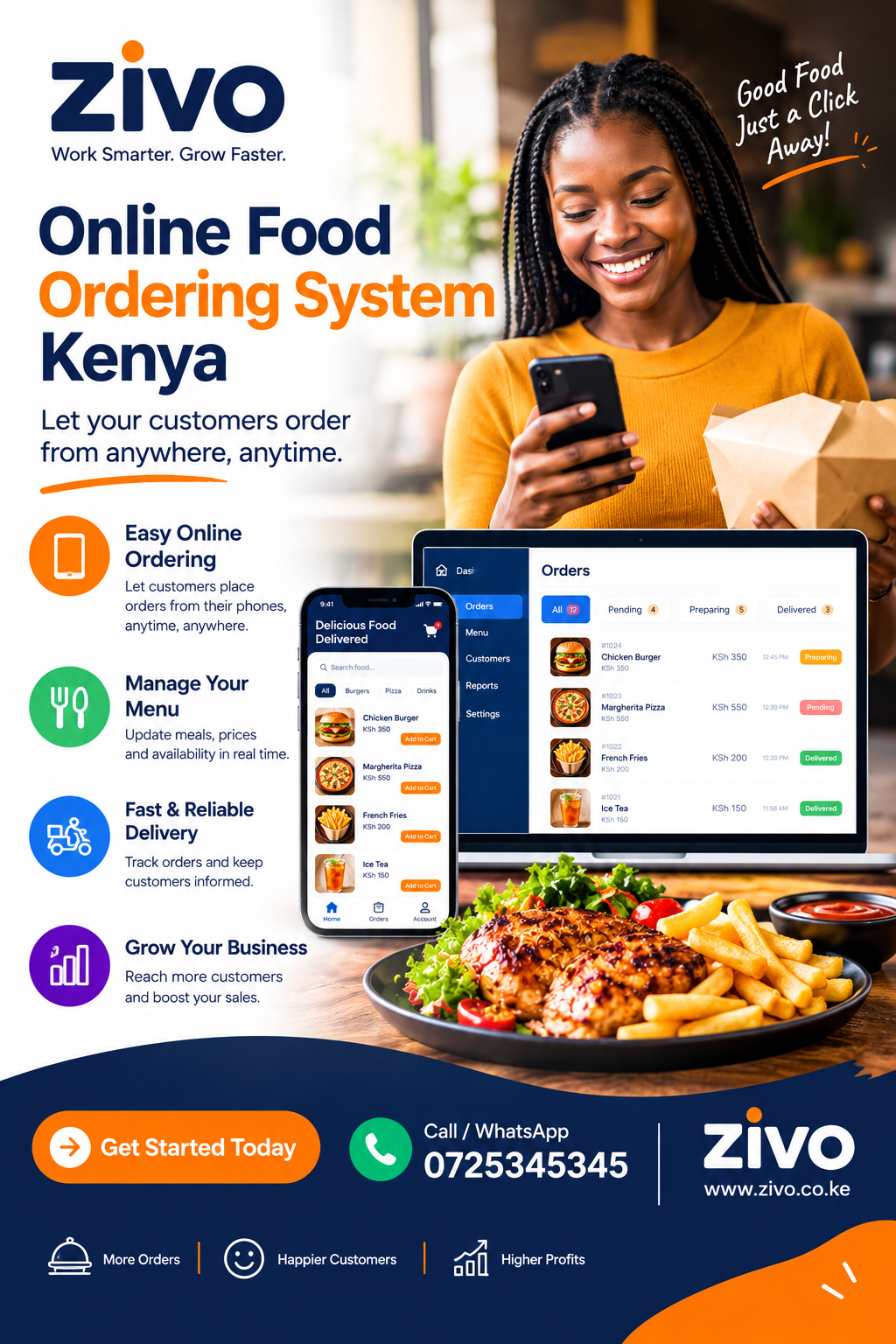
Online Food Ordering System Kenya: Complete Guide for Restaurants and Food Delivery Businesses
Running a restaurant in Kenya means managing much more than preparing and serving food. Orders can come through WhatsApp, phone calls, social media, a website, walk-in customers, or delivery channels. Payments may arrive through M-Pesa, cash, cards, or other methods, while kitchen teams and riders have to fulfil orders accurately and on time. An Online Food Ordering System Kenya can bring these activities into a more organised workflow, helping restaurant owners, takeaway businesses, caterers, cloud kitchens, and food delivery companies manage orders from one place.
For a growing food business, the difference between taking orders manually and managing them through connected software can become significant. A customer may send a WhatsApp message, an employee may write the order in a notebook, another employee may check an M-Pesa message, and a rider may receive delivery instructions through a phone call. Each individual step appears manageable, but the entire process becomes difficult when dozens or hundreds of orders arrive during busy periods.
This guide explains how an Online Food Ordering System Kenya can support restaurant operations, what features matter, how M-Pesa can fit into the ordering process, how delivery management works, and what Kenyan restaurant owners should consider before selecting a platform.
The goal is not simply to put a menu online. The real objective is to create a reliable process connecting the customer, order, payment, kitchen, delivery team, and financial record.
What Is an Online Food Ordering System?
An Online Food Ordering System Kenya is a digital platform that allows customers to place food orders while giving restaurants tools to receive, organise, process, track, and fulfil those orders.
Depending on the platform, customers may order through:
- A restaurant website
- A mobile-friendly ordering page
- A restaurant application
- Social media integrations
- Online checkout links
- QR codes
- Other connected ordering channels
Behind the customer-facing interface is an operational system that can contain information such as:
- Customer name
- Phone number
- Food items ordered
- Quantities
- Prices
- Delivery address
- Special instructions
- Payment status
- Order status
- Assigned delivery person
- Order history
For example, a customer in Nairobi may order two burgers, one portion of chips and two soft drinks for delivery to Kilimani. The restaurant needs to know what was ordered, how much the customer owes, whether payment has been received, where the food should go, when preparation should begin, and who is responsible for delivery.
An Online Food Ordering System Kenya helps turn those individual details into one structured transaction.
That is important because food ordering is not simply a sales activity. It is a chain of connected operational events.
The order lifecycle
A typical online food order may follow this sequence:
- The customer views the menu.
- The customer selects food.
- The customer provides contact and delivery information.
- The restaurant receives the order.
- Payment is requested or confirmed.
- Kitchen staff prepare the order.
- The order is packed.
- A rider or delivery employee is assigned.
- The food leaves the restaurant.
- The customer receives the order.
- The transaction is recorded for reporting.
If these steps are managed independently, mistakes become easier to make.
If they are connected, the business gets a clearer picture of what is happening.
Why Online Food Ordering Matters for Kenyan Restaurants
Kenyan restaurants operate in a market where customers are accustomed to mobile communication and digital payments. Restaurants can receive an order through a messaging application and receive payment through a mobile-money channel within the same customer interaction.
Safaricom states that its M-PESA Business Till is intended for businesses including restaurants that regularly collect customer payments.
This makes payment integration an important consideration when evaluating an Online Food Ordering System Kenya.
Consider a restaurant receiving 50 delivery orders during lunch.
Without a structured system, employees might have to:
- Search WhatsApp conversations.
- Confirm individual order totals.
- Check payment messages.
- Write orders manually.
- Call the kitchen.
- Call riders.
- Update customers individually.
- Reconcile payments later.
That creates unnecessary administrative work.
With a properly configured ordering workflow, the same restaurant can maintain a central record of the orders and their progress.
Customers expect convenience
Customers increasingly expect food businesses to make ordering straightforward.
They want to know:
- What food is available?
- How much does it cost?
- How can I order?
- How can I pay?
- When will the food arrive?
- Can I track my order?
- What should I do if something goes wrong?
An Online Food Ordering System Kenya can help a restaurant provide clearer answers by connecting customer orders to internal processes.
The technology does not automatically guarantee fast delivery or excellent service. Those still depend on the restaurant’s food preparation, staffing, logistics, menu design, and customer service. The system provides the operational structure that allows those activities to be managed more consistently.
Key Features to Look For
Not every ordering platform provides the same functionality. A restaurant should evaluate software according to its actual workflow rather than choosing a system simply because it has a long feature list.
Important capabilities may include the following.
1. Digital Menu Management
The menu is the foundation of online ordering.
Restaurant staff should be able to manage:
- Food names
- Descriptions
- Prices
- Categories
- Product images
- Available options
- Add-ons
- Portions
- Availability
If a restaurant sells chicken meals, for example, the customer might need to choose a portion size, side dish and drink.
The ordering system should make those choices clear.
An Online Food Ordering System Kenya should also make it easy to update prices and remove unavailable items.
A menu that displays food customers cannot actually order creates frustration.
2. Customer Order Management
Every order should have a clear record.
A restaurant should be able to identify:
- Order number
- Customer
- Contact information
- Items
- Quantity
- Total amount
- Payment status
- Preparation status
- Delivery status
- Notes
An Online Food Ordering System Kenya can help replace scattered order notes with a central order queue.
This becomes particularly valuable during peak periods.
If ten orders arrive within five minutes, employees should not have to remember which customer ordered what.
3. Multiple Ordering Channels
Customers do not all order in the same way.
Some may prefer a website. Others may send a WhatsApp message or call the restaurant.
A restaurant should therefore consider whether its chosen system can accommodate the channels that matter most to its customers.
An Online Food Ordering System Kenya is more useful when it fits the actual communication habits of the target market.
Zivo’s current platform, for example, describes WhatsApp sales workflows, invoices, M-Pesa collection and delivery operations as connected business processes.
4. M-Pesa Payment Support
Payment is one of the most important components of food ordering in Kenya.
Safaricom describes PayBill as a payment collection service for businesses and identifies Business Till as a solution for businesses such as restaurants that regularly collect payments.
An Online Food Ordering System Kenya should therefore be assessed according to how it handles the restaurant’s preferred payment process.
Useful payment capabilities can include:
- Payment requests
- Checkout links
- Payment confirmation
- Receipts
- Payment matching
- Outstanding payment visibility
- Refund records
- Transaction reports
Safaricom’s Customer to Business API also supports payment notifications to merchants after successful payments to supported PayBill or Till numbers.
The exact integration available depends on the ordering platform and its technical configuration, so restaurants should confirm the implementation before subscribing.
5. Delivery Management
Taking the order is only half the job.
The food still needs to reach the customer.
A good delivery workflow should allow staff to identify orders that are:
- Awaiting preparation
- Being prepared
- Ready for pickup
- Assigned to a rider
- Out for delivery
- Delivered
- Cancelled
- Delayed
An Online Food Ordering System Kenya can help connect the order to its delivery status.
Zivo currently describes a jobs-and-delivery workflow in which paid orders can become assigned jobs, staff can update progress, and managers can see paid-but-undelivered work.
That distinction matters.
A customer paying for food does not mean the restaurant has completed its responsibility. The order remains operationally open until the food has been delivered or collected.
How M-Pesa Fits Into Online Food Ordering
For many Kenyan restaurants, M-Pesa is central to the payment experience.
A customer may receive an order total and then pay through a Till, PayBill or an integrated checkout workflow.
An Online Food Ordering System Kenya should therefore make it easy for the restaurant to understand which orders have been paid.
The problem with manual reconciliation
Suppose a restaurant receives:
- 15 orders between 12:00 and 12:30.
- 12 payments through M-Pesa.
- 2 cash-on-delivery requests.
- 1 unpaid order.
If employees are checking payment messages manually, they need to match each payment to the correct customer and order.
Mistakes can happen.
A customer may use the wrong reference. An employee may miss a message. Two orders may have similar totals. A payment may arrive while the restaurant is handling a rush.
A connected Online Food Ordering System Kenya can reduce the administrative burden by keeping payment information alongside the relevant order.
Payment status should be visible
A useful order dashboard could distinguish:
| Status | Meaning |
|---|---|
| Pending payment | Order exists but payment is not confirmed |
| Paid | Payment has been received |
| Preparing | Kitchen is processing the order |
| Ready | Food is prepared |
| Out for delivery | Rider has collected the food |
| Delivered | Customer has received the order |
| Cancelled | Order will not be fulfilled |
The precise statuses vary by platform, but the principle is simple: staff should be able to see what requires action.
WhatsApp Ordering for Restaurants
WhatsApp is widely used for customer communication in Kenya, and restaurants may already receive orders through it.
A customer might send:
“Hello, can I get two beef burgers and chips delivered to Westlands?”
An employee then has to turn that conversation into an operational order.
An Online Food Ordering System Kenya can help organise this process when the platform supports WhatsApp workflows.
The ideal process is something like:
Customer conversation → Order → Invoice → Payment → Kitchen → Delivery → Completion
The advantage is not simply faster messaging. The advantage is maintaining a consistent business record.
Zivo currently promotes a shared WhatsApp inbox and workflows for creating invoices from customer chats, collecting payments and keeping customer records connected.
Why a shared inbox can help
A restaurant may have several employees handling customer communication.
If all orders are stored in one employee’s phone, the business can become dependent on that person.
A shared system can provide more continuity.
When another employee takes over, they can see:
- Customer details
- Previous communication
- Order status
- Payment status
- Delivery information
This can be particularly useful during shift changes.
Online Ordering for Small Restaurants
Some small restaurant owners assume they need to become large before adopting ordering software.
That is not necessarily the case.
An Online Food Ordering System Kenya can be useful for a small restaurant if the business is already struggling with manual order management.
For example, a small takeaway may receive 20–30 orders a day through WhatsApp.
The owner may currently use:
- A notebook
- M-Pesa messages
- A spreadsheet
- Phone calls
That arrangement may work temporarily.
But as order volume grows, the owner may start spending too much time on administration.
Start with the biggest problem
A restaurant does not have to automate everything immediately.
If the biggest problem is lost orders, start with order management.
If the biggest problem is payment reconciliation, focus on payment integration.
If deliveries are the problem, improve dispatch and delivery tracking.
If management cannot understand daily sales, prioritise reporting.
An Online Food Ordering System Kenya should be introduced to solve genuine operational problems.
Online Ordering for Cloud Kitchens
Cloud kitchens have a particularly strong reason to consider online ordering software.
Unlike traditional restaurants, a cloud kitchen may have limited or no walk-in customers. Digital orders can therefore be central to its business model.
An Online Food Ordering System Kenya can help a cloud kitchen coordinate:
- Online orders
- Menu items
- Payments
- Kitchen preparation
- Delivery
- Customer information
- Sales reports
A cloud kitchen may also operate several food brands from the same physical kitchen.
In that situation, order organisation becomes even more important.
The business may need to distinguish between different menus while maintaining a common operational workflow.
Online Ordering for Food Delivery Businesses
Food delivery businesses have additional requirements beyond traditional restaurant sales.
A delivery operation needs to know where every order is going and who is responsible for getting it there.
An Online Food Ordering System Kenya can help create visibility between the order and the delivery process.
Useful information may include:
- Delivery location
- Customer phone number
- Rider
- Delivery charge
- Order value
- Payment status
- Dispatch time
- Completion time
- Delivery status
This information can help managers investigate delays.
For example, if an order was paid at 1:05 p.m. but delivered at 2:20 p.m., the business can examine what happened between those events.
The objective is not merely to collect data. It is to understand where operational problems occur.
Managing Restaurant Orders During Peak Hours
Lunch and dinner can produce sudden increases in order volume.
A restaurant that normally handles five orders per hour may receive twenty orders in a short period.
An Online Food Ordering System Kenya can help staff maintain a visible queue rather than relying on memory.
During peak periods, employees need to answer questions quickly:
- Which order came first?
- Has it been paid?
- What is the kitchen preparing?
- Which orders are ready?
- Which rider is collecting each order?
- Which customer is waiting?
A visible order queue makes those questions easier to answer.
Kitchen coordination
The kitchen should not have to depend on a cashier shouting instructions across the restaurant.
A digital order record can provide structured information.
For example:
Order #1052
- 2 Chicken Burgers
- 1 Large Chips
- 2 Bottled Water
- No onions
- Delivery: Kilimani
- Payment: Confirmed
That is more useful than a vague message such as “two burgers for Kilimani.”
Menu and Product Management
Restaurants frequently change menus.
Prices may change because ingredient costs change. Some meals may become temporarily unavailable. Seasonal items may be introduced.
An Online Food Ordering System Kenya should make menu administration straightforward.
Important menu controls can include:
- Categories
- Product descriptions
- Prices
- Availability
- Variants
- Add-ons
- Meal combinations
- Images
- Preparation notes
Avoid unavailable-item orders
One common customer frustration occurs when a customer orders an item online only to discover later that it is unavailable.
A digital ordering platform should make it easier for staff to update availability.
If a restaurant runs out of chicken, for example, staff should be able to mark relevant meals unavailable rather than continuing to accept orders.
Inventory and Food Ordering
Food ordering and inventory management are closely connected.
If a restaurant sells 100 portions of a particular meal, it consumes ingredients.
The restaurant therefore needs to know what stock is available and what needs replenishment.
An Online Food Ordering System Kenya can become more valuable when ordering is connected to product and stock workflows.
Zivo’s retail/POS offering currently describes product catalogues, stock, sales orders, M-Pesa payments and fulfilment as connected functions.
The exact inventory capabilities of each platform differ, so restaurant owners should confirm whether the system supports their specific requirements.
Why stock visibility matters
Consider a restaurant that sells:
- Beef burgers
- Chicken burgers
- Pizza
- Chips
- Chicken wings
If the business does not know how much stock is being consumed, it can easily run into shortages.
Stock problems can lead to:
- Cancelled orders
- Customer complaints
- Emergency purchases
- Higher costs
- Wasted ingredients
An integrated ordering workflow can provide better visibility into what is being sold.
Customer Records and Repeat Orders
A restaurant should not treat every order as an isolated transaction.
Customer history can provide useful operational information.
An Online Food Ordering System Kenya can help maintain records such as:
- Customer name
- Phone number
- Previous orders
- Addresses
- Order frequency
- Payment history
- Notes
This can be useful when a regular customer orders again.
Instead of asking the customer to repeat every detail, staff may already have relevant information available.
Repeat customers
Repeat customers are particularly important for restaurants.
A customer who regularly orders the same lunch may appreciate a smoother ordering experience.
The business can use customer records to understand purchasing patterns without relying entirely on memory.
This can support:
- Customer service
- Promotions
- Repeat ordering
- Menu planning
- Customer communication
The restaurant should still respect privacy requirements and only collect and use customer information appropriately.
Delivery Charges and Location Management
Delivery costs vary depending on distance, area, rider arrangement and business model.
An Online Food Ordering System Kenya should allow the business to handle delivery charges according to its actual operating model.
For example, a restaurant might use different delivery fees for:
- Central Nairobi
- Westlands
- Kilimani
- Karen
- Kasarani
- Kiambu
- Other surrounding areas
The exact approach depends on the restaurant.
Some businesses use fixed delivery charges, while others calculate charges based on distance or third-party delivery arrangements.
The important point is that the customer should understand the delivery cost before completing the order.
Invoicing and Receipts
Online food ordering is also a financial transaction.
An Online Food Ordering System Kenya can help connect the order with financial records.
Depending on the platform, the business may need:
- Quotes
- Invoices
- Receipts
- Payment records
- Customer statements
- Refund records
- Sales reports
Zivo’s current platform describes invoices, receipts, customer statements, M-Pesa payment collection and financial reporting as part of its connected workflow.
Why financial records matter
At the end of the day, restaurant management needs more than the number of meals sold.
The owner may need to know:
- Total sales
- Payments received
- Outstanding payments
- Expenses
- Delivery costs
- Stock purchases
- Profitability
- Tax-related information
The more connected these records are, the less time management may need to spend reconstructing the day’s transactions.
Reporting and Restaurant Analytics
An Online Food Ordering System Kenya should ideally provide useful reports rather than simply storing transactions.
Useful restaurant reports can include:
| Report | What it can show |
|---|---|
| Sales report | Revenue over a selected period |
| Product report | Best-selling items |
| Payment report | Money collected by payment method |
| Order report | Number and value of orders |
| Delivery report | Completed and outstanding deliveries |
| Customer report | Customer activity |
| Inventory report | Stock movement |
| Expense report | Business spending |
The purpose of reporting is to support better operational decisions.
For example, if one menu item consistently sells well while another rarely sells, the restaurant can investigate why.
If deliveries are consistently delayed during a particular period, management can review staffing.
If unpaid orders are increasing, payment procedures may need attention.
Multi-Branch Restaurant Management
A restaurant group with several branches has different requirements from a single outlet.
An Online Food Ordering System Kenya may need to support multiple locations if the business wants central visibility.
A multi-branch operation may need:
- Branch-level sales
- Branch-level inventory
- Staff access controls
- Central reporting
- Separate menus
- Branch-specific pricing
- Delivery management
- Customer records
- Payment reporting
The manager may want to answer questions such as:
“Which branch handled the most online orders yesterday?”
“Which branch has the highest outstanding delivery value?”
“Which location needs additional stock?”
“Which branch is receiving the most repeat customers?”
A suitable system can make these questions easier to answer.
Staff Management and User Permissions
Not every employee should have access to every part of the system.
A cashier may need access to orders and payments.
A kitchen employee may only need order details.
A rider may need assigned deliveries.
A manager may need reporting and financial information.
An Online Food Ordering System Kenya should therefore be evaluated for user roles and permissions.
Zivo states that its business workspaces use role-based staff access so users can be restricted to the areas they need.
User permissions can help reduce accidental changes and keep responsibilities clearer.
Security and Customer Data
Restaurants collect customer information during online ordering.
That may include:
- Names
- Phone numbers
- Delivery addresses
- Order histories
- Payment-related information
An Online Food Ordering System Kenya should therefore be evaluated not only for features but also for security practices.
Questions to ask the provider include:
- How is customer data protected?
- Who can access customer information?
- Are staff permissions available?
- How are public payment links protected?
- How are passwords and credentials handled?
- What happens if an employee leaves?
- How are backups handled?
- How can customers request support?
Zivo’s published Trust Center provides information about workspace isolation, access controls and its current security position. It also states that an independent penetration-test report or security certification is not currently published.
That type of transparency is useful when evaluating software because businesses can distinguish between documented controls and assurances that still require verification.
Choosing the Right Ordering System
Choosing software should begin with the restaurant’s workflow.
An Online Food Ordering System Kenya should solve actual operational problems.
Before selecting a provider, write down the current ordering process.
For example:
Customer → WhatsApp → Staff notebook → M-Pesa → Kitchen → Phone call to rider → Delivery → Spreadsheet
Then identify where problems occur.
Perhaps the biggest problem is payment confirmation.
Perhaps it is missing customer information.
Perhaps it is poor delivery visibility.
Perhaps management cannot see sales.
Once those problems are clear, software evaluation becomes easier.
Questions to ask providers
Ask the provider:
- Does the platform support online orders?
- Can customers order through mobile devices?
- Can we manage our menu?
- Does it support M-Pesa workflows?
- Can we track payment status?
- Can staff see pending orders?
- Can we assign deliveries?
- Can we track delivery status?
- Can we manage multiple branches?
- Can we control staff permissions?
- Can we generate reports?
- Can we export records?
- Is customer support included?
- What are the transaction charges?
- Are there setup fees?
- Are integrations charged separately?
- Can the system scale as our order volume grows?
The answers should be documented before purchase.
Comparing Manual Ordering With Software
The differences become clearer when the two approaches are compared.
| Activity | Manual process | Digital ordering workflow |
|---|---|---|
| Customer order | WhatsApp/notebook | Central order record |
| Payment | Manual checking | Payment status |
| Kitchen | Verbal instructions | Structured order |
| Delivery | Phone calls | Assigned delivery |
| Customer history | Scattered | Central record |
| Reporting | Manual spreadsheet | Automated reports where supported |
| Order tracking | Memory/messages | Status workflow |
| Reconciliation | Time-consuming | Connected payment records |
An Online Food Ordering System Kenya does not remove every manual task, but it can reduce unnecessary duplication.
Common Mistakes When Choosing Food Ordering Software
Choosing based only on price
The cheapest platform is not necessarily the lowest-cost option.
If the system causes staff to spend extra time fixing problems, the apparent saving can disappear.
Choosing too many features
A restaurant does not need every available feature.
Too much complexity can make staff adoption harder.
Ignoring payment workflows
If most customers use M-Pesa, payment functionality should be considered a major requirement.
Ignoring delivery
Restaurants often focus on receiving orders and overlook what happens afterward.
Not testing the complete workflow
An Online Food Ordering System Kenya should be tested from customer order through completed delivery.
Forgetting staff training
Even good software can fail if employees do not understand how to use it.
Not checking support
Ask how support works before purchasing.
Find out:
- Contact channels
- Support hours
- Response expectations
- Training options
- Onboarding assistance
How to Implement an Online Ordering System
Implementation does not have to happen all at once.
An Online Food Ordering System Kenya can be introduced in stages.
Stage 1: Map the workflow
Document how customers currently order and how the restaurant processes those orders.
Stage 2: Clean the menu
Remove outdated items and confirm prices.
Stage 3: Set up customers and staff
Create user accounts and appropriate permissions.
Stage 4: Configure payments
Connect the supported payment process.
Stage 5: Test orders
Create test orders and follow them through the entire workflow.
Stage 6: Train employees
Show staff how to handle common situations.
Stage 7: Launch gradually
Start with a controlled group or limited ordering channel if appropriate.
Stage 8: Review performance
After launch, identify where customers or staff still experience friction.
Practical Example: A Nairobi Restaurant
Imagine a restaurant in Nairobi that receives orders through WhatsApp.
Before adopting software, the process looks like this:
- Customer sends WhatsApp message.
- Employee replies with price.
- Customer pays through M-Pesa.
- Employee checks M-Pesa message.
- Employee writes order on paper.
- Kitchen prepares food.
- Employee calls rider.
- Rider collects food.
- Customer calls asking about delivery.
- Employee checks with rider.
- Owner records sales later.
Now consider a connected workflow.
An Online Food Ordering System Kenya can support a process where:
- Customer order is recorded.
- Customer and order details remain together.
- Payment is requested.
- Payment status is updated.
- Kitchen receives the order.
- Delivery work is assigned.
- Rider updates progress.
- Manager sees completion.
- Financial records remain connected.
The second process does not eliminate the work of preparing food. It reduces the amount of administrative coordination required around that work.
How an Ordering System Can Improve Customer Experience
Customer experience is influenced by more than the food itself.
An Online Food Ordering System Kenya can contribute to a smoother experience by making the ordering process clearer.
Customers may benefit from:
- Clear menus
- Transparent pricing
- Convenient payment
- Order confirmation
- Delivery updates
- Faster communication
- Easier repeat ordering
Suppose a customer orders every Friday.
If the restaurant has useful customer history, staff may be able to provide faster service.
If the customer asks about a previous order, the business can find the relevant information rather than searching through hundreds of messages.
Reducing Missed and Forgotten Orders
One of the most practical benefits of structured ordering is visibility.
An Online Food Ordering System Kenya can help businesses identify orders that remain open.
For example, a manager could look at a queue and see:
- 4 new orders
- 7 orders preparing
- 3 ready orders
- 5 orders out for delivery
- 2 paid orders awaiting dispatch
This gives management a much clearer picture than asking individual employees for updates.
Zivo specifically describes a paid-but-undelivered reporting capability intended to keep paid work visible until fulfilment is completed.
Pricing Considerations
There is no single correct price for restaurant ordering software.
Costs may depend on:
- Number of users
- Number of branches
- Number of orders
- Payment integrations
- WhatsApp usage
- Delivery features
- Inventory features
- Reporting
- Support
- API access
- Setup and onboarding
An Online Food Ordering System Kenya should be evaluated using total cost rather than subscription price alone.
For example, a platform may have a low monthly fee but charge separately for:
- Transactions
- Additional users
- Additional branches
- WhatsApp messages
- Payment processing
- API access
- Support
Ask for a complete cost breakdown.
Zivo currently publishes several packages, including a free starting option and paid packages with additional WhatsApp, M-Pesa, operations, stock, delivery and reporting capabilities. Its published pricing should be checked directly because software packages can change.
Measuring Whether the System Is Working
After implementation, restaurant owners should measure practical outcomes.
An Online Food Ordering System Kenya should ultimately help the business operate more clearly.
Useful indicators can include:
- Number of online orders
- Average order value
- Payment completion rate
- Order preparation time
- Delivery completion time
- Cancelled orders
- Unpaid orders
- Repeat customers
- Most popular menu items
- Outstanding deliveries
The restaurant can compare these measurements before and after implementation where reliable historical data exists.
Future Growth and Scalability
A restaurant may start with one location and a small team.
Later, it may add:
- More branches
- More employees
- More delivery riders
- More menu items
- More ordering channels
- Catering
- Corporate customers
- Online promotions
An Online Food Ordering System Kenya should therefore be considered for both current and expected requirements.
The goal is not to purchase the biggest system immediately.
The goal is to avoid choosing a platform that becomes unsuitable as soon as the restaurant grows.
Online Food Ordering for Catering Businesses
Catering businesses have different order patterns from restaurants.
A customer may place a large order several days or weeks in advance.
The business needs to record:
- Event date
- Customer
- Number of guests
- Menu
- Quantity
- Delivery location
- Deposit
- Balance
- Special requirements
An Online Food Ordering System Kenya can be useful if the platform supports scheduled or larger orders.
Catering businesses should specifically confirm whether the system supports advance orders rather than assuming that a normal restaurant ordering workflow will handle them correctly.
Online Ordering for Bakeries and Food Producers
Bakeries may receive orders for:
- Birthday cakes
- Wedding cakes
- Bread
- Pastries
- Custom products
- Corporate orders
Some orders may require customisation.
An Online Food Ordering System Kenya can help maintain a record of customer instructions, quantities, payment status and delivery details when the platform supports these workflows.
This can be particularly useful for businesses where customers place orders in advance.
The Importance of Mobile-Friendly Ordering
Many restaurant customers use smartphones.
The ordering process should therefore work well on smaller screens.
An Online Food Ordering System Kenya should make it easy for customers to:
- Browse products
- Select quantities
- Enter details
- Confirm the order
- Make payment
- Receive confirmation
If customers struggle to use the ordering interface, they may abandon the order and return to messaging or phone calls.
Mobile usability should therefore be tested on actual phones rather than only on a desktop computer.
Integrating Orders With Broader Business Operations
A restaurant has financial and operational responsibilities beyond order taking.
It needs to manage:
- Suppliers
- Expenses
- Stock
- Staff
- Customers
- Payments
- Delivery
- Financial reporting
An Online Food Ordering System Kenya becomes more valuable when ordering information can connect to other business processes.
Zivo’s current platform positions sales, payments, expenses, staff and operational records as connected workflows rather than isolated applications.
For a restaurant owner, that can mean less duplication between different records.
Frequently Asked Questions
What is an online food ordering system?
An Online Food Ordering System Kenya is software that allows restaurants and food businesses to receive and manage customer orders digitally. Depending on the platform, it may also handle menus, payments, customer records, kitchen workflows, delivery and reporting.
Is an online ordering system suitable for a small restaurant?
Yes. A small restaurant can start with basic ordering and payment management and add additional features as order volume grows. The important consideration is choosing software that matches the restaurant’s actual workflow.
Can an online food ordering system support M-Pesa?
Many platforms support M-Pesa-related workflows, but the exact integration varies. Safaricom provides Business Till, PayBill and developer APIs for business payment use cases.
A restaurant should confirm whether the provider supports the specific M-Pesa functionality it needs.
Can restaurants receive orders through WhatsApp?
Yes, depending on the software. Some platforms provide WhatsApp integration or shared inbox functionality that allows businesses to manage customer conversations alongside orders.
Does online food ordering software manage delivery?
Some systems include delivery management, rider assignment and delivery-status tracking. Others focus mainly on taking orders. Restaurants should confirm the exact delivery capabilities before purchasing.
Can the system manage restaurant inventory?
Some platforms connect orders with product and stock management. This can help restaurants understand what products are being sold and monitor stock movement. The depth of inventory functionality varies between providers.
Can an online ordering system manage multiple branches?
Some platforms support multi-branch operations. These may include branch-level sales, staff permissions, inventory and reporting. Restaurant groups should specifically test these features before subscribing.
Does online ordering replace a POS system?
Not necessarily. Some platforms combine online ordering, POS, stock, payments and delivery. Others focus specifically on online ordering. The correct choice depends on how the restaurant operates.
How much does online food ordering software cost in Kenya?
There is no universal price. Costs depend on features, users, branches, integrations, transaction volumes and support. Restaurant owners should request a complete pricing breakdown before making a decision.
What should I check before buying restaurant ordering software?
Check the ordering channels, menu management, M-Pesa functionality, customer records, payment tracking, kitchen workflow, delivery management, reporting, user permissions, security, support and total cost.
A Simple Checklist for Kenyan Restaurant Owners
Before adopting an Online Food Ordering System Kenya, use this checklist:
Ordering
- Can customers place orders easily?
- Does the system work well on mobile?
- Can customers see current menu items?
- Can customers select quantities and options?
Payments
- Does it support the payment method used by your customers?
- Can staff see payment status?
- Are receipts available?
- Can payments be reconciled?
Kitchen
- Can staff see new orders?
- Can order status be updated?
- Can special instructions be recorded?
Delivery
- Can delivery addresses be captured?
- Can orders be assigned?
- Can staff see delivery status?
- Can completed deliveries be recorded?
Customers
- Are customer records maintained?
- Can staff view order history?
- Can repeat customers be identified?
Management
- Are sales reports available?
- Can managers see outstanding orders?
- Can users have different permissions?
- Can multiple branches be supported?
Security
- How is customer information protected?
- Who can access financial records?
- How are user accounts managed?
- What security documentation is available?
Why Connected Workflows Matter
The strongest reason to adopt an Online Food Ordering System Kenya is not simply to give customers another way to order food.
The bigger opportunity is connecting the entire transaction.
A customer places an order.
The restaurant receives it.
Payment is confirmed.
The kitchen prepares the food.
A delivery employee receives the task.
The order is delivered.
The financial record is updated.
The customer history remains available.
Management can review what happened.
That is a connected workflow.
Zivo’s current platform describes this principle across its sales, M-Pesa, expense, delivery and finance workflows, including keeping paid work visible until it has been fulfilled.
Final Thoughts
Choosing an Online Food Ordering System Kenya should begin with the restaurant’s actual problems rather than a generic list of software features.
A small takeaway may need a straightforward order and payment workflow.
A busy Nairobi restaurant may need WhatsApp ordering, M-Pesa collection, kitchen coordination and delivery management.
A restaurant chain may need branches, staff permissions, central reporting, stock management and consolidated financial information.
A cloud kitchen may prioritise digital ordering and delivery.
A catering company may need scheduled orders and customer-specific requirements.
The best system for each business depends on those operational realities.
For Kenyan businesses, payment integration deserves particular attention. Safaricom provides Business Till and PayBill services for merchant payments, and its developer platform provides APIs that can deliver payment notifications to businesses.
Delivery is equally important. A restaurant should not consider an order complete simply because the customer has paid. The business still needs to prepare, dispatch and fulfil the order.
That is why an Online Food Ordering System Kenya should ideally provide visibility across the complete order lifecycle.
When evaluating providers, test a realistic scenario.
Place an order.
Make a payment.
Send it to the kitchen.
Assign delivery.
Update the order.
Complete the delivery.
Then check the financial and customer records.
If the entire process is clear and connected, the system has a better chance of fitting the restaurant’s daily operations.
Restaurant technology should ultimately reduce unnecessary administration while giving managers better visibility.
For a Kenyan restaurant, the practical priorities are straightforward:
- Make ordering easy.
- Keep menus accurate.
- Make payment convenient.
- Track every order.
- Keep kitchen instructions clear.
- Assign delivery responsibility.
- Monitor outstanding deliveries.
- Maintain useful customer records.
- Connect sales with financial records.
- Give managers reliable reports.
An Online Food Ordering System Kenya can support these objectives when it is properly selected and implemented.
The technology itself is only one part of the solution. Restaurants still need good food, reliable staff, sensible pricing, effective customer service and dependable delivery operations.
But when those activities are supported by a connected digital workflow, restaurant management can become more organised and easier to monitor.
For businesses considering Zivo, the platform currently provides connected workflows covering customer sales, WhatsApp, M-Pesa, invoices, payments, expenses, stock, orders and delivery, with a free starting option and additional paid functionality.
The right starting point is therefore simple: identify the biggest ordering problem in the business, choose software that directly addresses it, test the complete workflow, train the team, and then expand the system as the restaurant grows.
Online Food Ordering System Kenya
Online Food Ordering System Kenya
Online Food Ordering System Kenya
Online Food Ordering System Kenya
Online Food Ordering System Kenya
Online Food Ordering System Kenya
Online Food Ordering System Kenya
Online Food Ordering System Kenya
Online Food Ordering System Kenya
Online Food Ordering System Kenya
Online Food Ordering System Kenya
Online Food Ordering System Kenya
Online Food Ordering System Kenya