
Payroll Software Kenya: A Complete Guide to Modern Payroll Management
Managing employees becomes significantly more complicated as a business grows. Salaries, attendance, overtime, commissions, deductions, leave, employee records and monthly reports can quickly become difficult to coordinate using spreadsheets and manual calculations. Payroll Software Kenya gives businesses a structured way to manage these processes while reducing repetitive administrative work and creating a clearer connection between employees, finance and management. This guide explains what modern payroll software should do, why Kenyan businesses need it, which features matter most, how automation can improve payroll accuracy, and how to choose a solution that fits your organisation.
For a small business with only a few employees, calculating salaries manually may initially seem manageable. The problem starts when the workforce grows, employees work different schedules, salaries change, commissions are introduced, or managers need reliable reports. A process that worked for five employees can become frustrating with 30, 50 or 100 employees.
Payroll Software Kenya can help businesses create a more organised payroll workflow by connecting workforce information with financial and operational processes. Instead of treating payroll as an isolated monthly task, businesses can build a system where employee records, attendance, overtime, deductions and salary information are maintained consistently.
This matters particularly for Kenyan SMEs because many businesses operate with lean administrative teams. One person may handle HR, payroll, procurement and basic accounting at the same time. A well-designed payroll system reduces the amount of repetitive work that has to be completed manually.
Payroll Software Kenya is therefore relevant not only to large corporations but also to growing shops, agencies, schools, restaurants, professional firms, contractors, property businesses, security companies and service providers.
What Is Payroll Software?
Payroll software is a digital system used to organise employee compensation and the information required to calculate and administer salaries.
Depending on the solution, it may handle:
- Employee profiles
- Salary structures
- Attendance
- Working hours
- Overtime
- Leave
- Bonuses
- Commissions
- Allowances
- Deductions
- Payroll calculations
- Payslips
- Payroll reports
- Payment records
- Workforce-cost analysis
Payroll Software Kenya becomes particularly useful when these activities need to work together rather than being stored in disconnected spreadsheets.
A payroll system does not simply replace a calculator. Its main value is creating a repeatable process. Employee information can be entered once, reviewed, updated when necessary and reused during payroll processing.
For example, if an employee receives a salary adjustment, the authorised change can be recorded in the employee profile rather than manually changing figures across several spreadsheets. If attendance affects overtime, the payroll workflow can use the relevant attendance information rather than requiring someone to calculate every employee’s hours separately.
Payroll Software Kenya can also provide management with a clearer view of workforce costs. This is important because salaries are often one of the largest recurring expenses for a business.
Why Kenyan Businesses Are Moving Away From Manual Payroll
Manual payroll is not necessarily wrong. For a very small business with straightforward salaries, it may work for some time.
The difficulty is that manual systems become harder to control as the organisation grows.
Consider a company with 40 employees. Some employees have fixed salaries. Others receive commissions. Several employees work overtime. A few take unpaid leave. One employee joins midway through the month, while another leaves before the payroll date.
A spreadsheet can calculate the figures, but the process still depends heavily on accurate data entry and human review.
Payroll Software Kenya helps address this problem by creating a centralised workflow where payroll information can be managed systematically.
Common problems with manual payroll include:
- Repeated data entry.
- Incorrect employee information.
- Forgotten allowances or deductions.
- Miscalculated overtime.
- Difficulty tracking changes.
- Delayed payroll preparation.
- Limited reporting.
- Poor visibility into labour costs.
- Difficult payroll reconciliation.
- Greater dependence on one individual.
The risk increases when employee information is spread across notebooks, Excel files, emails and WhatsApp conversations.
Payroll Software Kenya can provide a central point for payroll-related workforce information, making it easier for authorised users to work from consistent records.
The goal is not simply to remove people from the payroll process. Instead, software should allow people to spend less time on repetitive calculations and more time reviewing exceptions, approving changes and managing employees.
Payroll Management and Business Accuracy
Payroll accuracy has a direct effect on employee confidence.
Employees expect their salaries to be calculated correctly and paid on time. Even a small recurring error can create frustration, especially when employees have rent, school fees, transport costs and other commitments.
Payroll Software Kenya helps businesses create repeatable payroll procedures that reduce unnecessary manual intervention.
Accuracy begins with good employee data.
A payroll system should make it possible to maintain information such as:
- Employee name
- Employee identification details
- Job title
- Department
- Employment status
- Salary
- Allowances
- Commission arrangements
- Deduction rules
- Bank or payment information
- Attendance information
- Leave records
The exact fields depend on the organisation and its payroll requirements.
Payroll Software Kenya becomes more valuable when the employee database and payroll process are connected. A payroll administrator should not have to rebuild employee information every month.
Employee Records and Payroll
Employee records are the foundation of payroll.
If employee information is inaccurate, even an otherwise sophisticated payroll calculation can produce the wrong result.
Payroll Software Kenya can help businesses organise employee information so payroll administrators can work from a structured database.
A good employee record system should support controlled updates. When a salary changes, the organisation should know who approved the change and when it became effective.
The same principle applies to departments, job titles and employment status.
For growing businesses, historical information can also become important. Management may want to understand how workforce costs have changed over time or compare costs between departments.
Payroll Software Kenya can support this type of structured workforce administration when payroll data is maintained consistently.
Why a Central Employee Database Matters
Without a central database, the same employee may appear differently across multiple documents.
For example:
- HR may have one salary figure.
- Finance may have another.
- An attendance spreadsheet may use a different employee name.
- A manager may have an outdated record.
This creates unnecessary reconciliation work.
Payroll Software Kenya helps reduce this fragmentation by making employee information part of a structured digital workflow.
Attendance and Payroll
Attendance is one of the most important inputs for payroll in businesses where working hours affect employee compensation.
This includes organisations with:
- Shift workers
- Security teams
- Restaurants
- Retail outlets
- Schools
- Factories
- Field employees
- Hospitality teams
- Delivery teams
- Construction workers
Payroll Software Kenya can help businesses connect attendance information with workforce administration.
Attendance systems can capture clock-in and clock-out information, late arrivals, missing punches, working hours and other exceptions.
The important point is that attendance information should not automatically be treated as perfect. Managers may need to review unusual records before payroll is processed.
Payroll Software Kenya can support a workflow in which attendance exceptions are identified for review instead of silently affecting salary calculations.
Overtime Management
Overtime is another area where manual calculations can create problems.
Suppose an employee works additional hours several times during a month. If the overtime information is collected through messages and handwritten notes, the payroll administrator has to verify every entry.
Payroll Software Kenya can make overtime administration more structured by allowing businesses to capture the information used in payroll processing.
The exact overtime rules should always be configured according to the organisation’s employment policies and applicable Kenyan requirements.
Leave Management and Payroll
Leave is closely connected to workforce planning and, depending on the circumstances, payroll.
Businesses may need to manage different categories of leave while maintaining accurate employee records.
Payroll Software Kenya can help centralise leave information so managers and payroll administrators can work from the same records.
A digital leave process can provide:
- Leave requests
- Approval workflows
- Leave balances
- Absence records
- Employee notifications
- Historical leave information
This reduces the need to search through email messages or WhatsApp conversations to determine whether an employee was absent or had an approved leave request.
Payroll Software Kenya can also become useful for businesses where attendance and employee scheduling need to be considered alongside payroll.
Statutory Deductions and Kenyan Payroll
Payroll in Kenya requires attention to applicable statutory deductions and employer responsibilities.
Depending on the employee and current rules, payroll may involve areas such as PAYE, social health-related contributions, pension or social security contributions, housing-related deductions and other applicable items.
Because legislation, rates and requirements can change, businesses should ensure their payroll processes are reviewed against current official requirements rather than relying permanently on an old spreadsheet.
Payroll Software Kenya can help organisations structure payroll calculations, but software should not be treated as a substitute for professional tax or legal advice when circumstances are complex.
Why Payroll Compliance Matters
Payroll compliance affects more than accounting.
It can influence:
- Employee trust
- Financial reporting
- Employer records
- Tax administration
- Business planning
- Audit preparation
- Management confidence
Payroll Software Kenya provides a useful framework for thinking about payroll as an ongoing business process rather than a monthly calculation exercise.
Businesses should also maintain proper documentation for payroll changes, approvals and supporting records.
M-Pesa and Salary Payments
M-Pesa plays an important role in Kenyan business payments, making mobile money an important consideration when evaluating business software.
However, salary processing and business payment collection are not identical workflows.
Payroll Software Kenya can be part of a broader digital payroll strategy in which salary information is prepared accurately before payments are initiated through the organisation’s chosen payment channels.
A business should consider:
- How employees receive salaries.
- Whether bank payments are required.
- Whether mobile-money payments are appropriate.
- How payment confirmations are recorded.
- How payroll is reconciled.
- Who can authorise payments.
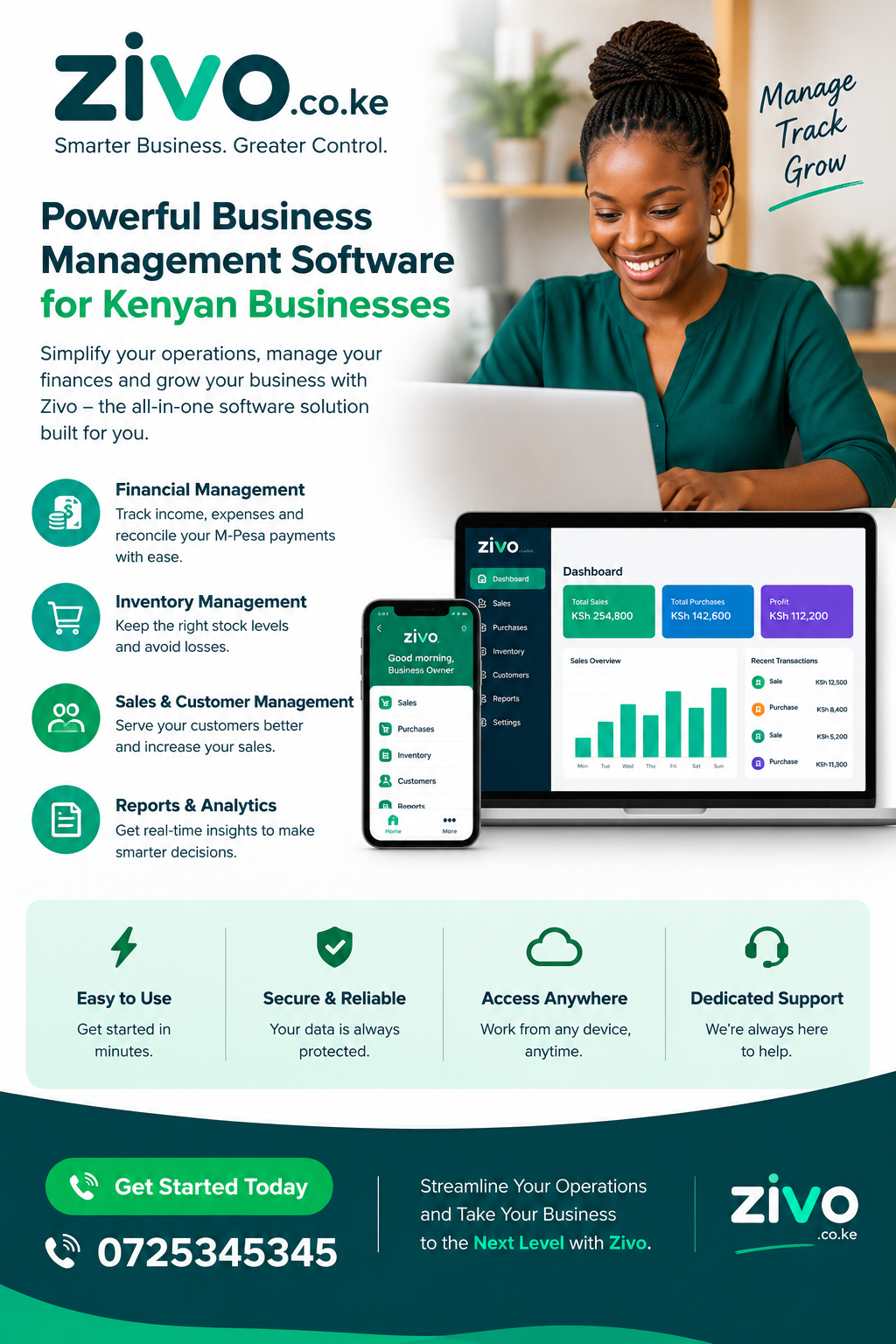
Zivo’s broader platform is designed around connected financial and workforce workflows, including staff management and financial records. Its public business-solutions information describes workforce tools covering employee records, shifts, clock-in and clock-out, lateness, overtime and workforce cost allocation.
Payroll Software Kenya can therefore be considered as part of a wider digital approach to payroll and workforce management.
Payslips and Employee Communication
Employees should be able to understand their pay.
A clear payslip or payroll statement can show the components that make up an employee’s final pay, subject to the organisation’s payroll configuration and applicable requirements.
Payroll Software Kenya can support businesses that want to move away from fragmented payroll records and toward a connected workforce workflow.
Clear payroll communication can reduce questions such as:
- Why is my salary different this month?
- Why was an allowance included?
- Why was an amount deducted?
- How was overtime treated?
- Was my absence recorded?
- Has my payroll been processed?
A well-organised payroll process makes it easier for HR and finance teams to answer these questions.
Payroll Software Kenya can also help businesses think about payroll as part of the employee experience rather than simply an accounting function.
Payroll for Small Businesses
Small businesses often assume payroll software is only useful for large organisations.
That assumption is increasingly difficult to justify.
A small company may have only 10 employees but still deal with multiple departments, commissions, attendance changes and different allowances.
Payroll Software Kenya can provide a more structured alternative to repeatedly editing spreadsheets as the business grows.
The key question should not be “How many employees do we have?”
Instead, ask:
How much payroll complexity does our business have?
A company with 15 employees working different shifts may have more payroll complexity than a company with 40 employees who all receive identical monthly salaries.
Payroll Software Kenya can therefore be relevant to businesses at different stages of growth.
Payroll for Medium-Sized Businesses
As a business grows, payroll becomes more connected to management reporting.
A company may want to know:
- Total salary costs.
- Departmental payroll costs.
- Overtime costs.
- Commission expenses.
- Workforce trends.
- Cost per branch.
- Cost per project.
- Changes in employee compensation.
Payroll Software Kenya can be part of a broader digital approach where workforce information contributes to operational decision-making.
For example, a business with three branches may discover that one branch consistently has higher overtime costs. That does not automatically mean the branch is inefficient. It could indicate longer operating hours, staffing shortages or stronger demand.
The value of reporting is therefore not simply showing numbers. It is helping managers ask better questions.
Payroll Software Kenya can support the idea of connecting payroll information to wider operational workflows where appropriate.
Payroll Reports Managers Should Consider
Reports are one of the biggest advantages of digital payroll.
A useful payroll system may provide reports covering:
- Payroll summaries
- Employee earnings
- Deductions
- Allowances
- Overtime
- Departmental costs
- Attendance
- Leave
- Payroll changes
- Payment status
- Workforce costs
Payroll Software Kenya makes the concept of reporting especially important for businesses that want payroll data to support management decisions.
Reports should be understandable rather than overloaded with unnecessary information.
A manager may need a one-page payroll summary while the finance team may need more detailed transaction-level information.
Payroll Software Kenya can be useful when considering how different users require different levels of payroll information.
Payroll and Cash Flow Planning
Payroll is a recurring financial commitment.
Businesses need to understand how much money will be required to meet workforce obligations and when payments need to be made.
Payroll Software Kenya can support more organised payroll planning by making expected workforce costs easier to review.
This becomes especially important for businesses whose income fluctuates.
For example, a service company may receive large customer payments at different points of the month while payroll remains a recurring obligation. Having clear payroll information can help management plan cash requirements.
Zivo describes its broader finance workspace as connecting payments, expenses, suppliers, customer statements, cash flow, profit and workforce-related workflows.
Payroll Software Kenya therefore fits into a wider discussion about integrating payroll with financial management rather than treating employee costs as a completely separate dataset.
Connecting Payroll With Workforce Management
Payroll becomes more powerful when connected with workforce information.
Consider an employee who:
- Joins the company.
- Is assigned to a department.
- Works scheduled shifts.
- Records attendance.
- Requests leave.
- Works approved overtime.
- Earns a commission.
- Receives a salary.
- Appears in payroll reports.
If every stage is stored separately, the business must repeatedly reconcile the information.
Payroll Software Kenya supports the principle of using a centralised workflow.
Zivo’s workforce solution publicly describes employee records, shifts, holidays, clock-in and clock-out, lateness, missing-punch exceptions, overtime and adjustment audit trails.
Payroll Software Kenya can therefore be evaluated not only by asking whether it calculates salaries, but by asking how well it connects payroll to the rest of the employee lifecycle.
Payroll Security and Access Control
Payroll information is sensitive business information.
Not every employee should be able to access salary information for the entire organisation.
A payroll solution should provide appropriate access controls so that authorised users can perform their responsibilities without exposing unnecessary information.
Payroll Software Kenya can help businesses consider access management as part of payroll system selection.
Important questions include:
- Who can create employees?
- Who can edit salary information?
- Who can approve payroll?
- Who can view payroll reports?
- Who can export information?
- Can access be removed when someone leaves?
- Are user activities recorded?
Zivo states that its workspaces use role-based access controls so staff can see the areas they need, while business data is separated by workspace.
Payroll Software Kenya can therefore be assessed partly on how well it supports controlled access and accountability.
Payroll Audit Trails
An audit trail records important changes and actions within a system.
For payroll, this can be valuable when someone needs to determine why a salary figure changed.
For example, suppose an employee’s salary increases in June. Management may want to know:
- When was the change entered?
- Who entered it?
- Who approved it?
- When did it take effect?
- Did the change affect the payroll calculation?
Payroll Software Kenya can help businesses understand why auditability is an important part of payroll technology.
A good system should make important payroll adjustments traceable.
Payroll Software Kenya can also be considered alongside other internal-control features when comparing payroll platforms.
Payroll and Employee Onboarding
Payroll begins before the first salary is processed.
When a new employee joins, the business needs to capture relevant information accurately and ensure that the employee is placed in the appropriate payroll structure.
Payroll Software Kenya can support a more structured employee onboarding process where employee information is collected once and then reused.
A basic onboarding workflow may include:
- Create employee profile.
- Assign department.
- Define salary structure.
- Record relevant allowances.
- Configure attendance requirements.
- Set leave information.
- Confirm payment details.
- Verify payroll information.
- Include employee in the appropriate payroll period.
Payroll Software Kenya helps illustrate why payroll should be viewed as part of the employee lifecycle rather than an isolated finance task.
Payroll and Employee Offboarding
The same principle applies when an employee leaves.
Businesses may need to process final payments, review outstanding information, close access and retain appropriate records.
Payroll Software Kenya can make the offboarding process more organised when employee information and payroll records are maintained together.
The exact final-pay process depends on the circumstances and applicable employment requirements, so businesses should seek appropriate professional guidance when necessary.
Payroll Software Kenya can also be part of a broader conversation about maintaining complete workforce records from onboarding through exit.
Payroll Automation Does Not Mean Removing Human Oversight
Automation is useful, but payroll should not become a completely uncontrolled process.
A good workflow combines automation with review.
For example:
- The system calculates payroll.
- Exceptions are identified.
- A payroll administrator reviews unusual entries.
- A manager approves the payroll.
- Finance verifies payment information.
- Payroll is finalised.
Payroll Software Kenya can support this type of approach by reducing repetitive calculations while leaving important decisions with authorised staff.
This is particularly important when payroll includes commissions, bonuses, overtime or manual adjustments.
Payroll Software Kenya can therefore be evaluated according to how well it balances automation with human review.
How to Choose the Right Payroll System
Choosing payroll software should begin with the business process rather than the feature list.
Before purchasing anything, document how payroll currently works.
Ask:
- Where are employee records stored?
- How is attendance captured?
- Who calculates payroll?
- How are changes approved?
- How are overtime hours verified?
- How are deductions handled?
- How are payslips produced?
- How are payroll records reconciled?
- What reports does management require?
Payroll Software Kenya becomes easier to evaluate when these requirements have been written down.
Then compare potential solutions against the actual workflow.
Payroll Software Kenya should not be selected simply because it has a long feature list. A simpler platform that fits the business properly may be more useful than a complicated system with functions nobody uses.
Features to Look For
When comparing payroll platforms, consider the following feature categories:
| Feature | Why It Matters |
|---|---|
| Employee records | Keeps workforce information organised |
| Salary management | Supports structured compensation |
| Attendance | Provides payroll input where hours matter |
| Overtime | Reduces manual hour calculations |
| Leave | Connects absences with workforce records |
| Deductions | Helps organise payroll adjustments |
| Payslips | Improves employee communication |
| Reports | Supports management decisions |
| User permissions | Protects sensitive information |
| Audit trails | Improves accountability |
| Integrations | Connects payroll with other workflows |
| Export options | Supports finance and record keeping |
Payroll Software Kenya should be assessed against the specific needs of the organisation rather than against a generic checklist alone.
Zivo’s public platform information shows a connected business approach spanning workforce, finance, expenses, payments and operational workflows.
Common Payroll Mistakes Businesses Should Avoid
Buying software does not automatically solve poor payroll processes.
Businesses should avoid several common mistakes.
1. Entering Poor-Quality Data
Even the best system will produce poor results if employee information is wrong.
2. Giving Too Many People Access
Payroll access should be based on job responsibilities.
3. Skipping Payroll Review
Automated calculations should still be reviewed before finalisation.
4. Ignoring Attendance Exceptions
Missing punches and unusual working hours should be investigated.
5. Using Outdated Rules
Payroll requirements can change. Businesses should review their configurations regularly.
6. Failing to Back Up Records
Important payroll information should be protected and recoverable.
Payroll Software Kenya can be evaluated against these operational requirements before implementation.
7. Choosing Software Based Only on Price
The cheapest option may become expensive if it requires extensive manual work.
Payroll Software Kenya should be viewed in terms of overall business value, not only subscription cost.
Payroll Software Cost Considerations
Payroll software pricing varies significantly depending on the provider, employee count, features, integrations, implementation and support.
Businesses should calculate the total cost of ownership rather than comparing subscription prices alone.
Consider:
- Subscription fees
- Setup fees
- Data migration
- Training
- Support
- Integrations
- Payment-related charges
- Additional users
- Additional branches
- Customisation
Payroll Software Kenya can therefore be assessed according to the total value delivered to the business.
Zivo’s current public pricing shows a free Start plan focused on invoices, expenses, customer balances and essential reports, with paid plans adding broader automation and team workflows. Its workforce capabilities are presented as part of the wider connected platform.
Payroll Software Kenya may be particularly useful as a search term and solution category for businesses comparing workforce and payroll technologies, but businesses should still verify the exact features available in their selected plan.
Implementation: Moving From Excel to Software
Changing payroll systems requires preparation.
Do not immediately upload every historical spreadsheet without first reviewing the data.
A better implementation process is:
- Clean employee records.
- Remove duplicates.
- Verify salaries.
- Confirm departments.
- Review attendance information.
- Document payroll rules.
- Configure the system.
- Test sample payrolls.
- Compare results with existing calculations.
- Train authorised users.
- Run a controlled payroll cycle.
- Review the results before full adoption.
Payroll Software Kenya can support the broader principle that digital transformation should follow a tested workflow rather than simply moving old processes into a new interface.
Testing is particularly important.
A business should test ordinary employees, overtime cases, new employees, employees who leave, allowances, deductions and unusual scenarios.
Payroll Software Kenya should be considered successful only when the workflow has been tested against the business’s actual requirements.
Payroll for Different Kenyan Business Types
Payroll needs differ depending on the industry.
Retail Businesses
Retailers may have multiple branches, shift workers and attendance-based schedules.
Restaurants
Restaurants may operate long hours and have employees working different shifts.
Security Companies
Security businesses often have large teams distributed across multiple locations.
Schools
Schools may have teachers, administrative employees, support staff and different compensation structures.
Professional Services
Agencies and consultancies may use fixed salaries combined with commissions or bonuses.
Construction and Field Services
Field teams may require attendance, project or job-based workforce tracking.
Payroll Software Kenya can therefore be relevant across different industries when the payroll solution is flexible enough to reflect the organisation’s actual workflow.
Payroll and Departmental Cost Control
Payroll reports can help managers understand how much different departments cost.
For example, a company might compare:
| Department | Employees | Main Cost Areas |
|---|---|---|
| Sales | 12 | Salaries and commissions |
| Operations | 18 | Salaries and overtime |
| Finance | 5 | Salaries |
| Customer Support | 10 | Salaries and shifts |
Payroll Software Kenya can help businesses structure workforce costs so management can compare departments more effectively.
The objective should not be to reduce employee costs blindly. Instead, management can identify unusual trends and investigate their causes.
If overtime increases sharply, the reason might be understaffing. If commissions rise, sales may also have increased.
Payroll Software Kenya can therefore contribute to better management visibility when payroll information is connected with operational data.
The Role of Reports in Payroll Decision-Making
Payroll reports can answer important management questions.
For example:
- How much did the workforce cost this month?
- Which department had the highest overtime?
- How much did commissions change?
- Which employees had payroll adjustments?
- How much did payroll change compared with previous periods?
- Are workforce costs aligned with revenue?
Payroll Software Kenya can support a reporting mindset in which payroll becomes a source of business intelligence.
The best reports are not necessarily the longest ones. A useful report should make an important question easier to answer.
Payroll Software Kenya can be evaluated according to whether managers can quickly understand the information presented.
Integrating Payroll With Finance
Payroll is fundamentally connected to business finances.
Employee costs affect cash flow, profitability and budgeting.
A connected business system can reduce the need to move information manually between payroll and accounting.
Payroll Software Kenya can therefore be considered alongside accounting, expense management and financial reporting tools.
Zivo publicly positions finance and workforce processes within a connected workspace, with finance tools covering payments, expenses, suppliers, statements, cash flow, profit, VAT summaries and journals, while workforce tools cover attendance and staff cost controls.
Payroll Software Kenya can therefore be part of a broader business-management strategy rather than a standalone payroll calculation tool.
Mobile-Friendly Payroll Management
Many Kenyan businesses operate outside traditional office environments.
Managers may need to review information while travelling between branches, visiting customers or supervising field teams.
Payroll Software Kenya becomes more practical when important workforce information can be accessed through a well-designed web or mobile experience.
Mobile access should still be secure. Convenience should never mean that sensitive payroll data is exposed unnecessarily.
Managers should be able to complete appropriate tasks remotely while sensitive functions remain restricted to authorised users.
Payroll Software Kenya can therefore be assessed for both accessibility and access control.
What Makes a Payroll System Easy to Use?
A payroll system can have many features and still be difficult to use.
Good usability usually means:
- Clear navigation
- Simple employee search
- Understandable payroll screens
- Clear error messages
- Straightforward approval workflows
- Easy report generation
- Consistent terminology
- Helpful dashboards
Payroll Software Kenya should be judged by how easily the payroll administrator can complete real tasks.
During a product demonstration, do not only ask the salesperson to show the dashboard.
Ask them to demonstrate a realistic process:
- Add an employee.
- Change a salary.
- Record attendance.
- Add overtime.
- Process payroll.
- Review deductions.
- Generate a payslip.
- Produce a payroll report.
Payroll Software Kenya should make these workflows understandable before the business commits to implementation.
Payroll Data and Business Continuity
Payroll records are important business records.
Businesses should understand how their selected provider handles:
- Data storage
- Backups
- Account security
- User access
- Data exports
- Account closure
- Recovery procedures
Payroll Software Kenya can be evaluated from this perspective as part of a wider software due-diligence process.
Zivo’s public Trust Center provides information about its operator, security controls, infrastructure and support commitments, while also stating that independent penetration-testing or security certification is not currently published.
This illustrates why businesses should ask providers direct security questions rather than assuming that every software provider offers the same level of assurance.
Payroll Software Kenya can therefore be evaluated using a checklist that includes security, support and data portability.
Payroll Support and Training
Software is only useful when employees know how to use it.
Before selecting a provider, ask what happens after implementation.
Find out:
- Is onboarding available?
- Is staff training included?
- Who handles technical issues?
- How are urgent payroll problems escalated?
- Is documentation available?
- Can the provider help with configuration?
- Are support hours clearly defined?
Payroll Software Kenya can be assessed based on both technology and service quality.
A payroll system should have clear responsibilities between the software provider and the customer.
The provider manages the platform. The business remains responsible for entering accurate employee information, approving payroll and ensuring that its internal policies are followed.
Payroll Software Kenya can be considered part of this broader relationship between software, people and process.
Payroll Automation and Business Growth
Payroll problems often become more visible during periods of growth.
A company that moves from 10 to 30 employees may suddenly need more structured payroll administration.
A company that expands to several branches may need centralised employee records.
A business that introduces commissions may need more sophisticated payroll calculations.
Payroll Software Kenya can help illustrate why payroll systems should be selected with future growth in mind.
The goal is not necessarily to purchase the most advanced platform available today. It is to choose a solution that can handle the business’s current requirements while providing a sensible path for expansion.
Payroll Software Kenya should therefore be assessed for scalability, user capacity, reporting and integration requirements.
Why Zivo Is Relevant to Kenyan Businesses
Zivo’s public platform is positioned as a connected business workspace for sales, payments, expenses, workforce and operations. Its workforce solutions include employee records, shifts, attendance, overtime, adjustment tracking and workforce cost allocation.
Payroll Software Kenya is therefore particularly relevant for businesses that do not want employee management completely separated from finance and daily operations.
Zivo also positions its platform around Kenyan business workflows involving M-Pesa, WhatsApp, invoices, expenses and business reporting.
This connected approach can be useful when a business wants payroll and workforce information to support broader financial and operational decision-making.
Payroll Software Kenya can be evaluated as part of that wider category of workforce technology.
Practical Payroll Workflow for a Kenyan SME
A simple monthly workflow might look like this:
Step 1: Review employee changes
Check new employees, exits, salary changes and approved adjustments.
Step 2: Review attendance
Check missing punches, overtime and other exceptions.
Step 3: Review leave
Confirm approved leave and relevant payroll implications.
Step 4: Run payroll
Calculate salaries and applicable deductions.
Step 5: Review exceptions
Investigate unusual results before approval.
Step 6: Approve payroll
An authorised manager reviews the final figures.
Step 7: Process payments
Use the organisation’s approved payment method.
Step 8: Generate records
Produce payslips and required payroll reports.
Step 9: Reconcile
Confirm payroll payments and financial records agree.
Payroll Software Kenya can support the broader principle of creating repeatable workflows rather than relying on individual employees to remember every monthly task.
Questions to Ask Before Buying Payroll Software
Before signing up, ask the provider:
- Does the software support our employee structure?
- Can we manage multiple departments?
- Can it handle overtime?
- Can it handle commissions?
- Can we manage leave?
- How are statutory deductions maintained?
- Can employees access payslips?
- What reports are available?
- Can roles and permissions be configured?
- Can payroll data be exported?
- What happens if we need support urgently?
- How is our data protected?
- What integrations are available?
- How easy is it to migrate from Excel?
- Can we test the system before full deployment?
Payroll Software Kenya can be assessed against this checklist before a business makes a final decision.
Frequently Asked Questions
1. What is Payroll Software Kenya?
Payroll Software Kenya refers to digital payroll solutions designed to help businesses manage employee information, salaries, deductions, attendance, overtime, reports and related workforce processes.
The exact features vary between providers, so businesses should compare systems according to their actual payroll requirements.
2. Is payroll software suitable for small businesses?
Yes. Small businesses can benefit when payroll involves several employees, attendance, commissions, overtime, multiple departments or regular employee changes.
Payroll Software Kenya can be particularly useful when a company wants to establish organised payroll processes before administrative complexity becomes difficult to manage.
3. Can payroll software work with M-Pesa?
Some business platforms integrate M-Pesa-related workflows, while others focus specifically on payroll calculations and reporting.
Businesses should verify the exact payment functionality available before choosing a system.
Payroll Software Kenya can be evaluated according to whether the desired payment and reconciliation workflow is supported.
4. Can payroll software calculate statutory deductions?
Payroll systems may support configured statutory calculations, but businesses should always verify that the software is maintained according to current Kenyan requirements.
Payroll Software Kenya should not be treated as a replacement for professional tax advice where a business has unusual or complex circumstances.
5. Does payroll software replace HR staff?
No. Payroll software automates processes, but people remain responsible for approvals, employee management, policy decisions and reviewing exceptions.
Payroll Software Kenya should be viewed as an administrative tool that helps HR and finance teams work more efficiently.
6. How does payroll software reduce errors?
It can reduce repetitive manual entry, standardise calculations, maintain employee records centrally and identify certain exceptions.
However, software cannot correct inaccurate information that users enter into the system.
Payroll Software Kenya is most effective when supported by clear internal procedures and regular review.
7. Can payroll software manage attendance and overtime?
Many modern workforce platforms connect attendance and overtime with payroll-related workflows.
Payroll Software Kenya can therefore be particularly useful for businesses with shifts, field employees or working-hour-based compensation.
8. What should a business consider before buying payroll software?
Businesses should evaluate features, usability, security, support, reporting, integrations, scalability and total cost.
Payroll Software Kenya should ultimately be judged according to whether it solves the organisation’s real payroll problems.
9. Can payroll software replace Excel?
For many businesses, payroll software can replace spreadsheets as the primary payroll-management workflow.
However, spreadsheets may still be useful for data preparation, analysis or temporary exports.
Payroll Software Kenya can help businesses move toward a more structured payroll environment.
10. Is cloud payroll software secure?
Security depends on the provider’s architecture, controls, user permissions, authentication, backups and operational practices.
Businesses should ask providers specific questions about security instead of assuming all cloud platforms work the same way.
Payroll Software Kenya can be evaluated alongside these considerations when comparing payroll solutions.
Final Checklist Before Implementing Payroll Software
Before going live, a business should confirm that:
- Employee records have been cleaned.
- Salaries have been verified.
- Departments are correct.
- Attendance data is accurate.
- Overtime rules are documented.
- Leave information is reviewed.
- Payroll deductions are configured correctly.
- User permissions are appropriate.
- Approval workflows are understood.
- Reports have been tested.
- Payslips have been reviewed.
- Payment procedures are documented.
- Data export procedures are understood.
- Staff have received training.
- A test payroll has been completed successfully.
Payroll Software Kenya should ultimately be introduced as part of a controlled process rather than as a rushed software purchase.
Conclusion
Payroll is one of the most important recurring administrative processes in any organisation with employees. When payroll is managed through disconnected spreadsheets, paper records and messages, the business can spend unnecessary time checking figures, correcting errors and searching for information.
Payroll Software Kenya provides a more structured approach by bringing employee information and payroll-related processes into a digital workflow.
The right system can help businesses organise employee records, monitor attendance, manage overtime, handle payroll calculations, produce reports and improve management visibility. It can also create stronger links between HR, finance and workforce operations.
For Kenyan businesses, the best solution is not necessarily the platform with the longest list of features. It is the system that fits the company’s actual processes, supports accurate records, provides appropriate access controls, offers useful reporting and can adapt as the organisation grows.
Payroll Software Kenya is therefore best approached as a business-management decision rather than simply an accounting software purchase.
Businesses should map their current payroll process, identify repetitive tasks, document their requirements and test potential solutions using realistic employee scenarios. That approach makes it easier to identify gaps before implementation.
Payroll Software Kenya can be especially valuable when payroll is connected with attendance, employee management and operational reporting.
For companies looking for a broader connected platform, Zivo’s public solution portfolio brings together workforce management, finance, expenses, payments and operational workflows in one business environment.
Payroll Software Kenya can therefore be viewed within the larger movement toward integrated business management, where payroll information is no longer isolated from the rest of the organisation.
The most important objective is simple: employees should be paid accurately and on time, managers should understand workforce costs, and the business should have reliable records that support its financial and operational decisions.
Payroll Software Kenya can help businesses move toward that goal when implemented alongside accurate data, clear approval procedures and appropriate payroll controls.
For a growing Kenyan business, investing in a structured payroll process can make monthly administration easier while creating a stronger foundation for future growth.
Payroll Software Kenya is therefore more than a search phrase. It represents an important category of business technology for organisations seeking greater payroll accuracy, efficiency, visibility and control.
Payroll Software Kenya can help businesses think beyond salary calculations and consider the full employee-to-finance workflow.
When evaluating providers, start with your real business requirements, test realistic scenarios, verify compliance-related functionality, review security and confirm the level of support available.
Payroll Software Kenya should ultimately make payroll easier to manage, easier to review and easier to understand.
The right implementation can reduce repetitive work, improve data consistency and give business owners a clearer picture of one of their most important operating costs.
Payroll Software Kenya can be an important part of building a more organised, scalable and accountable payroll process for a Kenyan business.