
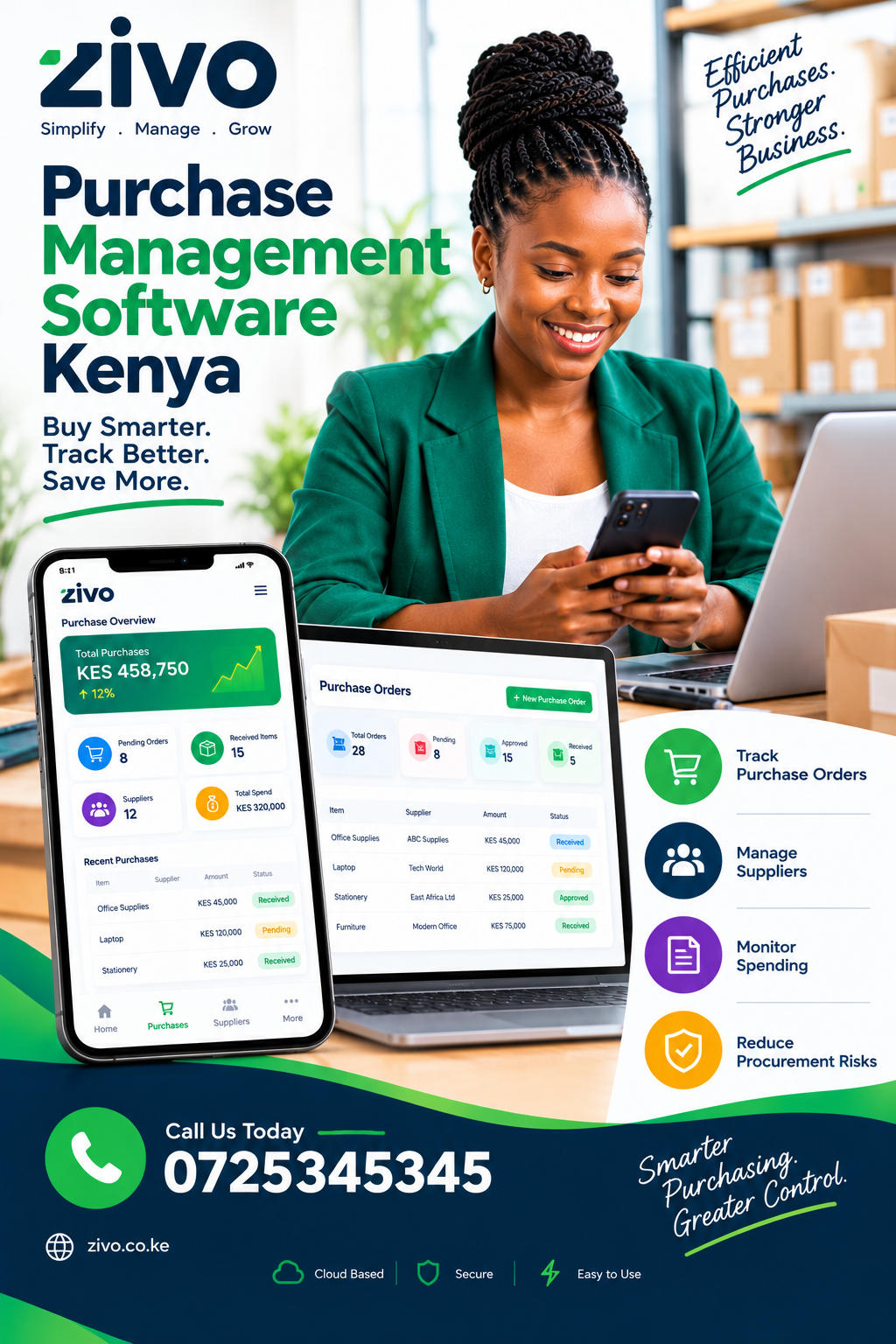
Purchase Management Software Kenya: Complete Guide for Smarter Business Purchasing
Introduction
Purchasing is one of the most important operational activities in any growing business. Whether a company buys stock for resale, materials for production, office supplies, equipment or services, purchasing directly affects costs, cash flow, inventory and profitability.
As a business grows, informal purchasing processes can become increasingly difficult to control. Employees may request items through WhatsApp, suppliers may send quotations through email, approvals may happen verbally, and receipts may end up in different folders. This creates a fragmented purchasing process that makes it difficult for management to know exactly what has been requested, approved, ordered, received and paid for.
A Purchase Management Software Kenya solution can help bring these activities into one structured workflow.
Instead of relying on scattered conversations and spreadsheets, businesses can create purchasing records that connect suppliers, purchase orders, approvals, goods received, supporting documents and payments.
For Kenyan SMEs, this is particularly valuable because purchasing decisions often have a direct relationship with cash availability, supplier relationships and inventory levels.
A well-designed Purchase Management Software Kenya platform can help management gain better visibility into purchasing activity while reducing unnecessary administrative work.
This guide explains how purchase management works, why it matters, what features businesses should look for, how supplier management fits into procurement, how purchase orders can improve control, how approvals can reduce unauthorized spending and how Zivo can support purchasing workflows for Kenyan businesses.
What Is Purchase Management?
Purchase management is the process of planning, requesting, approving, ordering, receiving and recording goods or services purchased by a business.
A typical purchasing process may look like this:
Purchase Request → Review → Approval → Purchase Order → Supplier Fulfilment → Goods Received → Invoice → Payment → Record
When every step is documented, management can see what is happening at each stage.
A Purchase Management Software Kenya system helps businesses organize these stages electronically.
This is different from simply recording an expense after money has already been spent.
Expense recording answers:
What did we spend?
Purchase management also asks:
Why was it purchased?
Who requested it?
Who approved it?
Which supplier was selected?
What was ordered?
What was received?
Has the supplier been paid?
That additional visibility is important for businesses that want stronger purchasing controls.
Why Purchase Management Matters for Kenyan SMEs
Small and medium-sized businesses often operate with limited working capital.
Every purchase therefore needs to be considered carefully.
Buying too much stock can tie up cash. Buying too little can result in stockouts. Paying suppliers before goods are properly received can create unnecessary risk. Allowing employees to purchase without approval can result in uncontrolled expenditure.
A Purchase Management Software Kenya solution can help management create a more consistent purchasing process.
It can also help businesses distinguish between:
- Requested purchases
- Approved purchases
- Ordered purchases
- Received purchases
- Paid purchases
- Outstanding supplier obligations
This distinction is useful because a purchase commitment can affect future cash flow even before the final payment is made.
The Problems With Manual Purchasing
Many businesses begin by managing purchases through simple methods.
For example, an employee may send a WhatsApp message saying that the business needs ten boxes of packaging material.
The manager approves the request in the same conversation.
The employee contacts a supplier.
The supplier sends a quotation.
The quotation is forwarded to the manager.
The employee pays the supplier.
The receipt is photographed.
The receipt is eventually sent to the accountant.
This process may work for a very small business.
However, it becomes difficult to audit as purchasing volume increases.
A Purchase Management Software Kenya platform can centralize these records.
Instead of searching through conversations, managers can review structured purchase information.
Purchase Requests
A purchase request is the starting point for many purchasing workflows.
The request should ideally explain:
- What is required
- Quantity
- Estimated cost
- Purpose
- Department
- Required date
- Supporting information
A Purchase Management Software Kenya solution can provide a structured place for employees to submit purchasing requirements.
This gives managers better information before approving spending.
It also creates a record showing why the purchase was requested.
Purchase Approvals
Approval is an important internal control.
Not every employee should necessarily be able to commit company funds.
A business may establish approval limits such as:
- Small purchases approved by supervisors
- Medium purchases approved by department managers
- Large purchases approved by senior management
A Purchase Management Software Kenya platform can support structured approval workflows where the relevant functionality is available.
The exact approval structure should reflect the company’s size, risks and internal policies.
The important principle is that purchasing authority should be clear.
Purchase Orders
A purchase order formally communicates what the business intends to buy from a supplier.
A purchase order can contain:
- Supplier
- Item
- Description
- Quantity
- Price
- Total
- Delivery details
- Terms
- Reference number
A Purchase Management Software Kenya system can help businesses create and maintain purchasing records instead of relying entirely on informal supplier messages.
Purchase orders also provide a reference against which received goods and supplier invoices can be checked.
Supplier Selection
Choosing the right supplier can have a major impact on business performance.
Businesses may compare suppliers based on:
- Price
- Quality
- Reliability
- Delivery time
- Payment terms
- Product availability
- Communication
- Previous performance
A Purchase Management Software Kenya platform can help organize supplier information alongside purchasing activity.
The objective is not simply to maintain a supplier contact list.
The objective is to create a clearer relationship between suppliers and actual purchasing activity.
Supplier Records
A centralized supplier record can contain information such as:
- Supplier name
- Contact information
- Products or services supplied
- Payment information
- Purchase history
- Outstanding obligations
- Supporting documents
A Purchase Management Software Kenya solution can make supplier information easier to retrieve.
This becomes increasingly useful when businesses work with many suppliers.
Without a centralized record, different employees may maintain different versions of supplier information.
Supplier Communication
Purchasing often involves communication between staff and suppliers.
Questions may include:
- Is the product available?
- What is the current price?
- When can delivery happen?
- Has the order been dispatched?
- Has the invoice been issued?
- Has payment been received?
A Purchase Management Software Kenya system can help businesses keep purchasing information connected to supplier records and operational processes where supported.
The goal is to reduce the amount of purchasing information trapped inside individual conversations.
Goods Received
Ordering something does not mean that it has been received.
This distinction is critical.
A business may order:
100 units
but receive:
80 units
If the company pays the supplier based only on the original purchase order, it may overpay.
A Purchase Management Software Kenya platform that supports goods-receipt workflows can help businesses compare what was ordered with what was actually delivered.
Zivo currently lists purchase orders and goods receipt within its procurement and supplier-control workflow.
Receiving Goods Accurately
When goods arrive, staff should ideally verify:
- Quantity
- Condition
- Product type
- Supplier
- Purchase order
- Delivery documentation
A Purchase Management Software Kenya solution can help create a record of the receiving process.
This is particularly useful for businesses that receive frequent deliveries.
It also creates greater accountability because management can determine who confirmed receipt.
Purchase Orders and Inventory
Purchasing and inventory are closely connected.
When a business purchases goods, those goods may eventually become stock available for sale or use.
If purchasing information and inventory information are completely disconnected, businesses can struggle to determine what has been ordered but not received.
A Purchase Management Software Kenya platform can help connect purchasing activity with stock workflows where supported.
Zivo’s current product information includes stock, purchase orders and delivery within its broader business workspace.
Avoiding Stockouts
A stockout occurs when a business does not have enough inventory to satisfy demand.
For retailers, wholesalers and distributors, stockouts can result in:
- Lost sales
- Delayed customer orders
- Customer dissatisfaction
- Emergency purchasing
- Higher transportation costs
A Purchase Management Software Kenya system can help businesses maintain better visibility into purchasing activity and incoming stock.
The objective is to make purchasing more proactive rather than waiting until stock has already run out.
Avoiding Overstocking
The opposite problem is overstocking.
Buying too much inventory can tie up cash.
Slow-moving goods may occupy warehouse space while the business still has supplier obligations and operating expenses.
A Purchase Management Software Kenya solution can help management review purchase activity alongside inventory and sales information where those workflows are connected.
Purchasing should therefore be based on demand, available cash, stock levels and supplier terms.
Purchase Management and Cash Flow
Every purchase affects cash flow directly or indirectly.
An immediate payment reduces available cash.
A credit purchase creates an obligation that may affect future cash.
A Purchase Management Software Kenya system can help management distinguish between orders, receipts and payments.
This makes it easier to understand what the business has committed to spend.
Cash-flow management is stronger when purchasing commitments are visible before they become unexpected payments.
Managing Supplier Credit
Supplier credit can help businesses manage working capital.
For example, a supplier may provide goods today and allow payment after 30 days.
This can give the business time to sell the goods and collect customer payments.
However, supplier credit also creates obligations.
A Purchase Management Software Kenya platform can help businesses organize supplier transactions and outstanding obligations.
Management should know:
- What was purchased
- What has been received
- What has been invoiced
- What has been paid
- What remains outstanding
Purchase Invoices
Supplier invoices should be connected to the purchasing process.
A supplier invoice may refer to:
- Purchase order
- Delivered goods
- Services provided
- Agreed price
- Quantity
A Purchase Management Software Kenya system can help create a stronger relationship between purchasing records and supplier invoices.
This can reduce the likelihood of paying invoices that do not match the original purchase.
Matching Purchases
Businesses can compare three important records:
Purchase Order
What the business ordered.
Goods Receipt
What the business actually received.
Supplier Invoice
What the supplier is charging.
A Purchase Management Software Kenya solution can help businesses establish this comparison where the relevant functionality is supported.
If the three records do not agree, management can investigate before payment.
This can reduce errors and improve financial control.
Preventing Duplicate Purchases
Duplicate purchasing can happen when several employees independently order the same item.
For example, two departments may both order printer paper without realizing that another order has already been placed.
A Purchase Management Software Kenya platform can provide greater visibility into existing purchase requests and orders.
This can help reduce unnecessary duplication.
Centralized purchasing information is particularly useful for businesses with multiple departments.
Department-Based Purchasing
Different departments may have different purchasing needs.
For example:
Sales: Marketing materials
Operations: Equipment and supplies
Finance: Office stationery
Technical: Hardware and software
A Purchase Management Software Kenya solution can help businesses associate purchasing activity with the appropriate department where departmental controls are available.
This allows management to understand where purchasing expenditure originates.
Purchase Budgets
Businesses may establish purchasing budgets for different periods.
For example:
- Monthly stock budget
- Office supplies budget
- Marketing budget
- Equipment budget
- Department budget
A Purchase Management Software Kenya platform can help businesses compare purchasing activity with planned spending where budgeting functionality is available.
The objective is not to prevent necessary purchases.
It is to make purchasing decisions more deliberate.
Purchase Approvals and Accountability
A purchasing system should make responsibility visible.
Management should be able to determine:
- Who requested the purchase
- Who approved it
- Who placed the order
- Who received the goods
- Who processed payment
A Purchase Management Software Kenya solution can provide stronger accountability by keeping these steps within a structured workflow.
Zivo’s procurement information specifically describes approval trails alongside suppliers, purchase orders, goods receipt and attachments.
Purchase Documents
Purchasing often involves multiple documents.
These may include:
- Supplier quotations
- Purchase orders
- Delivery notes
- Goods-received records
- Supplier invoices
- Receipts
- Contracts
- Product specifications
A Purchase Management Software Kenya platform that supports attachments can help businesses keep supporting documents connected to purchasing activity.
This is better than storing every document in unrelated folders.
Digital Document Management
Paper documents can be misplaced.
Email attachments can become difficult to find.
WhatsApp images can disappear among thousands of messages.
A Purchase Management Software Kenya system can help businesses organize purchasing documentation digitally.
When supporting information is connected to the relevant transaction, it becomes easier to retrieve during reviews.
Purchase Management for Retail Businesses
Retail businesses frequently purchase inventory.
They need to know:
- What products sell quickly
- What products are slow-moving
- What stock is currently available
- What has been ordered
- What suppliers are charging
- When deliveries are expected
A Purchase Management Software Kenya solution can help retailers coordinate purchasing with inventory and sales operations.
This can reduce reactive buying.
Purchase Management for Wholesalers
Wholesalers may manage large purchase volumes.
They may purchase from multiple suppliers and distribute products to numerous customers.
A Purchase Management Software Kenya system can help wholesalers maintain more structured supplier and purchase records.
This can make it easier to compare purchase prices, monitor deliveries and manage supplier obligations.
Purchase Management for Distributors
Distributors depend on reliable supply chains.
A delay from one supplier can affect customer deliveries.
A Purchase Management Software Kenya platform can help distributors organize orders, supplier activity and delivery information where supported.
The key is maintaining visibility from purchasing through receiving and fulfilment.
Purchase Management for Service Businesses
Service businesses also purchase items.
A cleaning company may purchase cleaning supplies.
A construction company may purchase materials.
An agency may purchase software subscriptions.
A repair business may purchase spare parts.
A Purchase Management Software Kenya system can help service businesses document these purchases rather than treating them as miscellaneous expenses.
Purchase Management for Construction Businesses
Construction companies may manage large numbers of suppliers.
They may purchase:
- Cement
- Steel
- Timber
- Electrical materials
- Plumbing materials
- Tools
- Safety equipment
A Purchase Management Software Kenya solution can help construction businesses structure purchasing requests and supplier orders.
Because construction projects can involve substantial spending, approval and receiving controls are particularly important.
Purchase Management for Manufacturers
Manufacturers depend on raw materials and components.
A production delay may occur if a critical input is unavailable.
A Purchase Management Software Kenya platform can help manufacturers organize supplier purchasing and incoming materials where supported.
Purchasing should be aligned with production requirements and stock levels.
Purchase Management and Supplier Performance
A supplier may offer competitive pricing but consistently deliver late.
Another supplier may charge slightly more but deliver reliably.
A Purchase Management Software Kenya system can help businesses accumulate purchasing information that supports supplier evaluation.
Management can consider:
- Price
- Delivery reliability
- Quality
- Communication
- Availability
- Payment terms
Supplier decisions should therefore consider total business value, not just the cheapest price.
Comparing Supplier Prices
Businesses often purchase the same item from different suppliers.
A Purchase Management Software Kenya platform can make purchasing information easier to review.
Management can compare:
- Unit price
- Quantity
- Delivery cost
- Payment terms
- Historical prices
This can improve purchasing negotiations.
It may also identify situations where prices have increased unexpectedly.
Negotiating With Suppliers
Good purchasing records can strengthen negotiations.
If a business knows that it purchases KSh 500,000 worth of products from a supplier every month, management has stronger information when discussing:
- Volume discounts
- Credit terms
- Delivery charges
- Payment periods
- Contract pricing
A Purchase Management Software Kenya solution can provide the purchasing history needed for these discussions.
Purchase Management and Profitability
Purchasing costs directly affect gross margins and profitability.
If a retailer sells a product for KSh 1,000 and the purchase cost increases from KSh 600 to KSh 750, the margin changes significantly.
A Purchase Management Software Kenya platform can help businesses maintain visibility into purchase prices.
Management can then evaluate whether selling prices need adjustment.
Purchase Price Changes
Supplier prices can change because of:
- Exchange rates
- Transport costs
- Market conditions
- Import costs
- Seasonal demand
- Supplier policy
A Purchase Management Software Kenya system can help businesses maintain purchasing records that make changes easier to identify.
Historical purchasing information is useful when negotiating with suppliers or reviewing margins.
Purchase Management and Expenses
Purchases and expenses are related but not identical.
A purchase may involve inventory that is later sold.
An expense may involve an operating cost such as rent or electricity.
A Purchase Management Software Kenya platform can help businesses maintain a distinction between purchasing activity and general expenses.
Zivo’s current solutions separate procurement and supplier control from expense and payout control while connecting both to the wider finance workflow.
Purchase Management and Payment Control
A purchase should not automatically result in immediate payment.
The business may need to verify:
- Approval
- Delivery
- Invoice
- Quantity
- Price
- Supplier details
A Purchase Management Software Kenya system can help organize these stages before payment.
This is particularly important when supplier invoices are large.
M-Pesa and Supplier Payments
Many Kenyan businesses use M-Pesa for supplier-related payments.
The challenge is ensuring that payments can be connected to the appropriate supplier transaction.
A Purchase Management Software Kenya platform can help businesses organize payment records where M-Pesa and payment-account workflows are supported.
Zivo currently describes M-Pesa payouts and payment accounts as part of its broader expense and finance workflows.
Businesses should test their exact supplier-payment process before implementation.
Purchase Reconciliation
Reconciliation helps confirm that purchasing records agree with payment records.
For example:
Supplier invoice: KSh 85,000
Payment: KSh 85,000
Status: Settled
If the payment is KSh 60,000, the business should be able to identify that a balance remains.
A Purchase Management Software Kenya solution can make these relationships easier to review.
Purchase Management and Cash Flow Planning
Purchasing commitments can affect future cash.
A business may have several approved purchase orders that have not yet been paid.
Even though the cash has not left the business today, those commitments may affect future liquidity.
A Purchase Management Software Kenya platform can help management see purchasing commitments alongside other financial information.
This can support more informed cash planning.
Purchase Management Dashboards
A purchasing dashboard should provide useful information.
Possible indicators include:
- Pending purchase requests
- Approved purchases
- Open purchase orders
- Goods awaiting receipt
- Supplier invoices
- Outstanding supplier balances
- Recent purchases
A Purchase Management Software Kenya system should be evaluated based on whether its reports answer practical management questions.
A dashboard should reduce uncertainty rather than simply display more numbers.
Purchase Reports
Management may need reports showing:
- Purchases by supplier
- Purchases by department
- Purchases by product
- Purchases by period
- Outstanding supplier obligations
- Purchase order status
A Purchase Management Software Kenya platform can provide a centralized purchasing record that supports management review.
The exact report availability should be confirmed during a product demonstration.
Purchase Management and Accounting
Purchasing eventually affects accounting records.
Businesses need to understand:
- What was purchased
- What was received
- What was invoiced
- What was paid
- What remains outstanding
A Purchase Management Software Kenya system that connects purchasing to finance can reduce duplicate data entry.
Zivo’s accounting information includes suppliers, expenses, payment accounts and supporting financial reports.
Why Integration Matters
Imagine purchasing information exists in one spreadsheet while supplier payments are tracked somewhere else.
The finance team may need to manually reconcile the two.
A Purchase Management Software Kenya solution can reduce this fragmentation when purchasing and finance workflows are connected.
The result can be a clearer transaction history.
Purchase Management and Audit Trails
Businesses need to understand what happened to important transactions.
An audit trail can help answer:
- When was the request created?
- Who changed it?
- Who approved it?
- When was the order created?
- Who received the goods?
- When was payment made?
A Purchase Management Software Kenya system can support greater accountability when appropriate audit and activity records are available.
This becomes more important as the organization grows.
Role-Based Access
Not every employee should have access to every purchasing function.
For example:
Requester: Creates purchase requests.
Approver: Reviews requests.
Procurement: Places orders.
Storekeeper: Confirms receipt.
Finance: Processes payment.
A Purchase Management Software Kenya platform with role-based controls can help businesses separate responsibilities.
Zivo states that staff access within its workspace is role-based.
Reducing Purchasing Fraud
Strong purchasing controls can reduce opportunities for fraud.
Potential risks include:
- Fake suppliers
- Duplicate invoices
- Unauthorized purchases
- Inflated quantities
- Fictitious deliveries
- Payments without approval
A Purchase Management Software Kenya solution can create a clearer trail of purchasing activity.
Technology does not eliminate fraud automatically.
Businesses still need appropriate policies, segregation of duties and management oversight.
Purchase Management and Business Growth
Purchasing processes that work for a five-person business may not work for a fifty-person business.
As the company grows, it may add:
- More suppliers
- More employees
- More departments
- More locations
- More inventory
- More purchase orders
A Purchase Management Software Kenya platform can help businesses standardize purchasing processes as transaction volumes increase.
Multi-Branch Purchasing
Businesses with multiple branches may face additional challenges.
A branch may place an order without headquarters knowing.
Another branch may purchase the same product from a different supplier at a higher price.
A Purchase Management Software Kenya system can provide centralized visibility where multi-location workflows are supported.
This can help management compare purchasing activity across branches.
Purchase Management for Growing SMEs
A growing SME needs controls that are practical.
Too few controls create risk.
Too many manual approval steps can slow the business down.
A Purchase Management Software Kenya solution should therefore make purchasing more controlled without making routine purchases unnecessarily difficult.
The best workflow depends on purchase value, risk and organizational structure.
Choosing Purchase Management Software
Businesses should evaluate software based on actual workflows rather than feature lists.
Ask the provider to demonstrate:
- Creating a purchase request
- Approving a request
- Creating a purchase order
- Selecting a supplier
- Attaching documents
- Recording goods received
- Recording the supplier invoice
- Processing payment
- Reviewing the purchase history
- Viewing relevant reports
A Purchase Management Software Kenya solution should be tested using realistic business scenarios.
This gives management a better understanding of whether the software fits the company.
Questions to Ask Before Buying
Before choosing a system, ask:
Does it support purchase orders?
Confirm whether purchase orders are available and how they are created.
Can it manage suppliers?
Check how supplier records are created and maintained.
Can purchases be approved?
Ask whether approval workflows can reflect your organization’s structure.
Can goods received be recorded?
This is important for businesses buying physical products.
Can documents be attached?
Ask whether quotations, invoices and delivery notes can be linked to transactions.
Can purchases connect to finance?
The purchasing process should ideally connect to relevant payment and financial records.
Can staff permissions be controlled?
Determine who can request, approve, order, receive and pay.
Can reports be generated?
Ask what purchasing reports are available.
Can the system support M-Pesa?
If supplier payments use M-Pesa, test the actual workflow.
Can it scale?
Confirm whether the platform can support your expected growth.
Implementing Purchase Management Software
Implementation should begin with understanding the current purchasing process.
Step 1: Map the current process
Document how purchases currently happen.
Step 2: Identify weaknesses
Look for:
- Missing approvals
- Duplicate orders
- Lost documents
- Supplier confusion
- Delayed receiving
- Payment errors
Step 3: Define roles
Determine who can request, approve, order, receive and pay.
Step 4: Clean supplier information
Remove duplicates and correct inaccurate records.
Step 5: Define purchase categories
Create appropriate categories for different types of purchases.
Step 6: Test workflows
Use realistic purchasing scenarios.
Step 7: Train employees
Every user should understand their responsibilities.
Step 8: Monitor adoption
Review whether employees are actually using the purchasing process.
A Purchase Management Software Kenya solution is most effective when purchasing policies and system workflows are aligned.
Common Purchase Management Mistakes
Businesses should avoid several common mistakes.
Ordering without approval
Employees may commit company funds without management knowledge.
Paying before verifying delivery
This can create unnecessary risk.
Using multiple supplier lists
Duplicate or inaccurate supplier information creates confusion.
Keeping purchase orders separate from invoices
This makes matching more difficult.
Failing to record goods received
Management may not know whether an order has actually arrived.
Ignoring supplier performance
The cheapest supplier is not always the best supplier.
Relying entirely on WhatsApp
Important purchasing information can become difficult to retrieve.
A Purchase Management Software Kenya platform can help address these issues through a more structured workflow.
How Zivo Supports Purchase Management
Zivo currently positions procurement and supplier control as part of its connected business platform.
Its published solutions describe suppliers, purchase orders, goods receipt, attachments and approval trails behind business spending.
For businesses evaluating Purchase Management Software Kenya, this connected approach is important because purchasing does not exist independently from the rest of the business.
A typical workflow may involve:
Supplier
↓
Purchase Request
↓
Approval
↓
Purchase Order
↓
Goods Received
↓
Supplier Invoice
↓
Payment
↓
Finance Record
Connecting these stages can provide a clearer purchasing history.
Zivo and Supplier Management
Supplier information is an important component of purchasing.
Zivo’s current product information includes suppliers within its finance and expense workflows, while its procurement workflow specifically addresses supplier purchasing activity.
For a business considering Purchase Management Software Kenya, the ability to connect supplier information with purchasing records can make supplier-related work easier to manage.
Management can review supplier activity rather than relying on individual employees to remember previous transactions.
Zivo and Purchase Orders
Purchase orders provide a formal record of intended purchases.
Zivo currently lists purchase orders within its Business workspace, alongside stock and delivery capabilities.
For businesses evaluating Purchase Management Software Kenya, purchase-order functionality should be tested with actual examples.
A useful demonstration should show:
- Creating an order
- Selecting a supplier
- Adding products
- Recording quantities
- Reviewing the order
- Receiving goods
- Connecting the transaction to subsequent financial activity
Zivo and Goods Receipt
Goods receipt is particularly important for businesses purchasing physical products.
Zivo’s current solutions page specifically includes goods receipt in its procurement and supplier-control workflow.
A business considering Purchase Management Software Kenya should therefore test how partial deliveries and complete deliveries are recorded.
For example:
Ordered: 100 units
Received: 80 units
Outstanding: 20 units
A purchasing system should make this difference visible where partial-receipt workflows are supported.
Zivo and Expense Management
Purchasing is closely connected to expenses.
Zivo’s current expense workflow includes suppliers and payees, receipts, departments, approval status, payment accounts, payment vouchers and M-Pesa payouts.
For businesses considering Purchase Management Software Kenya, this connection can help bridge purchasing activity and financial records.
However, businesses should distinguish procurement workflows from general expense tracking and confirm exactly which features are available under their selected plan.
Zivo and Financial Visibility
Zivo’s current finance workspace includes payment accounts, expenses, suppliers, cash flow, profit, VAT and journals.
For a business evaluating Purchase Management Software Kenya, this broader financial visibility can be valuable because purchasing decisions affect cash and profitability.
The purchasing system should not exist in isolation from the financial picture.
Purchase Management and Business Efficiency
Good purchasing processes can save more than money.
They can also save time.
Employees spend less time searching for documents.
Managers spend less time asking for updates.
Finance teams spend less time reconciling disconnected records.
A Purchase Management Software Kenya platform can help reduce administrative friction by organizing purchasing information.
This gives employees more time to focus on their core responsibilities.
Purchase Management and Supplier Relationships
Suppliers value reliable customers.
A business that consistently sends accurate purchase orders, receives goods efficiently and pays according to agreed terms can develop stronger supplier relationships.
A Purchase Management Software Kenya solution can help create more predictable purchasing processes.
Better organization can contribute to:
- Fewer disputes
- Faster approvals
- Clearer orders
- Better payment tracking
- More reliable communication
Purchase Management and Negotiating Power
Data can improve negotiation.
Suppose a business discovers that one supplier has received KSh 4 million in orders over the past year.
That information can support a conversation about:
- Volume discounts
- Better payment terms
- Delivery arrangements
- Long-term pricing
A Purchase Management Software Kenya platform can make purchasing history easier to analyze.
Purchase Management and Decision-Making
Managers need reliable information when deciding what to purchase.
They may ask:
- Do we really need this?
- Do we already have the item?
- Which supplier offers the best overall value?
- Can we afford it?
- Has the price increased?
- Is the supplier reliable?
- When do we need delivery?
A Purchase Management Software Kenya system can help provide the information needed to answer these questions.
The software does not replace management judgment.
It improves the information available to management.
Purchase Management and Working Capital
Working capital is affected by purchasing decisions.
If a business purchases too much inventory, cash becomes tied up.
If it purchases too little, it may lose sales.
If it pays suppliers too early, cash availability may decrease unnecessarily.
If it pays too late, supplier relationships may suffer.
A Purchase Management Software Kenya solution can help management maintain better visibility over purchasing commitments.
This can support more disciplined working-capital management.
Purchase Management for Kenyan SMEs
Kenyan SMEs often need software that is practical, affordable and easy to adopt.
The system should not require an enormous administrative team to operate.
A Purchase Management Software Kenya solution should make routine purchasing easier while providing stronger controls as the business grows.
Zivo’s current product positioning is specifically focused on Kenyan SMEs and connects customers, payments, expenses, suppliers, stock, delivery and finance within its broader workspace.
Frequently Asked Questions
What is Purchase Management Software Kenya?
Purchase Management Software Kenya refers to software used by businesses in Kenya to organize purchasing activities such as supplier management, purchase requests, purchase orders, approvals, goods receipt, purchasing documents and related financial processes.
Why should a small business use purchase management software?
A small business may benefit when purchasing becomes too complex to manage through WhatsApp, spreadsheets and paper documents.
A Purchase Management Software Kenya system can create a more consistent process for requests, approvals, orders and receiving.
Can purchase management software manage suppliers?
Yes. Supplier management is an important part of purchasing software.
A Purchase Management Software Kenya platform can maintain supplier records and connect them to purchasing activity where the functionality is available.
Can purchase orders be created digitally?
Many modern purchasing systems support purchase orders.
Zivo currently lists purchase orders as part of its business workspace.
Why are goods receipts important?
Goods receipts confirm what was actually delivered.
A Purchase Management Software Kenya system can help businesses compare ordered quantities with received quantities where goods-receipt functionality is available.
Can purchase management software help control spending?
Yes.
Approval workflows, purchase orders and receiving records can provide greater control over purchasing commitments.
Can it help manage supplier payments?
Purchasing systems can connect supplier obligations to payment workflows depending on the software.
A Purchase Management Software Kenya solution should be evaluated based on the exact payment and reconciliation features your business requires.
Can it work with M-Pesa?
This depends on the platform and plan.
Zivo currently lists M-Pesa capabilities across its payment and expense workflows, including M-Pesa payouts and reconciliation capabilities on applicable plans.
Can purchase management software connect with accounting?
It can when purchasing and finance workflows are integrated.
A Purchase Management Software Kenya solution should be tested to determine how purchases, suppliers, invoices, payments and financial reports connect.
Is purchase management only useful for large companies?
No.
Small businesses can benefit once purchasing becomes frequent enough that manual tracking creates delays, errors or poor visibility.
Purchase Management Checklist
Before implementing purchasing software, businesses should make sure they can answer the following questions.
Purchasing
- How are requests created?
- Who approves them?
- How are suppliers selected?
- How are purchase orders generated?
- How are changes documented?
Receiving
- Who confirms delivery?
- Can partial deliveries be recorded?
- Can supporting documents be attached?
- Can received quantities be compared with ordered quantities?
Suppliers
- Are supplier records centralized?
- Can purchase history be reviewed?
- Can supplier obligations be monitored?
- Can supplier documents be stored?
Finance
- How are supplier invoices recorded?
- How are payments recorded?
- Can payment accounts be tracked?
- Can purchasing affect financial reporting?
Controls
- Can users have different permissions?
- Is there an approval trail?
- Can management review activity?
- Can transactions be corrected without losing accountability?
A Purchase Management Software Kenya system should be judged against these practical requirements.
Final Thoughts
Purchasing is more than buying products.
It is a process that affects inventory, suppliers, cash flow, expenses, profitability and customer service.
When purchasing is managed through scattered conversations, spreadsheets and paper documents, businesses can lose visibility.
A Purchase Management Software Kenya platform can help create a structured process from purchase request through supplier fulfilment and financial recording.
For Kenyan SMEs, this can be particularly useful as transaction volumes increase.
The right purchasing workflow can help businesses:
- Control spending
- Improve supplier management
- Reduce duplicate purchases
- Track purchase orders
- Confirm goods received
- Organize supporting documents
- Improve accountability
- Understand supplier obligations
- Support better cash-flow decisions
Zivo’s current procurement offering includes suppliers, purchase orders, goods receipt, attachments and approval trails, while its wider workspace connects purchasing-related activity with expenses, payment accounts, stock, delivery and finance.
Businesses considering Purchase Management Software Kenya should therefore focus on the complete purchasing lifecycle rather than looking for a simple purchase-order generator.
The ideal process should connect:
Request
→
Approval
→
Supplier
→
Purchase Order
→
Goods Receipt
→
Supplier Invoice
→
Payment
→
Financial Record
This approach provides much stronger visibility than simply recording a purchase after the money has already left the business.
A Purchase Management Software Kenya solution should ultimately help the business answer a simple question at any time:
What have we purchased, from whom, why, for how much, what has been received, what has been paid, and what remains outstanding?
When management can answer that question quickly, purchasing becomes easier to control.
It also becomes easier to identify unnecessary spending, negotiate with suppliers, plan inventory, manage cash and protect profit.
For businesses that are ready to move away from fragmented purchasing processes, a structured digital workflow can provide the visibility required to operate more efficiently.
The goal is not simply to digitize purchasing.
The goal is to create a purchasing process that is controlled, traceable, accountable and connected to the rest of the business.
For a growing Kenyan SME, that can make purchasing a strategic business function rather than an administrative burden.