
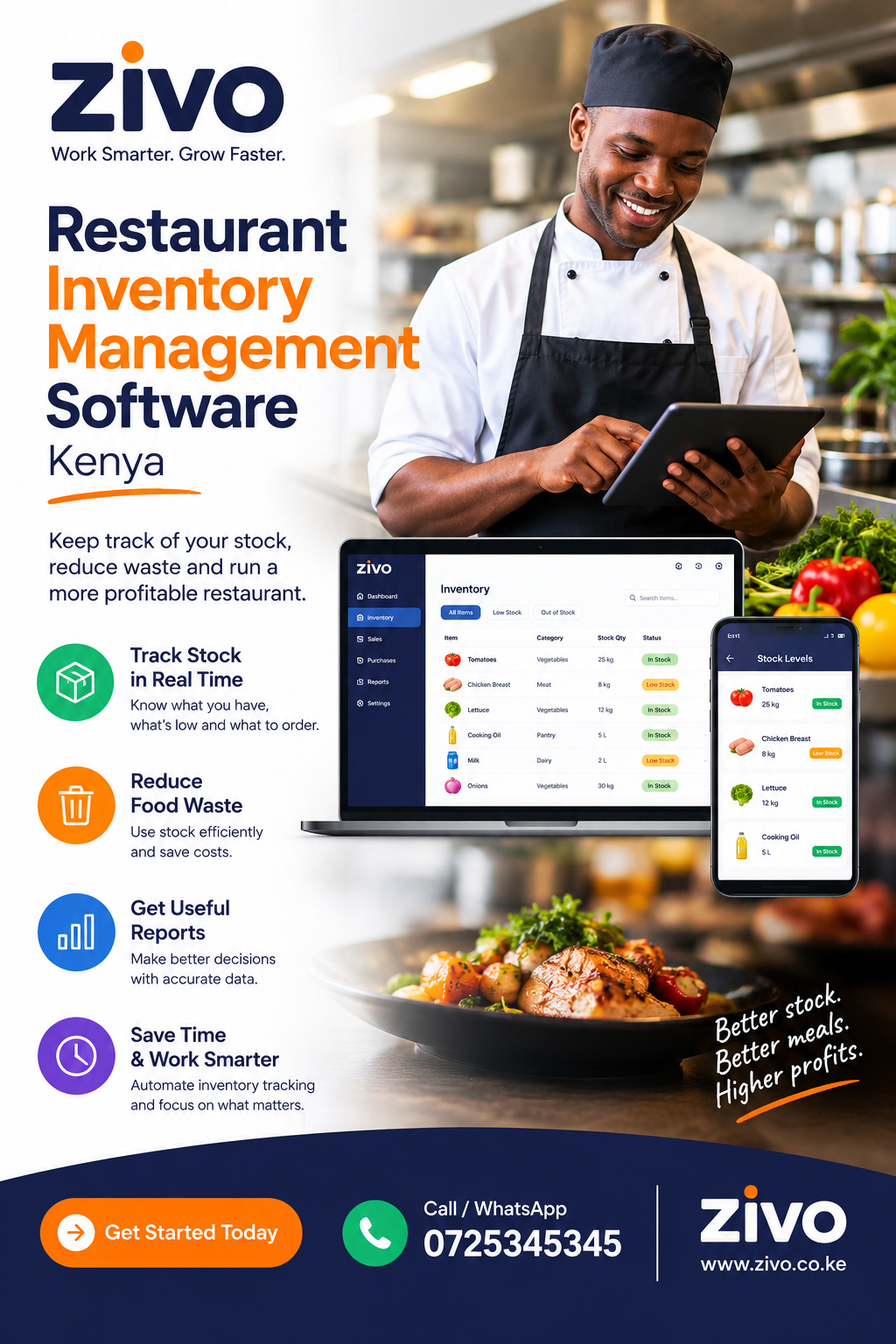
Restaurant Inventory Management Software Kenya: Complete Guide for Restaurants and Food Businesses
Running a restaurant involves much more than preparing meals and serving customers. Every day, a restaurant has to receive ingredients, monitor quantities, manage suppliers, control wastage, process orders, record sales and understand whether the food being sold is actually profitable. Restaurant Inventory Management Software Kenya gives restaurants a structured way to connect these activities and maintain better control over food stock.
For restaurants, cafés, hotels, bakeries, cloud kitchens and food delivery businesses in Kenya, inventory can quickly become one of the most difficult areas to manage manually. Flour, cooking oil, meat, vegetables, beverages, packaging materials and other supplies move through the business constantly. A reliable inventory system helps owners and managers know what is available, what has been consumed, what needs to be purchased and where money may be disappearing.
This guide explains how Restaurant Inventory Management Software Kenya can support daily restaurant operations. It covers stock control, purchasing, wastage, recipe costing, supplier management, low-stock monitoring, sales integration, M-Pesa workflows, reporting, multi-branch operations and the practical factors Kenyan restaurant owners should consider before choosing software.
What Is Restaurant Inventory Management Software?
At its simplest, Restaurant Inventory Management Software Kenya is a digital system for recording, monitoring and controlling the ingredients, products and supplies used by a restaurant.
Instead of relying on handwritten stock cards, notebooks or spreadsheets, restaurant staff can record stock movements electronically. Depending on the system, the business may be able to monitor purchases, sales, transfers, consumption, adjustments and available quantities from one workspace.
For example, imagine a Nairobi restaurant that purchases 100 litres of cooking oil at the beginning of the week. If the business relies on manual records, staff may record the purchase in a notebook and later estimate how much remains. If several cooks use the oil during the week, the figures can quickly become inaccurate.
With Restaurant Inventory Management Software Kenya, the restaurant can create a structured inventory record and connect stock activity with other business transactions. This gives managers a clearer picture of how supplies move through the operation.
The system can be particularly useful for restaurants that have:
- High daily order volumes
- Multiple suppliers
- Large ingredient lists
- Several employees handling stock
- Multiple branches
- Food delivery operations
- Frequent stock purchases
- Significant food wastage
- M-Pesa and other digital payments
- Complex menus
- Regular stock discrepancies
The objective is not simply to digitise a stock list. The objective is to create a reliable operational record that helps management make better decisions.
Why restaurant inventory is different from ordinary retail inventory
A shop usually sells a product exactly as it appears in its inventory catalogue. A restaurant works differently.
A restaurant may purchase chicken as a raw ingredient but sell it as part of several different meals. One kilogram of chicken may contribute to multiple customer orders. The same applies to vegetables, spices, flour, cooking oil, sauces and other ingredients.
This means restaurant inventory requires more than counting finished products.
Managers need to understand:
- What ingredients are available
- How much was purchased
- How much was consumed
- What was wasted
- What was used for staff meals
- What was transferred between locations
- What remains available
- What needs to be reordered
- How ingredient costs affect menu profitability
That is why a purpose-built inventory workflow can be valuable.
Why Restaurants in Kenya Need Better Stock Control
Food businesses operate with narrow margins in many cases, so small inventory mistakes can become expensive over time. Restaurant Inventory Management Software Kenya can help restaurants create a more consistent process for recording stock movement.
Consider a restaurant that sells 300 meals per day. If ingredients are measured informally, even a small amount of unexplained wastage on every meal can accumulate into a significant monthly cost.
The problem becomes more complicated when the restaurant has several employees and shifts.
One employee receives stock. Another stores it. A chef uses it. A waiter records sales. A manager checks the day’s revenue. If these activities are recorded separately, management may struggle to determine why expected stock does not match actual stock.
Restaurant Inventory Management Software Kenya can bring these activities into a more structured workflow.
Common inventory challenges in restaurants
Restaurants frequently encounter problems such as:
- Stockouts
An essential ingredient runs out during service. - Over-purchasing
Too much stock is purchased and some products expire before use. - Unrecorded wastage
Ingredients are discarded without being properly recorded. - Incorrect stock counts
Physical quantities do not match recorded quantities. - Poor supplier visibility
Managers cannot easily determine which supplier supplied particular products. - Manual calculations
Staff spend unnecessary time calculating stock balances. - Unclear food costs
Management knows revenue but does not have a reliable picture of ingredient costs. - Branch-level confusion
Stock is moved between branches without proper documentation. - Disconnected sales records
Sales happen in one system while inventory is maintained elsewhere. - Late purchasing decisions
Managers notice shortages only after the stock has nearly run out.
A structured inventory system can address many of these problems by creating a consistent record for every important movement.
Connecting Restaurant Sales With Inventory
One of the most important capabilities to consider when evaluating Restaurant Inventory Management Software Kenya is its relationship with sales.
Inventory becomes much more useful when it is connected to transactions.
Suppose a customer orders three chicken meals. The restaurant records the sale through its POS or order workflow. If the system supports appropriate inventory connections, the ingredients associated with those meals can be reflected in stock calculations.
This creates a relationship between:
Customer order → Sale → Ingredient consumption → Stock balance → Cost analysis
That relationship gives managers greater visibility.
Why disconnected systems cause problems
Imagine a restaurant using:
- WhatsApp for customer orders
- A cashbook for sales
- A notebook for inventory
- M-Pesa messages for payments
- Excel for monthly reporting
Each tool may work individually, but the restaurant has to reconcile the information manually.
That creates opportunities for errors.
Restaurant Inventory Management Software Kenya can help create a more connected operational structure when sales and stock records are designed to work together.
A restaurant owner should therefore ask a software provider:
- Does a completed sale affect stock records?
- Can staff track stock movements?
- Can products and ingredients be organised?
- Can purchasing be recorded?
- Can managers review stock reports?
- Can the system support multiple locations?
- Can payments and sales be connected?
The answers matter more than the appearance of the software dashboard.
Managing Ingredients More Effectively
A restaurant inventory system should allow businesses to organise the ingredients and supplies they actually use. Restaurant Inventory Management Software Kenya can be useful when restaurants need to maintain a central product and ingredient catalogue.
A catalogue might contain:
| Category | Examples |
|---|---|
| Meat | Beef, chicken, goat, fish |
| Vegetables | Tomatoes, onions, cabbage, carrots |
| Dry goods | Rice, flour, sugar, beans |
| Cooking supplies | Cooking oil, spices, sauces |
| Beverages | Soda, juice, bottled water |
| Packaging | Food containers, cups, bags |
| Cleaning supplies | Detergent, sanitiser, gloves |
The exact structure should reflect the restaurant’s operation.
Ingredient units matter
Restaurants should also think carefully about measurement units.
One supplier might sell cooking oil in 20-litre containers while the kitchen consumes it by the litre. Flour may be purchased in 50-kilogram bags but used by kilogram. Meat may be purchased in kilograms and portioned into individual servings.
A good inventory process should make these conversions manageable and consistent.
This is particularly important because poor unit management can make an otherwise accurate stock system unreliable.
Reducing Food Waste
Food wastage is one of the most important reasons restaurants need disciplined inventory control. Restaurant Inventory Management Software Kenya can help businesses record stock movement more consistently and identify unusual consumption patterns.
Not every stock reduction represents a sale.
Food can disappear from inventory because it was:
- Spoiled
- Damaged
- Overcooked
- Burnt
- Returned
- Used for staff meals
- Given as a complimentary meal
- Used during preparation
- Lost through portioning errors
- Expired
If every reduction is simply treated as a sale, management gets an inaccurate picture of restaurant performance.
Record wastage separately
A better approach is to create a process where wastage is recorded with a reason.
For example:
Ingredient: Tomatoes
Quantity: 8 kg
Reason: Spoilage
Date: Monday
Recorded by: Kitchen supervisor
Over time, these records can reveal patterns.
If tomatoes are repeatedly wasted at the same level, management can investigate purchasing quantities, storage conditions or kitchen preparation procedures.
Restaurant Inventory Management Software Kenya can therefore support not only stock counting but also operational accountability.
Purchasing and Supplier Management
Restaurants purchase ingredients frequently. Some buy every morning, while others purchase weekly or according to expected demand.
An inventory system can make purchasing more organised. Restaurant Inventory Management Software Kenya can support the connection between stock requirements and purchasing decisions when the software includes purchasing functionality.
Instead of asking, “What should we buy today?” managers can examine available stock and recent consumption before preparing an order.
A practical purchasing workflow
A restaurant can use a process such as:
- Review current stock.
- Identify items below the desired level.
- Review recent sales.
- Check upcoming events or expected demand.
- Review supplier availability.
- Prepare purchase requirements.
- Receive delivered goods.
- Verify quantities.
- Record the stock received.
- Store ingredients appropriately.
This reduces dependence on memory.
Supplier records
Supplier management is also important.
A restaurant may purchase chicken from one supplier, vegetables from another, beverages from a distributor and packaging materials from another business.
A central supplier record can help managers understand:
- Supplier name
- Contact information
- Products supplied
- Purchase history
- Prices
- Delivery frequency
- Outstanding balances
- Recent orders
Restaurant Inventory Management Software Kenya becomes more valuable when stock, purchasing and supplier information can be reviewed together.
Low-Stock Alerts and Reordering
Running out of a popular ingredient during lunch service is more than an inventory problem. It can become a customer-service problem.
If a restaurant cannot prepare a popular meal because an ingredient is unavailable, staff may have to tell customers that the item is sold out.
A low-stock process helps prevent this.
Restaurant Inventory Management Software Kenya can help managers monitor inventory levels and identify items that require attention.
For example:
| Ingredient | Current Stock | Minimum Level | Action |
|---|---|---|---|
| Cooking oil | 12 litres | 20 litres | Reorder |
| Rice | 75 kg | 40 kg | Monitor |
| Chicken | 18 kg | 25 kg | Reorder |
| Tomatoes | 32 kg | 15 kg | No action |
| Packaging boxes | 180 | 200 | Reorder |
The exact thresholds should depend on sales volume, supplier lead times and storage capacity.
Avoid setting arbitrary reorder levels
A restaurant should not set every ingredient to the same minimum quantity.
A busy restaurant may use 20 kilograms of chicken every day but only a few kilograms of a particular spice each month.
Reorder levels should reflect actual consumption.
This is another reason historical inventory and sales information is valuable.
Recipe Costing and Portion Control
Restaurant profitability depends heavily on food costs. Restaurant Inventory Management Software Kenya can support better cost visibility when the inventory workflow can connect ingredients with menu items.
Suppose a restaurant sells a plate of chicken and rice.
The recipe may include:
- 250 g chicken
- 200 g cooked rice
- 50 g vegetables
- Cooking oil
- Spices
- Sauce
- Packaging for takeaway orders
Each ingredient has a cost.
If ingredient prices change, the restaurant needs to understand how that affects the meal’s cost.
Why portion control matters
Two cooks may prepare the same meal differently.
Chef A uses 250 g of chicken.
Chef B uses 350 g.
If the restaurant sells hundreds of meals, the difference can become significant.
Standardised recipes and portion guidelines help restaurants maintain consistency.
Inventory data can then be compared against expected consumption.
For example, if 100 meals were sold and each meal should use 250 g of chicken, expected consumption is 25 kg. If the stock records show that 34 kg was used, management has a reason to investigate.
Restaurant Inventory Management Software Kenya can become part of that control process when inventory records are connected to operational data.
M-Pesa, Payments and Restaurant Operations
Digital payments are an important part of Kenyan business operations. A restaurant may receive payments through M-Pesa, cards, cash and other channels.
The payment itself does not replace inventory management, but connecting payment records with sales and operational workflows can improve visibility.
Restaurant Inventory Management Software Kenya can help form part of a connected restaurant workflow where appropriate.
For example:
Order received → Order confirmed → Payment recorded → Sale completed → Stock updated → Order prepared → Customer receives food
This is much easier to manage than separate records.
Zivo’s published business information describes workflows involving invoices, M-Pesa payments, stock, sales orders and fulfilment. Its retail workspace also connects POS sales, product catalogues, stock, warehouses, sales orders, M-Pesa payments and reporting.
Why payment visibility matters
Suppose a customer pays through M-Pesa but the kitchen team does not know that the order has been confirmed.
The order may be delayed.
Similarly, if staff prepare an order without confirming payment where payment confirmation is required, the restaurant can create unnecessary collection problems.
Connected workflows reduce these information gaps.
Managing Stock Across Multiple Restaurant Branches
A single restaurant is relatively straightforward compared with a business operating five or ten branches.
Multi-branch restaurants need to understand stock by location. Restaurant Inventory Management Software Kenya can support this type of discussion by focusing management attention on centralised inventory visibility.
Consider a restaurant group with branches in Nairobi, Mombasa and Kisumu.
Each location may have different:
- Sales volumes
- Menus
- Suppliers
- Stock levels
- Customer demand
- Storage capacity
- Delivery requirements
Head office may need consolidated reporting while each branch requires operational independence.
Inter-branch stock transfers
A branch may have excess stock while another branch is running low.
Instead of purchasing more immediately, management may transfer some stock between locations.
That movement should be recorded.
Otherwise, head office may believe the original branch still has the stock while the receiving branch also records it manually.
Restaurant Inventory Management Software Kenya can be particularly relevant when a restaurant wants to think about inventory as a network rather than a collection of disconnected stockrooms.
Inventory Reports Restaurant Managers Should Monitor
Software is useful only when the information helps management make decisions. Restaurant Inventory Management Software Kenya should therefore be evaluated partly on the quality and usefulness of its reports.
Important reports may include:
Stock-on-hand report
Shows the quantity currently available.
Stock movement report
Shows increases and decreases over a selected period.
Purchase report
Shows products purchased from suppliers.
Wastage report
Shows stock written off and the reasons recorded.
Sales report
Shows which products were sold and in what quantities.
Cost report
Helps management understand purchasing and ingredient costs.
Low-stock report
Identifies items approaching their minimum thresholds.
Supplier report
Shows purchasing activity by supplier.
Branch report
Useful for businesses operating multiple locations.
Restaurant Inventory Management Software Kenya can be more valuable when reports are easy for restaurant managers to understand rather than being designed only for technical users.
How Inventory Software Can Improve Daily Restaurant Work
The practical value of inventory software becomes clearer when we consider the daily routine.
A restaurant manager might begin the morning by reviewing stock levels.
The kitchen team receives ingredients.
Staff record incoming goods.
During service, customer orders are recorded.
Sales affect inventory records.
Managers monitor fast-moving items.
At the end of the day, the manager reviews sales and stock movement.
This creates a repeatable workflow.
Restaurant Inventory Management Software Kenya can help restaurants move from reactive stock management toward a more structured process.
Morning stock review
Managers can check:
- Ingredients available
- Items below minimum
- Expected deliveries
- Previous-day consumption
- Unresolved stock discrepancies
During service
Staff can monitor:
- Popular menu items
- Ingredient availability
- Orders
- Payments
- Completed transactions
Closing procedure
At the end of the day, management can review:
- Sales
- Stock movement
- Wastage
- Unusual adjustments
- Cash and payment records
- Items requiring replenishment
A consistent routine makes inventory management less dependent on individual memory.
Choosing the Right Restaurant Inventory System
Before selecting Restaurant Inventory Management Software Kenya, restaurant owners should identify their actual operational requirements.
The most expensive system is not automatically the most suitable. A small café may need a straightforward inventory workflow, while a large restaurant group may require multiple branches, detailed purchasing and advanced reporting.
Start with your current problems
Ask:
- Where do stock discrepancies occur?
- How often do ingredients run out?
- How much wastage is recorded?
- How are purchases currently documented?
- How are suppliers managed?
- How are sales recorded?
- How are digital payments reconciled?
- How are managers informed about stock problems?
- How often are stock counts performed?
The answers help identify which features matter.
Essential capabilities to consider
A restaurant inventory platform may need:
| Feature | Why it matters |
|---|---|
| Stock tracking | Shows available quantities |
| Product catalogue | Keeps items organised |
| Purchasing | Records incoming stock |
| Supplier management | Organises vendor information |
| Wastage tracking | Identifies avoidable losses |
| Sales integration | Connects revenue with stock movement |
| Low-stock alerts | Helps prevent shortages |
| Reporting | Supports management decisions |
| Multi-location support | Useful for restaurant groups |
| User permissions | Controls staff access |
| Payment integration | Connects transactions with operations |
Restaurant Inventory Management Software Kenya should be assessed against the restaurant’s real workflow rather than a generic feature checklist.
Cloud-Based Restaurant Inventory Management
Cloud software allows authorised users to access business information through internet-connected devices. Restaurant Inventory Management Software Kenya may be particularly useful for restaurant owners who need visibility while away from the premises.
For example, an owner could be at another location while a manager operates the restaurant.
Instead of calling staff repeatedly to ask:
“How much chicken is left?”
“Did we receive the vegetables?”
“Did the supplier deliver the oil?”
“How much did we sell today?”
the owner can potentially access the relevant reports from the system.
Benefits for owners
Cloud-based systems can provide:
- Remote visibility
- Centralised records
- Easier reporting
- Reduced paperwork
- Better collaboration
- Faster access to information
However, restaurant owners should still evaluate internet requirements, backup procedures, account security and user permissions before implementation.
Staff Access and Accountability
Inventory management is also a people-management issue. Restaurant Inventory Management Software Kenya can support accountability when different users have appropriate permissions and actions are recorded.
Not every employee needs access to every part of the system.
For example:
Kitchen staff:
May record wastage or view relevant ingredient information.
Storekeeper:
May receive stock and perform stock counts.
Cashier:
May process sales.
Manager:
May review reports and approve adjustments.
Owner:
May access business-wide information.
The exact permission structure depends on the software.
Why user accountability matters
When several people can make inventory adjustments without identification, investigating discrepancies becomes difficult.
A system that records user actions can help management ask:
- Who entered the adjustment?
- When was it entered?
- What quantity changed?
- Why was it changed?
This does not eliminate theft or mistakes, but it can make unusual activity easier to investigate.
Restaurant Inventory Software and Food Delivery
Food delivery adds another layer of complexity.
A restaurant may receive orders from its physical location, WhatsApp, its website, delivery platforms or other channels.
The business needs to make sure that an item shown as available can actually be prepared.
Restaurant Inventory Management Software Kenya can contribute to a broader restaurant workflow where orders, stock and fulfilment are connected.
Zivo’s current platform information describes sales orders, stock, payment tracking and fulfilment as connected operational workflows.
For delivery-focused businesses, this matters because an order can pass through several stages:
- Customer places order.
- Restaurant confirms order.
- Payment is received or verified.
- Kitchen prepares food.
- Order is packed.
- Rider or delivery staff receives it.
- Customer receives the order.
- Transaction is recorded.
Inventory is one component of this larger chain.
How Inventory Data Supports Better Decisions
Good restaurant management requires more than knowing today’s stock level. Restaurant Inventory Management Software Kenya can provide historical information that helps managers identify trends.
For example, managers can examine:
- Which ingredients are consumed fastest?
- Which menu items sell most frequently?
- Which products generate the most wastage?
- Which suppliers are used most?
- Which branches consume particular ingredients fastest?
- Which periods have unusually high demand?
This information can influence purchasing and menu decisions.
Example
Suppose a restaurant discovers that a particular meal sells heavily on Friday and Saturday evenings.
Management can prepare additional ingredients before the weekend.
Another ingredient may sell slowly throughout the week. Purchasing large quantities of that item may create unnecessary holding costs.
Inventory information therefore supports operational planning.
Common Mistakes When Implementing Restaurant Inventory Software
Buying software alone does not guarantee better inventory management. Restaurant Inventory Management Software Kenya works best when the restaurant establishes clear procedures around it.
Mistake 1: Entering inaccurate opening stock
If the initial stock balance is wrong, future reports may also be unreliable.
Mistake 2: Creating duplicate products
“Cooking Oil 20L”, “Oil 20 Litres” and “Cooking Oil Large” could accidentally become three separate inventory items.
Mistake 3: Ignoring units
A restaurant should decide whether an item is measured in kilograms, litres, pieces, cartons or another appropriate unit.
Mistake 4: Not recording wastage
Unrecorded wastage makes consumption look higher than expected without explaining why.
Mistake 5: Allowing unrestricted adjustments
Inventory adjustments should follow a controlled process.
Mistake 6: Failing to train staff
Even good software produces poor data when employees do not understand the workflow.
Mistake 7: Tracking stock but ignoring purchasing
Stock management is incomplete if managers cannot understand where inventory came from.
Mistake 8: Never reviewing reports
Data has little value if nobody uses it to make decisions.
How to Implement Inventory Software in a Restaurant
Implementation should be gradual and practical. Restaurant Inventory Management Software Kenya should fit the restaurant’s working habits rather than forcing staff through unnecessary complexity.
Step 1: List your inventory
Document all important ingredients and supplies.
Step 2: Standardise names
Use clear and consistent product names.
Step 3: Define units
Decide how every item will be measured.
Step 4: Enter suppliers
Create supplier records and relevant purchasing information.
Step 5: Perform a physical stock count
Count actual quantities before relying on the software’s figures.
Step 6: Configure sales workflows
Connect products or menu items to sales processes where supported.
Step 7: Establish wastage procedures
Define who records wastage and how reasons are captured.
Step 8: Train staff
Give each employee training appropriate to their role.
Step 9: Monitor reports
Review inventory regularly during the first few weeks.
Step 10: Improve the process
Use discrepancies and staff feedback to refine procedures.
Cost Considerations for Kenyan Restaurants
Price is an important consideration when evaluating Restaurant Inventory Management Software Kenya, but restaurant owners should look beyond the monthly subscription.
The total cost can include:
- Software subscription
- Setup
- Staff training
- POS hardware
- Barcode scanners
- Tablets or computers
- Internet
- Payment integration
- Support
- Data migration
- Custom workflows
A restaurant should compare these costs with the operational problems it is trying to solve.
Zivo currently publishes a free starting plan and paid plans, with its business plan including POS, stock and purchasing capabilities. Current pricing and feature limits should be confirmed directly with the provider because software plans can change.
Don’t choose software solely because it is cheap
A low subscription price may not be economical if the software cannot support the restaurant’s workflow.
Similarly, an expensive system may contain features the restaurant never uses.
The appropriate question is:
Does the system solve the operational problems that matter to this restaurant?
Security and Data Protection
Restaurant inventory data can contain commercially important information. Restaurant Inventory Management Software Kenya should therefore be evaluated for access controls and account security.
Important questions include:
- How are user accounts protected?
- Can permissions be assigned by role?
- Are backups available?
- Can access be removed when an employee leaves?
- Can management see user activity?
- How is business information stored?
- What happens if an employee loses their password?
Restaurants should also establish internal procedures for account security.
Employees should use individual accounts where appropriate rather than sharing one password across the entire business.
Restaurant Inventory Management for Small Cafés
A small café may not have hundreds of products, but inventory control can still make a significant operational difference. Restaurant Inventory Management Software Kenya can be relevant to cafés that want to move away from manual stock records.
A café may need to track:
- Coffee beans
- Milk
- Sugar
- Tea
- Bread
- Eggs
- Syrups
- Pastries
- Packaging
- Bottled drinks
The system does not have to be complicated.
For a small business, the priority may simply be accurate stock levels, purchasing records, sales information and basic reporting.
Inventory Management for Large Restaurants
Larger restaurants have more complex requirements. Restaurant Inventory Management Software Kenya may be part of a broader technology strategy involving multiple branches, staff, suppliers and delivery channels.
A large operation may need:
- Multiple warehouses
- Multiple branches
- Role-based access
- Detailed purchasing
- Stock transfers
- Advanced reporting
- Recipe management
- Ingredient costing
- Supplier analysis
- Approval workflows
- POS integration
- Payment reconciliation
The system should be scalable enough to handle growing transaction volumes.
Measuring Whether the System Is Working
After implementation, managers should measure results instead of assuming the software is helping. Restaurant Inventory Management Software Kenya should contribute to measurable improvements in inventory discipline.
Useful indicators include:
- Stock discrepancy frequency
- Food wastage
- Stockout frequency
- Purchase accuracy
- Inventory turnover
- Time spent preparing stock reports
- Number of emergency purchases
- Unexplained inventory adjustments
- Supplier delivery accuracy
For example, if a restaurant previously performed a complete stock reconciliation once per month but can now review stock movement every day, that may improve management visibility.
The exact results will depend on the restaurant, staff discipline and implementation quality.
Practical Example: A Nairobi Restaurant
Consider a fictional restaurant in Nairobi serving lunch, dinner and delivery orders.
Before introducing a structured system, the restaurant uses a notebook for purchases, Excel for monthly sales and WhatsApp for delivery orders.
The manager faces several problems:
- Chicken sometimes runs out during dinner.
- Vegetable wastage is not recorded.
- Supplier balances are difficult to reconcile.
- M-Pesa payments require manual checking.
- Stock counts take several hours.
- Management cannot easily compare weekly consumption.
After implementing a connected workflow, the restaurant establishes a product catalogue, supplier records, stock procedures and sales tracking.
Restaurant Inventory Management Software Kenya becomes part of the restaurant’s daily operating process.
The manager can now review stock movement, identify low-stock items, monitor purchases and compare sales information.
The important change is not merely that the restaurant has software.
The important change is that staff have a defined process for recording what happens.
Restaurant Inventory Management and Business Growth
As restaurants grow, manual systems become increasingly difficult to maintain. Restaurant Inventory Management Software Kenya can provide a structured foundation for businesses that expect their operations to become more complex.
Growth may involve:
- More customers
- More employees
- More menu items
- More suppliers
- More branches
- More delivery orders
- More payment transactions
Each additional layer creates more data.
Without a central system, management may spend increasing amounts of time collecting information.
With a connected system, the restaurant can create standard procedures that employees follow consistently.
What Should You Ask a Software Provider?
Before purchasing Restaurant Inventory Management Software Kenya, request a demonstration using a realistic restaurant scenario.
Ask the provider to demonstrate:
- Creating an ingredient.
- Recording a purchase.
- Receiving stock.
- Making a sale.
- Updating stock.
- Recording wastage.
- Checking low-stock items.
- Reviewing a stock report.
- Checking supplier information.
- Handling multiple locations if required.
- Connecting payments where supported.
- Exporting or reviewing relevant business reports.
Do not judge the platform only from screenshots.
A live workflow demonstrates whether the software actually fits the way the restaurant operates.
Frequently Asked Questions
What is Restaurant Inventory Management Software?
Restaurant Inventory Management Software Kenya is software used to organise and monitor restaurant ingredients, products, purchases, stock movements, wastage and related operational information.
It can help restaurants replace disconnected notebooks and spreadsheets with a structured inventory process.
Can restaurant inventory software track food wastage?
Yes, depending on the system. Restaurant Inventory Management Software Kenya can support wastage tracking when the platform provides stock-adjustment or wastage-recording functionality.
Restaurants should check whether the software allows them to record reasons for wastage and review historical reports.
Can inventory software work with restaurant POS systems?
Some systems connect inventory and POS workflows. Restaurant Inventory Management Software Kenya can be useful where sales and stock information need to work together.
Before purchasing, confirm exactly how a sale affects inventory and whether the system supports the restaurant’s preferred POS workflow.
Can a restaurant manage several branches with one system?
Some platforms support multi-branch operations. Restaurant Inventory Management Software Kenya can be considered when a restaurant group needs central visibility across locations.
The restaurant should confirm whether the software supports branch-level stock, transfers, permissions and consolidated reporting.
Does inventory software support M-Pesa?
Some business platforms integrate M-Pesa-related payment workflows. Restaurant Inventory Management Software Kenya may be relevant where restaurants want payments and operational records connected.
The exact M-Pesa functionality varies between providers, so restaurants should request a live demonstration.
Can inventory software calculate food costs?
Some restaurant systems support ingredient or recipe costing. Restaurant Inventory Management Software Kenya can form part of a broader cost-control workflow, but restaurants should confirm whether the specific costing features they need are included in their chosen plan.
Is inventory software suitable for a small restaurant?
Yes. Restaurant Inventory Management Software Kenya can be useful for a small restaurant if the system is simple enough for staff to use consistently and provides the necessary stock and reporting features.
A small café does not necessarily need the same complexity as a large restaurant group.
How often should restaurant stock be counted?
The appropriate frequency depends on the ingredient and the restaurant’s operating model. Restaurant Inventory Management Software Kenya can support regular monitoring, but physical counts should still be performed according to the restaurant’s control procedures.
High-value or fast-moving ingredients may require more frequent checks than slow-moving supplies.
What should I consider before buying restaurant inventory software?
Consider stock tracking, purchasing, wastage, supplier management, POS integration, payment workflows, reporting, user permissions, branch management, support, security and total cost. Restaurant Inventory Management Software Kenya should be evaluated using actual restaurant workflows rather than a generic feature list.
Final Thoughts
Inventory control is one of the foundations of a well-run restaurant. Restaurant Inventory Management Software Kenya can help businesses create a clearer connection between ingredients, purchasing, sales, payments and day-to-day operations.
The most useful system is not necessarily the one with the longest feature list. It is the one restaurant staff can use consistently and managers can rely on for accurate information.
For a Kenyan restaurant, the evaluation should focus on practical needs: ingredient tracking, purchasing, wastage, supplier management, sales integration, payment visibility, reporting and, where necessary, multi-branch operations.
Zivo’s current platform combines business workflows around sales, payments, stock, orders and fulfilment, while its retail/POS workspace specifically lists product catalogues, stock and warehouses, sales orders, M-Pesa payments and reporting.
A restaurant considering Restaurant Inventory Management Software Kenya should therefore start by documenting its current inventory problems. Identify where stock discrepancies occur, which ingredients are frequently unavailable, how wastage is recorded, how purchases are managed and how sales information reaches management.
From there, demonstrate the software using real restaurant scenarios.
If the system can make those everyday processes clearer, reduce unnecessary manual work and give managers reliable information for purchasing and operational decisions, it can become an important part of the restaurant’s technology stack.
The goal is ultimately simple: know what you have, know what you are using, understand what you are buying, identify where waste occurs and connect inventory information to the wider business operation.
Restaurant Inventory Management Software Kenya
Restaurant Inventory Management Software Kenya
Restaurant Inventory Management Software Kenya