
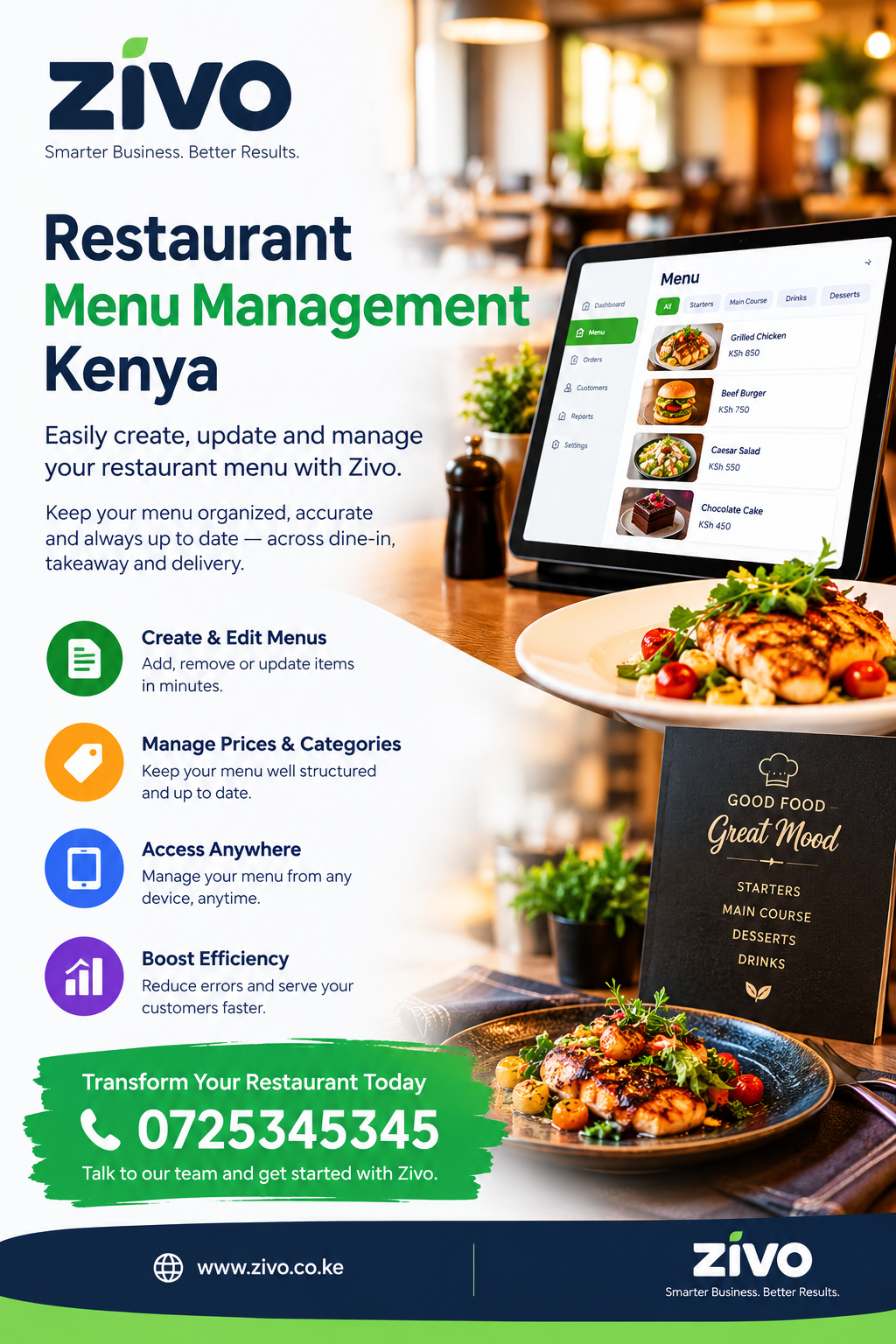
Restaurant Menu Management Kenya: A Complete Guide for Kenyan Restaurants
A well-managed menu is more than a list of meals and prices. Restaurant Menu Management Kenya helps restaurants keep food items, prices, descriptions, categories, availability, recipes and sales information organised as the business grows. This guide is designed for restaurant owners, café managers, hotel operators, food-service businesses and hospitality teams that want to understand how digital menu management can improve daily operations, reduce mistakes and create a better customer experience.
A restaurant may have excellent food, but an outdated menu can still create operational problems. A customer sees one price while the cashier has another. A meal appears available even though its ingredients have run out. A staff member enters an incorrect item because similar products are poorly organised. A promotion remains active after it has ended. These small issues can affect revenue, customer trust and staff productivity.
That is where structured menu management becomes valuable.
This guide explains what Restaurant Menu Management Kenya means, why it matters, which features restaurants should consider, how menus connect with inventory and payments, and how Kenyan businesses can select a system that fits their operations.
What Is Restaurant Menu Management?
At its simplest, Restaurant Menu Management Kenya refers to the process of creating, organising, updating and maintaining a restaurant’s menu information through a structured system.
A menu management system can contain much more information than the printed menu a customer sees.
Depending on the restaurant, the digital record may include:
- Food and beverage names
- Categories
- Descriptions
- Prices
- Sizes
- Add-ons
- Ingredients
- Recipes
- Product images
- Tax settings
- Discounts
- Availability
- Branch-specific prices
- Meal combinations
- Seasonal items
- Customer-facing menu information
For a small café, this could mean maintaining a simple list of breakfast meals, snacks, coffee and beverages.
For a large restaurant group, the same concept can involve hundreds of products across several branches.
Restaurant Menu Management Kenya becomes particularly useful when a business has enough menu items that manually updating prices and product information starts creating confusion.
Why a restaurant menu needs active management
Many restaurants treat a menu as something that is created once and rarely changed.
That approach can become problematic.
Ingredient costs change. Suppliers change. Customers develop new preferences. Certain meals sell better than others. Some products become unavailable. Restaurants introduce seasonal promotions or adjust portion sizes.
A menu therefore needs regular review.
Restaurant Menu Management Kenya provides a framework for treating the menu as an operational business asset rather than simply a printed document.
Why Menu Management Matters to Kenyan Restaurants
Kenyan restaurants operate in a competitive environment where customers can compare prices, meals and service quickly.
A restaurant in Nairobi, Mombasa, Kisumu, Nakuru or another growing town may serve customers through several channels at once.
For example, customers might order:
- At the restaurant counter
- From a table
- Through WhatsApp
- By telephone
- Through a website
- Through delivery platforms
- Through social media
- Through a direct ordering system
If every channel uses different menu information, errors become more likely.
Restaurant Menu Management Kenya can help businesses maintain one reliable source of menu information that can then support different sales channels.
Accurate prices
Price accuracy is one of the most important reasons to manage menus carefully.
Suppose a restaurant increases the price of a chicken meal from KES 650 to KES 700. If the printed menu says KES 650 but the POS system says KES 700, staff may have to explain the difference to customers.
That creates unnecessary friction.
A centralised menu makes it easier for authorised employees to update pricing and keep operational records aligned.
Restaurant Menu Management Kenya can therefore contribute to pricing consistency when the menu, sales process and customer-facing information are connected.
Accurate product availability
A menu should also reflect what the restaurant can actually sell.
If beef burgers are unavailable but the item remains active in the ordering system, customers can place orders that staff cannot fulfil.
This creates disappointment and potentially leads to refunds or cancellations.
Restaurant Menu Management Kenya can help restaurants think about menu availability as an operational issue rather than merely a marketing issue.
Key Features to Look For
A restaurant should evaluate menu software based on its actual workflow.
A long feature list does not automatically mean that a platform is suitable.
The most useful features usually include the following.
1. Product and Menu Item Management
A restaurant should be able to create and edit individual menu items easily.
Each product may have:
- Name
- Description
- Category
- Price
- Image
- Availability status
- Tax treatment
- Recipe information
- Internal notes
Restaurant Menu Management Kenya can make this information easier to organise when restaurants move away from scattered spreadsheets and handwritten records.
2. Categories and Subcategories
A restaurant with 100 menu items should not display everything as one long list.
Categories make menus easier for customers and staff to navigate.
Examples include:
- Breakfast
- Starters
- Main courses
- Vegetarian meals
- Chicken
- Beef
- Fish
- Pizza
- Burgers
- Desserts
- Soft drinks
- Fresh juices
- Coffee
- Tea
Restaurant Menu Management Kenya becomes more useful when products can be organised according to how customers actually browse the menu.
3. Price Management
Restaurants frequently need to update prices.
A good system should make it possible to change prices without rebuilding the entire menu.
Managers may also need different prices for:
- Dine-in customers
- Takeaway orders
- Delivery
- Corporate customers
- Special events
- Different branches
Restaurant Menu Management Kenya can support a more structured approach to price control where the chosen platform provides appropriate pricing functionality.
4. Menu Availability
A restaurant should be able to temporarily disable products that are unavailable.
For example, a seafood restaurant may run out of a particular fish. A café may sell out of pastries. A nyama choma restaurant may temporarily stop accepting orders for a particular meat option.
Instead of deleting the item, the restaurant can mark it unavailable and restore it later.
Restaurant Menu Management Kenya can help restaurants incorporate availability into their daily menu workflow.
5. Add-ons and Modifiers
Modern restaurant customers often want customisation.
Examples include:
- Extra cheese
- Extra sauce
- No onions
- Additional meat
- Large portion
- Extra avocado
- Different side dish
- Spicy option
A menu system should make these choices clear.
Restaurant Menu Management Kenya can help structure menu options so that staff do not have to depend entirely on free-text notes.
Menu Management and Inventory Control
One of the strongest reasons to digitise a restaurant menu is the relationship between menu items and inventory.
A restaurant does not simply sell ingredients. It sells prepared products made from multiple ingredients.
For example, a chicken burger may require:
- One bun
- A portion of chicken
- Lettuce
- Tomato
- Sauce
- Cooking oil
- Packaging
If ten burgers are sold, those ingredients are consumed.
Restaurant Menu Management Kenya becomes significantly more useful when menu information can work alongside stock records.
Recipe-based inventory
Recipe management allows restaurants to define what goes into each menu item.
For example:
| Menu item | Key ingredients |
|---|---|
| Chicken burger | Bun, chicken, lettuce, tomato, sauce |
| Beef pizza | Flour, beef, cheese, tomato sauce |
| Chips | Potatoes, cooking oil, salt |
| Fresh juice | Fruit, water, sugar |
| Cappuccino | Coffee beans, milk |
When sales are connected to recipes and inventory, managers can gain better visibility into ingredient consumption.
Restaurant Menu Management Kenya can therefore form part of a larger restaurant inventory strategy.
Reducing food wastage
Food waste can have a direct impact on restaurant profitability.
Waste may come from:
- Over-purchasing
- Spoilage
- Incorrect preparation
- Oversized portions
- Failed orders
- Kitchen mistakes
- Expired ingredients
Accurate menu and recipe information can help managers understand how much stock should theoretically be consumed.
Restaurant Menu Management Kenya can support this type of thinking when menu records, sales and stock information are connected.
Menu Costing and Profitability
A meal can be popular without being highly profitable.
Imagine a restaurant sells a meal for KES 800. The owner may assume the meal is profitable, but the real food cost could be much higher than expected.
The restaurant needs to understand the cost of ingredients and other relevant expenses.
Restaurant Menu Management Kenya can help restaurant owners consider menu profitability alongside sales volume.
Example of basic menu costing
Suppose a meal uses:
- Chicken: KES 220
- Rice: KES 45
- Vegetables: KES 50
- Sauce: KES 25
- Cooking oil: KES 30
- Garnish: KES 15
The approximate ingredient cost is KES 385.
If the meal sells for KES 800, the restaurant has a gross difference of KES 415 before other operating expenses.
This does not automatically mean KES 415 is profit.
The business still has expenses such as labour, rent, utilities, packaging, delivery, marketing and equipment.
Restaurant Menu Management Kenya can help frame menu decisions around actual costs instead of sales volume alone.
Identifying high-performing menu items
Restaurant managers should regularly ask:
- Which meals sell the most?
- Which meals generate the highest revenue?
- Which meals have strong margins?
- Which products rarely sell?
- Which products require expensive ingredients?
- Which meals generate frequent complaints?
- Which products take too long to prepare?
Restaurant Menu Management Kenya can support the broader process of using menu data to make better commercial decisions.
Digital Menus and Customer Experience
Customers increasingly expect convenient access to restaurant information.
A digital menu can allow customers to browse meals using a smartphone instead of waiting for a physical menu.
This can be particularly useful for:
- Cafés
- Hotels
- Food courts
- Fast-food restaurants
- Casual dining restaurants
- Delivery businesses
- Bars and entertainment venues
Restaurant Menu Management Kenya can support a digital-first approach when a restaurant needs to keep customer-facing information updated.
QR code menus
QR menus can reduce the need to print new menus every time a price changes.
For example, a restaurant can place a QR code on each table. Customers scan it and view the current menu.
If the price of a meal changes, management can update the digital menu instead of printing hundreds of new copies.
Restaurant Menu Management Kenya is particularly relevant to this approach because Zivo positions its broader platform around connecting customer, payment and operational records for Kenyan businesses.
Menu Management and M-Pesa Payments
M-Pesa is an important payment channel for many Kenyan businesses.
Restaurants may receive payments through:
- M-Pesa
- Cash
- Bank transfers
- Cards
- Online checkout
- Other digital payment methods
A menu system does not necessarily need to process payments itself, but restaurants should consider how menu information connects to the ordering and payment workflow.
Restaurant Menu Management Kenya can therefore be evaluated as part of a wider sales system rather than as an isolated menu tool.
For example:
Customer selects meal → Order is recorded → Total is calculated → Payment is requested → Payment is confirmed → Order is prepared → Sale is recorded.
The fewer times staff need to manually copy information, the fewer opportunities there are for errors.
Zivo currently describes workflows involving invoices, M-Pesa collection, receipts and paid work moving into fulfilment.
Managing Menus Across Multiple Branches
A restaurant group may operate branches in different locations.
Each branch may have:
- Different customer preferences
- Different suppliers
- Different ingredient costs
- Different opening hours
- Different menu availability
- Different pricing
- Different promotions
Restaurant Menu Management Kenya becomes important for businesses that need to maintain consistency without preventing branch-level adjustments.
Centralised menu control
Head office may control:
- Core products
- Brand descriptions
- Standard pricing
- Product images
- Promotions
- Menu categories
Branch managers may control:
- Availability
- Local specials
- Temporary stock-outs
- Branch-specific products
This balance gives management control while allowing branches to respond to local conditions.
Restaurant Menu Management Kenya can help restaurants consider how menu administration should work when the organisation becomes larger.
Menu Management for Cafés
Cafés often have smaller menus than full-service restaurants, but their products may have many variations.
A coffee menu might include:
- Espresso
- Americano
- Cappuccino
- Latte
- Mocha
- Macchiato
- Iced coffee
- Tea
- Fresh juice
- Smoothies
Customers may choose different sizes, milk options or flavours.
Restaurant Menu Management Kenya can be relevant to cafés that need to keep these variations organised.
The same principle applies to pastries and food.
A café may offer different combinations for breakfast, lunch or afternoon service.
Digital menu management can make these changes easier to control.
Menu Management for Hotels
Hotels often have more complicated food-service operations.
They may operate:
- Restaurants
- Room service
- Bars
- Breakfast buffets
- Conference catering
- Banqueting
- Poolside dining
- Events
Restaurant Menu Management Kenya can therefore be considered when menu information must be managed across different service areas.
A hotel may have different menus depending on location and time.
For example:
- Breakfast menu: 6:30 a.m. to 10:30 a.m.
- Lunch menu: 12:00 p.m. to 3:00 p.m.
- Dinner menu: 6:00 p.m. to 10:00 p.m.
- Room service: Extended hours
Time-based menus can make restaurant operations easier for staff and customers when properly configured.
Menu Management and Restaurant Orders
A menu is only useful if it supports accurate ordering.
When a customer selects an item, the restaurant should capture the correct product, quantity, price and modifications.
Restaurant Menu Management Kenya can help establish a connection between menu configuration and order entry when the software supports both processes.
Consider a customer ordering:
- Two chicken burgers
- One portion of chips
- Two bottled waters
- Extra cheese on one burger
The order should clearly show the details.
A poorly structured menu may cause staff to enter unclear descriptions manually.
A structured digital menu can reduce ambiguity.
Preventing Common Menu Mistakes
Restaurants should actively monitor common problems.
Mistake 1: Outdated prices
If employees use old menus, customers may be charged incorrectly.
Mistake 2: Duplicate products
A menu may contain the same meal twice under slightly different names.
Mistake 3: Unavailable products
Items may remain visible even after ingredients run out.
Mistake 4: Incorrect descriptions
Customers may receive something different from what the menu promised.
Mistake 5: Poor categorisation
Customers struggle to find products.
Mistake 6: Unclear modifiers
Staff do not know whether a customer selected a standard or customised option.
Mistake 7: Uncontrolled discounts
Staff may apply promotions inconsistently.
Restaurant Menu Management Kenya can be useful when restaurants are reviewing their processes specifically to prevent these operational errors.
Restaurant Menu Pricing Strategy
Menu pricing deserves careful attention.
The right price should consider more than ingredient costs.
Restaurants should consider:
- Food cost
- Labour
- Rent
- Utilities
- Packaging
- Delivery
- Taxes
- Waste
- Competitor positioning
- Customer expectations
- Desired margin
Restaurant Menu Management Kenya can support the operational side of pricing by keeping menu prices organised and easier to update.
Do not copy competitor prices blindly
A restaurant may see another business selling a burger for KES 600 and assume it should charge the same.
That may be a mistake.
The competitor could have different supplier prices, rent, portion sizes, labour costs or target customers.
Menu pricing should be based on the restaurant’s own numbers.
Promotions and Special Offers
Promotions can attract customers, but poorly controlled promotions can reduce margins.
Examples include:
- Buy one get one free
- Lunch specials
- Family packages
- Weekend offers
- Student discounts
- Happy-hour promotions
- Combo meals
- Loyalty discounts
Restaurant Menu Management Kenya can help restaurants think about promotions as controlled menu changes rather than informal instructions shared through staff WhatsApp groups.
A promotion should clearly define:
- Start date
- End date
- Eligible products
- Discount
- Customer group
- Branches
- Terms
This reduces confusion.
Menu Management and Staff Operations
Employees need accurate information.
A waiter should know the current price.
A cashier should know which products are available.
Kitchen staff should understand modifiers and preparation instructions.
Managers should know who changed a product or price where audit functionality exists.
Restaurant Menu Management Kenya can therefore form part of a wider restaurant staff-management workflow.
Role-based access can be especially useful.
For example:
| Role | Possible responsibility |
|---|---|
| Owner | Full menu control |
| Manager | Prices, products and availability |
| Cashier | Order entry |
| Waiter | Customer ordering |
| Kitchen | Preparation information |
| Accountant | Sales and financial reports |
Not every employee needs permission to change prices.
Reporting and Menu Performance
A restaurant should not simply create a menu and forget about it.
Performance data should influence decisions.
Useful reports can include:
- Sales by menu item
- Sales by category
- Daily sales
- Weekly sales
- Monthly sales
- Product quantities sold
- Revenue by branch
- Discounts
- Cancellations
- Refunds
- Best-selling items
- Slow-moving products
Restaurant Menu Management Kenya can be evaluated according to how well a system helps management turn menu information into actionable reports.
For example, suppose a restaurant discovers that 70% of its lunch sales come from ten menu items.
Management may decide to focus purchasing and preparation around those products.
Removing Poor-Performing Items
Not every menu item deserves to stay forever.
A restaurant should periodically review products that:
- Sell very slowly
- Have expensive ingredients
- Require complicated preparation
- Generate excessive waste
- Receive frequent complaints
- Occupy valuable menu space
Restaurant Menu Management Kenya can help structure this review process.
However, low sales do not automatically mean a product should be removed.
Some items may serve an important customer segment.
A vegetarian meal, for example, may have lower sales but still be important because it gives customers an option they cannot easily replace.
The decision should therefore consider both financial and customer-service factors.
Building a Better Restaurant Menu
A strong menu should be easy to understand.
Customers should quickly know:
- What the restaurant sells
- How much items cost
- What each meal contains
- What options are available
- Which items are popular
- Which items are unavailable
- Whether there are additional charges
Restaurant Menu Management Kenya can help restaurants maintain this clarity across digital and operational menu records.
Use clear descriptions
Instead of writing:
Chicken meal
A better description might explain the components:
Grilled chicken served with seasoned rice, vegetables and house sauce.
Descriptions should still remain concise.
The goal is to help customers make decisions without overwhelming them.
Managing Food Allergens and Dietary Information
Some customers need information about ingredients because of allergies or dietary preferences.
Depending on the restaurant, useful labels may include:
- Vegetarian
- Vegan
- Gluten-free
- Dairy-free
- Contains nuts
- Spicy
- Halal
Restaurants should only make claims they can verify.
Restaurant Menu Management Kenya can support better organisation of product information, although restaurants should always maintain appropriate food-safety procedures independently of their software.
Seasonal Menus
Kenyan restaurants may change menus depending on seasons, events or customer demand.
Examples include:
- Christmas menus
- Easter offers
- Valentine’s packages
- Ramadan menus
- School holiday menus
- Weekend specials
- Event catering packages
Restaurant Menu Management Kenya can make seasonal planning more structured when products can be activated and deactivated according to business needs.
Instead of deleting an old product, management can archive it and reuse it later.
Choosing the Right Restaurant Menu Software
Before selecting software, restaurant owners should define their requirements.
Ask:
- How many menu items do we have?
- How often do prices change?
- Do we operate one or several branches?
- Do customers order online?
- Do we use WhatsApp?
- Do we accept M-Pesa?
- Do menu items need recipes?
- Do we need inventory integration?
- Do we need POS functionality?
- Do we need delivery management?
- Which staff members need access?
- What reports does management require?
Restaurant Menu Management Kenya should be evaluated against these practical questions rather than against marketing claims alone.
Ask for a realistic demonstration
Do not accept a demonstration where the provider only clicks through features.
Give the provider a realistic restaurant scenario.
For example:
A customer orders two chicken burgers, one large chips and two sodas through WhatsApp. The customer pays by M-Pesa. One burger requires extra cheese. The restaurant runs out of chicken halfway through the day. Management then changes the burger price the following week.
Ask the provider to demonstrate the entire workflow.
Restaurant Menu Management Kenya should ultimately support the restaurant’s real processes, not merely look impressive during a sales presentation.
Questions to Ask a Software Provider
Before subscribing, ask:
- Can I update menu prices easily?
- Can I disable unavailable items?
- Can I create product categories?
- Can I add modifiers?
- Can I manage different branches?
- Can I connect products to inventory?
- Can I track sales by item?
- Can I manage discounts?
- Can staff have different permissions?
- Can the system work with M-Pesa?
- Can it connect with POS?
- Can it support delivery orders?
- Can I export my data?
- What support is available?
- What happens if the internet connection fails?
Restaurant Menu Management Kenya becomes much easier to evaluate when these questions are answered before purchase.
Security and Access Control
Restaurant systems can contain sensitive business information.
This may include:
- Sales records
- Customer names
- Phone numbers
- Payment records
- Supplier information
- Staff accounts
- Business reports
Access should therefore be controlled.
Restaurant Menu Management Kenya should be considered alongside basic security requirements such as user permissions, account protection, backups and appropriate data handling.
Zivo states that its workspaces use role-based staff access and that public checkout, invoice, receipt and statement links use secure tokens rather than exposing the dashboard.
Restaurants should still assess the exact security controls offered by whichever provider they choose.
How Zivo Can Fit Into Restaurant Operations
For a Kenyan restaurant, menu management is rarely an isolated task.
The menu connects to sales, payments, inventory, customers, expenses and fulfilment.
Zivo describes its platform as a connected workspace for customer records, sales, payments, expenses and operations. Its website also describes POS, stock, sales orders, M-Pesa payments and fulfilment capabilities.
Restaurant Menu Management Kenya can therefore be considered within a wider restaurant operating model.
A restaurant could, depending on its chosen workflow, think about the process as:
Menu → Order → Payment → Preparation → Fulfilment → Record → Report
Each stage produces information that can help management understand the business.
A Practical Implementation Plan
Restaurants should avoid trying to digitise everything at once.
A staged approach is often easier.
Step 1: Audit the existing menu
Write down every product.
Remove duplicates and outdated items.
Step 2: Standardise names
Choose consistent product names.
For example, use either “Chicken Burger” or “Grilled Chicken Burger” consistently rather than several variations.
Step 3: Organise categories
Group products logically.
Step 4: Review prices
Confirm that every price is current.
Step 5: Add recipes where useful
Document key ingredients and portions.
Step 6: Configure availability
Identify products that are seasonal or frequently unavailable.
Step 7: Connect sales and inventory
Where supported, connect menu items with stock consumption.
Step 8: Train staff
Give employees role-specific training.
Step 9: Test realistic orders
Use real examples before going live.
Step 10: Review performance
After implementation, monitor sales and customer feedback.
Restaurant Menu Management Kenya can be part of this structured implementation process.
Common Mistakes When Implementing Menu Software
Trying to digitise a bad menu
Software cannot fix poor menu organisation by itself.
Clean the menu first.
Giving everyone full access
Not every employee needs permission to change prices.
Ignoring inventory
If the menu says an item is available but the kitchen has no ingredients, customers will still experience a problem.
Failing to train staff
Even good software can fail if employees do not know how to use it.
Forgetting mobile users
Customers increasingly use phones to view menus.
Never reviewing menu performance
A menu should evolve with the business.
Restaurant Menu Management Kenya should be implemented as part of a business process, not simply as a software installation.
The Role of Data in Menu Decisions
Restaurant owners should use data to answer practical questions.
For example:
Which meal sells the most?
This helps identify customer demand.
Which meal generates the highest revenue?
This shows sales contribution.
Which meal has the highest ingredient cost?
This highlights margin pressure.
Which product generates the most waste?
This may indicate a purchasing or preparation problem.
Which meals sell strongly during specific hours?
This can support staffing and preparation planning.
Restaurant Menu Management Kenya can therefore be part of a data-driven restaurant management approach.
The goal is not to collect data for its own sake.
The goal is to make better decisions.
How Menu Management Can Improve Customer Experience
Customers want simple answers.
They want to know:
- What is available?
- How much does it cost?
- What does the meal contain?
- How long will it take?
- Can I customise it?
- How can I pay?
A clear menu reduces uncertainty.
Restaurant Menu Management Kenya can contribute to this experience when menu, ordering, payment and fulfilment workflows are properly connected.
For Kenyan restaurants using WhatsApp, this becomes particularly relevant. A customer may send a message, ask for a menu, select products and pay without ever visiting a website.
Zivo’s platform currently highlights WhatsApp sales, M-Pesa collection and fulfilment workflows as connected business activities.
Restaurant Menu Management and WhatsApp Orders
WhatsApp has become a practical communication channel for many Kenyan businesses.
A restaurant may receive a message such as:
“Hi, please send me two beef burgers, one chips and a mango juice to Kilimani.”
The restaurant needs to capture the order correctly.
A structured menu can help staff identify:
- Correct products
- Current prices
- Available options
- Quantities
- Add-ons
- Customer details
- Delivery information
Restaurant Menu Management Kenya can therefore work alongside WhatsApp ordering when both systems are properly integrated.
The Importance of Consistency
Imagine a restaurant with three branches.
Branch A calls a product “Chicken Supreme.”
Branch B calls it “Supreme Chicken.”
Branch C calls it “Chicken Special.”
If all three products are actually the same, reporting becomes more difficult.
Management may see three different products instead of one.
Restaurant Menu Management Kenya can help establish standard product naming across branches.
Consistency improves:
- Reporting
- Staff training
- Customer understanding
- Inventory analysis
- Sales comparisons
- Menu maintenance
Reviewing Your Menu Every Month
A useful restaurant habit is a monthly menu review.
Review:
Sales
Which products sold?
Revenue
Which products generated money?
Cost
Which products were expensive to produce?
Waste
Which products caused stock losses?
Customer feedback
Which meals received complaints or praise?
Availability
Which products were frequently unavailable?
Pricing
Which prices need review?
Restaurant Menu Management Kenya can support this recurring management process.
A monthly review does not mean changing everything.
Sometimes the best decision is to leave a successful menu item exactly as it is.
Frequently Asked Questions
1. What is Restaurant Menu Management Kenya?
Restaurant Menu Management Kenya is the structured process of creating, updating, organising and maintaining restaurant menu information, including products, prices, categories, availability, modifiers and related operational information.
2. Why is digital menu management important for restaurants?
Restaurant Menu Management Kenya helps reduce reliance on scattered paper menus and spreadsheets. It can make prices, products and availability easier to maintain while supporting ordering, sales and reporting workflows.
3. Can menu software connect with inventory?
Yes, depending on the platform. Restaurant Menu Management Kenya can be particularly useful when menu items are connected to recipes and inventory records, allowing restaurants to better understand ingredient consumption and stock requirements.
4. Can restaurants use M-Pesa with menu and ordering systems?
Many restaurant platforms support payment integrations, although capabilities vary by provider. Restaurant Menu Management Kenya should therefore be evaluated alongside the restaurant’s preferred M-Pesa workflow and reconciliation requirements.
Zivo currently describes M-Pesa STK collection, payment matching and connected fulfilment workflows.
5. Is digital menu management suitable for small restaurants?
Yes. Restaurant Menu Management Kenya is not only relevant to large restaurant groups. Small cafés, takeaways and family-owned restaurants can also benefit from accurate product records, pricing, availability and sales information.
6. Can a restaurant manage several branches?
The answer depends on the software. Restaurant Menu Management Kenya should be assessed for branch management, user permissions, centralised product control and branch-specific pricing or availability where required.
7. Should every menu item have a recipe?
Not necessarily. Restaurant Menu Management Kenya becomes more valuable for inventory control when important food products have defined recipes or ingredient relationships. Simple products such as bottled drinks may not need detailed recipes.
8. How often should a restaurant update its menu?
A restaurant should update menu information whenever prices, products, ingredients, availability or promotions change. A monthly performance review is also useful even when no immediate change is required.
Restaurant Menu Management Kenya can support a more disciplined review process.
9. How does menu management improve profitability?
Restaurant Menu Management Kenya can help managers compare product sales, prices and ingredient costs. This can make it easier to identify high-performing products, weak products, excessive discounts and meals that require pricing or recipe review.
10. What should a restaurant look for before buying menu software?
Restaurant Menu Management Kenya should be evaluated according to the restaurant’s real workflow. Important considerations include ease of use, menu editing, product availability, pricing, inventory, POS, M-Pesa, reporting, staff permissions, customer ordering and support.
Final Checklist for Restaurant Owners
Before implementing a menu management system, confirm that you can answer these questions:
- Is every menu item named consistently?
- Are prices accurate?
- Are descriptions clear?
- Are unavailable products removed or disabled?
- Are categories logical?
- Are modifiers properly defined?
- Are recipes documented where needed?
- Are ingredient costs understood?
- Can staff access only the functions they need?
- Can management review menu performance?
- Can sales connect with inventory?
- Can customers access current menu information?
- Can the system support M-Pesa workflows?
- Can the business manage multiple branches if necessary?
- Can reports help management make decisions?
Restaurant Menu Management Kenya can be used as a starting point for evaluating these requirements.
Conclusion
A restaurant menu is one of the most visible parts of the business, but it is also connected to many activities customers never see. Every menu item can affect purchasing, inventory, kitchen preparation, pricing, payments, sales reporting and profitability.
That is why menu management deserves more attention than simply designing an attractive list of meals.
Restaurant Menu Management Kenya can help restaurants create a more organised foundation for managing products, prices, categories, availability and related operational information.
For Kenyan businesses, the opportunity becomes even greater when menu information connects with local payment methods, customer communication, stock control and fulfilment.
A restaurant in Nairobi, Mombasa, Kisumu or another Kenyan market can start small. It does not need to digitise every process immediately. It can begin by cleaning its product catalogue, standardising prices and categories, and then gradually connect the menu with ordering, payments, inventory and reporting.
Restaurant Menu Management Kenya should ultimately be evaluated by one simple question: does it make the restaurant easier to manage and the customer experience more reliable?
The best system is not necessarily the one with the most features. It is the one that fits the restaurant’s actual workflow, is easy for staff to use and gives management dependable information.
For businesses considering an integrated approach, Zivo currently presents a connected workspace covering sales, M-Pesa payments, expenses, stock, POS, orders, fulfilment and reporting.
Restaurant Menu Management Kenya can therefore be viewed as one component of a broader restaurant management strategy.
The long-term objective is straightforward: accurate menus, fewer order mistakes, better stock visibility, clearer pricing, more informed decisions and a smoother experience for customers and staff.
Restaurant Menu Management Kenya is most valuable when it becomes part of that complete operational picture rather than remaining an isolated digital menu.
A restaurant that keeps its menu accurate, measures product performance and connects menu information with the rest of its business is better positioned to control costs and respond to customer demand.
Restaurant Menu Management Kenya can help establish that foundation when implemented around clear business processes.
Finally, restaurant owners should remember that technology is a tool. The real advantage comes from using accurate information to make better decisions about products, pricing, purchasing, staffing and customer service.
Restaurant Menu Management Kenya can support that journey when the chosen system is aligned with the restaurant’s needs.
Restaurant Menu Management Kenya can also be considered when comparing digital solutions for ordering, menu control and restaurant operations.
For a business that wants a connected approach to sales, payments and fulfilment, the ability to keep information together can reduce the manual work involved in moving between separate spreadsheets and communication channels. Zivo describes this connected approach across customer records, payments, expenses and operations.
Restaurant Menu Management Kenya therefore represents more than maintaining a digital food list. It represents an opportunity to bring greater structure to one of the most important parts of a restaurant’s commercial operation.
The final goal is simple: the right menu, the right price, the right information and the right product should reach the customer at the right time.
Restaurant Menu Management Kenya can help restaurants move toward that goal when it is combined with sound processes, accurate data and properly trained staff.
Restaurant Menu Management Kenya is worth considering as part of a wider Kenyan SME technology strategy where restaurant owners want to connect customer interactions, payments, sales, stock and fulfilment in one operational workflow. Zivo’s official platform describes these connected capabilities for Kenyan businesses.
A well-managed menu ultimately helps everyone: customers get clearer choices, employees get better information, managers get stronger visibility and owners can make decisions based on actual business performance.
Restaurant Menu Management Kenya can therefore be the starting point for a broader move toward a more organised, data-driven restaurant operation.