
Table of Contents
ToggleRestaurant Order Management Kenya: How Restaurants Can Improve Ordering, Service and Profits
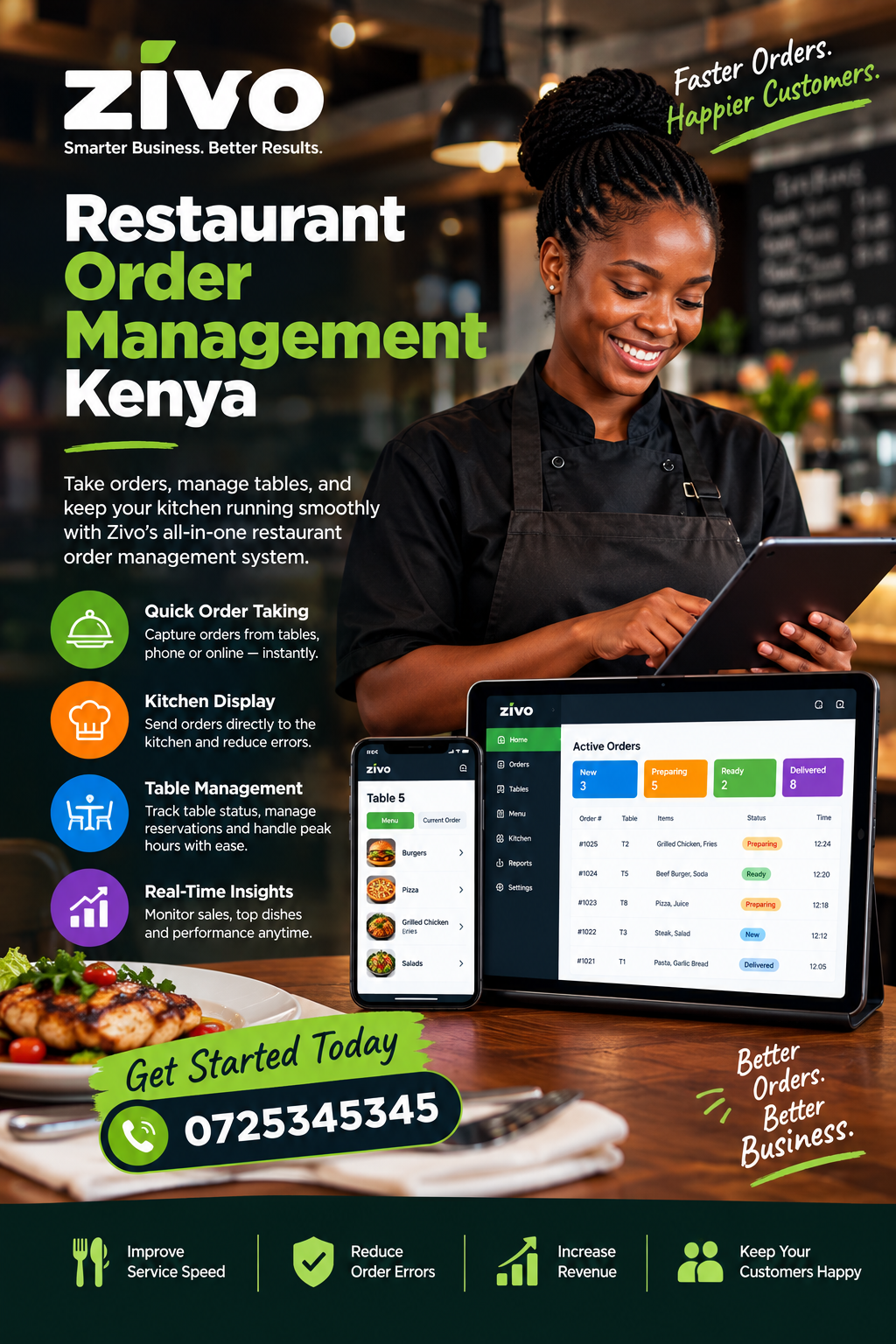
Running a restaurant involves much more than preparing good food. Staff must capture customer orders accurately, communicate them to the kitchen, process payments, track items, manage tables and keep customers informed. A reliable Restaurant Order Management Kenya solution can bring these activities into one organised workflow, helping restaurant owners, managers and supervisors reduce mistakes while improving service. This guide explains how restaurant order management works, the features to look for, how it supports Kenyan restaurants, and how to choose a system that fits your operation.
For many restaurants, order management becomes complicated as customer numbers increase. An order may begin with a waiter, move to a cashier, reach the kitchen, change because a customer requests an adjustment, and finally become part of the day’s sales records. If these steps depend entirely on handwritten tickets, verbal communication or disconnected applications, errors can easily occur.
A digital Restaurant Order Management Kenya solution gives restaurants a structured way to capture, process and monitor orders. Instead of relying on staff to remember every detail, the system records information and moves it through the appropriate stages.
This is particularly useful for restaurants in Nairobi and other Kenyan towns where businesses may serve customers through dine-in, takeaway, delivery and online channels at the same time. The more channels a restaurant handles, the more important organised order processing becomes.
What Is Restaurant Order Management?
Restaurant order management refers to the processes used to receive, record, prepare, modify, track and complete customer orders. It covers the journey from the moment a customer selects food or drinks to the point when the order is delivered and paid for.
A modern Restaurant Order Management Kenya system can digitise much of this process. Instead of writing orders manually and physically carrying tickets to different departments, restaurant employees can capture information electronically and send it to the relevant workstation.
A typical order workflow may look like this:
- A customer chooses meals or drinks.
- A waiter or cashier records the order.
- The order is transmitted to the kitchen or preparation area.
- Kitchen staff prepare the requested items.
- The order status is updated.
- Food is served or prepared for collection.
- The customer receives the bill.
- Payment is recorded.
- The completed transaction becomes part of the restaurant’s sales records.
The purpose is not simply to replace paper. Good Restaurant Order Management Kenya technology creates a clearer connection between ordering, preparation, billing, payments and reporting.
Why Order Management Matters
An incorrect order can have a surprisingly large impact on a restaurant. The customer may receive the wrong meal, the kitchen may waste ingredients preparing something unnecessary, the waiter may need to apologise and remake the order, and the business may lose money.
Order management helps reduce these avoidable problems.
It can also help managers answer practical questions such as:
- Which orders are still being prepared?
- Which tables have not been served?
- Which meals sell most frequently?
- How much revenue was generated today?
- Which payment methods are being used?
- How many orders were cancelled?
- Are takeaway orders being processed correctly?
- Where are delays happening?
When information is recorded consistently, restaurant managers can make decisions based on actual operating data rather than assumptions.
How Restaurant Ordering Works Without a Digital System
Some restaurants still depend heavily on handwritten order pads, verbal instructions and separate cash registers. These methods can work for a small operation with limited customers, but they become harder to control as the business grows.
Imagine a busy restaurant in Nairobi during lunchtime. Several waiters are taking orders simultaneously. One customer changes a drink, another requests a meal without an ingredient, and a third table places an additional order.
If orders are written on paper, staff must ensure that every change reaches the kitchen. A misplaced ticket or unclear handwriting can result in a mistake.
A Restaurant Order Management Kenya platform can reduce this dependency on manual communication. The waiter records the order once, and the information can be made available to the appropriate preparation or billing process.
This does not mean technology eliminates the need for trained employees. Staff still need to understand menus, customer service and restaurant procedures. Technology simply gives them a more reliable workflow.
Key Features to Look For
Not every restaurant needs the same system. A small café may have different requirements from a large restaurant, food court or multi-branch hospitality business.
However, several features are especially valuable.
1. Digital Order Capture
The foundation of any Restaurant Order Management Kenya solution is accurate order capture.
Staff should be able to select menu items quickly without unnecessary screens or complicated processes. The interface should make it easy to specify quantities, options, notes and special requests.
For example, a customer may order:
- Two chicken meals
- One vegetarian meal
- Three sodas
- One bottle of water
- Extra sauce
The system should record these details clearly.
2. Table Management
Restaurants that provide dine-in service need to know which customers are associated with which tables.
A useful system can help staff view table status, identify occupied tables and attach orders to the correct table. This reduces the risk of assigning a customer’s order to the wrong group.
Table management can be particularly helpful during busy periods when waiters are handling several tables at once.
3. Kitchen Order Communication
One of the most important benefits of digital ordering is faster communication between front-of-house and kitchen staff.
Instead of carrying handwritten tickets, orders can be transmitted to a kitchen display or designated printer, depending on the restaurant’s setup.
A Restaurant Order Management Kenya solution should make it clear which items have been ordered and what preparation instructions apply.
This can help reduce misunderstandings and make it easier for kitchen employees to prioritise work.
4. Order Modification
Customers frequently change their minds.
They may want:
- A different side dish
- An additional drink
- No onions
- Less spice
- Extra toppings
- A larger portion
- An additional item after the initial order
The system should allow authorised employees to modify orders without creating confusion.
Changes should be visible to the people responsible for preparing the food.
5. Order Status Tracking
Managers should be able to understand where an order is in the process.
Common statuses may include:
- New
- Confirmed
- Preparing
- Ready
- Served
- Completed
- Cancelled
This gives employees greater visibility and can help managers identify bottlenecks.
Managing Dine-In, Takeaway and Delivery Orders
Restaurants increasingly operate through multiple sales channels. A customer may sit at a table, call for takeaway or place an order through an online channel.
Managing these channels separately can create unnecessary complexity.
A Restaurant Order Management Kenya solution can help businesses establish a consistent order workflow across different channels.
Dine-In Orders
For dine-in service, the system should connect the order to a table or customer record where appropriate.
This makes it easier to:
- Add items to an existing order
- Transfer tables where necessary
- Split bills
- Track served items
- Process final payment
Takeaway Orders
Takeaway operations require clear identification of orders and collection times.
Staff need to know:
- Customer name
- Items ordered
- Order number
- Preparation status
- Payment status
- Collection status
A Restaurant Order Management Kenya system can organise these details so takeaway orders do not become mixed with dine-in transactions.
Delivery Orders
Delivery introduces additional information such as customer location, delivery instructions and contact details.
Restaurants handling delivery should ensure that the ordering system provides a clear process from order confirmation through preparation and dispatch.
The objective is to avoid situations where food is ready but the delivery process has not been organised.
Reducing Order Errors
Order errors cost restaurants money.
Suppose a customer orders a meal worth KSh 1,200, but the kitchen prepares the wrong item. The restaurant may need to prepare another meal, potentially discard the first one and delay the customer’s experience.
If this happens repeatedly, food costs and labour costs increase.
A Restaurant Order Management Kenya system can help reduce errors by ensuring that information is recorded clearly and transmitted through a standard workflow.
However, restaurant owners should not assume that software alone solves every problem.
Employees should still receive training on:
- Taking customer orders
- Confirming special requests
- Correcting mistakes
- Handling cancelled orders
- Processing refunds
- Managing discounts
- Closing completed transactions
The strongest results come when good procedures and reliable technology work together.
Supporting Faster Customer Service
Customers generally expect restaurants to be organised, especially during busy periods.
Long waits may result from several different problems. The kitchen may be overloaded, waiters may be struggling to communicate orders, payments may be slow, or staff may not know which orders are ready.
A Restaurant Order Management Kenya platform can improve visibility across the operation.
For example, a manager may notice that orders are consistently waiting too long before preparation. That information can encourage the restaurant to investigate staffing, menu complexity, preparation times or kitchen capacity.
Better visibility does not automatically make a restaurant faster. Instead, it helps management identify where improvements are needed.
M-Pesa and Digital Payments
Payment processing is an important part of restaurant operations in Kenya.
Customers may pay through M-Pesa, cards, cash or other supported methods. Restaurants need accurate records showing how each transaction was settled.
A Restaurant Order Management Kenya system can help connect the order with its payment information, depending on the payment integrations available.
For example, a restaurant manager may want to know:
| Payment Method | Purpose |
|---|---|
| M-Pesa | Mobile payments |
| Card | Electronic payments |
| Cash | Cash transactions |
| Other digital methods | Alternative payment channels |
The important issue is reconciliation.
A restaurant should be able to compare its recorded sales with the amounts actually received. If these figures do not match, management needs a way to investigate the difference.
Inventory and Order Management
Although order management and inventory management are separate functions, they are closely connected.
Every meal sold consumes ingredients. If a restaurant sells large quantities of chicken, vegetables, cooking oil or beverages, stock levels change throughout the day.
A Restaurant Order Management Kenya platform with suitable inventory capabilities can help businesses connect sales activity with stock monitoring.
Consider a restaurant selling 100 chicken meals in one day. The manager should have a way to understand the relationship between those sales and the ingredients consumed.
This can help identify:
- Fast-moving items
- Slow-moving products
- Potential wastage
- Stock shortages
- Purchasing requirements
- Unexpected consumption
Inventory data becomes more useful when it is connected to actual sales.
Avoiding Stock-Outs
A customer who orders an item only to be told that it is unavailable may have a poor experience.
Better stock visibility can help staff know which menu items are available.
Restaurants can also establish procedures for marking unavailable items promptly.
For example, if a particular dessert sells out at 7:00 p.m., employees should not continue accepting orders for it until inventory is replenished.
Billing and Invoicing
Once an order is complete, billing needs to be accurate.
A Restaurant Order Management Kenya solution can support billing by maintaining a connection between the customer’s order and the final amount due.
Depending on the system, restaurants may need features such as:
- Automatic bill calculation
- Tax handling
- Discounts
- Service charges
- Split bills
- Multiple payment methods
- Receipts
- Refund records
- Transaction history
Restaurant managers should pay particular attention to how discounts and cancellations are controlled.
If employees can apply unlimited discounts without authorisation, revenue leakage can occur.
Splitting Bills and Shared Payments
Groups often ask to divide restaurant bills.
One customer may want to pay for drinks while another pays for meals. A group of six people may each want to contribute.
A Restaurant Order Management Kenya system that supports flexible billing can make these situations easier to handle.
The system should make it possible to maintain an accurate connection between:
Order → Customer/Table → Bill → Payment
This chain is important for accurate records.
Restaurant Reporting
Reports help restaurant owners move from daily operations to management decisions.
A good reporting system can provide information about:
- Total sales
- Number of orders
- Average order value
- Popular menu items
- Payment methods
- Cancelled orders
- Discounts
- Refunds
- Staff activity
- Sales by period
- Sales by branch
A Restaurant Order Management Kenya solution becomes more valuable when reports are easy to understand.
Managers should not need advanced accounting knowledge to identify basic business trends.
Daily Sales Reports
Daily reports can help managers compare performance across different days.
For example:
| Day | Orders | Sales |
|---|---|---|
| Monday | 82 | KSh 96,400 |
| Tuesday | 91 | KSh 104,750 |
| Wednesday | 77 | KSh 89,200 |
These figures are illustrative rather than industry benchmarks, but they demonstrate how management can compare activity.
Menu Performance
Not every menu item contributes equally to revenue.
A restaurant might discover that a small group of meals generates a large share of orders. That information can influence menu placement, promotions and purchasing decisions.
A Restaurant Order Management Kenya system can make this information easier to review when reporting features are available.
Staff Accountability
Restaurant operations involve multiple employees. Without clear records, it can be difficult to understand who performed a particular action.
A digital system may record information such as:
- Who created an order
- Who modified an order
- Who applied a discount
- Who cancelled an order
- Who processed payment
A Restaurant Order Management Kenya platform with user permissions and activity records can support better accountability.
This is particularly important when multiple employees share access to the same restaurant operation.
User Permissions
Not every employee should have access to every function.
For example:
Waiter
- Create orders
- Add items
- View assigned tables
Cashier
- Process payments
- Issue receipts
- Manage approved billing actions
Manager
- View reports
- Approve selected adjustments
- Review transactions
Administrator
- Manage settings
- Manage users
- Configure system-level options
Permissions should reflect actual responsibilities.
Managing Discounts and Cancellations
Discounts can attract customers, but they can also create accounting problems if poorly controlled.
The restaurant should know:
- What discount was applied
- How much was discounted
- Who approved it
- Why it was applied
- Which order was affected
The same principle applies to cancellations.
A Restaurant Order Management Kenya solution should ideally maintain records that allow managers to review unusual activity.
For example, if an employee repeatedly cancels orders after receiving payment, management should be able to investigate.
Multi-Branch Restaurant Operations
Restaurants with more than one location have additional management challenges.
Each branch may have different:
- Sales volumes
- Staff
- Menu items
- Inventory
- Customers
- Operating hours
A Restaurant Order Management Kenya platform designed for multi-location operations can help management maintain a central view while allowing branches to operate independently.
This can be particularly useful for growing restaurant brands.
Managers may want to compare branches by:
- Sales
- Order volume
- Popular products
- Payment activity
- Staff performance
- Operational costs
Centralised information can make expansion easier to manage.
Choosing the Right System for a Kenyan Restaurant
Choosing restaurant software should begin with business requirements rather than a list of impressive features.
Before selecting a platform, ask the following questions.
1. What Type of Restaurant Do You Operate?
A small café may need a simple point-of-sale and ordering workflow.
A busy full-service restaurant may require:
- Table management
- Kitchen communication
- Staff permissions
- Multiple payment methods
- Inventory
- Reporting
A restaurant chain may require multi-branch support.
2. How Many Orders Do You Process?
A system that works for 30 orders per day may not be suitable for 500.
Think about current volume and expected growth.
3. Which Payment Methods Do Your Customers Use?
Kenyan restaurants should consider how their customers actually pay.
If M-Pesa is important to the business, payment integration and reconciliation should be part of the evaluation.
4. Does the System Work on Your Devices?
Staff may use computers, tablets or smartphones.
Check whether the system works properly on the devices used by your team.
5. Is It Easy to Train Staff?
A complicated system can slow down restaurant operations.
The best interface is not necessarily the one with the most buttons. It is the one that helps staff complete common tasks quickly and correctly.
Cost Considerations
Restaurant software pricing varies significantly depending on features, number of users, integrations, branches and support requirements.
Instead of focusing only on the subscription price, restaurant owners should consider total value.
Ask:
- How much time can the system save?
- Can it reduce order mistakes?
- Can it improve payment tracking?
- Can it reduce manual reporting?
- Can it support growth?
- Are there setup fees?
- Are integrations charged separately?
- What support is included?
A cheaper system that creates operational difficulties may cost more in the long run.
Likewise, an expensive platform may include features that a small restaurant never uses.
The right solution should match the actual business.
Common Mistakes When Implementing Restaurant Software
Buying software is only the beginning.
Several mistakes can reduce the benefits of implementation.
Mistake 1: Choosing Based Only on Price
Price matters, but it should not be the only consideration.
A restaurant depends on reliable operations, so functionality, usability and support are also important.
Mistake 2: Ignoring Staff Training
Employees need time to understand the new workflow.
Training should cover everyday scenarios as well as unusual situations.
Mistake 3: Moving Too Quickly
A restaurant should test the system before relying on it completely.
Start with controlled testing.
Check:
- Menu setup
- Order creation
- Order modification
- Kitchen communication
- Billing
- Payments
- Refunds
- Reports
Mistake 4: Giving Everyone Full Access
Unlimited access creates unnecessary risk.
Use permissions according to job responsibilities.
Mistake 5: Failing to Review Reports
A restaurant may collect useful information but never analyse it.
Managers should schedule regular reviews of sales, orders, cancellations and payment activity.
A Practical Restaurant Order Workflow
Consider a fictional Nairobi restaurant called Green Plate.
A customer arrives and chooses a table. The waiter opens the table in the system and records two meals and three drinks.
The order is transmitted to the kitchen. The customer then requests an additional side dish.
The waiter adds the item to the existing order.
The kitchen receives the update. Once the meals are ready, the order status changes.
At the end of the meal, the cashier reviews the bill. The customer pays using M-Pesa.
The payment is recorded against the order.
The transaction is then included in the restaurant’s daily report.
This example illustrates the value of a connected process. Each stage produces information that can be used by the next stage.
A Restaurant Order Management Kenya system can support this type of workflow when configured correctly.
Improving Restaurant Efficiency Step by Step
Restaurants do not need to transform every process at once.
A practical implementation can follow these stages.
Step 1: Document the Current Process
Write down how orders currently move through the business.
Identify:
- Who takes orders
- Who prepares them
- Who handles billing
- Who receives payments
- Who reviews sales
Step 2: Identify the Biggest Problems
Look for recurring issues.
Examples include:
- Incorrect orders
- Lost tickets
- Slow billing
- Payment discrepancies
- Stock-outs
- Poor reporting
Step 3: Configure the System
Set up:
- Menu
- Prices
- Tables
- Users
- Permissions
- Payment methods
- Reporting categories
Step 4: Train Employees
Use realistic examples.
Do not train staff only on ideal scenarios. Test changes, cancellations, discounts and payment problems.
Step 5: Monitor Performance
After implementation, review whether the system is actually improving operations.
A Restaurant Order Management Kenya solution should be judged by the business outcomes it supports, not simply by whether employees can log into it.
Security and Data Protection
Restaurants handle operational and customer information that should be protected.
Depending on the system, records may include:
- Customer details
- Employee information
- Sales data
- Payment records
- Transaction history
Businesses should consider user permissions, password security, backups and access controls.
Employees should only have access to the information necessary for their roles.
Management should also understand how the software provider handles stored data and what recovery procedures are available if a technical problem occurs.
Cloud-Based Restaurant Systems
Cloud software can provide several advantages for restaurant businesses.
Managers may be able to access reports without being physically present at the restaurant, depending on the platform.
For restaurant owners managing several locations, this can be useful.
A Restaurant Order Management Kenya platform hosted online can also make it easier to centralise information, although businesses should evaluate internet requirements, backup options and provider reliability.
Connectivity is especially important for restaurants where order processing depends heavily on online services.
Before implementation, businesses should understand what happens if the internet connection goes down.
Mobile Ordering and Customer Experience
Customers increasingly expect convenient ordering experiences.
Depending on the restaurant, this may include:
- QR-code menus
- Table-side ordering
- Online ordering
- Takeaway ordering
- Delivery ordering
- Digital receipts
The restaurant should avoid adding technology simply because it is available.
The better question is whether a feature improves the customer journey.
For example, QR ordering may be useful for a busy casual restaurant but less appropriate for a high-touch dining experience where customers expect personal service.
Using Data to Improve Menu Decisions
Restaurant order data can provide valuable insights into customer preferences.
Suppose a restaurant has 50 menu items but discovers that 10 products account for a significant proportion of orders.
Management can investigate why.
Perhaps these products:
- Have attractive prices
- Are easy to prepare
- Are prominently displayed
- Match local preferences
- Have strong customer reviews
A Restaurant Order Management Kenya solution can help make these patterns easier to identify when sales reporting is available.
Data should inform decisions rather than replace managerial judgement.
Restaurant Order Management and Customer Retention
Customer experience has a direct relationship with repeat business.
A customer who receives the wrong order, waits unnecessarily long or experiences billing problems may choose another restaurant next time.
Better order management can contribute to consistency.
Customers should ideally receive:
- The correct food
- Clear communication
- Accurate billing
- Reliable service
- Reasonable waiting times
Software cannot create hospitality by itself, but it can remove some administrative friction that gets in the way of good service.
What Makes a Good Restaurant System?
The best restaurant system is not necessarily the one with the longest feature list.
Look for a solution that is:
- Easy to use
- Reliable
- Scalable
- Secure
- Suitable for your workflow
- Compatible with your devices
- Able to support relevant payment methods
- Capable of producing useful reports
- Supported by responsive assistance
A Restaurant Order Management Kenya solution should fit the way your restaurant actually operates.
Before signing up, request a demonstration where possible. Ask the provider to show the complete journey from order creation to payment and reporting.
Questions to Ask a Software Provider
Restaurant owners can use the following checklist when comparing providers:
- Can the system manage dine-in and takeaway orders?
- Does it support table management?
- Can orders be sent to the kitchen?
- Can staff modify existing orders?
- Can customers split bills?
- Does it support M-Pesa or relevant payment integrations?
- Can managers track discounts and cancellations?
- Does it provide sales reports?
- Can different employees have different permissions?
- Can it support multiple branches?
- What happens when internet connectivity fails?
- How is data backed up?
- What customer support is provided?
- Can the system scale as the restaurant grows?
These questions can help separate genuinely useful software from solutions that simply look impressive during a sales presentation.
Frequently Asked Questions
1. What is Restaurant Order Management Kenya?
Restaurant Order Management Kenya refers to systems and processes that help restaurants capture, process, track and complete customer orders while connecting ordering with preparation, billing, payments and reporting.
2. Can restaurant software support M-Pesa payments?
Many restaurant systems can support M-Pesa directly or through integrations, depending on the provider. Restaurant owners should confirm exactly which payment integrations are available before implementation.
3. Is restaurant order management useful for small restaurants?
Yes. Small restaurants can benefit from better order accuracy, faster billing, organised records and clearer sales reporting. The system should simply be scaled to the restaurant’s actual requirements.
4. Can a restaurant manage takeaway and dine-in orders together?
A suitable Restaurant Order Management Kenya platform can support different order types within one workflow. This can help staff distinguish table orders from takeaway and other sales channels.
5. Does order management software replace restaurant employees?
No. Software supports employees by organising information and automating selected administrative tasks. Staff are still responsible for food preparation, hospitality, customer communication and operational decisions.
6. Can restaurant software help reduce order mistakes?
Yes. Digital order capture can reduce problems caused by illegible handwriting, misplaced tickets and verbal communication. However, staff training and good procedures remain important.
7. Can managers monitor restaurant sales remotely?
Depending on the platform, managers may be able to access reports remotely. This is particularly useful for owners who manage more than one location or cannot remain at the restaurant throughout the day.
8. What should I check before buying restaurant software?
Evaluate ease of use, order management, table management, payment support, reporting, inventory capabilities, permissions, security, scalability, support and the total cost of ownership.
9. Is cloud-based restaurant software suitable for Kenyan businesses?
Cloud systems can be suitable for Kenyan restaurants, especially businesses that want centralised access to information. However, internet reliability, offline procedures, data security and provider support should be evaluated.
The Future of Restaurant Operations in Kenya
Kenya’s restaurant sector continues to include businesses with very different operating models, from small cafés and takeaway outlets to large restaurants and multi-location brands.
As these businesses grow, operational visibility becomes increasingly important.
Restaurant owners need to understand what is being ordered, what is being prepared, what has been paid for and how the business is performing.
A Restaurant Order Management Kenya solution can provide the foundation for a more organised process.
Future restaurant technology is likely to place greater emphasis on connected ordering, digital payments, customer convenience, analytics and automation. Businesses that adopt technology should nevertheless remain focused on the fundamentals: accurate orders, good food, efficient service and customer satisfaction.
Technology should serve those goals.
How to Measure Whether Your System Is Working
After implementation, restaurant owners should establish measurable indicators.
Useful metrics can include:
- Average order processing time
- Number of order corrections
- Cancelled orders
- Payment discrepancies
- Average transaction value
- Sales by menu item
- Customer waiting time
- Stock-outs
- Refunds
- Daily sales
For example, if order corrections fall after implementation, that may indicate that digital order capture is improving accuracy.
If billing discrepancies remain high, management should investigate payment procedures rather than assuming the software is responsible.
The purpose of measurement is continuous improvement.
A Restaurant Order Management Kenya platform becomes more valuable when its information is actively used to improve restaurant operations.
Final Checklist for Restaurant Owners
Before implementing a restaurant order management system, make sure you have considered the following:
Operations
- How are orders currently captured?
- Where do mistakes occur?
- How are kitchen instructions communicated?
- How are completed orders tracked?
Payments
- Which payment methods are accepted?
- How are M-Pesa payments reconciled?
- How are refunds handled?
- Who can apply discounts?
Staff
- Which employees need access?
- What permissions should each role have?
- How will training be delivered?
- How will unusual situations be handled?
Reporting
- Which reports does management need?
- Can sales be analysed by period?
- Can menu performance be reviewed?
- Can transactions be traced?
Growth
- Can the system support more orders?
- Can it support additional branches?
- Can new employees be added easily?
- Can new menu items be created?
A system that answers these questions effectively is more likely to provide long-term value.
Conclusion
Efficient restaurant operations depend on accurate information moving through the business at the right time. From the first customer order to kitchen preparation, billing and payment, every stage affects the customer experience and the restaurant’s financial performance.
A Restaurant Order Management Kenya platform can help restaurants organise these processes, reduce avoidable mistakes and gain better visibility into daily operations. The value is greatest when ordering, payments, reporting, inventory and staff responsibilities are connected rather than handled as isolated tasks.
For Kenyan restaurants, local operating realities should also be considered. M-Pesa payments, connectivity, staff training, customer preferences, takeaway services and the needs of growing SMEs can all influence which system is appropriate.
The right solution should therefore be selected according to the restaurant’s actual workflow. A small café does not necessarily need the same technology as a multi-branch restaurant. What matters is choosing a system that is reliable, easy to use, secure and capable of growing with the business.
Ultimately, restaurant software should make everyday work clearer rather than more complicated. When employees can capture orders accurately, kitchens receive clear instructions, customers receive the right meals and managers can see reliable sales information, the entire operation becomes easier to control.
For restaurants evaluating their next technology investment, Restaurant Order Management Kenya should be considered as part of a broader strategy for improving order accuracy, customer service, payment visibility and operational efficiency.
Restaurant Order Management Kenya
Restaurant Order Management Kenya
Restaurant Order Management Kenya
Restaurant Order Management Kenya
Restaurant Order Management Kenya
Restaurant Order Management Kenya
Restaurant Order Management Kenya
Restaurant Order Management Kenya
Restaurant Order Management Kenya
Restaurant Order Management Kenya
Restaurant Order Management Kenya
Restaurant Order Management Kenya
Restaurant Order Management Kenya
Restaurant Order Management Kenya
Restaurant Order Management Kenya
Restaurant Order Management Kenya
Restaurant Order Management Kenya
Restaurant Order Management Kenya
Restaurant Order Management Kenya