
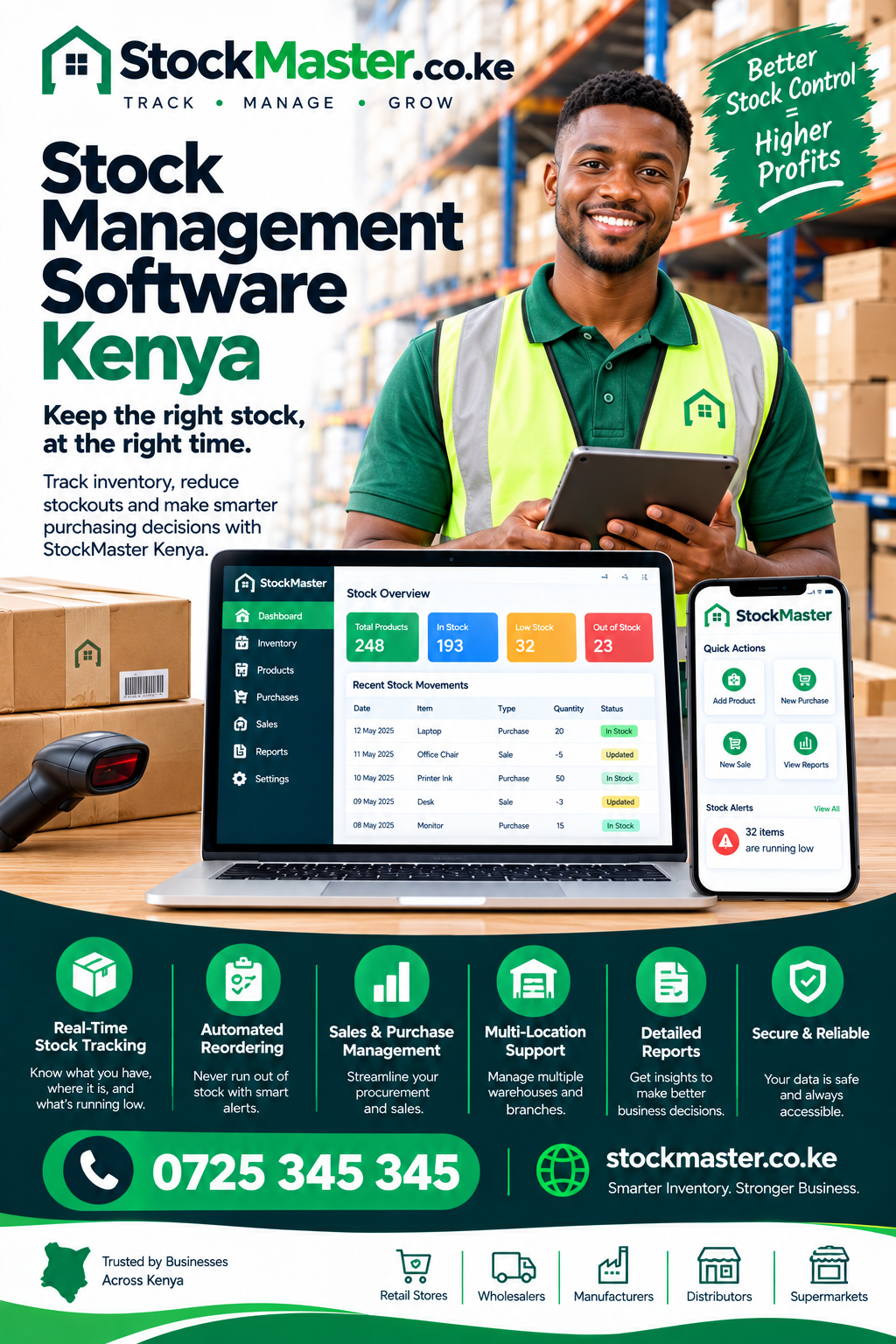
Stock Management Software Kenya: Complete Guide for Kenyan Businesses
Managing stock manually becomes increasingly difficult as a business grows. A small shop may begin with a notebook or spreadsheet, but once the business has hundreds of products, several suppliers, frequent sales and multiple employees, knowing exactly what is available becomes much harder. This is where Stock Management Software Kenya can help businesses create a more organized, accurate and visible approach to inventory control.
For Kenyan retailers, wholesalers, distributors, pharmacies, agrovets, hardware shops, supermarkets, online sellers and other product-based businesses, stock is one of the most important business assets. Too much stock can tie up working capital, while too little stock can lead to missed sales and unhappy customers. A reliable stock management system gives owners and managers a clearer picture of what is available, what has moved, what needs replenishment and where stock is located.
The goal of stock management is not simply to count products. It is to create a dependable connection between purchasing, receiving, storage, sales, payments, transfers, fulfilment and reporting. When these activities are disconnected, stock information can quickly become unreliable.
A modern Stock Management Software Kenya solution should therefore help a business move beyond basic stock counting. It should support a practical workflow where products are properly recorded, stock enters the business through documented processes, sales update inventory, transfers remain visible and management can review stock information alongside business activity.
This guide explains how Kenyan businesses can approach stock management, what features to look for, common challenges, implementation considerations and how integrated stock systems can support business growth.
What Is Stock Management Software?
Stock management software is a digital system used to record, organize and monitor products held by a business. Instead of relying entirely on paper records or spreadsheets, the business maintains product information and stock movements in a structured system.
A Stock Management Software Kenya platform can help businesses keep information such as:
- Product names
- Product codes
- Categories
- Selling prices
- Quantities
- Stock locations
- Warehouses
- Suppliers
- Sales
- Purchases
- Stock movements
- Transfers
- Returns
- Adjustments
- Reorder information
The exact features vary between software providers, so businesses should evaluate systems according to their actual operating requirements.
For example, a small clothing shop may need to track different sizes, colours and designs. A hardware business may need hundreds of product types with different brands and specifications. A pharmacy may need more detailed product information and carefully controlled processes. A distributor may need multiple warehouses and frequent stock transfers.
This means the best Stock Management Software Kenya is not necessarily the system with the longest feature list. It is the system that fits the way the business actually buys, stores, sells and moves products.
Why Stock Management Matters for Kenyan Businesses
Stock affects almost every part of a product-based business.
When customers ask whether a product is available, staff need reliable information. When a supplier delivers goods, someone needs to record what was received. When products move between branches, the movement needs to be visible. When an item is sold, the stock record should reflect that transaction.
Without clear processes, businesses can experience stock discrepancies.
Common causes include:
- Sales that were not recorded
- Incorrect quantities during receiving
- Damaged products
- Missing stock
- Duplicate product records
- Unrecorded returns
- Incorrect stock transfers
- Counting errors
- Manual spreadsheet updates
- Staff entering inconsistent product names
A Stock Management Software Kenya system can reduce the dependence on disconnected records by creating a central operating record.
The objective is not to assume that software eliminates every stock problem. Physical stock still needs to be counted and business processes still need to be followed. However, digital records can make it easier to identify where discrepancies occurred and which transaction or movement needs investigation.
The Difference Between Stock Tracking and Stock Management
Stock tracking and stock management are related but not identical.
Stock tracking answers questions such as:
- How many units are available?
- Where are they stored?
- When did the quantity change?
- Which product was sold?
- Which products were received?
Stock management goes further.
A Stock Management Software Kenya platform can help a business connect stock information with purchasing, sales, fulfilment and operational decisions.
For example, suppose a shop sells ten units of a particular product in one week. Simply knowing that ten units were sold is useful, but management may also want to know:
- How many units remain?
- How many were purchased?
- Which supplier provided them?
- What was the selling price?
- Which branch sold the most?
- Does the product need replenishment?
- Are there outstanding customer orders?
- Is the product moving faster than expected?
The more connected the information becomes, the more useful stock data becomes for decision-making.
Key Features to Look for in Stock Management Software
Before choosing a system, businesses should identify the features that matter most to their operations.
A good Stock Management Software Kenya solution may include several of the following capabilities.
1. Product Catalogue Management
The product catalogue is the foundation of digital stock management.
Each product should have a clear record that staff can identify consistently. Depending on the business, this may include:
- Product name
- Product code
- Category
- Selling price
- Cost information
- Unit of measurement
- Supplier
- Stock quantity
- Stock location
- Customer pricing
A structured catalogue reduces confusion when multiple employees handle sales and stock.
For example, instead of one employee recording “Blue Paint 20L” while another records “Paint Blue 20 Litres,” the business can establish a consistent product record.
A Stock Management Software Kenya platform becomes more useful when product information is standardized from the beginning.
2. Stock Quantity Tracking
Quantity tracking is one of the most obvious functions of stock software.
The business should be able to see the current quantity of products and understand how that quantity changes.
This is particularly important for businesses that handle many transactions every day.
A retailer may sell dozens or hundreds of products during a busy period. Updating stock manually after every transaction can be time-consuming and creates opportunities for errors.
A Stock Management Software Kenya system can connect stock changes to business transactions, depending on the configuration and capabilities of the platform.
3. Warehouse Management
Businesses with more than one stock location need more than a single total quantity.
A wholesaler may have:
- Main warehouse
- Branch warehouse
- Retail shop
- Delivery location
- Temporary storage area
If all quantities are combined into one figure, staff may believe that stock is available when it is actually located somewhere else.
Warehouse-aware stock management provides greater visibility.
A Stock Management Software Kenya solution should therefore be evaluated based on how it handles different stock locations and whether users can understand where products are held.
4. Stock Receiving
Receiving is one of the most important moments in the inventory process.
When products arrive from a supplier, the business needs to confirm:
- What was ordered
- What was delivered
- How many units arrived
- Which products arrived
- Where the products should be stored
- Whether anything was damaged or missing
A Stock Management Software Kenya platform can help businesses establish a consistent digital receiving process.
The important consideration is not simply whether the software has a “receive stock” button. The business should understand the entire workflow and determine who is responsible for confirming received quantities.
5. Stock Transfers
Stock transfers occur when products move from one location to another.
For example, a retailer with branches in Nairobi, Kiambu and Nakuru may need to move products between locations depending on demand.
Without a documented transfer process, the sending branch may reduce its stock while the receiving branch forgets to increase its quantity.
A Stock Management Software Kenya system can provide a structured way of recording these movements, depending on the software’s supported workflows.
6. Low-Stock Visibility
Businesses do not want to discover a stock shortage only after a customer places an order.
Low-stock visibility helps management identify products that may require attention.
For example, a shop could have:
- 100 units of Product A
- 35 units of Product B
- 7 units of Product C
- 2 units of Product D
If Product D normally sells quickly, two remaining units may require immediate action.
A Stock Management Software Kenya platform can make this type of information easier to review than a spreadsheet containing thousands of rows.
7. Sales and Stock Connection
Sales and inventory should not operate as completely separate processes.
When a product is sold, the stock position should be updated through the relevant sales workflow.
A Stock Management Software Kenya solution that connects products and sales can reduce duplicate data entry and give management a more complete picture of business activity.
This is especially useful for retailers where employees need to check product availability while serving customers.
Stock Management for Retail Shops
Retail shops deal with frequent transactions and often carry a large number of products.
A typical retail workflow might look like this:
- Create product records.
- Purchase products from suppliers.
- Receive products.
- Store them in the appropriate location.
- Sell products to customers.
- Record payment.
- Reduce available stock.
- Review remaining quantities.
- Replenish products when necessary.
A Stock Management Software Kenya platform can help connect these activities.
For example, a supermarket may need to monitor hundreds or thousands of product records. Manual updates can become difficult when many employees are involved.
A digital system can give staff a common product catalogue and a shared record of stock activity.
Stock Management for Wholesalers
Wholesalers often deal with larger quantities and more complex order patterns than small retailers.
They may sell products in bulk to:
- Retail shops
- Institutions
- Restaurants
- Contractors
- Distributors
- Online sellers
- Other businesses
For wholesalers, stock management is closely connected to purchasing and customer orders.
A Stock Management Software Kenya platform can help wholesalers keep customer demand, available stock and procurement activities more organized.
The business should also consider whether the software supports multiple stock locations, customer-specific pricing and order fulfilment requirements where necessary.
Stock Management for Hardware Businesses
Hardware stores often have very large catalogues.
A single store may sell:
- Cement
- Paint
- Plumbing fittings
- Electrical items
- Tools
- Timber
- Fasteners
- Roofing materials
- Building accessories
Many products can have similar names but different brands, sizes or specifications.
This makes product identification particularly important.
A Stock Management Software Kenya solution can help a hardware business establish standardized product records and reduce reliance on handwritten stock cards.
The business should also ensure that staff understand how to search for products and select the correct item during sales.
Stock Management for Agrovets
Agrovets may handle agricultural products, animal health products, equipment, feeds and other inventory.
The business needs to know what is available and where it is stored.
A Stock Management Software Kenya platform can help create structured product records and provide greater visibility into inventory movements.
However, businesses operating in regulated product categories should separately confirm that their chosen software and internal processes meet all applicable industry requirements.
Software should support business processes rather than replace professional or regulatory responsibilities.
Stock Management for Pharmacies
Pharmacies have specialized inventory requirements.
Product information may need to be handled with greater care, and businesses may need controls related to product categories, quantities and expiry information depending on their operations and applicable requirements.
A Stock Management Software Kenya system should therefore be evaluated carefully by pharmacy operators.
Rather than assuming that every inventory platform supports pharmacy-specific requirements, businesses should ask vendors to demonstrate the exact workflows they need.
Stock Management for Online Sellers
E-commerce businesses can experience stock problems when products are sold through multiple channels.
For example, a seller might receive orders through:
- Website
- Social media
- Marketplace
- Physical shop
If each channel maintains separate stock information, the business can accidentally accept orders for products that are no longer available.
A Stock Management Software Kenya solution can help businesses work toward a more centralized stock record, depending on its integrations and supported sales channels.
The important question is whether all relevant transactions can be reflected accurately in the inventory process.
Why Connecting POS and Stock Management Matters
Point-of-sale systems record customer purchases. Stock management systems monitor inventory.
When they are disconnected, employees may have to enter the same information more than once.
A Stock Management Software Kenya solution connected to point-of-sale activity can make the workflow more coherent.
For example:
Product selected → Sale completed → Payment recorded → Stock updated → Transaction reported
This creates a more connected operating record.
Zivo’s current retail/POS offering describes a workflow connecting product catalogues, stock, warehouses, sales orders, M-Pesa payments and reporting.
M-Pesa and Stock Management
M-Pesa is an important payment channel for many Kenyan businesses.
However, payment recording and stock management are two different functions.
A business needs to know not only whether the customer paid, but also:
- What was purchased?
- How many units were sold?
- Which customer placed the order?
- Has the order been fulfilled?
- Was the correct stock deducted?
- Does the payment correspond to the correct transaction?
A Stock Management Software Kenya platform can become more valuable when stock information is connected with the wider sales and payment workflow.
Zivo’s current public product information specifically describes M-Pesa payments alongside POS sales, stock and customer orders.
Managing Stock with Purchase Orders
Stock management begins before products reach the warehouse.
Purchasing decisions influence how much inventory a business holds.
A business may create purchase orders based on:
- Low stock
- Customer demand
- Seasonal demand
- Supplier lead times
- Planned promotions
- Expected orders
- Historical sales
A Stock Management Software Kenya system that connects purchasing and stock can help management follow the journey from supplier request to goods received.
The business should ask:
- Can purchase orders be recorded?
- Can suppliers be associated with purchases?
- Can received quantities be checked?
- Can incomplete deliveries be identified?
- Can purchase information be reviewed later?
These questions are more useful than simply asking whether a software package “has purchasing.”
Supplier Management and Inventory
Suppliers influence stock availability.
If a business relies heavily on a few suppliers, it needs a clear record of supplier activity.
Supplier information can include:
- Supplier name
- Contact information
- Products supplied
- Purchase history
- Outstanding transactions
- Delivery information
A Stock Management Software Kenya platform that keeps purchasing and supplier information organized can help businesses make better procurement decisions.
For example, management can review which supplier provides a particular product and understand the business’s purchasing history before placing another order.
Avoiding Overstocking
Overstocking occurs when a business holds more inventory than it can reasonably sell within the required period.
This can create several problems:
- Capital is tied up
- Storage space is consumed
- Products may become obsolete
- Damaged stock may increase
- Cash available for other business needs decreases
A Stock Management Software Kenya solution can provide better visibility into product quantities and movement.
However, software alone cannot decide the perfect stock level for every business.
Management still needs to consider customer demand, supplier lead times, seasonality and the nature of the products.
Avoiding Stockouts
Stockouts create the opposite problem.
A customer wants a product, but the business does not have it available.
This can result in:
- Lost sales
- Customer frustration
- Emergency purchasing
- Higher procurement costs
- Delayed orders
- Reduced confidence in the business
A Stock Management Software Kenya system can help businesses monitor stock levels and identify products that need attention.
The objective is to create enough visibility for management to act before a shortage becomes a customer-facing problem.
Stock Counts and Physical Verification
Digital stock records should not eliminate physical stock counts.
Physical verification remains important because real-world inventory can be affected by:
- Damage
- Theft
- Misplacement
- Returns
- Human error
- Incorrect receiving
- Incorrect sales entry
A Stock Management Software Kenya system can make it easier to compare physical observations with digital records.
Businesses should establish a stock-counting routine appropriate to their operations.
Some products may require frequent checks, while others may be reviewed less often.
The important point is to make physical verification part of the management process rather than treating it as an emergency exercise when records appear wrong.
Stock Adjustments
Sometimes the physical quantity differs from the digital quantity.
For example, the system may show 50 units while a physical count finds 48.
A responsible stock adjustment process should identify:
- The product
- The recorded quantity
- The physical quantity
- The difference
- The reason
- The person responsible for the adjustment
A Stock Management Software Kenya platform can help businesses create a clearer record of these changes when adjustment functionality is available.
Businesses should avoid allowing unrestricted stock adjustments because frequent unexplained changes can undermine the reliability of inventory information.
Stock Reporting
Stock data becomes valuable when it can support decisions.
Useful reports may include:
- Current stock
- Stock movement
- Sales by product
- Sales by category
- Low-stock items
- Stock by location
- Purchase history
- Product performance
- Outstanding orders
A Stock Management Software Kenya platform should be evaluated according to the reports management actually needs.
Do not select software simply because it displays a large number of dashboards.
A smaller number of useful reports can be more valuable than dozens of reports that nobody reviews.
Using Stock Data to Improve Business Decisions
Good stock records can help management ask better questions.
For example:
Which products sell fastest?
This can help guide purchasing decisions.
Which products remain in stock for long periods?
This may indicate slow-moving inventory.
Which branch sells more of a particular product?
This can inform stock transfers.
Which products frequently run out?
This may indicate that reorder processes need attention.
A Stock Management Software Kenya system can make these questions easier to investigate when stock, sales and purchasing data are connected.
Stock Management for Multi-Branch Businesses
Multi-branch businesses have additional inventory challenges.
Each branch may have:
- Different sales volumes
- Different customer preferences
- Different stock levels
- Different staff
- Different storage capacity
If management only sees one combined inventory number, it may be difficult to determine where stock is actually located.
A Stock Management Software Kenya platform should therefore be tested using the business’s real branch structure.
Ask the software provider to demonstrate:
- Branch stock
- Transfers
- Receiving
- Sales
- Product availability
- Reporting
- User permissions
Do not assume that a system designed for one shop will automatically handle a multi-location operation in the way your business requires.
User Roles and Stock Control
Not every employee should necessarily have permission to change everything.
A business may want:
- Sales staff to record sales
- Store staff to receive stock
- Supervisors to approve adjustments
- Managers to review reports
- Owners to control sensitive settings
A Stock Management Software Kenya platform with appropriate user controls can help align software permissions with business responsibilities.
The goal is accountability.
If everyone can freely edit stock quantities, management may struggle to determine why inventory changed.
Why Spreadsheets Become Difficult as Businesses Grow
Spreadsheets can be useful for starting a business.
They are flexible, inexpensive and familiar.
However, problems can appear as transaction volumes increase.
A spreadsheet may require staff to:
- Record a sale.
- Open another file.
- Find the product.
- Change the quantity.
- Save the file.
- Send an updated version.
- Repeat the process for another location.
This can become inefficient.
A Stock Management Software Kenya system can centralize information and reduce dependence on manually maintained stock files.
The decision to move away from spreadsheets should be based on operational complexity rather than business size alone.
Signs Your Business Needs Stock Management Software
Your business may be ready for dedicated stock software if:
- You regularly cannot confirm stock availability.
- Staff maintain multiple stock sheets.
- Different employees report different quantities.
- You frequently discover stock discrepancies.
- Products are sold before staff confirm availability.
- Customers are promised products that are unavailable.
- You operate more than one stock location.
- Stock transfers are difficult to track.
- Purchasing decisions are based mostly on guesswork.
- Management spends too much time preparing stock reports.
A Stock Management Software Kenya platform can help address these operational challenges by providing a more structured system.
How to Choose the Right Stock Management Software
Choosing software should begin with the business process, not the feature list.
Write down the journey of a typical product.
For example:
Supplier order → Goods received → Stock stored → Customer order → Sale → Payment → Stock movement → Fulfilment → Report
Then ask the software provider to demonstrate that exact workflow.
A Stock Management Software Kenya solution should be tested against real scenarios rather than generic demonstrations.
Use actual products, actual quantities and realistic transactions during the evaluation.
Questions to Ask a Software Provider
Before buying, ask:
Product management
- How are products created?
- Can products be categorized?
- Can product codes be used?
- Can prices be updated?
- Can similar products be differentiated?
Stock management
- How is stock added?
- How are sales reflected?
- How are stock adjustments recorded?
- Can stock be viewed by location?
- Can stock transfers be recorded?
Purchasing
- Can purchase orders be created?
- Can supplier information be stored?
- Can goods received be recorded?
- Can incomplete deliveries be identified?
Sales
- Does the system connect stock with sales?
- Does it support POS?
- Can customer orders be recorded?
- Can payment information be connected to transactions?
Reporting
- Which stock reports are available?
- Can managers see stock movement?
- Can reports be exported?
- Can reports be filtered?
A Stock Management Software Kenya provider should be able to demonstrate the workflows that matter to your business.
Implementing Stock Management Software
Buying software is only the beginning.
Implementation determines whether the system becomes useful.
Step 1: Clean the product list
Before importing information, remove duplicates and correct product names.
A clean starting catalogue makes future reporting easier.
Step 2: Confirm opening stock
Conduct a physical count and agree on the opening quantities.
Do not simply copy numbers from an old spreadsheet if those numbers are known to be unreliable.
Step 3: Define responsibilities
Decide who can:
- Add products
- Change prices
- Receive stock
- Transfer stock
- Adjust quantities
- Approve changes
- View reports
Step 4: Test the complete workflow
Run several realistic transactions.
For example:
Receive stock → sell product → record payment → verify stock → review report
A Stock Management Software Kenya implementation should be tested from beginning to end.
Step 5: Train employees by role
Sales staff do not need the same training as store managers.
Training should focus on what each person actually does.
Step 6: Review the first records
During the early implementation period, management should review stock movements frequently.
This helps identify process mistakes before they become habits.
Common Stock Management Mistakes
Even with software, businesses can make avoidable mistakes.
Mistake 1: Creating duplicate products
If the same product appears under several names, reporting becomes confusing.
Mistake 2: Ignoring opening balances
Incorrect starting stock creates problems immediately.
Mistake 3: Allowing uncontrolled adjustments
Frequent unexplained adjustments reduce accountability.
Mistake 4: Not recording damaged goods
Damaged inventory still affects the stock position.
Mistake 5: Forgetting transfers
Stock moved between branches must be recorded properly.
Mistake 6: Failing to review reports
Information is only useful when management uses it.
A Stock Management Software Kenya platform should support disciplined processes rather than encourage businesses to assume that automation alone solves inventory problems.
How Stock Management Supports Cash Flow
Stock and cash flow are closely connected.
When a business buys inventory, cash leaves the business.
That inventory then needs to be sold before the business recovers the value through revenue.
If too much cash remains tied up in slow-moving products, the business may experience pressure even when its shelves look full.
A Stock Management Software Kenya solution can give management clearer visibility into stock quantities and movement.
This does not automatically produce a cash-flow forecast, but accurate inventory information can contribute to better financial decision-making.
Stock Management and Profitability
Revenue alone does not tell the whole story.
A business can generate many sales while still experiencing poor profitability if purchasing, wastage, pricing and inventory decisions are poorly controlled.
Stock information can help management investigate:
- Product movement
- Purchase costs
- Selling prices
- Slow-moving items
- Stock losses
- Stockouts
- Overstocking
A Stock Management Software Kenya system can become one part of a broader business management process.
When inventory information is connected with sales and financial records, management has more context for evaluating business performance.
Stock Management for Growing SMEs
A business may begin with a handful of products and eventually grow into a much larger operation.
Growth introduces complexity.
More products mean more records.
More customers mean more sales.
More suppliers mean more purchasing activity.
More employees mean more people interacting with stock.
More branches mean more movement between locations.
A Stock Management Software Kenya system can help businesses establish structured processes before operational complexity becomes difficult to manage.
The best time to introduce proper processes is usually before stock problems become a daily crisis.
Integrating Stock With the Wider Business
Inventory does not operate independently.
It interacts with:
- Sales
- Customers
- Suppliers
- Payments
- Purchasing
- Delivery
- Accounting
- Reporting
This is why businesses should consider integrated software rather than looking only for a digital stock card.
A Stock Management Software Kenya platform can be more useful when it forms part of a wider business workflow.
Zivo’s current business platform describes a broader workspace connecting sales, M-Pesa, expenses, stock, delivery and business records.
Stock Management and Customer Service
Customers expect businesses to know whether products are available.
If a customer asks for a product and the business cannot provide a reliable answer, confidence can decline.
Accurate stock information allows staff to respond more confidently.
A Stock Management Software Kenya system can help staff access a common stock record instead of relying on separate notebooks or messages.
For businesses selling through WhatsApp, online channels and physical shops, connected information becomes even more valuable.
Stock Management for Seasonal Demand
Some products sell more during specific periods.
Examples can include:
- School-related products
- Agricultural supplies
- Holiday merchandise
- Event products
- Weather-related goods
- Construction materials during active projects
A Stock Management Software Kenya system can help management review previous stock movement and current quantities when making purchasing decisions.
However, businesses should combine software information with their knowledge of the market and expected customer demand.
The Role of Inventory Reports in Management Meetings
Stock reports should not be generated only when there is a problem.
Management can review selected stock indicators regularly.
For example, a weekly meeting could examine:
- Low-stock products
- Fast-moving products
- Slow-moving products
- Stock discrepancies
- Pending purchases
- Outstanding orders
- Transfers
- Major adjustments
A Stock Management Software Kenya platform can support this review process when the required reports are available.
The important thing is to establish a routine.
How Stock Software Can Improve Accountability
Accountability improves when responsibilities are clearly defined.
If a product is received, the system should make it clear who handled the receiving process.
If a stock adjustment is made, management should know why.
If stock is transferred, the movement should be documented.
A Stock Management Software Kenya solution can support this type of structured workflow depending on its permissions and audit capabilities.
Before implementation, ask the provider to demonstrate how user actions are recorded.
Mobile and Cloud-Based Stock Management
Many Kenyan business owners are not permanently seated at a desk.
They may move between shops, warehouses, suppliers and customer locations.
A cloud-based business system can make information accessible from suitable devices, depending on the provider and internet requirements.
A Stock Management Software Kenya solution should therefore be assessed for usability on the devices your employees actually use.
Do not assume that a platform that looks good on a desktop will automatically provide the same experience on mobile.
Test it.
Security and Stock Information
Inventory records can be commercially sensitive.
They may reveal:
- Product quantities
- Supplier relationships
- Pricing
- Sales activity
- Purchasing patterns
- Branch performance
A Stock Management Software Kenya provider should explain how access is controlled and which users can view or change different information.
Businesses should also understand their own responsibilities around account security, passwords and employee access.
Cost Considerations
Software pricing should not be considered in isolation.
The real question is whether the system delivers enough operational value for the business.
Consider:
- Subscription cost
- Number of users
- Number of locations
- Setup requirements
- Training
- Support
- Additional modules
- Integrations
- Data migration
- Reporting requirements
A Stock Management Software Kenya solution should be evaluated against the cost of the current manual process as well.
For example, how many hours are employees spending preparing stock reports? How much time is lost investigating discrepancies? How often does the business lose sales because stock information is unreliable?
A Practical Stock Management Checklist
Before selecting software, confirm that your preferred system can support the following:
Product management
- Product catalogue
- Product categories
- Product codes
- Pricing
- Product information
Inventory
- Stock quantities
- Stock movements
- Stock adjustments
- Stock counts
- Stock locations
Warehousing
- Multiple locations where needed
- Receiving
- Transfers
- Location-based visibility
Sales
- POS
- Customer orders
- Product selection
- Payment records
- Sales reporting
Purchasing
- Suppliers
- Purchase orders
- Receiving
- Purchase history
Reporting
- Stock reports
- Sales reports
- Movement reports
- Low-stock visibility
- Management reporting
A Stock Management Software Kenya platform should be assessed against this checklist using the actual requirements of your business.
Frequently Asked Questions
What is the purpose of stock management software?
The purpose is to help a business maintain organized records of products, quantities and stock movements while supporting purchasing, sales, transfers and reporting.
A Stock Management Software Kenya solution can reduce reliance on paper records and disconnected spreadsheets.
Is stock management software useful for small businesses?
Yes. Small businesses can benefit when their product catalogue or transaction volume makes manual tracking difficult.
However, the right level of software should match the complexity of the business.
Can stock software work with a POS system?
Many modern business systems connect POS and stock functions. Businesses should confirm the exact workflow supported by their chosen provider.
A Stock Management Software Kenya solution can be particularly useful when the sale and inventory records remain connected.
Can I manage stock across multiple branches?
Some systems support multiple stock locations or warehouses.
If your business has several branches, ask the provider to demonstrate stock transfers, branch-level quantities and reporting before purchasing.
Does stock software replace physical stock counting?
No.
Physical counting remains important because real-world inventory can differ from digital records.
Software helps maintain the record, while physical verification helps confirm that the record reflects reality.
Can stock management software support M-Pesa sales?
Some business platforms connect sales, payments and inventory.
Zivo’s current retail/POS workflow specifically lists M-Pesa payments alongside products, stock and sales orders.
A Stock Management Software Kenya solution should be tested using an actual M-Pesa sales scenario if this is important to your business.
How long does implementation take?
Implementation time depends on the size and complexity of the business.
A business with a small, clean product catalogue may implement faster than a company with thousands of products, several warehouses and years of inconsistent records.
Should I migrate all my old spreadsheet data?
Not necessarily.
First clean the data and determine which information is actually needed.
Importing inaccurate or duplicated information can create problems in the new system.
What should I demonstrate before buying?
Ask the provider to demonstrate one complete transaction.
For example:
Purchase → Receive → Store → Sell → Pay → Update Stock → Fulfil → Report
This gives you a much better understanding of whether the system fits your business.
A Stock Management Software Kenya platform should be evaluated using real business scenarios rather than a generic presentation.
The Future of Stock Management for Kenyan Businesses
Stock management is becoming increasingly connected to other business operations.
Businesses no longer want isolated systems that only show quantities.
They increasingly need workflows that connect:
- Customers
- Orders
- Products
- Stock
- Suppliers
- Payments
- Fulfilment
- Finance
- Reporting
This connected approach can reduce duplicate entry and improve visibility.
A Stock Management Software Kenya solution can therefore be viewed as part of a broader operational system rather than simply a replacement for a stock notebook.
For Kenyan SMEs, this is particularly useful when sales happen through multiple channels and payments increasingly move through digital methods.
Final Thoughts
Stock is too important to manage entirely through guesswork.
Whether you operate a retail shop, wholesale business, hardware store, agrovet, pharmacy, online shop or distribution operation, reliable inventory information can make everyday decisions easier.
A good Stock Management Software Kenya platform should help answer practical questions:
- What do we have?
- Where is it?
- What has been sold?
- What has been received?
- What has moved?
- What needs replenishment?
- Which orders are waiting?
- Which products are moving quickly?
- Where are discrepancies occurring?
The strongest systems go beyond simply displaying stock quantities. They connect inventory with sales, purchasing, payments and fulfilment so that the business can follow a product from acquisition through to customer delivery.
Before choosing software, map your existing process. Identify where stock enters the business, how it is stored, how sales are recorded, how payments are received, how transfers occur and how management reviews inventory.
Then ask software providers to demonstrate that exact workflow.
A Stock Management Software Kenya solution should make the process clearer rather than adding unnecessary complexity.
For growing Kenyan businesses, the goal is not to digitize every activity simply because technology is available. The goal is to build a dependable operating system that gives employees useful information, gives managers better visibility and gives owners greater confidence in the numbers.
When stock information is accurate, connected and consistently maintained, businesses can make better purchasing decisions, reduce avoidable discrepancies, respond to customers more confidently and build stronger foundations for growth.
The right stock management system should therefore become part of the daily rhythm of the business—not another tool that employees have to update after everything else is done.