
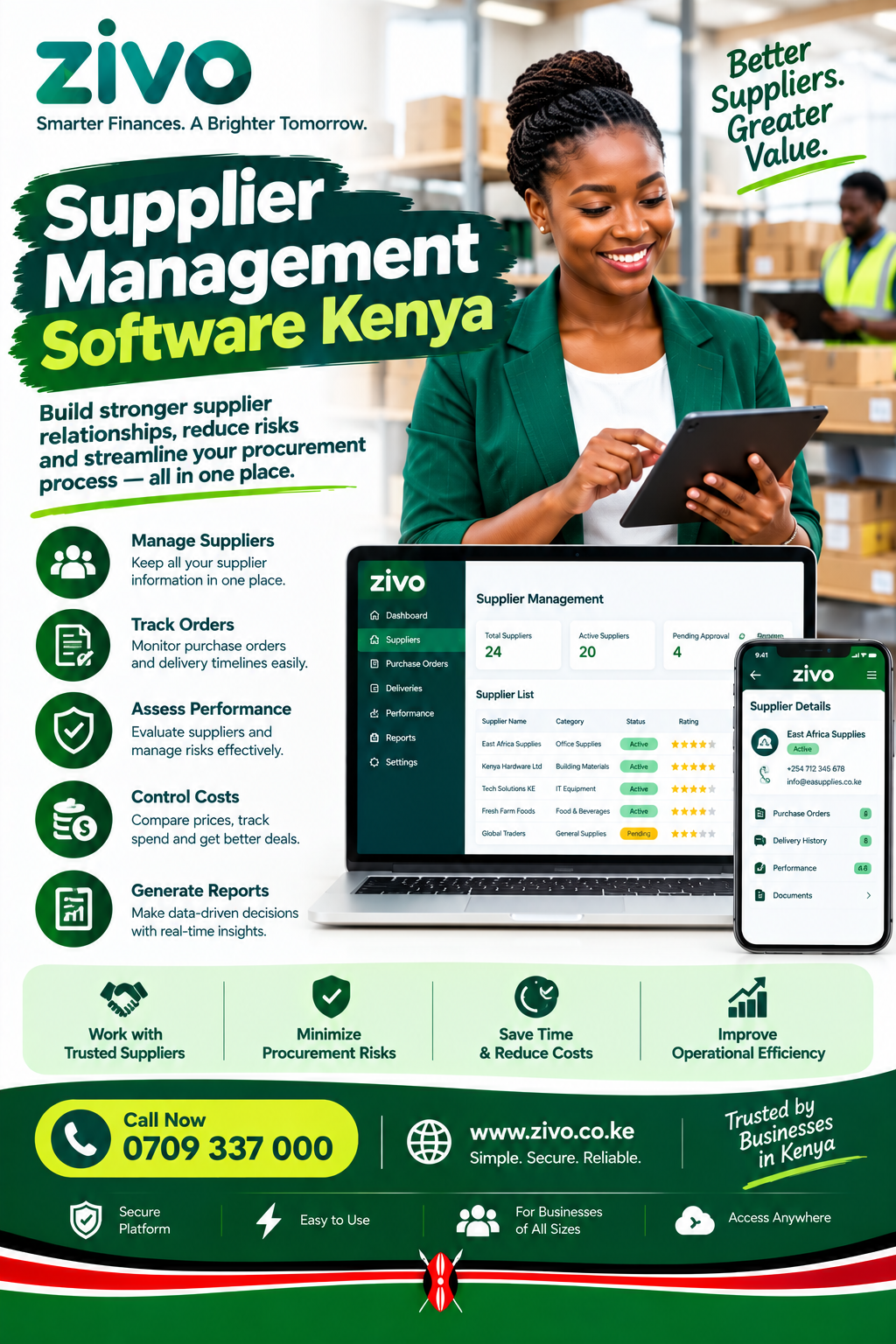
Supplier Management Software Kenya: Complete Guide for Kenyan Businesses
Managing suppliers efficiently is essential for businesses that want to control costs, maintain reliable stock levels, improve cash flow, and build strong commercial relationships. As Kenyan businesses grow, manually managing supplier information through spreadsheets, notebooks, emails, WhatsApp conversations, and paper documents can become increasingly difficult. This is where Supplier Management Software Kenya becomes valuable. A centralized supplier management solution can help businesses organize supplier information, manage purchase orders, track deliveries, monitor invoices, control approvals, process payments, and maintain better procurement records.
For a growing business, supplier management is much more than maintaining a list of vendors and their telephone numbers. Suppliers influence how much a business spends, how quickly products become available, how efficiently operations run, and how much working capital remains available. With Supplier Management Software Kenya, businesses can create structured processes around supplier relationships and purchasing activities instead of depending entirely on manual administration.
Kenyan businesses also operate in an environment where different payment and communication channels are commonly used. A supplier may send a quotation through WhatsApp, provide an invoice by email, deliver goods with a physical delivery note, and receive payment through M-Pesa or a bank account. When these activities are recorded in separate places, finance and procurement teams can struggle to establish a complete transaction history. Supplier Management Software Kenya can help bring supplier-related information into a more organized digital workflow.
The goal of supplier management software is therefore not simply to replace paper. It is to create a reliable process connecting supplier information, procurement, purchasing, receiving, invoicing, approvals, payments, and reporting.
What Is Supplier Management Software Kenya?
Supplier Management Software Kenya refers to software that enables Kenyan businesses to manage supplier relationships and supplier-related business activities through a centralized digital system. Depending on the platform, these activities can include supplier onboarding, supplier records, purchase orders, quotation management, delivery tracking, invoice management, payment approvals, supplier payments, reconciliation, reporting, and supplier performance monitoring.
Instead of storing supplier information in several spreadsheets, a business can use Supplier Management Software Kenya to create a centralized supplier record. Employees can then access relevant supplier information according to their responsibilities and permissions.
A supplier record may contain information such as:
- Supplier name
- Contact details
- Products or services supplied
- Payment terms
- Purchase history
- Purchase orders
- Invoices
- Delivery records
- Payment history
- Supporting documents
- Internal notes
- Supplier performance information
This information becomes increasingly valuable as the business grows.
For a company with five suppliers, manual management may appear manageable. For a company dealing with fifty, one hundred, or several hundred suppliers, the same manual approach can create significant administrative pressure. Supplier Management Software Kenya gives businesses an opportunity to establish scalable supplier-management processes.
Why Supplier Management Software Kenya Is Important
Suppliers directly affect business performance.
If suppliers deliver late, the business may experience stock shortages. If suppliers increase prices unexpectedly, margins may decline. If supplier invoices are not tracked properly, payments may be delayed. If purchases are not approved correctly, businesses may spend money unnecessarily.
This makes Supplier Management Software Kenya an important business-management tool.
A structured supplier system can help businesses answer important questions quickly:
- Which suppliers are currently active?
- What products does each supplier provide?
- How much have we purchased from each supplier?
- Which purchase orders are pending?
- Which goods have been received?
- Which supplier invoices remain unpaid?
- Which payments have been approved?
- Which supplier payments have been completed?
- How much are we expected to pay suppliers?
- Which suppliers consistently deliver on time?
Without centralized information, answering these questions can require searching through several systems. Supplier Management Software Kenya can simplify this process by bringing supplier information closer to procurement and financial workflows.
The Challenges of Manual Supplier Management
Many businesses begin with manual supplier management.
An owner may keep supplier details in a notebook. A procurement officer may use Excel to record purchases. Finance staff may maintain another spreadsheet for invoices. Employees may communicate with suppliers through personal WhatsApp accounts.
Initially, this may appear inexpensive.
However, manual processes become increasingly difficult when transaction volumes increase. Supplier Management Software Kenya can help businesses move away from fragmented supplier administration.
Common problems associated with manual supplier management include:
Duplicate Supplier Records
The same supplier may be entered multiple times under slightly different names.
Lost Documents
Invoices, quotations, and delivery notes may become difficult to locate.
Delayed Approvals
Purchase requests may sit in email inboxes or WhatsApp conversations.
Payment Confusion
Finance teams may struggle to determine which supplier invoices have already been paid.
Poor Visibility
Management may not have an accurate view of total supplier spending.
Weak Accountability
It may be difficult to determine who approved a particular purchase.
Supplier Performance Problems
Businesses may continue using unreliable suppliers because supplier performance is not systematically recorded.
A centralized Supplier Management Software Kenya platform can help address these challenges.
Centralized Supplier Records
One of the fundamental features of Supplier Management Software Kenya is centralized supplier information.
A business should be able to maintain a single source of truth for each supplier.
For example, the company may record the supplier’s:
- Legal or trading name
- Main contact person
- Telephone number
- Email address
- Location
- Products supplied
- Services supplied
- Payment terms
- Tax information where applicable
- Purchase history
- Invoices
- Delivery records
- Supporting documentation
Centralization prevents important information from being scattered across departments.
It also protects the business when employees leave.
If supplier relationships are managed through personal phones and individual spreadsheets, important institutional knowledge may disappear when an employee exits the company. Supplier Management Software Kenya allows businesses to establish supplier information as part of the company’s operational records rather than individual employee records.
Supplier Onboarding
Supplier onboarding is another important component of supplier management.
Before purchasing from a new supplier, businesses may need to collect information and verify relevant details.
A structured Supplier Management Software Kenya workflow can help businesses standardize supplier onboarding.
A typical process could involve:
- Identifying a potential supplier.
- Collecting supplier information.
- Reviewing supplier documentation.
- Confirming products or services.
- Approving the supplier.
- Creating the supplier record.
- Making the supplier available for purchasing.
Standardization reduces inconsistencies.
Instead of allowing every procurement employee to collect different information, management can establish a common process.
Managing Supplier Contacts
Supplier relationships depend heavily on communication.
Businesses should know who to contact when they need:
- A quotation
- An urgent delivery
- A price confirmation
- An invoice
- A credit note
- A statement
- A payment confirmation
- A product replacement
Supplier Management Software Kenya can help businesses maintain organized supplier contact information.
This becomes particularly important when supplier relationships involve several representatives.
Purchase Order Management
Purchase orders are central to procurement control.
A purchase order tells the supplier what the business intends to purchase.
It can contain:
- Supplier details
- Product or service
- Quantity
- Unit price
- Total amount
- Delivery requirements
- Internal references
- Approval information
With Supplier Management Software Kenya, businesses can connect purchase orders with supplier records and broader procurement workflows.
This helps employees understand what was ordered and from whom.
Purchase orders also provide useful information when invoices arrive.
Finance teams can compare the invoice against the purchase order before processing payment.
Purchase Approvals
Procurement approvals are important because not every employee should necessarily have unlimited authority to spend company funds.
A structured Supplier Management Software Kenya workflow can help businesses establish approval procedures.
For example:
| Stage | Responsible Team |
|---|---|
| Purchase request | Employee |
| Request review | Department manager |
| Supplier selection | Procurement |
| Purchase approval | Authorized manager |
| Invoice verification | Finance |
| Payment approval | Finance manager |
| Payment processing | Finance |
| Reconciliation | Accounting |
The actual process can vary according to business size and industry.
The important thing is to make responsibilities clear.
Goods Receipt Management
Ordering products does not necessarily mean that all ordered goods have been received.
A business may order 500 units but receive only 450.
Without a proper receiving process, the business could accidentally pay for the full order.
Supplier Management Software Kenya can support a structured approach to supplier transactions by connecting purchasing information with receiving and verification processes.
Businesses should ideally be able to compare:
Ordered quantity → Received quantity → Invoiced quantity → Paid quantity
This provides stronger purchasing controls.
Supplier Invoice Management
Supplier invoices need to be captured, verified, approved, and tracked.
A company dealing with many suppliers can receive invoices through different channels.
These may include:
- Physical copies
- Supplier portals
- Sales representatives
- Procurement employees
A centralized Supplier Management Software Kenya solution can help businesses organize these documents and associate them with relevant supplier transactions.
This reduces the risk of invoices being lost or forgotten.
Supplier Payment Tracking
Supplier payment tracking is one of the most important functions in procurement finance.
Finance teams need to know whether a supplier invoice is:
- Pending verification
- Awaiting approval
- Approved
- Scheduled for payment
- Paid
- Reconciled
With Supplier Management Software Kenya, businesses can structure supplier information and procurement processes in ways that support better payment visibility.
Payment tracking also improves supplier relationships.
Suppliers are more likely to have confidence in a business when payment processes are organized and predictable.
M-Pesa Supplier Payments
M-Pesa is an important part of the Kenyan business environment.
Many businesses use M-Pesa for operational payments, including payments to suppliers.
The challenge is ensuring that payments are properly connected to the underlying business transaction.
Supplier Management Software Kenya can help businesses think about supplier management as part of a broader financial workflow rather than as a standalone contact database.
A supplier payment process can be structured as:
Supplier invoice → Verification → Approval → Payment → Confirmation → Reconciliation
This gives finance teams better visibility over the entire transaction.
Supplier Reconciliation
Reconciliation helps businesses confirm that their internal records correspond with actual financial transactions.
A business may have an approved supplier invoice, but that does not necessarily mean the payment was successfully completed.
Similarly, a payment may appear in a bank or mobile-money statement without being correctly matched to the supplier transaction.
A structured Supplier Management Software Kenya approach can help businesses improve the connection between supplier obligations and financial records.
Reconciliation can help identify:
- Duplicate payments
- Unallocated payments
- Failed transactions
- Outstanding invoices
- Incorrect allocations
- Payment discrepancies
Supplier Performance Management
Price should not be the only factor when evaluating suppliers.
A supplier that charges a low price but frequently delivers late may ultimately cost the business more.
Supplier performance can be evaluated using:
- Delivery reliability
- Product quality
- Pricing
- Availability
- Responsiveness
- Communication
- Invoice accuracy
- Payment terms
- Return handling
Supplier Management Software Kenya can help businesses maintain supplier histories that support more informed supplier evaluations.
Over time, procurement teams can identify suppliers that consistently meet expectations.
Supplier Relationship Management
Good supplier relationships can become a competitive advantage.
Reliable suppliers can help businesses maintain stock availability and respond to customer demand.
They may also provide:
- Better pricing
- Flexible payment terms
- Faster delivery
- Priority access to products
- Better communication
- Faster problem resolution
A structured Supplier Management Software Kenya system can help businesses maintain professional supplier processes.
When orders, invoices, payments, and communication are properly organized, suppliers have greater clarity about the relationship.
Supplier Management for Retail Businesses
Retailers depend heavily on supplier reliability.
Supermarkets, pharmacies, hardware shops, electronics stores, clothing retailers, agrovet shops, and other retail businesses may work with dozens or hundreds of suppliers.
They need to know:
- What is being purchased?
- From which supplier?
- At what price?
- In what quantity?
- When will it arrive?
- Has it been received?
- Has it been paid?
Supplier Management Software Kenya can help retailers establish greater organization around these supplier activities.
This can also help retailers identify purchasing patterns and negotiate better terms.
Supplier Management for Wholesalers
Wholesalers purchase products in significant quantities.
They often deal with multiple suppliers and warehouses.
Their procurement processes may involve:
- Bulk orders
- Supplier quotations
- Purchase orders
- Goods receiving
- Stock management
- Supplier invoices
- Supplier payments
- Delivery coordination
A centralized Supplier Management Software Kenya solution can provide greater visibility across these activities.
Wholesalers can use purchasing histories to understand which suppliers provide the best combination of price, quality, and reliability.
Supplier Management for Distributors
Distributors depend on continuous product availability.
If suppliers fail to deliver, customer orders may be delayed.
Supplier performance therefore becomes directly connected to customer service.
Supplier Management Software Kenya can help distributors maintain better records of supplier purchases and procurement activities.
This makes it easier to identify pending orders and potential supply problems.
Supplier Management for Hardware Stores
Hardware businesses often deal with a large number of product categories.
These may include:
- Cement
- Steel
- Timber
- Paint
- Roofing products
- Electrical materials
- Plumbing products
- Tools
- Building accessories
Price differences between suppliers can have a significant impact on margins.
Using Supplier Management Software Kenya can help hardware businesses organize supplier purchases and analyze purchasing patterns.
This information can also support supplier negotiations.
Supplier Management for Construction Companies
Construction businesses depend on timely procurement.
Materials may need to arrive according to project schedules.
A delay in cement, steel, plumbing materials, electrical products, or other supplies can affect project progress.
Supplier Management Software Kenya can help construction businesses structure supplier purchasing and maintain procurement records.
This creates better visibility over what has been ordered, received, invoiced, and paid.
Supplier Management for Restaurants
Restaurants purchase food, beverages, packaging, cleaning supplies, equipment, and other products regularly.
Fresh-food suppliers are particularly important because deliveries may occur daily or several times a week.
A structured Supplier Management Software Kenya process can help restaurant operators organize supplier records and recurring purchases.
This can help management identify suppliers that consistently provide reliable service.
Supplier Management for Schools
Schools purchase a broad range of goods and services.
These may include:
- Food
- Stationery
- Furniture
- Cleaning supplies
- Technology
- Uniforms
- Maintenance
- Transport
- Construction services
Using Supplier Management Software Kenya can help institutions create clearer procurement processes.
Approvals can also be structured according to institutional responsibilities.
Supplier Management for NGOs
NGOs and other organizations often need strong procurement accountability.
Purchases may need to be linked to specific programs, projects, budgets, or funding requirements.
A centralized Supplier Management Software Kenya solution can help organizations maintain clearer purchasing records.
Supporting documents can also be retained with relevant transactions.
Supplier Management for Service Businesses
Service businesses also work with suppliers.
Examples include:
- Internet providers
- Marketing agencies
- Consultants
- Software vendors
- Cleaning companies
- Office suppliers
- Equipment maintenance providers
Even when a business does not sell physical products, supplier expenses can represent a substantial part of operating costs.
Supplier Management Software Kenya can help service businesses organize these supplier relationships.
Connecting Supplier Management With Expenses
Supplier purchases are business expenses.
This means procurement and expense management should not operate as completely separate functions.
A purchase begins with a business requirement, becomes a procurement transaction, generates an invoice, requires approval, and eventually results in a payment.
Supplier Management Software Kenya can help businesses create a more connected supplier-management process.
A connected workflow can look like:
Supplier → Purchase Request → Purchase Order → Receipt → Invoice → Approval → Payment → Reconciliation
This provides a more complete transaction history.
Supplier Management and Cash Flow
Supplier obligations have a direct impact on cash flow.
A business may have several supplier invoices due within the next thirty days.
If management does not have visibility into these obligations, cash-flow planning becomes difficult.
Supplier Management Software Kenya can help businesses organize supplier commitments and improve visibility over purchasing activities.
Managers can review:
- Pending purchases
- Approved invoices
- Upcoming payments
- Supplier balances
- Recent supplier expenditure
- Recurring supplier expenses
This information supports better cash-flow planning.
Supplier Management and Inventory
Inventory and supplier management are closely connected.
When inventory levels fall, the business needs to reorder.
The supplier must be selected, the purchase approved, the order created, and the goods received.
A centralized Supplier Management Software Kenya system can help businesses connect procurement activities with inventory requirements.
This is particularly valuable for businesses that sell physical products.
Supplier Management and Cost Reduction
Supplier costs have a direct effect on profitability.
Even small purchasing inefficiencies can accumulate over thousands of transactions.
Businesses can use supplier data to identify:
- High-cost suppliers
- Price inconsistencies
- Duplicate purchasing
- Excessive emergency purchases
- Unnecessary supplier charges
- Missed volume discounts
Supplier Management Software Kenya gives businesses a structured way to think about supplier data as a source of cost-control information.
Supplier Price Comparison
Different suppliers may offer the same product at different prices.
A business that does not compare purchasing data may continue paying more than necessary.
Supplier-management data can help procurement teams compare:
| Factor | Supplier A | Supplier B | Supplier C |
|---|---|---|---|
| Unit price | Low | Medium | High |
| Delivery time | Medium | Fast | Slow |
| Quality | Good | Excellent | Good |
| Payment terms | 30 days | 14 days | 30 days |
| Reliability | Good | Excellent | Average |
The cheapest supplier may not always be the best supplier.
Using Supplier Management Software Kenya can help businesses maintain information that supports more informed supplier decisions.
Supplier Negotiations
Accurate purchasing data strengthens negotiations.
A procurement manager can approach a supplier with information about:
- Total annual purchases
- Purchase frequency
- Average price
- Product categories
- Payment history
- Delivery performance
This is much stronger than relying on memory.
Supplier Management Software Kenya can support businesses in maintaining organized supplier histories that can contribute to better procurement decisions.
Supplier Management and Procurement Transparency
Transparency is particularly important when multiple employees participate in procurement.
Management needs confidence that purchases are:
- Legitimate
- Necessary
- Properly approved
- Correctly received
- Correctly invoiced
- Properly paid
A structured Supplier Management Software Kenya process can help improve procurement transparency.
It creates a stronger connection between the request and the final payment.
Supplier Management and Accountability
Accountability becomes more important as businesses grow.
A company should know who requested a purchase and who approved it.
It should also be possible to determine who received the goods and who processed the invoice.
Supplier Management Software Kenya can support the creation of more structured supplier workflows.
This reduces reliance on verbal approvals.
Supplier Management for Multi-Branch Businesses
Businesses with several branches often experience procurement challenges.
One branch may purchase products from one supplier while another branch purchases the same products from another supplier.
Prices may vary significantly.
With Supplier Management Software Kenya, businesses can move toward centralized supplier information and more consistent procurement processes.
Management can compare branch purchasing activity and identify opportunities for centralized negotiations.
Supplier Management and Document Control
Supplier transactions generate many documents.
These include:
- Quotations
- Purchase orders
- Delivery notes
- Invoices
- Receipts
- Statements
- Contracts
- Certificates
- Payment confirmations
Losing these documents can create unnecessary administrative problems.
A structured Supplier Management Software Kenya platform can help businesses organize supplier-related documentation around relevant transactions.
Supplier Management and Communication
Supplier communication frequently occurs through phone calls and WhatsApp.
These conversations can contain important information about:
- Prices
- Product availability
- Delivery dates
- Order confirmations
- Invoice requests
- Payment questions
When communication remains entirely within personal accounts, the business can lose access to important information.
A professional Supplier Management Software Kenya approach should therefore make supplier information accessible to authorized members of the organization.
Supplier Management and Business Growth
Business growth increases procurement complexity.
A company may begin with ten suppliers.
Later, it may have fifty.
Eventually, it may have hundreds.
Manual processes that worked at the beginning may become inefficient.
Supplier Management Software Kenya helps businesses think about supplier management as a scalable business process.
Instead of adding more spreadsheets as the company grows, management can establish a structured system.
How to Choose Supplier Management Software Kenya
Businesses should carefully evaluate supplier-management solutions before selecting one.
Important factors include:
1. Supplier Management
Can the platform maintain complete supplier records?
2. Purchase Orders
Can employees create and track purchase orders?
3. Goods Receiving
Can the business record what was actually received?
4. Invoice Management
Can supplier invoices be tracked?
5. Approval Workflows
Can management control purchasing approvals?
6. Payment Tracking
Can finance monitor supplier payment status?
7. Reconciliation
Can payments be matched to supplier obligations?
8. Reporting
Can managers analyze supplier spending?
9. User Permissions
Can employees receive appropriate access?
10. Scalability
Can the system support future business growth?
Benefits of Supplier Management Software Kenya
The benefits of Supplier Management Software Kenya extend across procurement, finance, operations, and management.
Better Organization
Supplier information is centralized.
Better Procurement Control
Purchases can follow defined approval processes.
Better Payment Visibility
Finance can identify outstanding and completed payments.
Better Accountability
Businesses can maintain clearer transaction histories.
Reduced Administrative Work
Employees spend less time searching for information.
Better Supplier Relationships
Organized procurement and payment processes improve professionalism.
Better Cost Control
Purchasing data supports supplier comparisons and negotiations.
Better Cash-Flow Planning
Upcoming supplier obligations become easier to understand.
Implementing Supplier Management Software Kenya
Successful implementation requires more than installing software.
Businesses should begin by documenting existing supplier processes.
The company should identify:
- How suppliers are currently selected
- Where supplier information is stored
- How purchases are requested
- Who approves purchases
- How purchase orders are created
- How goods are received
- How invoices are verified
- How payments are approved
- How payments are reconciled
The business can then identify process gaps.
A structured Supplier Management Software Kenya implementation can then be configured around the organization’s actual requirements.
Step-by-Step Supplier Management Process
Step 1: Identify the Supplier
Research and select a suitable supplier.
Step 2: Create the Supplier Record
Capture important supplier information.
Step 3: Submit a Purchase Request
An employee identifies what is needed.
Step 4: Review the Request
The relevant manager reviews the requirement.
Step 5: Approve the Purchase
The authorized person approves the request.
Step 6: Create a Purchase Order
The procurement team creates the order.
Step 7: Receive the Goods
The business verifies delivery.
Step 8: Receive the Invoice
The supplier provides the invoice.
Step 9: Verify the Invoice
Finance checks the invoice against purchasing and receiving records.
Step 10: Approve Payment
The authorized person approves payment.
Step 11: Make Payment
Payment is processed.
Step 12: Reconcile
The payment is matched to the relevant transaction.
Step 13: Review Supplier Performance
Management evaluates the supplier.
This process provides a complete supplier-management cycle.
Supplier Management KPIs
Businesses should measure supplier-management performance.
Useful indicators include:
- Purchase-order processing time
- Supplier delivery performance
- Invoice processing time
- Payment processing time
- Number of duplicate invoices
- Number of delayed deliveries
- Supplier spending
- Average purchase cost
- Purchase-order compliance
- Supplier response time
A structured Supplier Management Software Kenya system can help businesses establish better visibility into these areas.
Why Zivo Can Support Supplier Management
Zivo is positioned as a broader business operating platform rather than merely a supplier contact database.
Its business tools bring together areas such as finance, procurement, payments, expenses, inventory, communication, and other operational processes.
This connected approach matters because supplier management affects several parts of a business.
A supplier purchase can create an expense.
The expense can create a payment obligation.
The payment affects cash flow.
The payment eventually needs to be reconciled.
The purchased goods may affect inventory.
A platform that connects these activities provides greater context.
Supplier Management Software Kenya for Modern Businesses
The modern business environment requires better information.
Managers cannot rely entirely on memory or manually prepared spreadsheets when procurement volumes increase.
A centralized Supplier Management Software Kenya solution can help businesses create reliable procurement records.
This is useful for both small and large organizations.
Supplier Management Software Kenya and Digital Transformation
Digital transformation is not simply about replacing paper with computers.
It involves improving the way information moves through an organization.
Supplier-management software can help businesses replace fragmented processes with connected workflows.
Instead of:
WhatsApp → Excel → Email → Paper Invoice → Manual Payment → Spreadsheet
the business can work toward:
Supplier → Purchase → Approval → Receipt → Invoice → Payment → Reconciliation
This makes procurement more transparent.
The Future of Supplier Management Software Kenya
The future of Supplier Management Software Kenya is likely to involve increasingly connected procurement and financial workflows.
Businesses will continue looking for systems that connect:
- Supplier records
- Procurement
- Purchase orders
- Inventory
- Expenses
- Payments
- M-Pesa
- Banking
- Accounting
- Reporting
- Communication
Automation will also become increasingly valuable.
However, the objective should not be automation for its own sake.
The objective should be to reduce repetitive work while improving accuracy, visibility, and accountability.
Frequently Asked Questions About Supplier Management Software Kenya
What is Supplier Management Software Kenya?
Supplier Management Software Kenya is software that helps Kenyan businesses manage suppliers, procurement, purchase orders, invoices, deliveries, approvals, payments, reconciliation, and supplier performance.
Why do businesses need Supplier Management Software Kenya?
Businesses need it because supplier activities can become difficult to manage as purchasing volumes increase. A centralized system can improve organization, visibility, accountability, and procurement control.
Can Supplier Management Software Kenya manage purchase orders?
Yes. A suitable supplier-management platform can connect supplier information with purchase-order workflows, approvals, receiving, and invoice processes.
Can Supplier Management Software Kenya track supplier payments?
Yes. Supplier-management systems can help businesses track payment status and connect supplier obligations with financial workflows.
Can Supplier Management Software Kenya support M-Pesa?
Some solutions designed for Kenyan businesses support M-Pesa-related payment and reconciliation workflows. Businesses should confirm the specific capabilities of the platform they choose.
Is Supplier Management Software Kenya useful for SMEs?
Yes. SMEs can benefit from centralized supplier records, purchasing controls, invoice tracking, payment visibility, and reduced administrative work.
Is Supplier Management Software Kenya useful for retailers?
Yes. Retail businesses can connect supplier purchasing with inventory and operational requirements.
Is Supplier Management Software Kenya useful for wholesalers?
Yes. Wholesalers can use supplier-management software to manage bulk purchases, supplier relationships, purchase orders, deliveries, and payments.
Can Supplier Management Software Kenya help reduce costs?
It can help businesses analyze purchasing patterns, compare suppliers, identify price differences, and improve procurement controls.
Can Supplier Management Software Kenya improve supplier relationships?
Yes. Organized purchase orders, clear communication, reliable records, and better payment tracking can contribute to stronger supplier relationships.
What features should businesses look for?
Businesses should consider supplier records, supplier onboarding, purchase orders, goods receipt, invoice management, approval workflows, payment tracking, reconciliation, reporting, permissions, integrations, and scalability.
Conclusion
Effective supplier management is essential for business efficiency, profitability, and financial control. As businesses grow, relying on spreadsheets, notebooks, paper invoices, emails, and personal WhatsApp accounts becomes increasingly difficult.
Supplier Management Software Kenya gives businesses a more structured way to manage supplier relationships and procurement activities.
The value of supplier management software goes beyond maintaining supplier contacts. It can connect supplier records with purchase orders, receiving, invoices, approvals, expenses, payments, reconciliation, inventory, and reporting.
For Kenyan businesses, these capabilities can help create more professional procurement processes.
Retailers can improve purchasing visibility.
Wholesalers can manage bulk supplier relationships.
Distributors can monitor procurement and deliveries.
Construction companies can organize material purchases.
Restaurants can manage recurring suppliers.
Schools and institutions can improve procurement accountability.
Service businesses can organize recurring supplier expenses.
Growing companies can establish scalable purchasing processes.
The right Supplier Management Software Kenya solution can therefore become an important component of a company’s wider digital transformation strategy.
Businesses should evaluate their current procurement processes, identify their biggest supplier-management challenges, and select technology that addresses those specific requirements.
The strongest approach is to connect supplier management with the rest of the business rather than treating procurement as an isolated activity.
When supplier information, purchasing, approvals, invoices, payments, expenses, cash flow, and reconciliation work together, management gains a clearer picture of how money moves through the organization.
For Kenyan businesses seeking stronger procurement control and better operational visibility, Supplier Management Software Kenya provides an important pathway toward more organized supplier management.
Ultimately, effective supplier management is about more than paying vendors on time. It is about knowing who the business buys from, what it buys, how much it spends, what has been received, what remains outstanding, who approved the transaction, and how supplier performance affects the business.
That is why investing in the right Supplier Management Software Kenya can help businesses build stronger procurement processes, improve accountability, control costs, and create a more scalable operational foundation.