WhatsApp Sales Automation vs Manual Follow-Up: Which Is Better for Growing Businesses in Kenya?
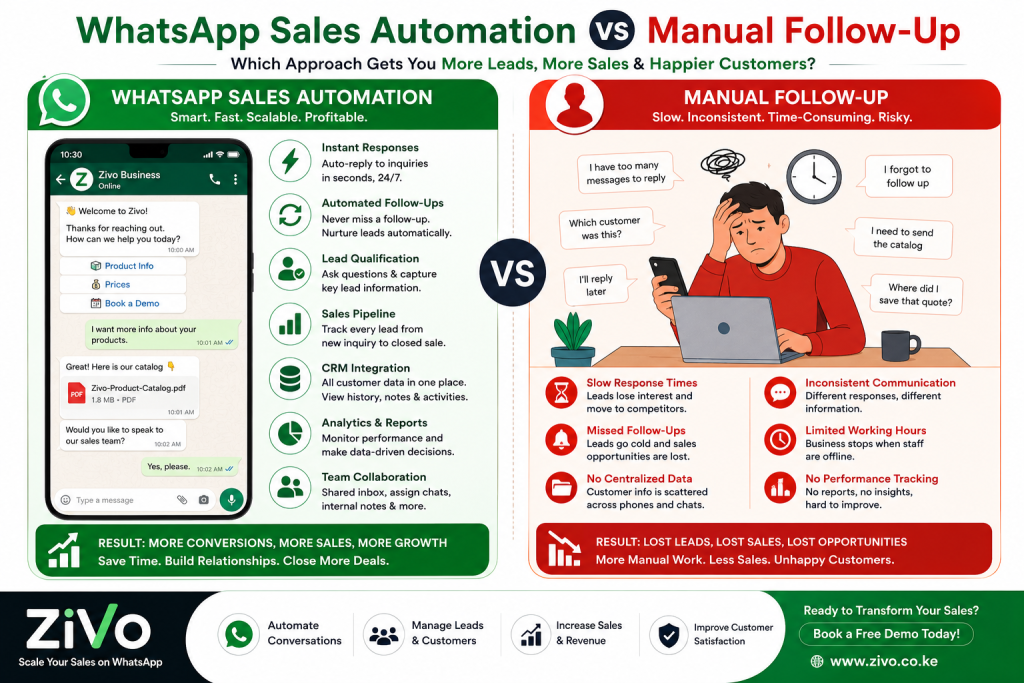
In today’s highly competitive business environment, responding to customer inquiries quickly can mean the difference between closing a sale and losing a potential customer. Whether you run a retail shop, real estate agency, SACCO, school, clinic, or e-commerce business, customers expect instant responses—especially on WhatsApp, the most popular messaging platform in Kenya.
Many businesses still rely on staff to manually follow up with leads, answer questions, send quotations, and remind customers to complete purchases. While this approach may work for a small number of inquiries, it quickly becomes inefficient as your customer base grows. This is where the debate around WhatsApp Sales Automation vs Manual Follow-Up becomes increasingly important.
Modern businesses are turning to WhatsApp sales automation platforms like Zivo to improve response times, automate repetitive tasks, and increase conversion rates. Instead of depending on employees to remember every follow-up, automation ensures that every lead receives timely communication without delays.
In this guide, we compare WhatsApp Sales Automation vs Manual Follow-Up, examining their features, advantages, disadvantages, costs, and overall impact on sales performance. By the end of this article, you’ll understand why automation is becoming the preferred choice for businesses seeking sustainable growth.
What Is WhatsApp Sales Automation?
WhatsApp sales automation refers to the use of software to automate customer interactions, lead nurturing, follow-ups, reminders, and sales processes on WhatsApp.
Rather than requiring staff to send every message manually, automation allows businesses to create workflows that communicate with customers based on predefined triggers.
Common automation features include:
- Automatic welcome messages
- Instant replies
- Lead qualification
- Follow-up sequences
- Quote delivery
- Appointment reminders
- Order confirmations
- Payment reminders
- Customer segmentation
- Sales pipeline tracking
- CRM integration
- Team inbox management
Unlike manual communication, automated workflows operate 24 hours a day without interruption.
When comparing WhatsApp Sales Automation vs Manual Follow-Up, automation offers consistency, speed, and scalability that manual processes cannot match.
What Is Manual Follow-Up?
Manual follow-up involves employees personally contacting leads and customers through WhatsApp.
Sales representatives typically:
- Reply to inquiries
- Send quotations
- Follow up after meetings
- Ask customers if they are ready to buy
- Share product information
- Send payment instructions
- Remind customers about appointments
Although this personal approach can build relationships, it also presents several challenges.
Staff members may:
- Forget to follow up
- Respond slowly
- Miss important messages
- Become overwhelmed during busy periods
- Deliver inconsistent customer experiences
This is why many organizations evaluate WhatsApp Sales Automation vs Manual Follow-Up before expanding their sales operations.
Why Businesses Still Use Manual Follow-Up
Despite technological advancements, many businesses continue using manual follow-up because:
Low Initial Investment
Using WhatsApp manually requires little more than a smartphone and an internet connection.
There is no need to purchase software immediately.
Personal Communication
Customers often appreciate speaking directly with a sales representative.
Personal conversations help build trust, especially for high-value purchases.
Flexibility
Sales staff can tailor responses to individual customers.
They can negotiate prices, answer complex questions, and adjust conversations based on customer needs.
Easy to Start
Small businesses can begin selling immediately without implementing new systems.
However, as inquiry volumes increase, manual communication becomes increasingly difficult to manage.
This is one reason WhatsApp Sales Automation vs Manual Follow-Up has become a common discussion among growing businesses.
Limitations of Manual Follow-Up
Although manual communication offers personalization, it also introduces several operational challenges.
Slow Response Times
Modern customers expect immediate replies.
If your sales team takes several hours—or even days—to respond, customers may choose competitors instead.
Automation provides instant responses regardless of business hours.
Missed Opportunities
Busy sales representatives sometimes forget to follow up.
Potential customers who initially showed interest may never receive another message.
This results in lost revenue.
Human Error
Manual communication often leads to:
- Forgotten appointments
- Incorrect information
- Missed quotations
- Duplicate responses
- Unanswered messages
Automation significantly reduces these risks.
Limited Working Hours
Employees work specific shifts.
Automation works:
- During weekends
- At night
- On holidays
- During peak sales periods
This continuous availability is a major advantage in WhatsApp Sales Automation vs Manual Follow-Up.
Advantages of WhatsApp Sales Automation
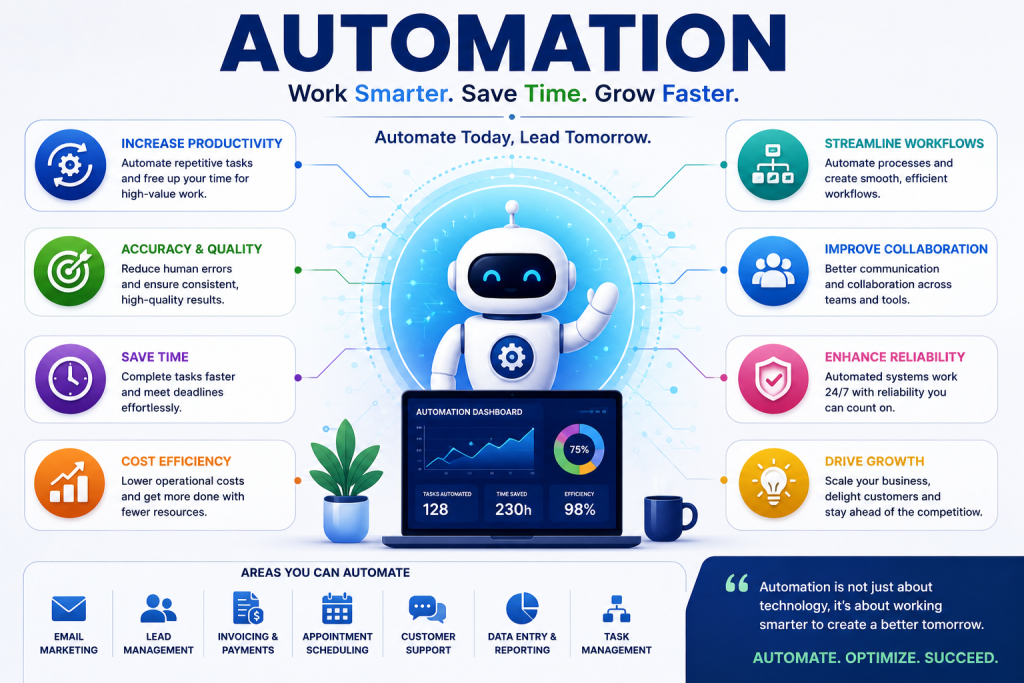
Automation transforms WhatsApp into a powerful sales platform.
Instant Customer Engagement
Customers receive immediate responses the moment they send a message.
This improves:
- Customer satisfaction
- Lead conversion
- Brand perception
Fast responses also increase the likelihood of closing sales.
Automated Follow-Up Sequences
Following up consistently is essential for converting leads.
Automation can send messages such as:
- Day 1: Thank you for your inquiry.
- Day 2: Here is our latest brochure.
- Day 4: Are you still interested?
- Day 7: Limited-time offer.
- Day 10: Final reminder.
No sales representative needs to remember these tasks manually.
Lead Qualification
Automation asks customers questions such as:
- Which product are you interested in?
- What is your budget?
- Which location are you in?
Qualified leads are automatically assigned to the appropriate sales representative.
Reduced Administrative Work
Instead of answering repetitive questions, sales teams focus on:
- Closing deals
- Building relationships
- Solving complex customer needs
This significantly improves productivity.
WhatsApp Sales Automation vs Manual Follow-Up: Feature Comparison
| Feature | WhatsApp Sales Automation | Manual Follow-Up |
|---|---|---|
| Instant Replies | ✅ | ❌ |
| 24/7 Availability | ✅ | ❌ |
| Automated Follow-Ups | ✅ | ❌ |
| Lead Qualification | ✅ | Manual |
| Team Collaboration | ✅ | Limited |
| CRM Integration | ✅ | ❌ |
| Sales Analytics | ✅ | Manual |
| Customer Segmentation | ✅ | Limited |
| Workflow Automation | ✅ | ❌ |
| Scalability | Excellent | Limited |
This comparison clearly shows why many businesses are moving toward automated customer engagement.
Improved Customer Experience
Customers value speed and convenience.
With WhatsApp sales automation, they receive:
- Immediate greetings
- Fast answers
- Consistent communication
- Timely reminders
- Professional interactions
Manual follow-up depends entirely on staff availability.
This creates inconsistent customer experiences.
As businesses compare WhatsApp Sales Automation vs Manual Follow-Up, customer satisfaction often becomes one of the deciding factors.
Time Savings for Sales Teams
Imagine your sales team receives:
- 100 inquiries per day
- 500 inquiries per week
- 2,000 inquiries every month
Responding manually to each message consumes valuable time.
Automation handles repetitive conversations while forwarding qualified prospects to sales representatives.
This enables teams to focus on revenue-generating activities rather than repetitive messaging.
Scalability
A startup handling ten inquiries daily may manage manual communication successfully.
However, what happens when inquiries increase to:
- 200 per day?
- 1,000 per week?
- Multiple branches?
- Nationwide customers?
Manual follow-up becomes increasingly difficult.
Automation scales effortlessly without requiring proportional increases in staff.
This scalability is one of the strongest reasons businesses choose WhatsApp Sales Automation vs Manual Follow-Up.
Why Kenyan Businesses Are Choosing Zivo
Businesses across Kenya are increasingly adopting Zivo because it combines WhatsApp communication, sales automation, CRM functionality, and customer engagement into one easy-to-use platform.
With Zivo, businesses can:
- Automate lead capture
- Send instant replies
- Manage conversations from one shared inbox
- Track sales pipelines
- Monitor team performance
- Follow up automatically
- Improve response times
- Increase sales conversions
Whether you operate in Nairobi, Mombasa, Kisumu, Eldoret, Nakuru, or anywhere else in Kenya, Zivo helps you sell smarter by replacing repetitive manual tasks with intelligent automation.
Part 2: Cost, ROI, Automation Workflows, Case Studies, and Business Benefits
Cost Comparison: WhatsApp Sales Automation vs Manual Follow-Up
Cost is one of the biggest considerations when businesses decide how to manage customer communication. At first glance, manual follow-up may appear to be the cheaper option because it requires only a smartphone and employees to respond to customers. However, the real cost extends far beyond salaries.
When evaluating WhatsApp Sales Automation vs Manual Follow-Up, businesses should consider hidden costs such as missed sales opportunities, slow response times, inconsistent communication, and reduced employee productivity.
The Hidden Costs of Manual Follow-Up
Many businesses underestimate how much manual communication costs over time.
Common hidden costs include:
- Employees spending hours replying to repetitive questions
- Missed leads due to delayed responses
- Forgotten follow-up messages
- Inconsistent customer experiences
- Lost sales because prospects lose interest
- Difficulty managing conversations across multiple team members
As the number of customer inquiries grows, these hidden costs continue to increase.
This is one of the reasons businesses begin comparing WhatsApp Sales Automation vs Manual Follow-Up more seriously.
The Return on Investment (ROI) of WhatsApp Sales Automation
Although WhatsApp automation software requires an investment, it often delivers a much higher return through improved efficiency and increased sales.
Benefits include:
- Faster response times
- Higher lead conversion rates
- Reduced administrative workload
- Increased customer satisfaction
- Better team productivity
- Improved sales tracking
Instead of hiring more employees to handle growing inquiry volumes, businesses can automate routine conversations and allow their sales teams to focus on closing deals.
When comparing WhatsApp Sales Automation vs Manual Follow-Up, automation typically offers a stronger long-term return on investment.
Sales Pipeline Management
Every business has customers at different stages of the buying journey.
Some are:
- New inquiries
- Qualified leads
- Waiting for quotations
- Ready to purchase
- Existing customers
- Returning customers
Without proper organization, it becomes difficult to know which customers require follow-up.
Manual Pipeline Management
Using manual follow-up often involves:
- Remembering conversations
- Searching through chat histories
- Updating spreadsheets
- Setting phone reminders
- Reviewing notebooks
This approach becomes inefficient as customer numbers increase.
Automated Pipeline Management
With platforms like Zivo, every customer automatically moves through the sales pipeline.
Examples include:
- New Lead
- Contacted
- Qualified
- Proposal Sent
- Negotiation
- Won
- Lost
Sales managers can instantly see where every customer is in the buying process.
This visibility is a significant advantage in WhatsApp Sales Automation vs Manual Follow-Up.
CRM Integration
Customer Relationship Management (CRM) helps businesses organize customer interactions and improve long-term relationships.
Manual follow-up often stores customer information across:
- Individual phones
- Excel spreadsheets
- Paper notebooks
- Email inboxes
This scattered information makes customer management difficult.
Zivo CRM Features
Zivo integrates WhatsApp conversations with customer records, allowing businesses to:
- Store customer profiles
- Record communication history
- Track sales progress
- Assign leads to team members
- Monitor customer activity
- Access conversations from one platform
This centralization improves both efficiency and customer service.
Team Collaboration
Many businesses have multiple employees handling sales inquiries.
Without automation, challenges include:
- Duplicate responses
- Missed messages
- Lack of accountability
- Confusion over customer ownership
Shared Team Inbox
Zivo enables teams to manage WhatsApp conversations collaboratively.
Benefits include:
- Assigning chats to team members
- Internal notes
- Conversation history
- Performance tracking
- Faster customer responses
When discussing WhatsApp Sales Automation vs Manual Follow-Up, team collaboration is another area where automation clearly outperforms manual methods.
Sales Analytics and Reporting
Successful businesses rely on data rather than assumptions.
Automation platforms provide valuable insights such as:
Lead Reports
Monitor:
- Number of new leads
- Source of inquiries
- Conversion rates
- Lead quality
Team Performance
Track:
- Response times
- Closed sales
- Customer satisfaction
- Agent productivity
Campaign Performance
Measure:
- Click-through rates
- Message delivery
- Customer engagement
- Sales generated
Manual follow-up rarely provides this level of reporting without significant effort.
Customer Segmentation
Every customer has different needs.
Automation allows businesses to organize customers into groups such as:
- New prospects
- Existing customers
- VIP clients
- Wholesale buyers
- Retail customers
- Customers who abandoned purchases
This segmentation enables highly personalized communication.
Manual follow-up makes customer segmentation much more difficult.
This is another key point in WhatsApp Sales Automation vs Manual Follow-Up.
Business Continuity
One overlooked advantage of automation is business continuity.
Imagine a salesperson:
- Takes leave
- Resigns
- Changes departments
- Becomes unavailable
If conversations exist only on that employee’s phone, valuable customer information may be lost.
Automation platforms store all conversations securely in one centralized system.
New employees can continue conversations without disruption.
Case Study: Online Electronics Store
A Kenyan electronics retailer received hundreds of WhatsApp inquiries every day.
Initially, all responses were handled manually.
Challenges included:
- Slow replies
- Missed follow-ups
- Lost quotations
- Low conversion rates
After implementing Zivo’s WhatsApp automation:
- Average response time dropped from 45 minutes to less than one minute.
- Lead conversion increased by 32%.
- Customer satisfaction improved significantly.
- Sales representatives spent more time closing deals instead of answering repetitive questions.
The company concluded that WhatsApp Sales Automation vs Manual Follow-Up strongly favored automation for high-volume businesses.
Case Study: Real Estate Agency
A growing real estate company used WhatsApp to communicate with property buyers.
Agents struggled to remember every follow-up after property viewings.
The agency adopted Zivo to automate:
- Welcome messages
- Property brochures
- Appointment confirmations
- Viewing reminders
- Follow-up campaigns
Within four months:
- Appointment attendance increased.
- More leads converted into buyers.
- Staff productivity improved.
- Customer communication became more consistent.
Management viewed WhatsApp Sales Automation vs Manual Follow-Up as a strategic decision that directly contributed to business growth.
Customer Testimonial
“Before implementing Zivo, our sales team spent most of the day responding to the same questions. Now customers receive instant replies, and our team focuses on closing sales. We’ve seen a noticeable increase in conversions.”
— Sales Manager, Nairobi
Another Success Story
“WhatsApp has become our primary sales channel. Zivo automated our follow-ups, reminders, and lead management, allowing us to serve more customers without hiring additional staff. The improvement in efficiency has been remarkable.”
— Retail Business Owner, Mombasa
Why Automation Is the Future of Sales
Customer expectations continue to evolve.
Today’s buyers expect:
- Immediate responses
- Personalized communication
- Fast service
- Convenient purchasing experiences
Businesses relying entirely on manual communication risk falling behind competitors that embrace automation.
When comparing WhatsApp Sales Automation vs Manual Follow-Up, automation provides a competitive advantage by delivering faster, more consistent, and more scalable customer engagement.
Here’s Part 3, completing the blog post with a service description for Zivo, FAQs, conclusion, CTA, SEO title, and meta description.
Why Choose Zivo for WhatsApp Sales Automation?
If your business depends on WhatsApp to generate leads and close sales, you need more than a messaging app—you need a complete sales automation platform. Zivo is designed to help Kenyan businesses automate customer communication, manage leads efficiently, and convert more prospects into paying customers.
Ultimately, WhatsApp Sales Automation vs Manual Follow-Up shows that automation is the future of customer engagement. Companies that embrace automation improve productivity, increase sales conversions, strengthen customer relationships, and create more efficient operations. If your goal is to grow your business while providing outstanding customer service, WhatsApp Sales Automation vs Manual Follow-Up clearly favors automation. Start your journey with Zivo today and experience firsthand why WhatsApp Sales Automation vs Manual Follow-Up is transforming how successful businesses communicate, sell, and grow.
Whether you’re a small business or a large enterprise, Zivo provides the tools needed to streamline your sales process and improve customer engagement.
Zivo Features
Shared Team Inbox
Allow multiple sales representatives to manage WhatsApp conversations from one centralized dashboard.
Benefits include:
- Assign conversations
- Avoid duplicate replies
- Track conversation history
- Improve collaboration
- Increase accountability
Automated Follow-Up Campaigns
Never lose a lead because someone forgot to follow up.
With Zivo you can automatically send:
- Welcome messages
- Product catalogues
- Price lists
- Quotations
- Appointment reminders
- Payment reminders
- Promotional offers
- Re-engagement campaigns
Automation keeps your sales pipeline active around the clock.
CRM Integration
Every customer interaction is stored in one place.
Sales teams can easily view:
- Customer profiles
- Purchase history
- Previous conversations
- Notes
- Sales stage
- Assigned representative
This eliminates the need to search through multiple WhatsApp chats.
Sales Pipeline Management
Track every opportunity from the first inquiry to the final sale.
Common pipeline stages include:
- New Lead
- Contacted
- Qualified
- Proposal Sent
- Negotiation
- Closed Won
- Closed Lost
Managers gain complete visibility into team performance and sales progress.
Reporting and Analytics
Make informed decisions with real-time reports such as:
- Number of new leads
- Conversion rates
- Response times
- Sales performance
- Agent productivity
- Customer engagement
Instead of guessing what works, Zivo provides measurable insights.
Industries That Benefit from Zivo
Zivo supports businesses across many industries, including:
- Real estate agencies
- Retail stores
- E-commerce businesses
- Schools and colleges
- Healthcare providers
- SACCOs
- Insurance companies
- Financial institutions
- Tour and travel companies
- Hotels and restaurants
- Car dealerships
- Professional service firms
If your customers communicate through WhatsApp, Zivo can help automate and optimize your sales process.
How to Implement WhatsApp Sales Automation
Transitioning from manual communication to automation is easier than many businesses expect.
Step 1: Define Your Sales Process
Identify:
- Common customer questions
- Frequently requested products
- Typical follow-up schedule
- Sales stages
Step 2: Build Automated Workflows
Create automation for:
- New inquiries
- Follow-up reminders
- Appointment confirmations
- Payment reminders
- Customer feedback
Step 3: Train Your Sales Team
Ensure staff understand:
- Using the shared inbox
- Managing assigned conversations
- Updating the sales pipeline
- Monitoring reports
Step 4: Monitor Performance
Track improvements in:
- Response times
- Lead conversion
- Customer satisfaction
- Sales revenue
- Team productivity
Continuous optimization leads to even better results.
Frequently Asked Questions
Is WhatsApp sales automation suitable for small businesses?
Yes. Small businesses benefit from faster responses, improved customer service, and better lead management without hiring additional staff.
Can automation replace sales representatives?
No.
Automation handles repetitive communication while sales representatives focus on building relationships, negotiating, and closing deals.
Is customer information secure?
Yes.
Professional platforms like Zivo use secure cloud infrastructure, user permissions, and encrypted data storage to protect customer information.
Can Zivo integrate with existing systems?
Yes.
Zivo can integrate with CRM systems, websites, forms, and other business applications to create a seamless sales workflow.
Does automation reduce customer satisfaction?
Quite the opposite.
Customers appreciate receiving immediate responses, timely follow-ups, and consistent communication, while complex questions can still be escalated to a human sales representative.
Conclusion
The choice between WhatsApp Sales Automation vs Manual Follow-Up has become increasingly important as customer expectations continue to evolve. While manual communication may still work for businesses handling only a few inquiries each day, it quickly becomes inefficient as sales volumes grow.
Comparing WhatsApp Sales Automation vs Manual Follow-Up shows that automation delivers faster response times, consistent customer engagement, improved lead management, and higher productivity. Businesses no longer need to worry about forgotten follow-ups, delayed replies, or missed sales opportunities.
Another major advantage of WhatsApp Sales Automation vs Manual Follow-Up is scalability. As your business grows, automation allows you to manage thousands of conversations without dramatically increasing staffing costs. This makes it easier to maintain excellent customer service while expanding your operations.
Security and reporting are additional areas where WhatsApp Sales Automation vs Manual Follow-Up strongly favors automation. With centralized customer records, detailed analytics, and secure cloud storage, businesses gain greater visibility and control over their sales activities.
Ultimately, WhatsApp Sales Automation vs Manual Follow-Up is about choosing the solution that supports long-term growth. Businesses that invest in automation position themselves to respond faster, convert more leads, improve customer satisfaction, and operate more efficiently.
If your goal is to grow sales, reduce manual work, and deliver exceptional customer experiences, WhatsApp Sales Automation vs Manual Follow-Up clearly points toward automation as the smarter investment. With Zivo, you can transform WhatsApp into a powerful sales engine that works around the clock, helping your business generate more leads, close more deals, and build lasting customer relationships.
Choosing between WhatsApp Sales Automation vs Manual Follow-Up is a critical decision for businesses that want to improve customer engagement and increase sales. While manual follow-up may be suitable for businesses with a small number of daily inquiries, it becomes increasingly difficult to manage as customer demand grows. When comparing WhatsApp Sales Automation vs Manual Follow-Up, automation consistently delivers greater efficiency, faster response times, and better customer experiences.
One of the biggest advantages of WhatsApp Sales Automation vs Manual Follow-Up is the ability to engage customers instantly. Automated workflows ensure that every lead receives timely responses, follow-up messages, and important updates without relying on sales representatives to remember every interaction. This makes WhatsApp Sales Automation vs Manual Follow-Up an important consideration for businesses looking to reduce missed opportunities and increase conversions.
Another key difference in WhatsApp Sales Automation vs Manual Follow-Up is scalability. As your business expands, automation allows you to manage thousands of conversations while maintaining consistent communication and high service standards. Unlike manual processes, WhatsApp Sales Automation vs Manual Follow-Up demonstrates how automation supports growth without requiring a proportional increase in staffing costs.
From improved reporting and customer relationship management to better collaboration and data security, WhatsApp Sales Automation vs Manual Follow-Up clearly highlights the advantages of modern sales technology. Businesses gain valuable insights into customer behavior, monitor team performance, and make informed decisions using real-time analytics. These capabilities make WhatsApp Sales Automation vs Manual Follow-Up a smart investment for companies focused on sustainable growth.
For Kenyan businesses seeking to stay competitive, WhatsApp Sales Automation vs Manual Follow-Up is no longer simply a technology choice—it is a business growth strategy. Platforms like Zivo help organizations automate repetitive tasks, nurture leads more effectively, and deliver exceptional customer experiences around the clock. By adopting Zivo, businesses can fully realize the benefits that WhatsApp Sales Automation vs Manual Follow-Up offers in today’s digital marketplace.
Why Businesses Trust Zivo
Businesses across Kenya choose Zivo because it helps them:
- Automate sales conversations
- Capture and qualify leads
- Manage customer relationships
- Reduce response times
- Increase conversions
- Improve team collaboration
- Monitor sales performance
- Deliver exceptional customer experiences
Instead of relying on manual processes, Zivo enables businesses to scale their sales operations confidently and efficiently.
Call to Action
Stop losing sales because of delayed responses or forgotten follow-ups.
Empower your business with Zivo’s WhatsApp Sales Automation platform and transform the way you engage with customers. From instant replies and automated follow-ups to CRM integration and detailed analytics, Zivo provides everything you need to grow your business through WhatsApp.
Book a free demo today and discover how Zivo can help your business convert more leads, improve customer satisfaction, and increase revenue.