
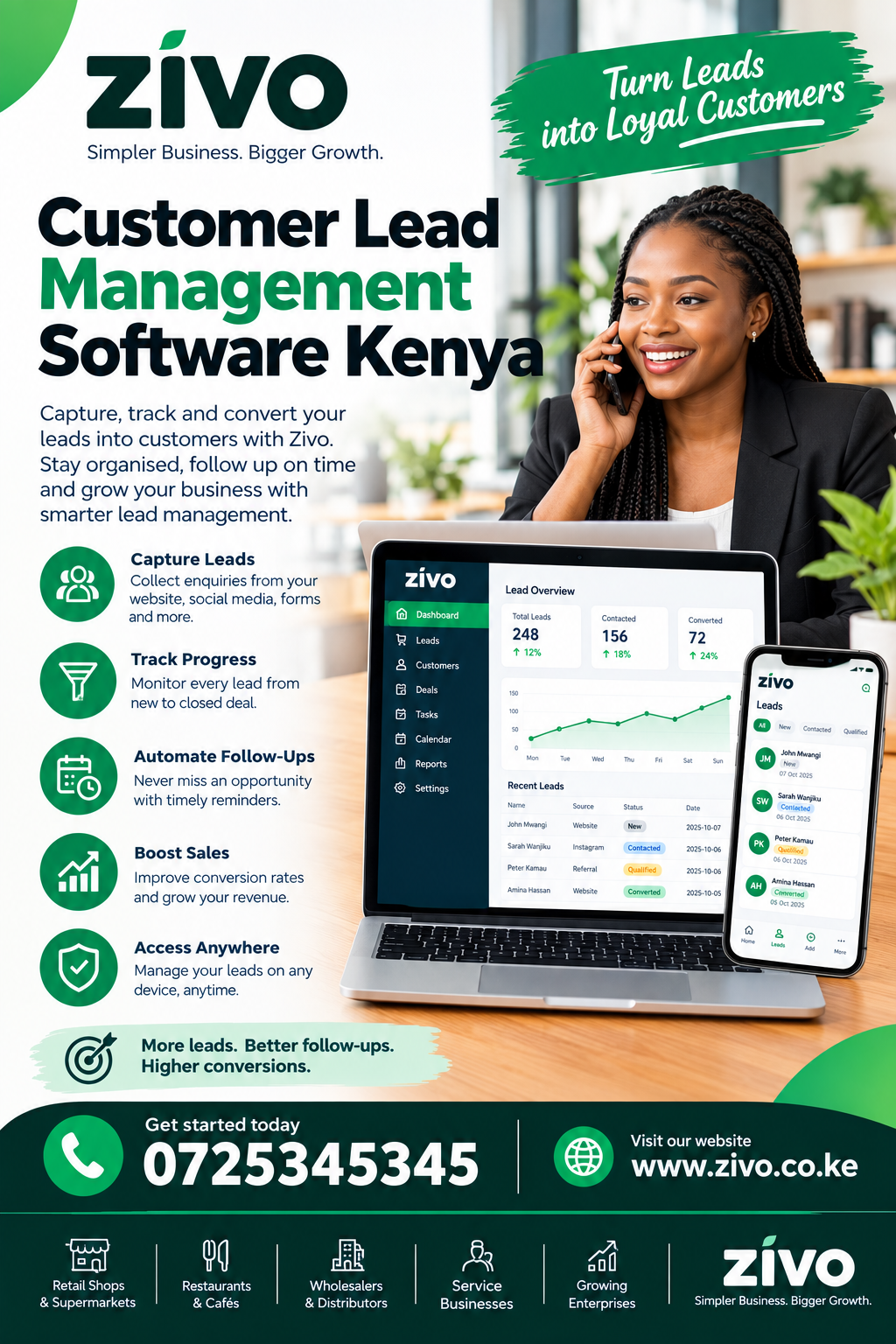
How Kenyan Businesses Can Capture, Organise and Convert More Leads
Winning a customer often starts long before a sale is made. A person may ask for a price on WhatsApp, call a business, walk into a shop, respond to a social media post, or leave an enquiry on a website. If that enquiry is not recorded and followed up, the business can lose a sale without knowing exactly where things went wrong. For Kenyan SMEs, retailers, restaurants, service businesses and growing companies, Customer Lead Management Software Kenya can provide a structured way to capture enquiries, organise prospects and make follow-up part of the daily sales process. This guide explains what lead management means, which features matter, how it can support sales teams, and what to consider before choosing a system.
What is lead management?
A lead is a person or organisation that has shown some level of interest in a product or service but has not necessarily become a paying customer. The interest might be as simple as requesting a quotation or as strong as asking when a product can be delivered. Lead management is the process of collecting those enquiries, recording useful information, assigning responsibility, following up and moving each prospect toward a clear outcome.
For a small Kenyan business, this can be done with a notebook, spreadsheet, phone contacts or a dedicated platform. The difference is consistency. A structured system makes it easier to know who contacted the business, what they wanted, when they should be contacted again and whether the opportunity was won or lost. That is where Customer Lead Management Software Kenya becomes useful.
A good lead process should answer five basic questions: Where did the lead come from? What does the customer need? Who is handling the lead? What is the next action? What happened in the end? When those answers are available in one place, sales conversations become easier to manage and managers have a clearer view of the pipeline.
Lead versus customer
A lead is not the same as a customer. A lead may still be comparing suppliers, asking questions or waiting for a quotation. A customer has already made a purchase or entered into an active business relationship. Treating every contact as a customer can make reporting confusing, while treating every enquiry casually can cause valuable opportunities to disappear.
The practical goal is to create a clear journey from enquiry to qualified opportunity, sale and repeat business.
Why Kenyan businesses lose leads
Many lost leads are not lost because the product is poor. They disappear because the follow-up process is weak. An employee may receive an enquiry on a personal phone, forget to record it, promise to call later and then become busy with another task. A second lead may arrive through Facebook while a third comes through a website form. Without a central process, nobody has the full picture.
Customer Lead Management Software Kenya can help bring those conversations into a more organised sales workflow, but the software is only valuable when the business also defines a sensible process. Staff need to know what counts as a new lead, how quickly to respond, what information to collect and when an opportunity should be marked as won, lost or pending.
Common causes of lead leakage include:
- Enquiries being stored only in personal phones.
- No clear owner for a new prospect.
- Quotations sent without a follow-up date.
- Duplicate customer records.
- No history of previous conversations.
- Leads being forgotten after a busy day.
- Managers having no simple pipeline view.
- Marketing channels being measured separately from sales results.
A system does not magically fix these problems. It makes them visible and gives the team a repeatable place to manage them.
The value of a central lead database
Imagine a Nairobi service business receives 30 enquiries in a week. Some arrive by phone, others through WhatsApp, referrals and social media. If the information is spread across four employees’ phones, the owner may not know which enquiries are active. A central lead database gives the business a shared record.
Customer Lead Management Software Kenya can support this central approach by keeping prospect details, notes, status, source and follow-up information together. The objective is not to collect every possible detail. It is to capture the information that helps the team sell and serve the customer better.
Useful fields may include:
| Lead information | Why it matters |
|---|---|
| Name | Identifies the prospect |
| Phone or email | Enables follow-up |
| Lead source | Shows where enquiries originate |
| Product or service interest | Helps staff prepare |
| Lead status | Shows the current stage |
| Assigned staff member | Creates ownership |
| Next follow-up date | Prevents missed actions |
| Notes | Preserves conversation context |
| Estimated value | Helps prioritise opportunities |
The database becomes more useful when information is kept current. A lead that was contacted yesterday should not still appear as a brand-new enquiry.
Capturing leads from different channels
Customers do not all use the same route to contact a business. One person may call after seeing a Google result. Another may message on WhatsApp. Someone else may respond to an Instagram promotion. A company buyer might send an email requesting a quotation.
Customer Lead Management Software Kenya is most useful when it helps the business create a consistent process regardless of where the enquiry began. Even when every channel cannot be technically integrated, staff can still record the source and move the lead into a common pipeline.
Lead sources worth tracking include:
- Website forms
- WhatsApp enquiries
- Phone calls
- Walk-in customers
- Social media
- Referrals
- Events and exhibitions
- Paid advertising
- Existing customer referrals
Tracking source matters because not every marketing activity produces the same quality of leads. A business might discover that referrals generate fewer enquiries than social media but convert at a much higher rate. That insight can influence future marketing decisions.
Lead qualification: knowing which prospects need attention first
Not every enquiry deserves the same amount of immediate attention. Some prospects are only gathering information, while others are ready to buy. Lead qualification helps a team decide where to focus.
Customer Lead Management Software Kenya can be used alongside a simple qualification method. For example, a business could consider the customer’s need, urgency, budget, decision-making position and fit with the product. The goal is not to make the process unnecessarily complicated. It is to distinguish a serious opportunity from a general enquiry.
A useful qualification approach might classify leads as:
- New — the enquiry has just been received.
- Contacted — the team has responded.
- Qualified — the prospect appears to fit the offer.
- Quotation sent — pricing or a proposal has been provided.
- Follow-up — the business is waiting for a decision.
- Won — the customer purchased.
- Lost — the opportunity did not proceed.
- Nurture — the customer may buy later.
The exact stages should match the business. A restaurant, software company, wholesaler and salon may all need different pipelines.
Follow-up is where many sales are won
Getting a lead is only the beginning. The next question is what happens after the first conversation. A customer who requests a quotation may need clarification. Someone who asks about delivery may need stock confirmation. A business buyer may need several days to obtain approval.
Customer Lead Management Software Kenya can help make follow-up visible rather than relying entirely on memory. A salesperson can record the last interaction and the next action, while a manager can see which leads have been sitting without activity.
Good follow-up does not mean sending the same message repeatedly. It means continuing the conversation with a useful reason to contact the prospect. Examples include confirming a quotation, answering a product question, sharing availability, clarifying terms or checking whether the customer still needs the service.
A practical follow-up record should answer:
- When was the prospect last contacted?
- What did they say?
- What was promised?
- When should the next contact happen?
- Who is responsible?
- Is the opportunity still active?
This small discipline can prevent a surprisingly large number of leads from going cold.
Managing sales pipelines
A sales pipeline gives the business a visual or structured view of opportunities at different stages. Instead of seeing a long list of names, the team can understand how many prospects are new, qualified, awaiting a quotation or close to buying.
Customer Lead Management Software Kenya can support pipeline management when its statuses are designed around the actual sales journey. The pipeline should be simple enough for staff to update every day. Too many stages can create administrative work without improving decision-making.
For example, a B2B supplier might use:
New enquiry → Qualified → Meeting → Quotation → Negotiation → Won/Lost
A retail-oriented business may need something shorter:
New lead → Product interest → Follow-up → Purchased
Managers can use the pipeline to identify bottlenecks. If many opportunities remain at “quotation sent” for weeks, the issue may not be lead generation. It may be pricing, response time, unclear proposals or weak follow-up.
M-Pesa and payment-related workflows
Kenyan businesses frequently use M-Pesa as part of everyday transactions. Lead management and payment management are not the same thing, but the two processes can connect at the point where a prospect becomes a paying customer.
Customer Lead Management Software Kenya can support the customer journey by helping the team maintain the sales record while payment activity is handled through the appropriate financial or POS workflow. The important principle is to avoid treating payment as proof that the entire sales process is understood.
For example, a business might record that a customer accepted a quotation, then separately confirm whether the required payment was received. Once the transaction is completed, the lead can be marked as won and the customer moved into the normal customer service process.
Where integrations are available, businesses should verify exactly what the system supports before relying on automated payment updates. Payment confirmation, refunds, partial payments and reconciliation can have accounting implications and should be handled carefully.
Measuring lead conversion
A business cannot improve what it never measures. Lead conversion is one of the most useful measures because it connects enquiries with outcomes.
Customer Lead Management Software Kenya can make it easier to calculate or review basic indicators such as the number of new leads, qualified leads, quotations, won opportunities and lost opportunities. These figures can then be compared by period, salesperson, product or source where the system supports those reports.
For instance, suppose a company receives 100 enquiries in a month. If 30 become qualified opportunities and 10 become customers, the business can investigate the stages between those numbers. Perhaps the initial enquiries are weak, or perhaps the follow-up process is slow.
Useful metrics include:
- New leads per week or month
- Qualified lead rate
- Lead-to-sale conversion
- Average response time
- Opportunities by source
- Sales value by source
- Lost lead reasons
- Follow-up completion rate
- Pipeline value
The point of reporting is not to create impressive dashboards. It is to help managers make better decisions.
Why lead source tracking matters
Marketing can become expensive when a business cannot tell which activities generate useful customers. Counting enquiries alone may give a misleading picture.
Customer Lead Management Software Kenya allows businesses to think about lead sources more carefully. A Facebook campaign might bring many enquiries, while referrals might bring fewer but higher-value customers. A website may produce steady enquiries that take longer to close. A sales representative may generate fewer leads but convert a large percentage.
Recording the source for every lead creates a basic connection between marketing and sales.
A simple monthly review could ask:
- Which source generated the most leads?
- Which source produced the most qualified leads?
- Which source generated the most sales?
- Which source produced the highest-value customers?
- Where are leads dropping out?
- Which channels deserve more attention?
These questions are more useful than simply asking how many people clicked an advert.
Lead management for SMEs in Kenya
Small and medium-sized businesses often operate with limited staff. The owner may handle sales, procurement, customer service and finance in the same week. A complicated CRM can therefore become a burden if it requires too much data entry.
Customer Lead Management Software Kenya should be judged by how well it fits the daily workflow. A small business may need only a few fields, clear statuses, reminders, notes and simple reports. A larger organisation may need permissions, multiple sales teams, advanced reporting and integrations.
Before adopting a system, ask whether staff can realistically keep it updated. A simple system that people use every day is more valuable than an advanced system that nobody maintains.
Kenyan businesses should also consider the practical environment in which staff work. Mobile access, internet reliability, communication channels, local payment habits and the need for quick customer responses can all influence what features are genuinely useful.
Lead management for restaurants and hospitality
Restaurants may generate leads in ways that are different from traditional sales businesses. A customer could enquire about a birthday event, office catering, a wedding function, a group booking or a recurring corporate meal order.
Customer Lead Management Software Kenya can help the restaurant treat these enquiries as opportunities rather than ordinary messages. Staff can record the event date, number of guests, requested package, budget range, follow-up date and outcome, subject to the restaurant’s chosen workflow.
The process could look like this:
Enquiry → Event details → Quote/package → Follow-up → Deposit/payment → Confirmed booking
A restaurant can then review which types of enquiries become bookings. It may discover that corporate catering produces stronger repeat business than one-off events, for example. That insight can guide promotions and sales effort.
The same principle applies to hotels, caterers and other hospitality businesses that handle enquiries before a transaction is completed.
Lead management for service businesses
Service businesses face a different challenge: the customer may not know exactly what they need. A lead may begin with a request for a consultation, inspection, quotation or explanation.
Customer Lead Management Software Kenya helps the team preserve the details gathered during that first conversation. This matters when the eventual service depends on information that was discussed earlier.
A Kenyan service business could use lead stages such as:
- Enquiry received
- Needs assessment
- Site visit or consultation
- Proposal prepared
- Follow-up
- Negotiation
- Approved
- Service scheduled
- Won or lost
The system does not need to make every business follow the same model. The best pipeline reflects the actual steps a customer passes through.
Service businesses should also record reasons for lost opportunities. “Price too high,” “customer postponed,” “competitor selected,” and “not a suitable service” are more useful than simply marking an opportunity as lost.
Choosing the right features
When comparing systems, focus on features that solve real problems. A long feature list can look impressive, but it does not necessarily mean the software is suitable for a particular business.
Customer Lead Management Software Kenya should ideally support the basic tasks a sales team performs repeatedly. Depending on the business, useful features may include:
- Lead capture
- Contact management
- Lead source tracking
- Custom statuses
- Staff assignment
- Follow-up reminders
- Notes and activity history
- Search and filtering
- Sales pipeline
- Quotation tracking
- Reports
- Customer conversion
- User permissions
- Mobile-friendly access
- Integrations with other business systems
Ask how each feature will be used. If a business cannot explain why it needs a feature, it may not be a priority.
Ease of use matters
The best lead management process is one employees actually follow. If recording a lead takes too many steps, staff may return to notebooks and personal messages.
A useful test is to give a staff member a new enquiry and observe how long it takes to create the record, assign it and schedule the next action. This practical test can reveal more than a software brochure.
Data quality and duplicate records
Lead management depends on accurate information. Duplicate records can cause confusion, especially when two employees contact the same person without realising it.
Customer Lead Management Software Kenya can be more effective when businesses establish basic data rules. For example, staff can search for an existing phone number before creating a new contact, use consistent names, and update statuses after every meaningful interaction.
A data-quality checklist can include:
- Check for existing customer records.
- Use consistent phone-number formats.
- Record the correct lead source.
- Keep notes clear and factual.
- Close or update stale leads.
- Avoid duplicate contacts.
- Use agreed pipeline stages.
Clean data improves reporting as well. If the same customer appears three times, conversion figures and customer counts can become unreliable.
Protecting customer information
Lead records may contain names, phone numbers, email addresses, business information and conversation notes. Businesses should treat this information responsibly and apply appropriate security controls.
Customer Lead Management Software Kenya should therefore be evaluated not only for sales features but also for access controls, authentication, backups, permissions and data-handling practices. The specific safeguards available will depend on the platform.
Staff should receive simple guidance on who can access customer records, what information should be entered, and how accounts should be protected. Shared passwords should be avoided where individual user accounts are available.
For Kenyan businesses, privacy and data protection obligations should also be considered. When a business collects personal information, it should understand its responsibilities and avoid collecting information simply because the software provides a field for it.
Automation without losing the human touch
Automation can reduce repetitive work, but customer relationships still require human judgement. A reminder can tell a salesperson to follow up; it cannot replace a useful conversation.
Customer Lead Management Software Kenya can be used as part of a balanced workflow. Routine tasks such as reminders, status changes or notifications may be automated where the platform supports them, while staff continue to handle questions, objections and negotiations.
Good automation should make service feel faster, not more robotic. A customer who has asked for a specific quotation should not receive a generic message that ignores the original request.
Start with simple automation:
- Create a follow-up reminder after a quotation.
- Notify a manager when a high-value lead is assigned.
- Flag leads with no recent activity.
- Move completed opportunities into customer records.
- Generate routine pipeline reports.
Once those workflows are reliable, a business can consider more advanced automation.
Common mistakes when implementing lead software
Buying software is not the same as implementing a lead management process. Businesses can spend money on a system and still lose opportunities if the team does not use it consistently.
Customer Lead Management Software Kenya can support the process, but avoid these common mistakes:
1. Recording too much information.
If staff must complete dozens of fields for every enquiry, adoption may fall.
2. Creating unclear statuses.
Employees need to understand exactly what “qualified,” “pending” or “active” means.
3. Ignoring old leads.
A database filled with untouched enquiries becomes less useful over time.
4. Failing to assign ownership.
Every active opportunity should have someone responsible.
5. Measuring activity instead of outcomes.
A large number of calls does not automatically mean strong sales.
6. Forgetting lost-lead reasons.
Without this information, management cannot identify recurring problems.
7. Choosing software before defining the process.
The business should first understand how it sells, then select tools that support that workflow.
How to introduce a lead management system step by step
A small business does not need to transform everything on the first day. A staged approach can make adoption easier.
Customer Lead Management Software Kenya Start by documenting the current process. Write down where leads arrive, who receives them, how quotations are handled and how follow-ups happen. Then identify the biggest gap. It might be missed follow-ups, poor visibility or duplicate records.
Next, create a simple pipeline. Keep the number of stages manageable and define what each stage means.
Then decide which fields are essential. At minimum, most businesses need contact details, source, interest, owner, status and next action.
After that, train staff using real examples. Show them how to record a new lead, update it after a call and close it when the opportunity is won or lost.
Finally, review the process after a few weeks. Ask staff where they struggle and remove unnecessary steps. The system should become easier to use as the business learns what information actually matters.
What should a business expect from its investment?
The value of lead management software should not be judged only by the number of features on a pricing page. The more useful question is what business problem the system solves.
Customer Lead Management Software Kenya may justify its cost if it helps the team respond faster, reduces forgotten enquiries, improves follow-up consistency, gives managers visibility and makes sales reporting more reliable. The actual return will depend on the business, its sales volume, adoption and the quality of its process.
Before buying, estimate the cost of lost opportunities. If a business receives many enquiries each month and regularly forgets to follow up, even a small improvement in conversion may matter.
Businesses should compare:
| Consideration | Question to ask |
|---|---|
| Cost | Is the pricing sustainable as the team grows? |
| Users | How many staff need access? |
| Features | Which features solve current problems? |
| Adoption | Can staff learn it quickly? |
| Support | Where will users get help? |
| Integrations | Does it fit existing workflows? |
| Reporting | Can management see useful sales information? |
| Security | Are customer records appropriately protected? |
| Scalability | Can the system support future growth? |
Avoid choosing software simply because it has the largest feature list.
How Zivo can fit into a broader business workflow
For businesses that use a wider business management platform, lead management becomes more valuable when it connects with other activities. A sales enquiry can eventually become a customer, order, invoice or payment.
Customer Lead Management Software Kenya is relevant to this broader view because businesses often need more than a contact list. They need a practical path from the first enquiry to the completed transaction.
For a business using POS or retail operations, that may mean connecting customer information with sales activity. For a restaurant, it may mean handling catering or event enquiries alongside normal restaurant operations. For a growing SME, it may mean having customer, sales and operational information available without moving between unrelated spreadsheets.
The exact integrations and workflows available should always be checked against the current product capabilities. Businesses should not assume that two systems will exchange information automatically just because they both offer customer management features.
Improving response time
A fast response does not always win a customer, but a delayed response can make a business easier to ignore. This is especially important when customers are comparing several suppliers.
Customer Lead Management Software Kenya helps make response time something a business can manage rather than guess about. If leads have timestamps and activity history, managers can identify where delays happen.
A useful internal target can be defined according to the business. A restaurant catering enquiry may need quick acknowledgement, while a complex B2B proposal may require more preparation. The goal is to establish a realistic standard and measure whether the team meets it.
Businesses can improve response time by:
- Checking new leads at defined intervals.
- Assigning new enquiries immediately.
- Using templates for common questions.
- Escalating urgent enquiries.
- Preparing standard product information.
- Recording the next action before closing the current task.
Speed should be combined with accuracy. A rushed answer that fails to address the customer’s question can create another round of messages.
A practical example for a Kenyan SME
Consider a Nairobi-based business selling equipment to other businesses. A prospect sends a WhatsApp enquiry asking for prices for several items.
Customer Lead Management Software Kenya can be used to record the prospect, the requested products, the source of the enquiry and the person responsible. The salesperson confirms stock and prepares a quotation. The lead status changes to “quotation sent,” and a follow-up date is recorded.
Two days later, the salesperson contacts the prospect. The customer says the price is acceptable but wants a different delivery arrangement. That information is added to the record. The salesperson sends an updated quotation and schedules another follow-up.
The customer accepts. The opportunity is marked as won, and the relevant customer and sales records are updated.
Now imagine the owner reviewing the month. Instead of searching through WhatsApp messages, the owner can review how many opportunities were received, which ones converted and where opportunities were lost, provided the chosen system supports those reports.
The example is deliberately simple. The value comes from consistent execution.
Frequently asked questions
What does customer lead management software do?
Customer Lead Management Software Kenya helps businesses organise prospective customers from the first enquiry through follow-up and, where applicable, conversion into a sale. Typical functions include lead capture, contact details, lead status, assignment, notes, reminders, pipeline tracking and reporting.
Is lead management useful for a small business?
Yes. A small business may have fewer leads, but losing even a few good opportunities can matter. A simple system can help the owner or sales team remember enquiries, assign responsibility and follow up consistently.
Can a restaurant use lead management?
Yes. Restaurants can use it for catering enquiries, event bookings, corporate orders, large group requests and other opportunities that require communication before the customer pays.
Does lead management replace a POS system?
No. Lead management and POS serve different purposes. A POS system is generally focused on transactions and operational sales, while lead management focuses on prospects and the journey toward a sale. They can complement each other.
Can lead management work with M-Pesa?
It depends on the software and integrations available. Lead management can record the sales journey, while payment processing and confirmation may be handled by a connected payment, POS or financial system. Businesses should verify the exact integration before relying on it.
How many lead stages should a business have?
There is no universal number. Use enough stages to reflect meaningful differences in the sales journey, but avoid creating a stage for every minor action. Employees should understand what each stage means.
What information should be collected about a lead?
Start with information that supports the sale: name, contact details, source, product or service interest, status, assigned staff member, notes and next action. Collect additional personal information only when there is a genuine business reason and appropriate handling.
How often should lead records be updated?
They should be updated whenever there is a meaningful change, such as a new conversation, quotation, customer decision or next step. Waiting until the end of the month can make the information unreliable.
Final thoughts
A lead is an opportunity, not a guaranteed sale. The businesses that handle enquiries well are more likely to know what customers need, respond consistently and learn from both successful and unsuccessful conversations. That requires a process that people can follow every day.
Customer Lead Management Software Kenya can be part of that process by giving Kenyan businesses a central place to capture prospects, assign responsibility, record conversations, manage follow-ups and review sales activity. The most important step, however, is not buying software. It is deciding how the business wants leads to move from first contact to a clear outcome.
Start with the basics. Record every meaningful enquiry. Give every active lead an owner. Set the next action. Keep customer information accurate. Review stalled opportunities. Learn why customers do not buy. Then use reporting to improve the process.
For a growing SME, restaurant, retailer or service provider, these habits can create a more dependable sales operation without making the workflow unnecessarily complicated. The right technology should support that discipline, not replace it.
When comparing solutions, test the system with real Kenyan business scenarios and choose features that solve actual problems. If a platform makes it easier for your team to respond, follow up, convert and retain customers, it is doing the job that lead management software is supposed to do.
A practical next step
Before selecting a system, list the last 20 enquiries your business received. Identify where each one came from, whether anyone followed up, what happened, and what information was missing. That exercise will show you where your current process breaks down.
Customer Lead Management Software Kenya is most valuable when it addresses those specific gaps. Use the findings from your review to define the features you need, test shortlisted platforms and train the team around one clear process.
The objective is straightforward: fewer forgotten opportunities, better customer conversations and a sales pipeline that management can actually understand.
Customer Lead Management Software Kenya should ultimately make the business more organised without making selling harder. The best setup is one employees can use consistently, managers can trust and customers can benefit from through faster, more informed service.
Customer Lead Management Software Kenya
Customer Lead Management Software Kenya
Customer Lead Management Software Kenya
Customer Lead Management Software Kenya
Customer Lead Management Software Kenya
Customer Lead Management Software Kenya
Customer Lead Management Software Kenya
Customer Lead Management Software Kenya
Customer Lead Management Software Kenya
Customer Lead Management Software Kenya
Customer Lead Management Software Kenya
Customer Lead Management Software Kenya
Customer Lead Management Software Kenya
Customer Lead Management Software Kenya
Customer Lead Management Software Kenya
Customer Lead Management Software Kenya
Customer Lead Management Software Kenya
Customer Lead Management Software Kenya
Customer Lead Management Software Kenya
Customer Lead Management Software Kenya
Customer Lead Management Software Kenya
Customer Lead Management Software Kenya
Customer Lead Management Software Kenya
Customer Lead Management Software Kenya