
Table of Contents
ToggleCustomer Statement Software Kenya: Complete Guide to Smarter Customer Account Management
Managing customer accounts becomes difficult when a business relies on spreadsheets, handwritten records, scattered invoices, and manual calculations. Customer Statement Software Kenya gives businesses a structured way to organize customer transactions, monitor balances, prepare statements, and keep financial information easier to access. This guide explains what the software does, why it matters to Kenyan businesses, the features to consider, how it can improve payment follow-up, and how to choose a solution that fits your operations.
What Is Customer Statement Software?
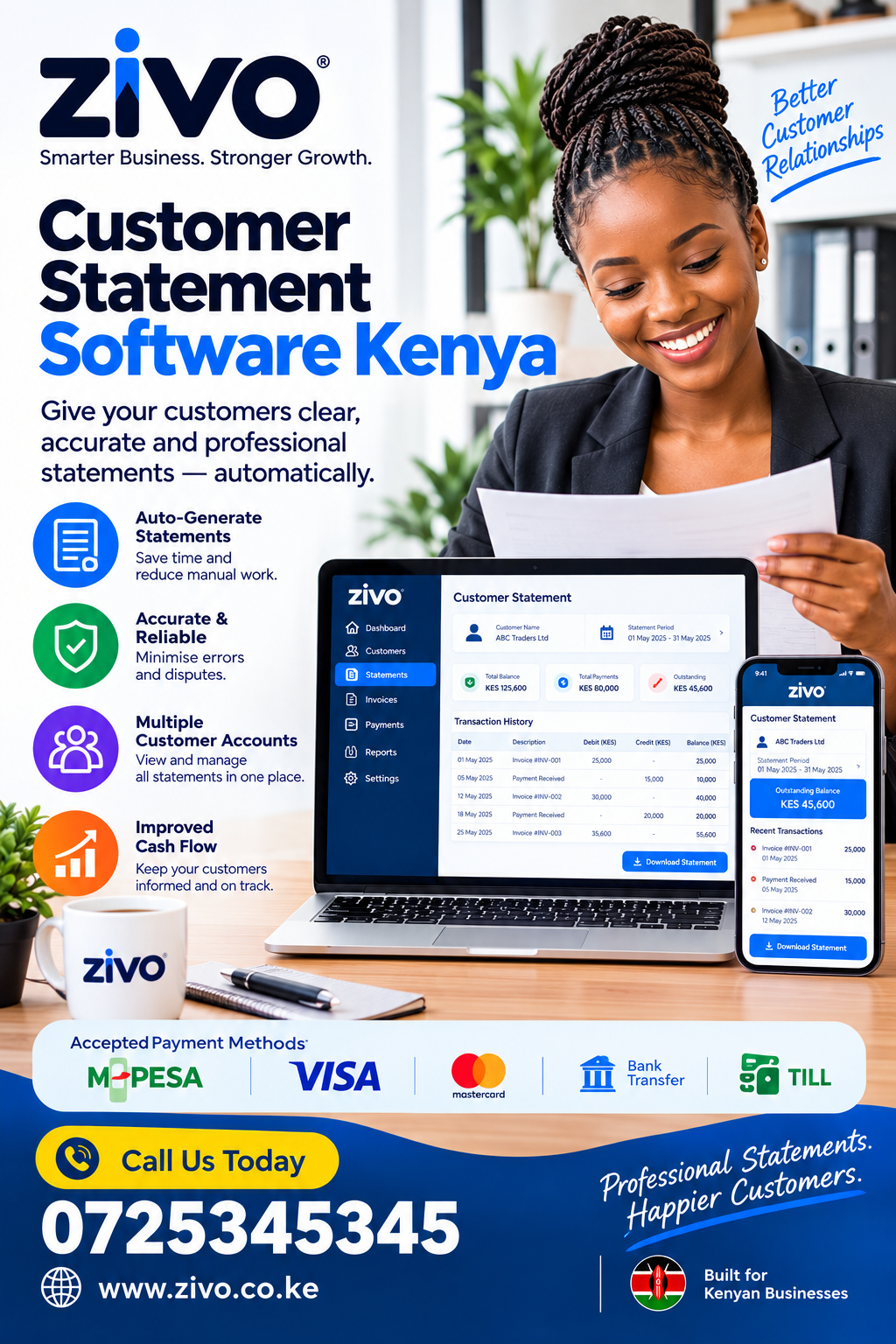
Customer Statement Software Kenya refers to software designed to help businesses prepare, manage, and maintain customer account statements digitally. Instead of manually compiling invoices, payments, credit notes, outstanding balances, and transaction histories, the business can keep those records in a centralized system.
A customer statement usually provides a summary of financial activity between a business and a customer over a particular period. Depending on the business, it may show:
- Opening balance
- Invoices issued
- Payments received
- Credit notes
- Adjustments
- Outstanding amounts
- Transaction dates
- Invoice references
- Closing balance
- Payment status
Customer Statement Software Kenya can make this information easier to organize and retrieve when customers request account updates.
For a business that serves dozens, hundreds, or thousands of customers, maintaining these records manually can consume significant administrative time. A digital system reduces the need to search through multiple files before answering a basic question such as, “How much do I still owe?”
The software can also make communication more professional. Rather than sending screenshots of spreadsheets or manually typing transaction histories into emails or messages, businesses can generate consistent statements based on recorded transactions.
Why Customer Statements Matter to Kenyan Businesses
Customer Statement Software Kenya is particularly useful where businesses sell products or services on credit, maintain customer accounts, issue recurring invoices, or receive payments at different times.
Consider a wholesale business in Nairobi supplying goods to retail shops. A customer may receive several invoices throughout the month and make several partial payments. By the end of the month, both parties need to understand exactly what has been billed, what has been paid, and what remains outstanding.
Without an organized account statement, disagreements can arise.
The customer may believe an invoice was already settled. The business may have recorded a payment against a different invoice. A credit note may have been missed. A payment may have been received through a different channel and not entered into the accounting records immediately.
Customer Statement Software Kenya helps create a consistent transaction history that can be reviewed when such questions arise.
This is useful for many Kenyan businesses, including:
- Wholesalers
- Distributors
- Retailers
- Professional service firms
- Schools and training institutions
- Contractors
- Agencies
- Subscription businesses
- Property-related businesses
- Healthcare businesses
- Suppliers
- Small and medium-sized enterprises
The exact requirements differ by industry, but the underlying need is similar: businesses need accurate customer account information.
How Customer Statement Software Works
Customer Statement Software Kenya normally works by bringing customer transactions into one digital record.
A typical workflow may look like this:
- Create a customer profile.
- Record or generate an invoice.
- Record the customer’s payment.
- Apply the payment to the appropriate account or invoice.
- Record adjustments or credit notes when necessary.
- Update the customer’s outstanding balance.
- Generate a statement for a selected period.
- Send or share the statement with the customer.
The exact workflow depends on the software.
A good system should make the process straightforward enough that staff members do not need advanced accounting or technical skills to retrieve a customer statement.
Customer Statement Software Kenya can also help businesses reduce repetitive administrative work. When customer records are maintained consistently, staff do not have to reconstruct account histories every time a statement is requested.
For example, a customer could request a statement covering January to September. Instead of manually collecting nine months of invoices and payment records, an employee can select the customer and date range and generate the relevant statement.
That difference becomes increasingly important as a business grows.
Key Features to Look For
Customer Statement Software Kenya should provide more than a simple printable document. The best solution for a particular business depends on how customer accounts are managed, but several features are broadly useful.
Customer Account Profiles
Each customer should have a dedicated account containing relevant information and transaction history.
Useful details may include:
- Customer name
- Contact information
- Account number
- Invoices
- Payments
- Credit notes
- Outstanding balance
- Payment history
- Account status
A centralized profile means employees can access the customer’s financial history without searching through multiple spreadsheets.
Automatic Statement Generation
Customer Statement Software Kenya should make statement generation simple.
Users should ideally be able to select a customer and specify a date range. The system can then produce a statement showing transactions within that period.
This is especially helpful when customers request statements frequently.
Invoice Tracking
Statements are more useful when they are connected to invoices.
The system should make it possible to see which invoices have been:
- Paid
- Partially paid
- Unpaid
- Overdue
- Cancelled
- Adjusted
This gives the business a clearer picture of customer account activity.
Payment Recording
Customer Statement Software Kenya should make it easy to record customer payments accurately.
For Kenyan businesses, payment records may come from several channels, including bank transfers, cash, card payments, and mobile money.
A centralized payment record helps staff identify when money was received and how it was allocated.
Outstanding Balance Tracking
One of the main reasons businesses prepare customer statements is to communicate outstanding balances.
A useful system should automatically calculate the balance based on recorded transactions rather than requiring employees to perform calculations manually.
For example:
| Transaction | Amount |
|---|---|
| Opening balance | KSh 10,000 |
| New invoice | KSh 25,000 |
| Payment received | KSh 15,000 |
| Closing balance | KSh 20,000 |
If the underlying transactions are correct, the system can calculate the balance without repeatedly using a calculator or spreadsheet formula.
Improving Payment Follow-Up
Customer Statement Software Kenya can support better payment follow-up because staff can quickly identify customers with outstanding balances.
Without centralized records, employees may know that money is owed but lack a clear view of:
- How much is outstanding
- Which invoices are unpaid
- How old the debt is
- What payments have already been received
- When the customer was last contacted
A customer statement can provide this information in a format that is easier for both the business and customer to understand.
For example, instead of sending a message saying, “Please clear your outstanding amount,” the business can provide a statement showing the invoices and payments that produced the balance.
This makes the communication more specific.
Customer Statements and M-Pesa Payments
Customer Statement Software Kenya can be especially valuable for Kenyan businesses that receive mobile payments.
M-Pesa is widely used for business transactions in Kenya, and businesses may receive numerous payments throughout the day. The challenge is not simply receiving money; it is maintaining accurate records showing which customer made which payment and what the payment was intended to settle.
Where a software solution supports relevant payment workflows or integrations, businesses can improve the connection between payments and customer accounts.
However, businesses should confirm exactly what a software package supports before purchasing it. Some systems may record manually entered payments, while others may offer deeper integrations.
The important principle is that a payment should be correctly reflected in the customer’s account.
Reducing Spreadsheet Dependence
Customer Statement Software Kenya can reduce the need to depend heavily on spreadsheets for customer account management.
Spreadsheets are useful tools, especially for small businesses. However, problems can develop as transaction volumes increase.
Common issues include:
- Accidental deletion of records
- Incorrect formulas
- Duplicate entries
- Multiple versions of the same file
- Difficulty tracking changes
- Limited access control
- Manual statement preparation
- Delayed updates
A dedicated system provides a more structured environment.
This does not mean spreadsheets have no place in business. They can still be useful for analysis, data exports, and temporary calculations. The difference is that the core customer records can remain within a purpose-built system.
Better Customer Service
Customer Statement Software Kenya can also improve customer service.
Customers often contact businesses with questions about their accounts. They may ask:
- “What is my current balance?”
- “Which invoice is unpaid?”
- “Did you receive my payment?”
- “Can you send me my statement?”
- “How much did I owe before my last payment?”
- “Why is this invoice still showing as outstanding?”
When staff have immediate access to organized information, these questions can be handled more efficiently.
A customer does not necessarily care which spreadsheet contains the information. They want an accurate answer.
Centralized account information gives customer-facing employees a better foundation for providing that answer.
Improving Financial Visibility
Customer Statement Software Kenya can give business owners greater visibility into customer balances.
Instead of relying entirely on memory or periodic spreadsheet reviews, management can examine account information from the system.
Useful questions include:
- Which customers have unpaid invoices?
- How much is currently outstanding?
- Which accounts have frequent late payments?
- Which customers have recently made payments?
- How much revenue remains to be collected?
- Which accounts require follow-up?
This information can support cash-flow planning and day-to-day financial management.
It is important to distinguish customer statements from full accounting systems. A statement-management feature may provide valuable account information, but businesses with more complex accounting requirements should evaluate whether they also need accounting, tax, payroll, inventory, or other functionality.
Customer Statement Software for SMEs
Customer Statement Software Kenya can be valuable for small and medium-sized enterprises because SMEs often have limited administrative staff.
In a small business, the same employee may handle sales, invoicing, customer service, payment recording, and account follow-up.
Manual statement preparation adds another task.
Automation can allow employees to spend less time assembling transaction histories and more time serving customers or handling revenue-generating activities.
A small business should not automatically choose the most complicated software available. The goal is to find a solution that fits its actual workflow.
A business with 30 active credit customers may have very different requirements from a distributor managing several thousand accounts.
Industry Applications
Customer Statement Software Kenya can be used across multiple sectors because customer statements are relevant wherever transactions occur between a business and its customers.
Wholesale and Distribution
Wholesalers often issue multiple invoices to the same customer. A statement can consolidate the account into one view.
Professional Services
Consultancies, agencies, contractors, and other service providers may invoice customers periodically. Statements can help clients understand accumulated charges and payments.
Retail Businesses
Retailers that sell on credit can use customer statements to track outstanding balances.
Education
Schools and training businesses may need account statements showing fees billed, payments received, and balances.
Healthcare
Healthcare providers that allow account-based billing may use statements to summarize charges and payments.
Subscription Businesses
Businesses offering recurring services can use statements to communicate billing activity over time.
Automated Customer Account Management
Customer Statement Software Kenya can automate several repetitive account-management tasks.
Automation might include:
- Updating balances
- Generating statements
- Tracking invoice status
- Recording payments
- Identifying overdue accounts
- Sending reminders
- Producing reports
The exact automation available varies between platforms.
Businesses should therefore evaluate software based on actual features rather than assuming that every product provides the same level of automation.
A useful approach is to write down the tasks employees currently perform manually and then determine which of those tasks the software can handle.
Statement Formats and Communication
Customer Statement Software Kenya should ideally make statements clear and professional.
A useful statement generally needs enough information for the customer to understand the account without having to ask additional questions.
Depending on the business, this could include:
- Business name and contact details
- Customer details
- Statement period
- Transaction date
- Reference number
- Description
- Debit amount
- Credit amount
- Running balance
- Closing balance
Businesses should also consider how statements will be delivered.
Possible methods include:
- Downloadable documents
- Customer portals
- Printed statements
- Messaging platforms, where supported
The best method depends on customer preferences and the capabilities of the software.
Data Accuracy Matters
Customer Statement Software Kenya cannot compensate for inaccurate information entered into the system.
If an employee records KSh 5,000 instead of KSh 50,000, the generated statement will still be wrong.
For that reason, businesses should establish clear procedures for recording transactions.
Good practices include:
- Record transactions promptly.
- Use consistent customer records.
- Avoid duplicate customer accounts.
- Reconcile payment records regularly.
- Review unusual balances.
- Correct errors through proper adjustments.
- Restrict access to sensitive financial information.
Software is a tool. Reliable processes are still necessary.
Security and Access Control
Customer Statement Software Kenya should be evaluated for security features, especially when it stores customer financial information.
Businesses should consider whether the system provides:
- User accounts
- Password protection
- Role-based permissions
- Secure data storage
- Activity records
- Backup mechanisms
- Controlled access to financial information
Not every employee needs access to every function.
For example, a sales employee may need to view customer balances but may not need permission to delete financial transactions.
Access controls can help reduce accidental changes and unauthorized activity.
Businesses should also understand how their software provider handles backups, data retention, and account recovery.
Reports That Support Management Decisions
Customer Statement Software Kenya can provide reports that turn customer transaction data into more useful management information.
Depending on the system, reports may cover:
- Outstanding balances
- Customer payment history
- Sales
- Invoice status
- Receivables
- Overdue accounts
- Transaction summaries
- Customer activity
Reports can help management identify patterns.
For example, if a business notices that several large customers consistently delay payments, management may review its credit terms or collection process.
The software does not make that business decision automatically. It provides organized information that can support the decision.
Customer Statements and Credit Management
Customer Statement Software Kenya can also support responsible credit management.
Before giving customers credit, a business may establish conditions such as:
- Maximum credit limit
- Payment period
- Required documentation
- Approval process
- Follow-up procedures
Once credit is extended, statements help both parties monitor the account.
A customer who receives a clear statement can see what has been billed and what remains unpaid.
From the business perspective, account visibility can help staff identify customers whose balances are approaching internal limits.
Choosing the Right Software
Customer Statement Software Kenya should be selected based on business needs rather than the number of features advertised.
Start by identifying the current problem.
For example:
“Our staff spend too much time preparing statements.”
That is more useful than saying:
“We need financial software.”
Once the problem is defined, identify the capabilities needed to solve it.
Create a Feature Checklist
Your checklist might include:
| Requirement | Why It Matters |
|---|---|
| Customer profiles | Keeps account information organized |
| Statement generation | Reduces manual preparation |
| Invoice tracking | Shows billing status |
| Payment recording | Keeps balances updated |
| Outstanding balance tracking | Supports collection |
| Reports | Improves visibility |
| User permissions | Controls access |
| Data backup | Protects records |
| Export options | Supports analysis |
| Mobile accessibility | Helps staff work remotely |
Not every business needs every feature.
Questions to Ask a Software Provider
Customer Statement Software Kenya can be evaluated more effectively when businesses ask practical questions before committing.
Consider asking:
- Can I create individual customer accounts?
- Can I generate statements for specific date ranges?
- Can the system show invoice and payment history?
- Can customers receive statements electronically?
- Does it support Kenyan payment workflows?
- Can users have different access permissions?
- Can data be exported?
- How are records backed up?
- Can the system handle our expected customer volume?
- What support is available when problems occur?
A demonstration can be particularly useful because it allows staff to see whether the workflow is intuitive.
Pricing Considerations
Customer Statement Software Kenya pricing varies depending on the provider, features, number of users, transaction volume, integrations, and subscription structure.
Businesses should not evaluate cost based solely on the monthly subscription.
Consider the total value of the system.
For example, if employees currently spend several hours every week preparing statements, reducing that workload has operational value.
Other potential benefits include:
- Faster customer responses
- Fewer manual calculations
- Better payment follow-up
- Easier record retrieval
- Improved visibility
- More consistent statements
At the same time, businesses should avoid paying for functionality they will never use.
Common Mistakes When Managing Customer Statements
Customer Statement Software Kenya can help reduce several common problems, but businesses should understand those problems first.
Using Multiple Customer Records
Creating duplicate profiles for the same customer can fragment transaction history.
Delaying Payment Entries
If payments are entered days later, account balances may temporarily be inaccurate.
Failing to Reconcile Accounts
Businesses should periodically compare recorded transactions against actual payment records.
Sending Incomplete Statements
A statement should provide enough context for the customer to understand the balance.
Giving Everyone Full Access
Excessive permissions can increase the risk of accidental changes.
Ignoring Overdue Balances
An account-management system is most useful when the information leads to appropriate action.
Moving From Manual to Digital Statements
Customer Statement Software Kenya does not mean a business needs to digitize everything overnight.
A gradual transition may be easier.
Step 1: Review Existing Records
Identify where customer information currently lives.
You may have:
- Excel files
- Accounting records
- Receipt books
- Invoice folders
- Mobile payment records
- Bank statements
- Customer correspondence
Step 2: Clean the Data
Remove duplicates and correct obvious errors before importing information.
Step 3: Establish Customer Accounts
Create a consistent profile for each active customer.
Step 4: Enter Opening Balances
If the business already has outstanding accounts, ensure opening balances are accurately recorded.
Step 5: Train Staff
Employees should understand how to create invoices, record payments, generate statements, and correct errors.
Step 6: Test the Process
Generate sample statements and compare them against existing records.
Step 7: Go Live
Once the records and workflow have been tested, make the software the main system for customer statements.
How Software Can Improve Internal Accountability
Customer Statement Software Kenya can help businesses establish clearer responsibility for customer account management.
When records are scattered across personal spreadsheets and paper files, it can be difficult to establish who changed what.
A centralized system with user permissions and activity records can create a clearer operational trail.
This can be useful when investigating questions such as:
- Who recorded a payment?
- When was an invoice created?
- Was an adjustment made?
- Why did the balance change?
- Which customer account was updated?
The availability of these features varies between software products, so they should be confirmed before implementation.
Supporting Business Growth
Customer Statement Software Kenya becomes increasingly useful as a business acquires more customers.
A company may begin with ten customers and manage accounts comfortably using simple records. After several years, the same business may have hundreds of active accounts.
The old process may no longer scale.
Growth increases the number of:
- Invoices
- Payments
- Customer questions
- Account adjustments
- Follow-ups
- Statements
- Financial records
A structured system helps businesses create repeatable processes before administrative complexity becomes overwhelming.
Customer Statements for Nairobi and Other Kenyan Markets
Customer Statement Software Kenya can be useful for businesses operating in Nairobi as well as other parts of Kenya.
A company in Nairobi may serve customers in Mombasa, Kisumu, Nakuru, Eldoret, Thika, or other towns. Customer accounts therefore need to remain accessible regardless of where staff members or customers are located.
Cloud-based systems can be particularly useful for businesses with distributed teams, provided the selected platform offers the required accessibility and security.
Businesses should also consider internet reliability, mobile access, user training, and customer communication habits when choosing software.
Integrating Customer Statements With Other Business Processes
Customer Statement Software Kenya becomes more valuable when customer account information connects logically with other business activities.
For example:
Sales → Invoice → Payment → Customer Account → Statement → Receivables Report
When these processes are disconnected, employees may have to enter the same information multiple times.
Integrated workflows can reduce duplicate work.
Depending on the software, businesses may also connect customer statement management with:
- Invoicing
- Receipts
- Expenses
- Inventory
- Payment processing
- Accounting
- Sales management
- Customer relationship management
The appropriate level of integration depends on the business.
Preparing for Better Digital Record Keeping
Customer Statement Software Kenya can contribute to broader digital record-keeping practices.
Good digital records should be:
- Organized
- Searchable
- Accurate
- Accessible to authorized users
- Regularly backed up
- Consistently maintained
This makes it easier for employees to retrieve information when customers, managers, auditors, or other authorized parties need it.
Businesses should still maintain appropriate retention and privacy procedures based on their operational and legal requirements.
What Makes a Good Customer Statement?
Customer Statement Software Kenya should produce statements that are easy to understand.
A customer should ideally be able to look at the document and answer three questions:
- What transactions occurred?
- What has been paid?
- What is the remaining balance?
Clarity matters more than unnecessary visual complexity.
A statement filled with irrelevant information can be just as frustrating as one that lacks important details.
A clean transaction table with clear dates, references, amounts, and balances is usually easier to review.
Customer Statement Software and Cash-Flow Management
Customer Statement Software Kenya can contribute to better receivables visibility.
Cash flow depends partly on when customers pay for goods or services already delivered.
If a business does not know which customer balances are outstanding, it becomes harder to plan collections.
Statement software can help answer questions such as:
- What amount is currently receivable?
- Which customers have overdue balances?
- Which accounts require attention?
- How much has been collected recently?
Management can then use this information alongside budgets, bank records, sales reports, and other financial information.
Mobile Access and Remote Work
Customer Statement Software Kenya may be especially useful when employees need to access customer accounts away from the office.
For example, a sales representative meeting a customer may need to confirm an account balance before discussing a new order.
If the system supports secure mobile or web access, the employee may be able to retrieve the necessary information without returning to the office.
Businesses should verify mobile compatibility and security before selecting a system.
Training Employees to Use the System
Customer Statement Software Kenya works best when employees understand both the software and the underlying accounting process.
Training should cover:
- Customer creation
- Invoice entry
- Payment recording
- Statement generation
- Corrections
- Reporting
- User permissions
- Data security
Training should also explain what employees should do when they notice an error.
For example, staff should know whether to edit a transaction, create an adjustment, or contact a supervisor.
A clear procedure helps prevent inconsistent corrections.
Frequently Asked Questions
1. What is customer statement software?
Customer Statement Software Kenya is software that helps businesses maintain customer account records and generate statements showing invoices, payments, balances, credits, and other transactions over a selected period.
2. Who needs customer statement software?
Customer Statement Software Kenya can be useful for businesses that invoice customers, sell on credit, manage recurring accounts, or regularly need to provide transaction statements.
3. Can customer statement software track unpaid invoices?
Customer Statement Software Kenya can support unpaid invoice tracking when invoice and payment records are maintained in the system. Businesses should confirm the specific receivables features available from their chosen provider.
4. Can it support M-Pesa payments?
Customer Statement Software Kenya may support payment recording or M-Pesa-related workflows depending on the platform. Before purchasing, businesses should confirm whether the product provides direct integration, manual payment recording, or another payment workflow.
5. Is customer statement software suitable for small businesses?
Customer Statement Software Kenya can be suitable for SMEs when the software matches their customer volume, workflow, budget, and reporting requirements. A small business does not necessarily need an enterprise-level system.
6. Can customer statements be generated for specific dates?
Customer Statement Software Kenya can provide date-based statements when the software supports statement-period filtering. This allows users to review transactions for a selected period rather than an entire customer history.
7. How does software help reduce statement errors?
Customer Statement Software Kenya can reduce manual calculation and copying errors by using stored transaction records to produce statements. However, accurate data entry and reconciliation remain essential.
8. What should I check before buying customer statement software?
Customer Statement Software Kenya should be evaluated for customer profiles, statement generation, invoice tracking, payment records, reporting, security, user permissions, integrations, support, and ease of use.
9. Can customer statement software replace accounting software?
Customer Statement Software Kenya may handle important customer-account functions, but it should not automatically be considered a complete accounting replacement. Businesses should compare the software’s actual features with their accounting requirements.
10. Is cloud-based customer statement software useful?
Customer Statement Software Kenya can be useful when authorized employees need access from different locations. Businesses should evaluate connectivity, security, backups, user permissions, and provider reliability before adopting a cloud-based platform.
Practical Example: A Kenyan Distributor
Customer Statement Software Kenya can be illustrated through a simple business scenario.
Imagine a distributor supplying products to 100 retail shops.
The distributor issues invoices throughout the month. Some customers pay immediately, while others have seven-, fourteen-, or thirty-day payment arrangements.
At the beginning, the finance employee manages everything through spreadsheets.
As customer numbers grow, several problems appear:
- Payments are sometimes recorded late.
- Employees create duplicate customer names.
- Customers request statements frequently.
- Outstanding balances are difficult to review.
- Staff spend hours preparing statements.
- Management cannot quickly identify the largest overdue accounts.
The distributor introduces a centralized customer account system.
Each customer receives an individual profile. Invoices and payments are recorded against the appropriate account. When a customer requests a statement, staff select the account and relevant period.
The business has not eliminated the need for financial controls. Instead, it has created a more organized process.
That distinction matters.
Software should support good business procedures rather than replace them.
Building a Statement Management Workflow
Customer Statement Software Kenya can become part of a broader workflow for managing customer accounts.
A practical process could be:
Customer onboarding
↓
Customer account creation
↓
Invoice generation
↓
Payment recording
↓
Account reconciliation
↓
Statement generation
↓
Customer communication
↓
Payment follow-up
↓
Receivables reporting
This process gives employees a clear sequence to follow.
It also makes it easier to identify where problems occur. If the balance is wrong, management can investigate whether the issue occurred during invoicing, payment recording, reconciliation, or adjustment.
Benefits Beyond Statement Generation
Customer Statement Software Kenya is not valuable simply because it produces a PDF or printed statement.
Its larger value comes from organizing customer-account information.
Potential benefits include:
- Better record accessibility
- Faster customer responses
- Reduced manual calculations
- Easier payment follow-up
- Improved receivables visibility
- More consistent account management
- Better internal organization
- Reduced dependence on disconnected spreadsheets
These benefits can contribute to a more structured finance operation.
However, the actual results depend on implementation, data quality, employee adoption, and the capabilities of the chosen software.
Final Considerations Before Implementation
Customer Statement Software Kenya should be introduced with a clear implementation plan.
Before going live, confirm:
- Existing customer data has been reviewed.
- Duplicate accounts have been removed.
- Opening balances are correct.
- Staff understand the new workflow.
- User permissions have been configured.
- Payment recording procedures are documented.
- Statement formats have been reviewed.
- Backup arrangements are understood.
- Support contacts are available.
Do not rush the migration simply because the software is ready.
A few days spent cleaning customer data can prevent months of confusion later.
Conclusion
Customer Statement Software Kenya can help Kenyan businesses move from fragmented customer-account records toward a more organized digital process. By centralizing invoices, payments, balances, credits, and transaction histories, businesses can make statement preparation easier and improve visibility into what customers owe.
The most important consideration is not simply whether software can generate a statement. Businesses should look at the complete customer-account workflow: how customers are created, how invoices are issued, how payments are recorded, how balances are reconciled, how statements are generated, and how outstanding accounts are followed up.
For a small business, the right solution may provide a simple way to replace repetitive spreadsheet work. For a growing company, it may become part of a wider invoicing and receivables process.
Before choosing a system, define the problems you want to solve, list the features your team actually needs, test the workflow, and confirm how customer data will be protected. With the right implementation, digital statement management can give employees quicker access to reliable account information while giving customers clearer records of their transactions.