
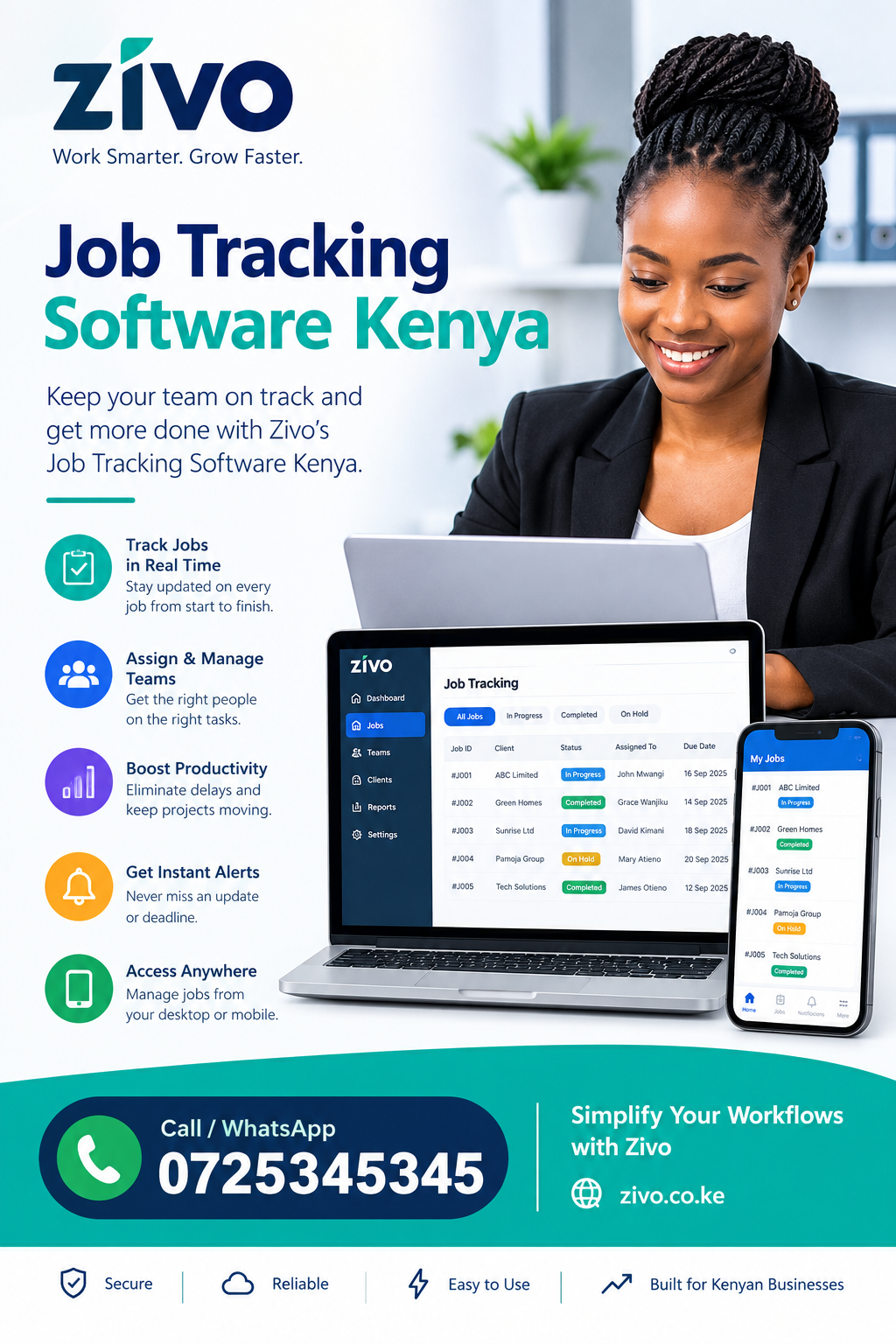
Job Tracking Software Kenya: How to Manage Jobs, Staff, Customers and Deliveries
For Kenyan businesses that handle customer orders, service requests, installations, repairs, deliveries, field assignments or other forms of work, Job Tracking Software Kenya can provide a structured way to organize work from the moment a customer makes a request until the job is completed. Instead of relying on notebooks, WhatsApp messages, spreadsheets and verbal instructions, businesses can use a centralized system to assign work, monitor progress, record important details and keep customer-related information connected.
Job tracking becomes especially important as a business grows. A company may have several employees handling different assignments at the same time, customers waiting for updates, managers checking whether work has been completed and finance teams needing information about payments. Without a clear workflow, jobs can easily be forgotten, delayed or assigned to the wrong person.
For Kenyan SMEs, contractors, service providers, distributors, repair businesses, installation companies and other organizations, a structured job management process can make daily operations easier to control.
What Is Job Tracking Software?
Job Tracking Software Kenya refers to software designed to help businesses organize, assign, monitor and complete individual jobs or work assignments. A job could be a customer delivery, equipment installation, repair request, maintenance assignment, field service visit or another task that requires employees to perform specific work.
Instead of managing jobs across multiple disconnected systems, a business can create a digital record for each assignment. The record can contain information such as the customer name, job description, responsible employee, location, due date, payment status, notes and completion status.
The main purpose is visibility. Managers should be able to see which jobs are new, which are being handled, which are delayed and which have already been completed.
For a growing company, Job Tracking Software Kenya can also provide a more consistent workflow for employees. Staff members know what they have been assigned, while managers have a clearer picture of operational activity.
Why Businesses Need a Structured Job Tracking Process
Many businesses begin by tracking jobs manually. A customer sends a WhatsApp message, a salesperson writes the details in a notebook, a manager calls an employee and the employee later reports back.
This may work when the company has only a few customers and assignments. As volume increases, however, manual processes become difficult to maintain.
Job Tracking Software Kenya can help businesses replace scattered job information with a centralized process. Instead of asking several people for updates, managers can refer to the relevant job record.
A structured process can help answer questions such as:
- What work has been requested?
- Who is responsible for it?
- When should it be completed?
- Has the customer paid?
- Where should the work be performed?
- What materials or equipment are required?
- What stage is the job currently at?
- Has the customer been updated?
- Has the employee marked the work as complete?
These questions are common in service-oriented businesses. Having a reliable way to answer them can improve operational visibility.
Common Problems With Manual Job Management
Manual job management can create several operational problems.
Missed Assignments
When requests arrive through phone calls, WhatsApp messages, emails and physical conversations, there is a risk that an assignment will not be recorded properly.
Job Tracking Software Kenya can provide a central place where work requests are converted into identifiable jobs.
Unclear Responsibility
A manager may tell an employee to handle a customer request but forget to confirm who is responsible. Another employee may assume the work belongs to someone else.
A digital assignment process makes responsibility clearer.
Delayed Customer Updates
Customers often want to know when their order, installation, repair or service request will be completed. When employees lack access to current job information, customer communication can become slow.
Job Tracking Software Kenya can support a workflow where job status is updated as work progresses.
Poor Visibility for Managers
Managers cannot effectively control operations if they do not know what their employees are working on. A centralized job list provides a clearer operational overview.
Difficult Follow-Up
If a customer calls several days after making a request, staff may struggle to locate the original information. A digital job record makes follow-up easier because relevant information can remain attached to the assignment.
Turning Customer Requests Into Jobs
A strong job management process should begin when work is requested.
A customer might request a repair, delivery, installation, consultation or other service. The request should then be converted into a job with enough information for the assigned employee to act.
Job Tracking Software Kenya can support this transition by giving businesses a structured record for each assignment.
For example, an installation company could receive a request from a customer in Nairobi. The job record might contain:
- Customer name
- Telephone number
- Installation address
- Product or service requested
- Payment status
- Assigned technician
- Expected completion date
- Customer instructions
- Internal notes
- Current job status
This gives the employee a practical reference point rather than requiring them to search through old conversations.
Job Assignment and Staff Accountability
Assigning a job is one of the most important parts of job management.
Employees need to know what they are expected to do, where they need to do it and when the work should be completed.
Job Tracking Software Kenya can help managers connect jobs with specific staff members or departments. This reduces uncertainty about responsibility.
For example, a company providing appliance repairs may have technicians specializing in different types of equipment. A manager can assign the appropriate technician based on the nature and location of the job.
Clear assignment also creates accountability. If a job remains incomplete, management can identify the responsible employee and determine what is causing the delay.
Tracking Job Status
A job should not simply be classified as open or closed. Businesses can benefit from several stages that show where work currently stands.
Typical statuses include:
- New
- Assigned
- Accepted
- In Progress
- Awaiting Customer
- Awaiting Materials
- Completed
- Cancelled
Job Tracking Software Kenya can help businesses organize jobs around these stages.
The exact workflow depends on the type of business. A delivery company may use statuses such as dispatched, in transit and delivered, while a repair company may use received, diagnosed, awaiting parts, under repair and completed.
The important point is that the status should communicate useful information to management and staff.
Monitoring Field Employees
Businesses with employees working outside the office often face additional management challenges.
Technicians, sales representatives, installers, delivery teams, maintenance workers and other field employees may spend most of their day away from the office.
Job Tracking Software Kenya can give managers a better way to monitor assigned work without requiring constant phone calls.
Instead of repeatedly asking an employee for updates, management can review the job status and notes associated with an assignment.
This does not eliminate communication. Rather, it gives communication a more organized foundation.
Managing Customer Information
A job should not exist in isolation from the customer who requested it.
Customer information can be important when employees need to confirm addresses, review previous interactions or understand the service history.
Job Tracking Software Kenya can help businesses maintain a connection between the customer and the work being performed.
For example, if a customer has previously requested maintenance services, a future employee can benefit from knowing what was done previously. This can reduce repeated questions and make service delivery more consistent.
Linking Jobs With Orders and Payments
Many jobs originate from a sale or customer payment.
A customer may purchase a product and then require delivery. Another customer may pay for an installation service. A company may receive payment for a repair before assigning a technician.
Job Tracking Software Kenya can help businesses connect operational work with commercial activity.
This is particularly useful when management needs to identify work that has been paid for but has not yet been delivered.
A useful workflow could look like this:
Customer request → Quote or order → Payment → Job creation → Staff assignment → Work in progress → Completion
This approach reduces the possibility of paid work being forgotten.
Managing Delivery Jobs
Delivery operations require accurate information because customers expect their orders to arrive within a reasonable timeframe.
A delivery job may contain:
- Customer details
- Delivery address
- Order information
- Contact details
- Assigned driver
- Vehicle information
- Expected delivery date
- Payment status
- Delivery notes
- Completion status
Job Tracking Software Kenya can help organize these details within a defined workflow.
For businesses handling multiple deliveries each day, this can provide managers with a clearer view of pending and completed work.
Managing Service and Repair Jobs
Repair businesses frequently deal with jobs that have several stages.
A customer may report a problem, a technician may inspect the equipment, parts may need to be ordered and the actual repair may take place later.
Job Tracking Software Kenya can help represent these stages more clearly.
A repair job might therefore move through:
Request received → Technician assigned → Inspection → Diagnosis → Parts required → Repair → Testing → Completed
This structure can make it easier to identify where delays are occurring.
If several jobs are waiting for parts, management can see that the issue is not necessarily employee productivity. The bottleneck may be procurement.
Job Tracking for Installation Businesses
Installation companies often need to coordinate people, equipment, customer locations and schedules.
Examples include:
- Internet installation
- Security system installation
- Solar equipment installation
- Furniture installation
- Appliance installation
- Construction-related services
- Electrical installations
Job Tracking Software Kenya can help businesses organize installation assignments and give employees access to relevant job information.
Before an installer leaves the office, they should know the customer, location, work required and any special instructions.
After the work is completed, the employee can update the job status and provide completion information.
Managing Job Deadlines
Deadlines are important because delayed jobs can affect customer satisfaction and revenue.
A manager may need to know which jobs are due today, which are overdue and which have future deadlines.
Job Tracking Software Kenya can help businesses organize jobs around expected completion dates.
A daily review can focus on three groups:
- Jobs due today
- Jobs already overdue
- Jobs approaching their deadlines
This creates a practical routine for identifying work that requires attention.
Identifying Overdue Jobs
An overdue job is more than an operational statistic. It may represent a customer waiting for service, an employee who needs assistance or a process that is creating delays.
Job Tracking Software Kenya can help managers identify outstanding assignments and determine what action is needed.
For example, an overdue installation might be delayed because the customer was unavailable. Another may be delayed because the assigned technician has too many jobs.
Without structured information, these situations can be difficult to distinguish.
Improving Staff Coordination
Employees often depend on one another.
A salesperson may create the customer order. The accounts team may confirm payment. A manager may assign the work. A technician may perform the service. Another employee may confirm completion.
Job Tracking Software Kenya can support coordination by keeping job information accessible within a defined workflow.
This can reduce dependence on informal instructions.
Instead of saying, “Please check with John about that customer,” a manager can refer to the job record and see the current assignment and status.
Job Notes and Instructions
Some jobs require additional information that cannot be captured through a simple status.
A customer may provide access instructions, preferred appointment times, technical requirements or other notes.
Job Tracking Software Kenya can make it easier to retain those details alongside the relevant assignment.
Clear job notes can reduce mistakes, especially when employees need to work with information originally collected by another member of staff.
Tracking Job Completion
Completion should be clearly defined.
For a delivery company, completion may mean the customer received the package. For a repair business, it may mean the equipment was repaired and tested. For an installation company, it may mean the installation was completed and confirmed.
Job Tracking Software Kenya can support a workflow where employees update assignments when work has actually been completed.
Businesses should establish clear completion criteria rather than allowing employees to mark work complete without sufficient confirmation.
Using Job Data for Management Decisions
Job information becomes more valuable when management reviews it regularly.
A business can examine questions such as:
- How many jobs were completed this week?
- How many remain open?
- Which employees have the highest workload?
- Which jobs are overdue?
- Which customers have repeated requests?
- Which services generate the most assignments?
- Where are delays occurring?
- How long do jobs typically take?
Job Tracking Software Kenya can help turn operational information into a more useful management resource.
Managers can use these insights to adjust staffing, scheduling, processes and customer communication.
Using Job Tracking With WhatsApp
WhatsApp is widely used by Kenyan businesses to communicate with customers and employees.
However, conversations can become difficult to manage when they contain important job information that is not transferred into an operational system.
Job Tracking Software Kenya can complement customer communication by ensuring that the actual work assignment has a structured record.
A WhatsApp message can initiate a request, but the request still needs to become a trackable job.
This distinction is important. Communication tells people what someone has said. Job management establishes what the business needs to do about it.
Job Tracking for Small Businesses
Small businesses may assume that formal job management is only necessary for large companies.
That is not always the case.
A small company with five employees can still lose track of assignments if customers are increasing and work is being coordinated manually.
Job Tracking Software Kenya can help smaller businesses introduce structure without requiring a large administrative team.
For a growing company, the objective should be to establish a reliable workflow before operational complexity becomes difficult to control.
Job Tracking for Growing Businesses
Growth introduces more customers, employees, transactions and assignments.
A business that handled ten jobs per week manually may struggle when it begins handling fifty or one hundred.
Job Tracking Software Kenya can support businesses as the number of jobs increases by providing a centralized way to organize assignments.
Scalability is particularly important because changing processes after a company has become highly dependent on spreadsheets and informal communication can be difficult.
Reducing Duplicate Work
Duplicate work can occur when two employees unknowingly handle the same customer request.
For example, a customer may call twice about a delayed installation. Two different employees may create separate instructions for the same request.
Job Tracking Software Kenya can reduce this risk by giving employees a shared view of existing assignments.
Before creating a new job, staff can check whether an open assignment already exists for the customer.
Organizing Jobs by Department
Some organizations have several departments handling different types of work.
For example:
- Sales
- Installation
- Repairs
- Delivery
- Maintenance
- Customer support
- Finance
Job Tracking Software Kenya can help businesses organize jobs around the department responsible for completing them.
Department-level organization can also make reporting easier because management can identify where workloads are concentrated.
Managing Workloads
One employee may have ten open jobs while another has only two.
Without visibility, management may continue assigning work to the busiest employee.
Job Tracking Software Kenya can support workload management by making assignments easier to review.
Managers can compare the number of open jobs assigned to different employees and redistribute work when necessary.
Workload management should consider complexity as well as quantity. Five complicated installations may require more time than ten simple deliveries.
Prioritizing Jobs
Not every job has the same urgency.
A customer waiting for a routine service may not have the same priority as a customer whose critical equipment has stopped working.
Job Tracking Software Kenya can help businesses establish priority levels.
Possible priorities include:
- Low
- Normal
- High
- Urgent
Businesses should define what each priority means so that employees make consistent decisions.
Creating Better Daily Workflows
A good job tracking process can support a daily management routine.
At the start of the day, a manager can review:
- New jobs
- Unassigned jobs
- Jobs scheduled for today
- Overdue jobs
- High-priority jobs
- Jobs awaiting customer information
- Jobs awaiting payment
- Jobs approaching their deadlines
Job Tracking Software Kenya can support this type of operational review.
At the end of the day, managers can review completed assignments and identify work that needs to carry forward.
Improving Customer Service
Customers usually care about outcomes rather than internal processes.
They want to know whether the service will be delivered, when it will happen and what they should expect.
Job Tracking Software Kenya can contribute to better customer service by giving employees access to more organized job information.
When a customer asks for an update, staff can refer to the job status rather than searching through multiple communication channels.
Keeping Customers Informed
Proactive communication can prevent some customer complaints.
If a job is delayed, informing the customer early is generally more useful than waiting until the customer calls.
Job Tracking Software Kenya can support an internal process where employees identify delayed jobs and communicate appropriate updates.
The software does not replace good customer service. It gives employees better information with which to provide it.
Measuring Completion Rates
A business can use job data to understand operational performance.
One simple metric is the percentage of jobs completed within the expected timeframe.
Job Tracking Software Kenya can help businesses organize the underlying job records needed for this type of analysis.
Other useful measurements can include:
- Average completion time
- Number of overdue jobs
- Jobs completed per employee
- Jobs cancelled
- Jobs awaiting materials
- Jobs awaiting customer action
These measures can help management identify operational patterns.
Identifying Bottlenecks
A bottleneck occurs when one part of the process slows down the rest of the operation.
For example, a business may have enough technicians but insufficient spare parts. Another business may have enough delivery vehicles but slow order processing.
Job Tracking Software Kenya can make these bottlenecks easier to identify when jobs contain meaningful status information.
If many assignments remain at the same stage, management can investigate the reason.
Job Tracking and Accountability
Accountability works best when employees know what they are responsible for and what constitutes completion.
Job Tracking Software Kenya can provide a clearer record of responsibility for each assignment.
This can be especially useful when several employees work on similar tasks.
Instead of relying on memory, management can refer to the job history and recorded updates.
Managing Job History
Job history can become useful when customers return.
A business may need to know what work was previously completed, when it happened and who handled it.
Job Tracking Software Kenya can help retain job-related information that may be useful for future service.
Historical information can also help businesses identify recurring problems.
If the same customer repeatedly requests repairs for the same equipment, management can investigate whether a broader solution is necessary.
Job Tracking for Contractors
Contractors often manage multiple projects, workers, locations and customer requirements.
Each assignment can have its own schedule, scope and completion criteria.
Job Tracking Software Kenya can provide a structured approach for managing individual work assignments within a broader business operation.
Contractors can use job records to distinguish between different customers and locations while maintaining clearer responsibility for individual tasks.
Job Tracking for Maintenance Companies
Maintenance businesses often operate on recurring schedules.
Examples include:
- Building maintenance
- Equipment maintenance
- Cleaning services
- Security system maintenance
- Electrical maintenance
- Plumbing services
- HVAC servicing
Job Tracking Software Kenya can help maintenance businesses organize service requests and track whether scheduled work has been completed.
For recurring customers, maintaining historical job records can also make future planning easier.
Job Tracking for Professional Services
Job tracking is not limited to physical field work.
Professional service businesses may also have assignments that need to be managed from initiation through completion.
Examples include consulting tasks, technical support, design work, inspections and other customer-specific assignments.
Job Tracking Software Kenya can provide a structured framework for organizing such work.
The important factor is whether the business needs to track individual pieces of customer-related work.
Choosing the Right Job Tracking Features
Businesses should focus on features that solve actual operational problems.
Useful capabilities may include:
- Job creation
- Job assignment
- Staff management
- Status tracking
- Customer records
- Job notes
- Due dates
- Priority levels
- Department assignment
- Completion tracking
- Reporting
- Payment information
- Order information
- Delivery information
- Mobile accessibility
Job Tracking Software Kenya should be evaluated based on how well these features fit the company’s workflow rather than simply how many features the software offers.
Ease of Use Matters
A sophisticated system is not useful if employees do not use it consistently.
Job Tracking Software Kenya should be simple enough for employees to understand and use as part of their normal daily work.
Managers should consider how many steps are required to create a job, assign it, update it and close it.
If employees find the system difficult, they may return to informal communication channels.
Mobile Accessibility for Field Teams
Field employees may not spend much time at a desk.
Technicians, drivers and installers may need to review job details while working away from the office.
Job Tracking Software Kenya can be particularly useful when employees need access to job information while handling assignments in different locations.
A mobile-friendly workflow can reduce the need to return to the office simply to check instructions or update a job.
Connecting Job Tracking With Business Operations
Job tracking should ideally fit into the broader business process.
A customer may begin with a conversation, receive a quotation, place an order, make payment and then require delivery or service.
Job Tracking Software Kenya becomes more useful when job information can remain connected to related customer and commercial information.
This creates a more complete operational picture.
Instead of viewing sales, payments and jobs as completely separate activities, management can understand how they relate to one another.
Security and Access Control
Business job records may contain customer names, phone numbers, addresses, payment information and internal instructions.
Access should therefore be managed carefully.
Job Tracking Software Kenya should be considered alongside questions about user access, data protection and account security.
Businesses should determine which employees need access to particular information and ensure that sensitive information is not unnecessarily exposed.
Reporting and Management Visibility
Reports can help managers move beyond individual job records.
Instead of checking every assignment manually, managers may want summarized information about operational activity.
Job Tracking Software Kenya can support a more structured approach to reviewing jobs, depending on the features and workflows available in the chosen system.
Useful reporting categories can include open jobs, completed jobs, overdue work, employee workloads and job activity over a selected period.
Using Job Tracking to Improve Efficiency
Efficiency does not simply mean completing more jobs.
It also means reducing unnecessary steps, preventing mistakes and using resources effectively.
Job Tracking Software Kenya can help businesses identify where their job process is consuming unnecessary time.
For example, if employees repeatedly call managers for basic job information, improving information availability can reduce interruptions.
If customers repeatedly call for status updates, clearer internal tracking can improve the company’s ability to respond.
Job Tracking and Business Growth
A company may start with a simple spreadsheet because it has only a few assignments.
As the company grows, the spreadsheet may become difficult to maintain.
Job Tracking Software Kenya can provide a more structured environment for businesses that have outgrown informal methods.
The transition to digital job management can be particularly valuable when the business begins adding employees, branches, service categories or geographic coverage.
How to Implement a Job Tracking System
Businesses should not simply install software and expect immediate results.
Implementation should begin with mapping the current workflow.
Step 1: Identify Job Types
List the types of work the business performs.
Step 2: Define Job Stages
Determine how work moves from request to completion.
Step 3: Define Responsibilities
Identify which employee or department handles each stage.
Step 4: Establish Required Information
Decide what information must be recorded before a job can be assigned.
Step 5: Train Employees
Explain how jobs should be created, assigned and updated.
Job Tracking Software Kenya can deliver better results when employees understand the workflow behind the system.
Step 6: Review the Process
After implementation, management should monitor whether employees are consistently updating jobs and whether the system is improving visibility.
Common Mistakes to Avoid
Businesses can make several mistakes when implementing job management software.
Creating Jobs Without Enough Information
An employee cannot complete work effectively if the assignment lacks essential customer or task information.
Job Tracking Software Kenya should be used with clear requirements for what information must be captured.
Failing to Update Statuses
A job tracking system only remains useful when employees keep information current.
Creating Too Many Statuses
An overly complicated workflow can confuse employees.
Ignoring Overdue Work
Managers should not only look at new jobs. Older incomplete assignments require attention too.
Failing to Define Completion
Employees should understand what “completed” means for each type of job.
Cost Considerations
The cost of job management software can vary depending on the provider, number of users, features and subscription structure.
Businesses should not evaluate cost in isolation.
Instead, consider the operational problems the system is expected to solve.
Job Tracking Software Kenya may be valuable when it reduces missed assignments, improves staff coordination, saves administrative time and provides better visibility into customer work.
A business should compare the cost of the software with the time and resources currently spent managing jobs manually.
Questions to Ask Before Choosing Software
Before adopting a system, businesses can ask:
- Can we create and assign jobs easily?
- Can employees update job status?
- Can managers see outstanding work?
- Can customer information be attached to jobs?
- Can we track deadlines?
- Can we identify overdue jobs?
- Can staff access assignments remotely?
- Can jobs be connected to orders or payments?
- Can the system support our current workflow?
- Can it continue supporting us as we grow?
Job Tracking Software Kenya should ultimately be evaluated according to the specific needs of the business.
Frequently Asked Questions
What is job tracking software?
Job tracking software is a digital system used to create, assign, monitor and complete work assignments. It can help businesses manage customer requests, employee responsibilities, deadlines and job statuses from a centralized location.
Who can use job tracking software?
Service providers, contractors, repair companies, delivery businesses, installation companies, maintenance teams, distributors and other organizations that manage customer-related work can use job tracking software.
Can small businesses use job tracking software?
Yes. Small businesses can use job tracking systems to organize assignments, improve accountability and reduce dependence on spreadsheets, notebooks and scattered messages.
Can job tracking software manage field employees?
Yes. A suitable system can help businesses assign jobs to field employees and give managers better visibility into outstanding, active and completed assignments.
Can job tracking software help with deliveries?
Yes. Delivery businesses can use job records to manage customer information, delivery assignments, expected dates and completion status.
How does job tracking improve customer service?
It gives staff better access to current information about customer assignments. This can make it easier to answer questions about job status, expected completion and outstanding work.
Can job tracking software connect with payments?
Depending on the software, job records can be connected with payment or order information. This can help businesses identify work that has been paid for but still needs to be delivered.
Why should businesses track overdue jobs?
Overdue jobs may indicate staffing problems, missing materials, customer availability issues or inefficient processes. Tracking them gives management an opportunity to investigate and address the underlying problem.
Is job tracking the same as project management?
They overlap, but they are not always identical. Project management generally focuses on larger projects involving multiple tasks and milestones, while job tracking often focuses on individual customer assignments or work orders.
What should a business look for when selecting job tracking software?
Businesses should consider ease of use, job assignment, status tracking, customer information, deadlines, reporting, mobile accessibility, integrations, security and compatibility with existing workflows.
Building a Reliable Job Management Routine
The value of Job Tracking Software Kenya increases when the business establishes clear operating habits around it.
Every new request should be captured. Every job should have an owner. Employees should update statuses consistently. Managers should review overdue work. Completed jobs should be properly closed.
These habits create reliable operational data.
A business can then use that information to understand where work is progressing well and where improvements are required.
For Kenyan businesses handling increasing volumes of customer work, Job Tracking Software Kenya can form part of a broader digital management strategy covering customers, orders, payments, staff and service delivery.
The objective is not simply to create more digital records. It is to create a workflow in which the right employee knows what needs to be done, management can see what is happening, and customers receive the service they were promised.
A structured process also creates a stronger foundation for growth. When jobs are consistently captured and managed, adding more customers and employees becomes easier to coordinate.
Businesses can further improve the process by reviewing job data regularly, identifying repeated delays and adjusting responsibilities based on actual workloads.
For organizations that depend on reliable service delivery, the ability to know what has been requested, what has been assigned, what is currently in progress and what has been completed is an important part of daily operational control.