
ARTICLE
Kenyan businesses process a large number of customer payments through M-Pesa every day, but receiving money is only one part of effective financial management. The bigger challenge is confirming that every payment has been correctly matched to the right customer, invoice, account, order, or service. M-Pesa Payment Reconciliation Software Kenya can help businesses automate this process, reduce manual work, identify unmatched transactions, and maintain cleaner financial records. This guide explains how payment reconciliation works, why it matters, the features businesses should look for, and how an automated approach can improve day-to-day operations.
What Is M-Pesa Payment Reconciliation?
M-Pesa payment reconciliation is the process of comparing payments received through M-Pesa against the records maintained by a business. The objective is simple: every incoming payment should be identified, verified, allocated correctly, and reflected in the appropriate customer or business account.
For a business receiving dozens or hundreds of payments, this can become difficult when reconciliation is performed manually. Staff may need to download transaction statements, inspect payment references, search customer records, compare amounts, and update accounting or business management systems.
A system such as M-Pesa Payment Reconciliation Software Kenya can bring these activities into a structured workflow.
Consider a property management company collecting rent. A tenant may pay KSh 25,000 through M-Pesa. The business needs to determine who made the payment, which unit it relates to, which invoice should be cleared, whether the amount is correct, and whether the payment has already been recorded.
Without an efficient process, an otherwise straightforward transaction can require several manual steps.
With automated reconciliation, the system can compare transaction information against existing records and help staff quickly identify:
- Matched payments
- Unmatched payments
- Partial payments
- Overpayments
- Duplicate entries
- Incorrect references
- Outstanding balances
- Transactions requiring manual review
This creates a more reliable payment management process.
Why M-Pesa Reconciliation Matters to Kenyan Businesses
M-Pesa is deeply integrated into everyday business transactions in Kenya. Customers use mobile payments for purchases, subscriptions, rent, school fees, professional services, deliveries, memberships, and many other obligations.
The convenience for customers creates a corresponding responsibility for businesses: payment records must remain accurate.
Using M-Pesa Payment Reconciliation Software Kenya can help organizations move away from manually checking individual transactions and toward a more systematic reconciliation process.
Poor reconciliation can cause several problems.
1. Payments Can Remain Unallocated
A payment may reach the company’s account without immediately being associated with the correct customer.
If staff cannot identify the payer, the money may sit in an unidentified or suspense category until someone investigates.
2. Customer Balances Can Become Incorrect
When a payment has been received but not allocated, a customer may incorrectly appear to have an outstanding balance.
For example, a customer could have paid KSh 10,000 but still receive an automated reminder because the transaction was never matched to their account.
3. Financial Reporting Becomes Less Reliable
Business reports depend on accurate underlying records. If payments are missing, duplicated, or incorrectly allocated, revenue and outstanding balance reports can become misleading.
A structured approach supported by M-Pesa Payment Reconciliation Software Kenya helps create a clearer relationship between actual transactions and internal financial records.
4. Manual Work Consumes Staff Time
Reconciliation can become repetitive when employees have to inspect transaction records one by one.
Automation allows employees to spend more time on exceptions and less time on routine matching.
5. Errors Are Harder to Detect
Human beings can make mistakes when copying transaction numbers, entering amounts, identifying customers, or updating spreadsheets.
Software does not eliminate every possible error, but it can reduce repetitive data-entry tasks and make exceptions easier to identify.
How Automated Payment Reconciliation Works
The basic reconciliation process follows a logical sequence.
First, transaction information is brought into the business system. The system then compares the transaction details against existing customer, invoice, account, or order records.
A solution such as M-Pesa Payment Reconciliation Software Kenya can use information such as:
- Transaction reference
- Amount
- Transaction date
- Customer information
- Account number
- Invoice number
- Payment reference
- Phone number where appropriately recorded
- Internal customer or account identifiers
The system attempts to establish a match.
When the transaction meets the expected matching criteria, it can be marked as reconciled. Transactions that do not match are placed into an exception or review workflow.
This distinction is important because good reconciliation software should not simply assume that every payment belongs to the first customer with a similar name or amount.
The Difference Between Payment Recording and Reconciliation
Payment recording and reconciliation are related, but they are not exactly the same.
Payment recording means entering or importing a transaction into a business system.
Reconciliation means checking that the transaction corresponds correctly with another record and resolving differences where necessary.
For example, imagine an organization has an invoice for KSh 15,000.
A payment of KSh 15,000 is received.
Recording tells the organization that KSh 15,000 was received.
Reconciliation confirms that:
- The transaction actually exists.
- The amount is correct.
- The payment belongs to the correct customer.
- The payment should be applied to the KSh 15,000 invoice.
- The invoice can be marked as paid.
- The customer balance is updated.
A platform such as M-Pesa Payment Reconciliation Software Kenya can support this wider process instead of treating every payment as an isolated entry.
Key Features to Look For
Not all payment management tools provide the same capabilities. Businesses should evaluate reconciliation software based on how well it fits their actual payment workflow.
Automated Transaction Matching
One of the most valuable features is automated matching.
Instead of asking an employee to manually search through customer records, the system can compare payment information against predefined matching rules.
For example, a payment reference might contain an invoice number. The system can use that reference to locate the corresponding invoice.
If the amount also matches, the transaction can be flagged as a likely match.
A platform such as M-Pesa Payment Reconciliation Software Kenya should make these matching rules easy to understand and manage.
Exception Management
Not every payment will match automatically.
A customer might enter the wrong reference. Another might pay a different amount from the invoice. Someone might pay on behalf of another person.
Instead of hiding these transactions, the system should present them clearly for review.
Exception management can include categories such as:
- Unmatched
- Partially matched
- Overpaid
- Duplicate
- Incorrect reference
- Unknown payer
- Manual review required
This gives finance teams a clear list of issues requiring attention.
Payment Reference Tracking
Payment references are particularly useful when identifying transactions.
Good reconciliation software should retain the transaction reference and make it searchable.
With M-Pesa Payment Reconciliation Software Kenya, businesses can benefit from having transaction information organized rather than scattered across spreadsheets, emails, screenshots, or manually maintained notes.
Customer Account Matching
A business may have thousands of customer records.
The reconciliation system should make it easy to determine which account received a payment.
This is particularly important for organizations dealing with recurring payments, subscriptions, rent, school fees, memberships, or installment plans.
Invoice Matching
Where the business uses invoices, reconciliation should connect incoming payments to the correct invoice.
This provides a complete payment trail from invoice creation to settlement.
For example:
Invoice issued → Payment received → Transaction matched → Invoice updated → Customer balance adjusted → Receipt generated
A solution such as M-Pesa Payment Reconciliation Software Kenya can help businesses structure these steps into one workflow.
M-Pesa Reconciliation for SMEs
Small and medium-sized businesses often operate with limited finance teams. The business owner may also be responsible for checking payments, following up customers, managing suppliers, and reviewing expenses.
Manual reconciliation becomes particularly challenging in this environment.
An SME may receive payments throughout the day while employees are simultaneously handling customers and operations.
At the end of the day, someone still needs to determine what has been paid.
M-Pesa Payment Reconciliation Software Kenya can help SMEs organize transaction records and reduce dependence on spreadsheets.
This is useful for businesses such as:
- Retail shops
- Service providers
- Schools
- Property managers
- Professional firms
- Membership organizations
- Distributors
- Online businesses
- Clinics and service centers
- Hospitality businesses
- Subscription businesses
The goal is not simply to introduce another software system. The goal is to make payment administration easier and more accurate.
Reducing Spreadsheet Dependency
Spreadsheets can be useful for analysis, but they become difficult to manage when they are used as the primary reconciliation system.
A spreadsheet-based process might involve:
- Downloading payment records.
- Copying transaction information.
- Opening a customer spreadsheet.
- Searching for the customer.
- Finding the relevant invoice.
- Entering the payment.
- Updating the balance.
- Marking the transaction as reconciled.
- Preparing a report.
Repeating this process hundreds of times creates opportunities for mistakes.
With M-Pesa Payment Reconciliation Software Kenya, businesses can centralize transaction information and create a consistent workflow.
The spreadsheet can then be used for analysis or export rather than serving as the entire payment-management system.
Improving Cash Flow Visibility
Businesses need to know how much money has actually been received.
An invoice may show KSh 100,000 due, but that does not mean KSh 100,000 has been collected.
A reconciliation system helps distinguish between:
- Amount billed
- Amount received
- Amount allocated
- Amount outstanding
- Amount awaiting reconciliation
This provides management with a clearer picture of collections.
For example, if a company has KSh 500,000 in invoices but only KSh 350,000 has been reconciled as received, management can focus collection efforts on the remaining balance.
A tool such as M-Pesa Payment Reconciliation Software Kenya can therefore contribute to better financial visibility.
Handling Partial Payments
Partial payments are common in many Kenyan businesses.
A customer might owe KSh 50,000 but pay KSh 20,000 today and KSh 30,000 later.
The reconciliation system should not automatically treat the first payment as an error.
Instead, it should apply the KSh 20,000 payment against the relevant account and leave the remaining KSh 30,000 outstanding.
This is one reason reconciliation should be connected to customer balances and invoices.
With M-Pesa Payment Reconciliation Software Kenya, businesses can create a clearer history of how an invoice or account was settled over time.
Handling Overpayments
Overpayments require careful treatment.
Suppose a customer owes KSh 18,000 but sends KSh 20,000.
The system should record the full payment while making the KSh 2,000 difference visible.
Depending on the organization’s policy, the excess amount could potentially be treated as a customer credit, allocated to another approved obligation, or flagged for refund processing.
The important point is that the discrepancy should be visible.
A reconciliation workflow supported by M-Pesa Payment Reconciliation Software Kenya can help businesses identify such exceptions rather than allowing them to disappear into general transaction records.
Identifying Duplicate Payments
Duplicate records can distort financial reports.
A transaction might accidentally be entered twice, especially where staff manually copy information between systems.
The actual customer may have paid once, but the internal system could show two payments.
Software can help compare transaction references, amounts, dates, and other available information to highlight potential duplicates.
M-Pesa Payment Reconciliation Software Kenya can be particularly valuable where transaction volumes make manual duplicate checking impractical.
Payment Reconciliation and Customer Service
Reconciliation is not only a finance function.
It directly affects customer experience.
Imagine a customer has paid for a service but the internal system still shows an outstanding amount. The customer may need to send a screenshot or transaction confirmation to prove payment.
That creates unnecessary friction.
A better reconciliation process helps customer service teams answer questions such as:
- Has the payment been received?
- When was it received?
- What amount was received?
- Which invoice was it applied to?
- Is there any balance remaining?
- Is the payment still awaiting verification?
A system such as M-Pesa Payment Reconciliation Software Kenya can help businesses provide more accurate answers because payment records are easier to trace.
Reports That Finance Teams Need
Reporting is an important part of reconciliation.
A useful system should make it possible to view payment activity from different perspectives.
Common reports can include:
| Report | Purpose |
|---|---|
| Reconciled payments | Shows transactions successfully matched |
| Unmatched payments | Highlights transactions requiring review |
| Customer payment history | Shows payments associated with a customer |
| Outstanding balances | Identifies unpaid amounts |
| Daily collections | Summarizes money received |
| Payment exceptions | Shows discrepancies and unresolved issues |
| Transaction history | Provides a searchable record of payment activity |
A business using M-Pesa Payment Reconciliation Software Kenya should be able to obtain useful information without manually rebuilding reports every time management asks for an update.
Improving Financial Controls
Financial controls are procedures that help businesses protect the accuracy and integrity of their records.
Payment reconciliation can support controls by creating a consistent process for recording and reviewing transactions.
For example, organizations can establish procedures where:
- Transactions are imported or recorded.
- The system attempts automated matching.
- Exceptions are identified.
- Authorized staff review exceptions.
- Reconciled payments update customer balances.
- Reports are reviewed periodically.
This provides greater structure than relying on informal communication between finance employees.
A structured system such as M-Pesa Payment Reconciliation Software Kenya can therefore form part of a wider financial-control framework.
Audit Trails and Accountability
When multiple employees handle payments, management needs to understand what happened to a transaction.
An audit trail can help answer questions such as:
- Who processed the transaction?
- When was it reconciled?
- Was the record changed?
- Was an exception manually resolved?
- Which account received the payment?
- What was the previous balance?
This information is especially useful when investigating discrepancies.
A solution such as M-Pesa Payment Reconciliation Software Kenya can be valuable when businesses want greater visibility into payment processing activities.
Security Considerations
Payment information should be handled carefully.
Businesses should consider access controls, user permissions, secure authentication, data protection, backups, and appropriate audit mechanisms when selecting financial software.
Not every employee needs access to every financial function.
For example:
- Customer service staff may need to view payment status.
- Finance staff may need reconciliation access.
- Managers may need reporting access.
- Administrators may manage system settings and user permissions.
A good implementation of M-Pesa Payment Reconciliation Software Kenya should align system access with staff responsibilities.
Businesses should also establish internal procedures for handling transaction information responsibly.
Integration With Accounting Processes
Payment reconciliation becomes even more useful when it connects with other business functions.
A payment may begin as a customer transaction and then affect:
- Customer balance
- Invoice status
- Accounts receivable
- Revenue reporting
- Cash-flow reporting
- Receipts
- Management dashboards
The fewer times staff need to re-enter the same information, the lower the risk of transcription errors.
With M-Pesa Payment Reconciliation Software Kenya, businesses can think of reconciliation as part of a broader financial workflow rather than an isolated task.
A Practical Example
Consider a Kenyan service company with 300 active customers.
The company issues invoices every month. Customers pay through M-Pesa, and the finance team currently checks transaction records manually.
At the end of the month, staff spend significant time identifying payments.
The company introduces an automated reconciliation process.
A typical workflow might look like this:
Step 1: Invoice creation
An invoice is issued to each customer.
Step 2: Customer payment
The customer pays using M-Pesa.
Step 3: Transaction capture
The payment transaction enters the reconciliation workflow.
Step 4: Matching
The system compares available payment information with customer and invoice records.
Step 5: Automatic allocation
Where the transaction meets the matching rules, it is allocated to the correct account.
Step 6: Exception review
Transactions that cannot be matched are placed into an exception queue.
Step 7: Account update
The customer balance is updated.
Step 8: Reporting
Finance staff can review reconciled and outstanding transactions.
This approach means employees spend their time dealing with unusual transactions instead of repeatedly performing basic searches.
How to Choose the Right Software
Selecting a reconciliation platform should start with the business process rather than the software features.
Before choosing a solution, ask:
How many payments do we process?
A business handling 20 payments per week has different needs from one handling thousands of transactions.
What information identifies a customer?
The answer might involve invoice numbers, account numbers, phone numbers, customer IDs, or payment references.
How are exceptions currently handled?
Understand what happens when the payment amount or reference does not match.
Do we need invoice integration?
If the business relies heavily on invoicing, payment matching should ideally connect directly to invoice records.
Who will use the system?
Consider finance officers, accountants, managers, administrators, customer service staff, and other relevant users.
What reports are required?
Identify the reports management actually uses before selecting a platform.
Businesses evaluating M-Pesa Payment Reconciliation Software Kenya should also consider usability. A technically powerful system is less useful if employees find it difficult to operate.
Questions to Ask a Software Provider
Before adopting a payment reconciliation solution, businesses can ask providers the following questions:
- How does transaction matching work?
- Can the system identify unmatched payments?
- Can partial payments be handled?
- How are overpayments treated?
- Can users search transaction references?
- Does the system maintain an audit trail?
- Can different users have different permissions?
- What reports are available?
- Can payment records connect to customer accounts?
- How are system backups handled?
- What support is available during implementation?
- Can the system scale as transaction volumes increase?
These questions can help businesses compare solutions based on actual operational requirements.
Common Reconciliation Mistakes
Even when a business uses software, poor processes can still create problems.
Mistake 1: Using Inconsistent References
If customers are not given clear payment instructions, identifying transactions becomes harder.
Businesses should establish simple and consistent payment references wherever possible.
Mistake 2: Ignoring Exceptions
An unmatched payment should not remain unresolved indefinitely.
Organizations should define who reviews exceptions and how quickly they should be addressed.
Mistake 3: Allowing Too Many Manual Edits
Manual corrections should be controlled and traceable.
Mistake 4: Failing to Review Reports
Automated reconciliation does not remove the need for management oversight.
Reports should be reviewed regularly to identify recurring issues.
Mistake 5: Choosing Software Based Only on Price
A cheap system that creates additional work may ultimately cost more than a properly designed solution.
Businesses should consider the total operational value.
How Automation Can Save Staff Time
The main benefit of automation is not that employees become unnecessary. Instead, automation changes where employees spend their time.
Without automation, staff may spend hours searching transaction lists.
With automated matching, the system can handle transactions that meet predefined criteria while staff focus on exceptions.
This can create a more efficient division of work.
For example:
Before automation
- Search transaction
- Copy reference
- Search customer
- Check invoice
- Enter payment
- Update balance
- Mark transaction
After automation
- System identifies likely match
- Employee reviews exceptions
- Approved match updates the account
- Finance team reviews reports
A solution such as M-Pesa Payment Reconciliation Software Kenya can therefore support operational efficiency without removing human oversight.
Reconciliation for Recurring Payments
Recurring payment businesses face a particular challenge because customers may make similar payments every month.
Examples include:
- Rent
- Subscriptions
- Membership fees
- School fees
- Service contracts
- Maintenance charges
The business needs to distinguish one payment period from another.
A reconciliation system can make this easier by maintaining customer histories and linking payments to the appropriate billing records.
With M-Pesa Payment Reconciliation Software Kenya, organizations can build a more consistent process for recurring collections.
Managing Arrears More Effectively
Reconciliation is closely connected to arrears management.
If payments are not recorded correctly, a business cannot accurately determine who owes money.
Suppose a customer owes KSh 30,000 and pays KSh 10,000.
The customer’s actual outstanding amount is KSh 20,000.
If the KSh 10,000 payment is not reconciled, the system may incorrectly show KSh 30,000 outstanding.
This can lead to incorrect reminders and poor collection decisions.
A reliable reconciliation workflow supported by M-Pesa Payment Reconciliation Software Kenya helps ensure that balances reflect actual payment activity.
Daily Reconciliation Versus Monthly Reconciliation
Some businesses reconcile payments daily, while others perform reconciliation weekly or monthly.
The right frequency depends on transaction volumes, business requirements, reporting needs, and internal controls.
Daily reconciliation can help businesses identify issues quickly.
Monthly reconciliation may be suitable for certain organizations with lower transaction volumes.
However, waiting too long can make investigations more difficult because more transactions accumulate.
With M-Pesa Payment Reconciliation Software Kenya, businesses can have a centralized record that supports more frequent monitoring without requiring staff to rebuild the reconciliation process from scratch.
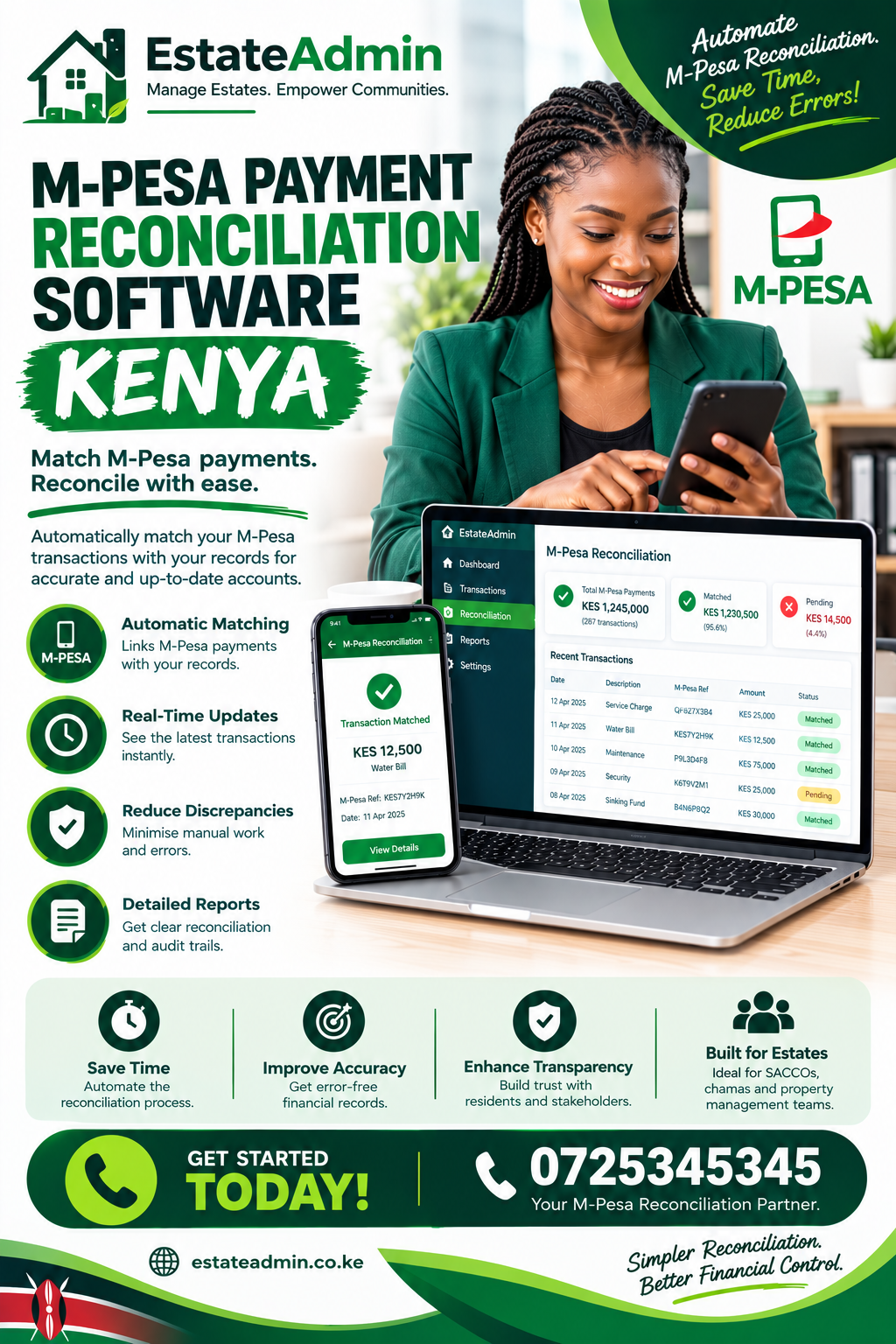
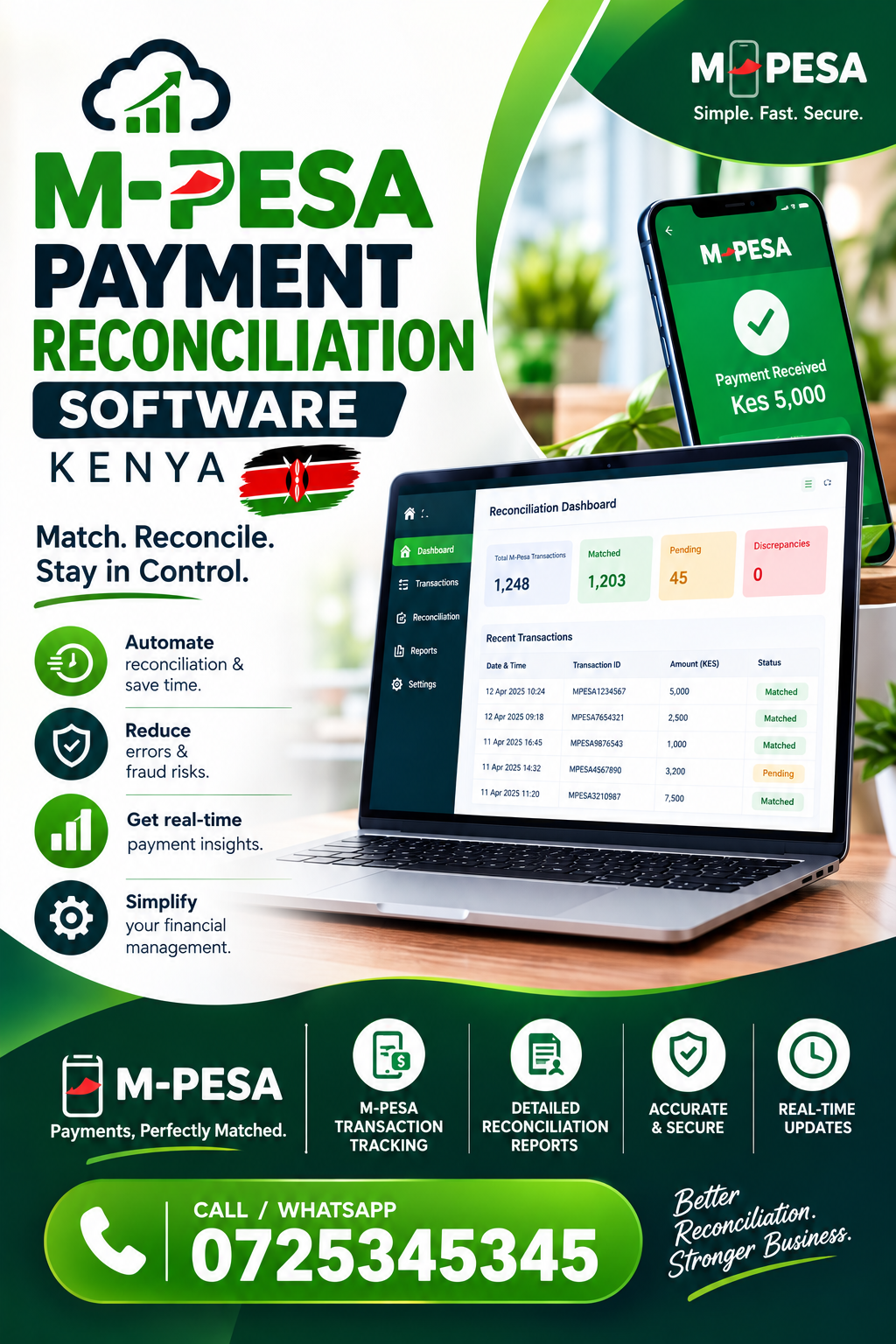
What a Good Reconciliation Dashboard Should Show
A useful dashboard should make important information visible at a glance.
For example:
Today’s payments: KSh 450,000
Reconciled: KSh 425,000
Unmatched: KSh 25,000
Transactions: 184
Exceptions: 12
The exact dashboard design will vary between businesses, but the principle is the same: management should quickly understand payment status.
A platform such as M-Pesa Payment Reconciliation Software Kenya can support decision-making when it presents payment information clearly.
Mobile Payments and the Future of Business Finance
Mobile payments have changed how Kenyan businesses collect money.
The next challenge is ensuring that the records surrounding those payments are equally efficient.
Businesses increasingly need systems that connect payment collection with invoicing, customer management, accounting, reporting, and operational workflows.
This is where M-Pesa Payment Reconciliation Software Kenya becomes relevant.
The value is not simply in seeing that money entered an account. The real value comes from understanding where that money belongs and what it means for the business.
Frequently Asked Questions
What is M-Pesa payment reconciliation?
M-Pesa payment reconciliation is the process of comparing M-Pesa transactions with business records to ensure payments are correctly identified, allocated, and reflected in customer or invoice balances. M-Pesa Payment Reconciliation Software Kenya can automate much of this process.
Why should Kenyan businesses automate payment reconciliation?
Automation can reduce repetitive manual work, improve payment visibility, highlight unmatched transactions, and reduce errors associated with manual data entry. M-Pesa Payment Reconciliation Software Kenya can be particularly useful for businesses processing many transactions.
Can reconciliation software handle partial payments?
A suitable system should support partial-payment scenarios by applying the amount received to the relevant account while maintaining the remaining balance. M-Pesa Payment Reconciliation Software Kenya can form part of a workflow designed around these requirements.
What happens when a payment cannot be matched?
An unmatched transaction should normally be placed into an exception or review queue. Staff can then investigate the payment and assign it to the correct account. M-Pesa Payment Reconciliation Software Kenya can help businesses organize this review process.
Can payment reconciliation improve customer service?
Yes. When payment records are easy to search and customer balances are updated accurately, staff can respond to payment-related questions more quickly. M-Pesa Payment Reconciliation Software Kenya can support better visibility into transaction histories.
Is payment reconciliation useful for small businesses?
Yes. SMEs may have fewer transactions than large organizations, but they often have smaller finance teams. Automating repetitive reconciliation work can free employees to focus on other responsibilities. M-Pesa Payment Reconciliation Software Kenya can support this type of workflow.
What should businesses look for when choosing reconciliation software?
Businesses should consider transaction matching, exception handling, reporting, customer-account integration, permissions, audit trails, usability, scalability, and support. M-Pesa Payment Reconciliation Software Kenya is one way to frame the search around practical business needs.
Does reconciliation replace accounting?
No. Reconciliation is part of financial administration and can work alongside accounting processes. It helps ensure payment records are accurate before they feed into broader financial reporting. M-Pesa Payment Reconciliation Software Kenya can support this process without being treated as a replacement for every accounting function.
Building a Better Payment Management Process
Technology alone does not create good reconciliation.
Businesses also need clear procedures.
A practical process could include:
- Give customers clear payment instructions.
- Use consistent payment references.
- Capture transactions systematically.
- Automate straightforward matching.
- Review exceptions regularly.
- Keep an audit trail.
- Update customer balances promptly.
- Review reconciliation reports.
- Investigate recurring discrepancies.
- Improve matching rules based on real transaction patterns.
The software should support this process rather than complicate it.
For businesses considering M-Pesa Payment Reconciliation Software Kenya, the best starting point is to document how payments are currently received, recorded, matched, corrected, and reported.
Final Thoughts
M-Pesa has made it convenient for Kenyan customers to pay businesses, but convenient payment collection must be supported by accurate financial administration. Businesses need to know not only that money has been received, but also who paid, what the payment was for, which invoice or account it belongs to, and whether the transaction has been correctly recorded.
M-Pesa Payment Reconciliation Software Kenya can help bring these activities into a more structured workflow. By automating routine matching, highlighting exceptions, maintaining transaction histories, and improving reporting, reconciliation software can reduce unnecessary manual work while giving businesses better visibility into their collections.
The strongest implementation starts with the business process. Identify how payments currently move from the customer to the business records, determine where errors or delays occur, and then choose technology that addresses those specific gaps.
For a Kenyan SME, property manager, service provider, retailer, membership organization, or other payment-receiving business, a reliable reconciliation process can make the difference between simply collecting money and actually maintaining accurate, actionable financial records.
The practical goal of M-Pesa Payment Reconciliation Software Kenya is therefore straightforward: make it easier to match payments accurately, resolve exceptions quickly, maintain trustworthy customer balances, and give management a clearer picture of money received.
As transaction volumes grow, these capabilities become increasingly valuable. A well-designed reconciliation process can help businesses spend less time searching through payment records and more time serving customers, managing operations, and making informed financial decisions.