
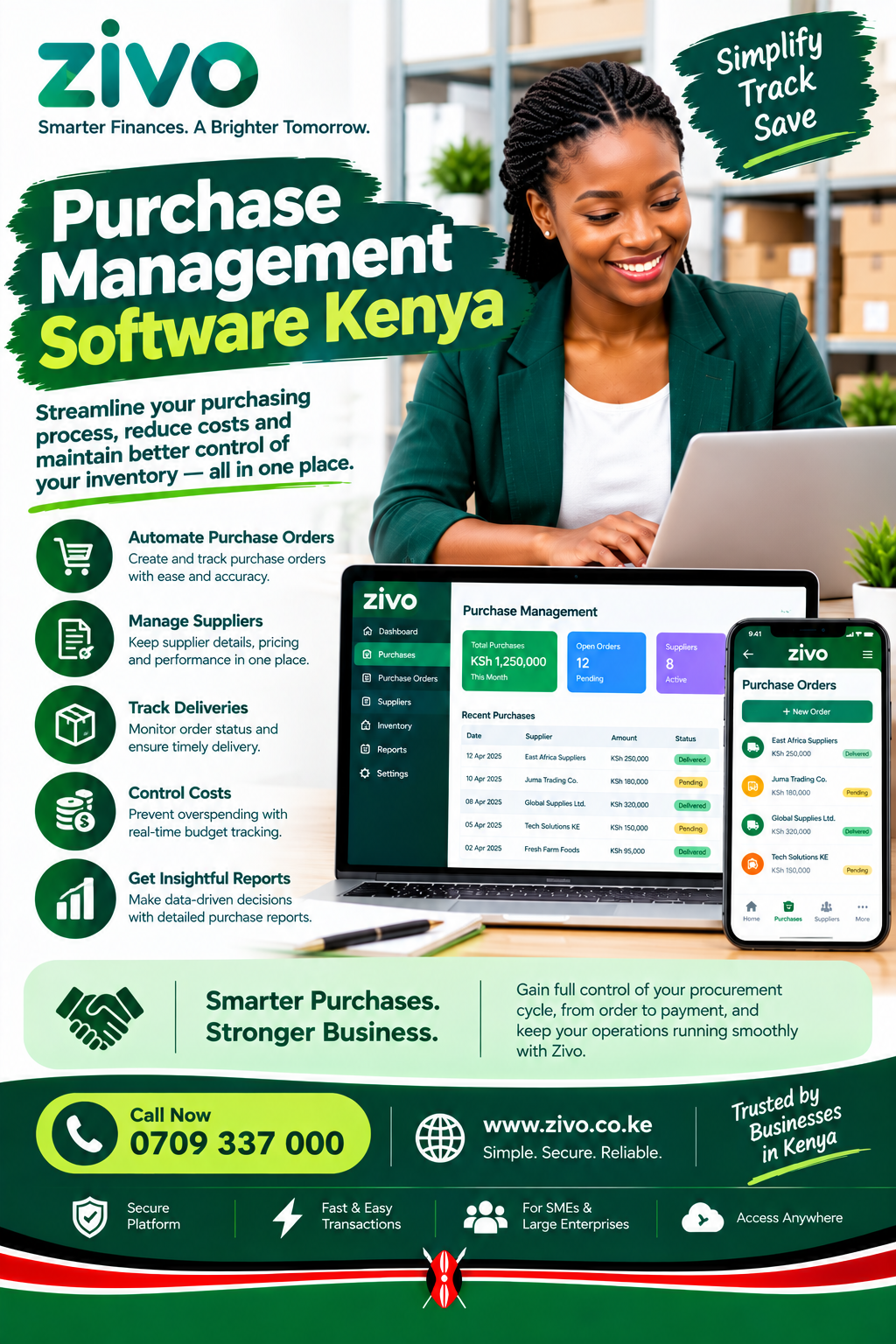
Purchase Management Software Kenya: Streamlining Procurement, Suppliers, Payments and Business Growth
For Kenyan businesses, purchasing is no longer simply about calling a supplier, requesting a quotation and paying an invoice. Modern businesses need visibility, accountability, approval controls, supplier coordination, accurate records and reliable payment tracking. This is why Purchase Management Software Kenya has become an increasingly important solution for SMEs, retailers, distributors, contractors, service companies and growing enterprises. With the right platform, businesses can move from scattered WhatsApp conversations, spreadsheets, paper purchase orders and manual payment follow-ups to a connected purchasing workflow. Zivo provides procurement and supplier controls that bring suppliers, purchase orders, goods receipt, attachments and approval trails into a more structured business process.
What Is Purchase Management Software Kenya?
Purchase Management Software Kenya is technology designed to help businesses plan, request, approve, order, receive and account for goods and services purchased from suppliers. Instead of managing procurement through disconnected spreadsheets, emails, notebooks and messaging applications, businesses can centralize purchasing activities and create a consistent process.
In a growing company, purchasing affects almost every department. Sales depends on having the right stock. Operations depends on materials being available on time. Finance needs accurate invoices and payment records. Management needs to control spending. Customers expect products and services to be delivered without unnecessary delays.
That is why Purchase Management Software Kenya should not be viewed as simply a digital replacement for a purchase order book. It should become part of the wider operating system of the business.
A good procurement platform helps answer important questions:
- What does the business need to buy?
- Who requested the purchase?
- Which supplier will provide it?
- Has the purchase been approved?
- What quantity was ordered?
- What has already been delivered?
- Has the supplier submitted an invoice?
- Has the invoice been approved?
- Has payment been made?
- Which account or payment method was used?
- Is the transaction properly recorded?
- Does the purchase affect stock, cash flow or profitability?
With Purchase Management Software Kenya, these questions can become part of a connected purchasing workflow rather than separate manual investigations.
Why Kenyan Businesses Need Better Purchase Management
Kenyan businesses operate in an environment where suppliers, mobile money, bank payments, WhatsApp communication, delivery schedules and inventory management frequently overlap. A purchasing manager may receive a quotation through WhatsApp, forward it to a director for approval, receive a payment request through another message and later search through M-Pesa statements to confirm whether the supplier was paid.
This process can work for a very small business. However, as transaction volumes increase, it becomes increasingly difficult to maintain accuracy.
Purchase Management Software Kenya provides a structured way to manage procurement while reducing the amount of repetitive administrative work required from staff.
Consider a hardware business purchasing cement, steel, electrical equipment and plumbing materials. Without a centralized system, purchase requests may be communicated verbally, purchase quantities may be written on paper and supplier invoices may be stored in different WhatsApp conversations. When management wants to know how much was spent on a particular supplier, staff may have to search several records.
With Purchase Management Software Kenya, the purchasing process can be organized around identifiable transactions, suppliers, approvals, purchase orders and receiving records.
This becomes especially important when a business has:
- Multiple branches
- Several purchasing staff
- Many suppliers
- Regular stock replenishment
- Multiple approval levels
- High transaction volumes
- Frequent M-Pesa payments
- Several bank or payment accounts
- Different departments requesting purchases
- Multiple warehouses
- Strict financial controls
The Difference Between Manual Purchasing and Digital Procurement
Manual purchasing often depends on people remembering what happened. Digital purchasing depends more on a defined process.
In a manual environment, an employee might say that a purchase was approved because a manager replied “go ahead” on WhatsApp. A finance employee may then pay the supplier and later attempt to match the payment with the original request.
A structured Purchase Management Software Kenya approach allows the organization to define the purchasing process before transactions become complicated.
For example:
Purchase request → Review → Approval → Purchase order → Supplier delivery → Goods receipt → Invoice → Payment → Reconciliation → Reporting
The exact process will vary between businesses, but the important principle is that each stage should be visible and accountable.
This helps management identify bottlenecks. If purchases are regularly delayed at the approval stage, management can investigate the approval process. If suppliers frequently deliver less than ordered, receiving records can highlight the problem. If invoices remain unpaid, finance can identify outstanding transactions.
How Zivo Supports Purchase Management
Zivo is positioned as a connected business platform rather than a standalone procurement application. Its current solution scope includes procurement and supplier controls, with suppliers, purchase orders, goods receipt, attachments and approval trails behind business spending.
This makes Purchase Management Software Kenya relevant for businesses that want purchasing connected to finance and operational workflows.
Zivo’s broader finance and spend controls include itemized requests, suppliers and payees, receipts, departments, approval status, payment accounts, payment vouchers and M-Pesa payouts.
That connection matters because purchasing does not end when a purchase order is created.
A purchase has financial consequences.
If a business orders KSh 250,000 worth of stock, management needs to know:
- Why the stock was purchased.
- Which supplier provided it.
- Who approved the purchase.
- How much was ordered.
- How much was received.
- What invoice was submitted.
- How much was paid.
- Which payment account was used.
- Whether the purchase affected cash flow.
- Whether the goods were added to available stock.
This is where Purchase Management Software Kenya can support better purchasing discipline.
Key Features of Purchase Management Software Kenya
A useful procurement platform should provide more than purchase order creation. It should support the wider purchasing lifecycle.
1. Supplier Management
Suppliers are central to purchasing.
A business may have dozens, hundreds or even thousands of suppliers. Keeping supplier information in notebooks or individual employee phones makes it difficult to maintain consistency.
Purchase Management Software Kenya should help businesses maintain supplier-related information alongside purchasing activities.
Supplier records can support:
- Supplier identification
- Purchase history
- Contact information
- Transaction records
- Purchase orders
- Invoices
- Payment status
- Delivery history
- Supplier communication
- Performance review
A centralized supplier record also reduces duplication.
2. Purchase Requests
Not every employee should be able to order anything at any time.
A purchasing process normally begins with a request.
For example, a warehouse manager may request additional stock because inventory has fallen below the desired level. A project manager may request construction materials. An office manager may request stationery or equipment.
With Purchase Management Software Kenya, purchase requests can be treated as structured business activities rather than informal messages.
A purchase request can include:
- Requested item
- Quantity
- Estimated cost
- Department
- Reason for purchase
- Required date
- Preferred supplier
- Supporting documents
- Requesting employee
This gives approvers enough information to make a better decision.
3. Approval Workflows
Approval is one of the most important controls in procurement.
A company may decide that purchases below KSh 20,000 require one approval, purchases between KSh 20,000 and KSh 100,000 require two approvals, and larger purchases require senior management authorization.
Purchase Management Software Kenya can support organizations that need stronger purchasing authorization processes.
Approval workflows can reduce unauthorized expenditure and improve accountability.
Instead of asking, “Who approved this purchase?” management can refer to the transaction history.
4. Purchase Orders
A purchase order creates a formal record of what the business intends to buy.
A typical purchase order may contain:
- Supplier
- Purchase order number
- Products or services
- Quantities
- Prices
- Taxes where applicable
- Delivery information
- Payment terms
- Approval status
Purchase Management Software Kenya can make purchase orders part of a larger procurement workflow.
This is especially useful for businesses that make repeated purchases from multiple suppliers.
5. Goods Receipt
Ordering goods does not mean the goods have been received.
This distinction is critical.
Suppose a business orders 500 units of a product but receives only 450. If the business records the purchase simply because the purchase order exists, its records may become inaccurate.
A structured receiving process helps businesses distinguish between:
Ordered quantity and received quantity.
Purchase Management Software Kenya can therefore be valuable for businesses that need stronger controls between ordering and receiving.
Zivo’s procurement scope specifically includes goods receipt alongside suppliers and purchase orders.
6. Supporting Documents
Procurement transactions often involve quotations, invoices, delivery notes, receipts and other documents.
Keeping these documents separately creates unnecessary administrative work.
Purchase Management Software Kenya can help businesses associate supporting information with purchasing transactions.
This makes future review easier.
For example, if an auditor or manager asks why a payment of KSh 85,000 was made to a supplier, staff should be able to trace the transaction back to its purchasing documentation.
7. Payment Tracking
Purchasing and payment are closely connected.
A supplier may send an invoice after delivering goods. Finance then needs to determine whether the invoice is approved, whether funds are available and whether payment has already been processed.
Purchase Management Software Kenya can help create a more visible connection between procurement and financial activity.
Zivo’s finance controls include payment accounts, payment vouchers and M-Pesa payouts, making spend management part of a wider financial workflow.
8. M-Pesa Reconciliation
M-Pesa is an important part of business payments in Kenya.
However, receiving an M-Pesa confirmation does not automatically mean that a business has a complete accounting record.
The finance team still needs to understand:
- Who was paid?
- Why were they paid?
- Which purchase does the payment relate to?
- Was the amount correct?
- Was the payment approved?
- Has it been reconciled?
Purchase Management Software Kenya becomes more useful when procurement is connected with payment and reconciliation workflows.
Zivo’s current finance functionality includes M-Pesa, bank accounts, settlements and reconciliation.
Purchase Management Software Kenya for Retail Businesses
Retail businesses are among the strongest users of structured purchasing systems because stock availability directly affects sales.
A retailer may purchase hundreds of products every month.
If purchasing is not connected to stock, the business can experience:
- Stockouts
- Overstocking
- Emergency purchases
- Poor supplier planning
- Higher costs
- Lost sales
- Unnecessary cash tied up in inventory
Purchase Management Software Kenya can help retailers think of purchasing as part of the inventory cycle.
The basic cycle is:
Sales → Stock reduction → Reorder point → Purchase request → Approval → Purchase order → Supplier delivery → Goods receipt → Stock increase
Zivo’s purchase and inventory capabilities are designed around connecting purchasing, suppliers, stock and payment workflows. Its current materials describe purchase order generation from low-stock alerts and supplier transaction tracking.
Purchase Management for Distributors
Distributors usually purchase goods in larger volumes than ordinary retailers.
They may also work with many suppliers while supplying products to numerous customers.
For such businesses, Purchase Management Software Kenya can help bring greater structure to procurement.
Imagine a distributor selling electrical products.
The business may purchase:
- Cables
- Switches
- Sockets
- Lighting equipment
- Circuit breakers
- Conduits
- Accessories
If purchasing is managed through spreadsheets, it becomes difficult to know which products are being purchased from which supplier and at what frequency.
A structured procurement platform creates better visibility.
Purchase Management for Contractors
Construction and contracting businesses have unique procurement needs.
A project may require:
- Cement
- Steel
- Timber
- Sand
- Aggregates
- Electrical materials
- Plumbing materials
- Paint
- Equipment
- Safety supplies
Each purchase affects the project budget.
Purchase Management Software Kenya can support businesses that want procurement to be more structured and traceable.
Instead of simply recording an expense after money has been spent, the business can establish a purchasing process before the expenditure occurs.
This improves budget discipline.
Purchase Management for Service Businesses
Service businesses also purchase goods and services.
A cleaning company may purchase cleaning chemicals and protective equipment. An IT company may purchase laptops, routers and networking equipment. A professional services firm may purchase office equipment, subscriptions or outsourced services.
Purchase Management Software Kenya is therefore relevant beyond traditional retail and wholesale businesses.
The key principle is simple:
Every business that spends money on suppliers can benefit from structured purchasing controls.
Reducing Procurement Errors
Procurement errors can be expensive.
Common examples include:
- Duplicate purchases
- Wrong quantities
- Wrong supplier
- Incorrect prices
- Unauthorized orders
- Duplicate payments
- Missing invoices
- Missing delivery records
- Incorrect stock records
- Poor documentation
Purchase Management Software Kenya can reduce reliance on informal processes by creating structured records for procurement.
Digital workflows do not eliminate human mistakes completely, but they can make errors easier to identify.
For example, a receiving process can help identify a mismatch between what was ordered and what arrived.
Improving Supplier Relationships
Supplier relationships depend heavily on communication and reliability.
Suppliers want to know:
- Whether an order has been approved
- When they should deliver
- Whether an invoice has been received
- When payment will be made
- Whether there is a problem with the transaction
A business that regularly loses invoices or delays payments may eventually experience poor supplier relationships.
Purchase Management Software Kenya can support a more organized approach to supplier transactions.
Zivo’s current purchasing content also emphasizes connecting supplier conversations, payment requests, M-Pesa tracking and reconciliation into a single workflow.
Connecting WhatsApp and Procurement
WhatsApp is deeply embedded in Kenyan business communication.
Suppliers may send:
- Quotations
- Invoices
- Delivery notes
- Payment reminders
- Order confirmations
- Product availability updates
The challenge is that ordinary WhatsApp conversations can become difficult to manage as a business grows.
Zivo’s purchase management approach includes a shared WhatsApp inbox designed to help teams collaborate around supplier conversations.
Purchase Management Software Kenya can therefore be viewed as part of a broader communication-to-transaction workflow rather than an isolated procurement tool.
Purchase Orders and Inventory Control
A purchase order is particularly valuable when connected to inventory.
Suppose a retailer sells 1,000 units of a product per month and wants to maintain two weeks of safety stock.
When inventory falls below the defined threshold, management can initiate replenishment.
Purchase Management Software Kenya supports the concept of using purchasing as a proactive activity rather than waiting until stock completely runs out.
Zivo’s published purchase and inventory material describes generating purchase orders from low-stock alerts.
This can help businesses reduce emergency procurement.
Purchase Management and Cash Flow
Every purchase affects cash flow.
A business can be profitable on paper but still struggle if too much cash is tied up in stock or supplier commitments.
Purchase Management Software Kenya helps frame procurement as part of financial management.
Before approving a purchase, management should consider:
- Current cash balance
- Expected customer collections
- Existing supplier obligations
- Stock requirements
- Purchase urgency
- Expected sales
- Payment terms
Zivo’s finance control room includes business wallet information, M-Pesa and bank accounts, settlements, reconciliation, cash flow, profit, VAT and outstanding balances.
This broader financial visibility is valuable because procurement decisions should not be made independently of cash flow.
How Purchase Management Improves Accountability
Accountability is one of the strongest reasons to digitize procurement.
A good purchasing process should make it possible to identify:
- Who requested the purchase
- Who approved it
- Who placed the order
- Who received the goods
- Who processed the invoice
- Who authorized payment
- Which account was used
Purchase Management Software Kenya can help businesses create this chain of accountability.
This becomes increasingly important as organizations grow.
In a five-person business, everyone may know what happened.
In a company with 50, 100 or 500 employees, relying on memory is not enough.
Purchase Management for Multi-Branch Businesses
Multi-branch businesses have another challenge: purchasing visibility.
A head office may need to understand what individual branches are purchasing and why.
Without centralized controls, one branch may overstock a product while another branch experiences shortages.
Purchase Management Software Kenya can help management establish standardized procurement procedures across locations.
The business can define:
- Approved suppliers
- Approval levels
- Purchasing responsibilities
- Receiving procedures
- Documentation standards
- Payment controls
This creates greater consistency.
Purchase Management and Financial Reporting
Procurement data is useful beyond the purchasing department.
Finance can use purchasing records to understand expenditure.
Management can analyze supplier spending.
Operations can review delivery performance.
Inventory teams can monitor replenishment.
Purchase Management Software Kenya therefore becomes a source of operational intelligence.
Useful procurement reports may include:
| Report | Business Value |
|---|---|
| Purchase orders | Shows committed purchases |
| Supplier purchases | Shows spending by supplier |
| Pending approvals | Identifies procurement bottlenecks |
| Goods received | Confirms delivered quantities |
| Outstanding invoices | Supports payment planning |
| Purchase history | Helps analyze buying patterns |
| Supplier performance | Supports supplier decisions |
| Payment records | Improves financial visibility |
Controlling Unauthorized Spending
One of the biggest weaknesses of informal procurement is unauthorized spending.
An employee may make a purchase without management approval because they believe the item is urgently required.
Later, finance receives an invoice with no supporting documentation.
Purchase Management Software Kenya can help businesses establish authorization procedures before money leaves the business.
This does not mean every small purchase needs complicated bureaucracy.
Instead, businesses can create appropriate approval rules based on transaction size, department or purchase type.
Improving Procurement Efficiency
Efficiency is not simply about doing things faster.
It is about reducing unnecessary steps.
Consider a traditional process:
- Employee sends WhatsApp request.
- Manager asks for quotation.
- Employee searches for quotation.
- Manager approves in WhatsApp.
- Procurement creates a spreadsheet entry.
- Purchase order is created manually.
- Supplier delivers goods.
- Delivery note is misplaced.
- Invoice arrives later.
- Finance searches for the purchase.
- Payment is made.
- Finance later reconciles the payment.
A structured Purchase Management Software Kenya process can reduce duplication by connecting these stages.
The objective is not merely to digitize paperwork. It is to create a connected workflow.
Purchase Management and Supplier Performance
Not every supplier performs equally.
One supplier may consistently deliver on time. Another may frequently deliver late. Another may provide competitive prices but poor quality.
Businesses need evidence when evaluating suppliers.
Purchase Management Software Kenya can support data-driven supplier management when purchasing records are centralized.
Management can consider:
- Delivery reliability
- Purchase frequency
- Pricing
- Quality
- Payment terms
- Responsiveness
- Order accuracy
This can help businesses negotiate better terms and make more informed supplier decisions.
Purchase Management and Cost Control
Cost control starts before the purchase is made.
If management only examines expenses after payment, opportunities to control unnecessary spending may already have been lost.
Purchase Management Software Kenya can support a preventive approach to purchasing.
For example, management can establish:
- Preferred suppliers
- Spending limits
- Approval thresholds
- Purchase categories
- Budget controls
- Required supporting documents
This makes procurement more deliberate.
Why M-Pesa Matters in Kenyan Procurement
Kenyan businesses frequently use M-Pesa for supplier payments.
However, the convenience of mobile money can create reconciliation challenges when transaction records are not connected to business records.
Purchase Management Software Kenya can be particularly useful when purchasing and payment tracking are part of the same workflow.
Zivo’s published purchase management material describes connecting supplier conversations with payment requests, M-Pesa tracking and reconciliation.
This reduces the need for finance teams to manually piece together payment information from different sources.
Purchase Management for SMEs
Small businesses often believe that procurement software is only necessary for large corporations.
That is not always the case.
An SME may have only five employees but still make hundreds of purchases each year.
As the business grows, the owner may no longer be involved in every transaction.
Purchase Management Software Kenya can help establish purchasing discipline before the business becomes difficult to control.
Early adoption can make growth easier because processes are already documented and standardized.
How to Choose Purchase Management Software Kenya
Before choosing a procurement platform, Kenyan businesses should evaluate several areas.
Supplier Management
Can the platform organize supplier information and purchase history?
Purchase Orders
Can the business create and track purchase orders?
Approvals
Can different purchases follow appropriate approval workflows?
Goods Receipt
Can the business record what was actually received?
Documents
Can quotations, invoices and supporting documents be connected to transactions?
Payments
Can purchase transactions connect to payment records?
M-Pesa
Does the solution support workflows relevant to Kenyan mobile-money transactions?
Reporting
Can management understand spending patterns?
Integration
Can purchasing connect to finance, inventory and operations?
Purchase Management Software Kenya should therefore be evaluated based on the entire procurement lifecycle rather than one feature.
Why Zivo Is Relevant for Kenyan Businesses
Zivo is designed around the idea that business activities should be connected.
Its current solution scope covers procurement and supplier control, finance and spend control, and a broader finance control room.
The platform’s published purchase management content highlights supplier communication, structured supplier requests, purchase order generation, M-Pesa payment tracking, reconciliation and approval workflows.
Purchase Management Software Kenya therefore fits naturally into a wider digital transformation strategy.
Instead of purchasing being isolated from finance, purchasing can become part of the same business workflow.
Common Problems Solved by Purchase Management Software
Businesses considering procurement automation usually face several recurring problems.
Problem 1: Lost Purchase Requests
Requests sent through individual WhatsApp accounts can easily be missed.
Problem 2: Delayed Approvals
Managers may not know which purchases are waiting for authorization.
Problem 3: Missing Documentation
Invoices and delivery notes may be difficult to locate.
Problem 4: Payment Confusion
Finance may struggle to determine whether a supplier has already been paid.
Problem 5: Poor Inventory Planning
Purchases may be made too late or in excessive quantities.
Problem 6: Weak Supplier Visibility
Management may not know which suppliers receive the largest share of business spending.
Problem 7: Manual Reconciliation
Finance teams may spend hours matching payments with invoices.
A structured Purchase Management Software Kenya platform addresses these challenges by bringing more purchasing information into a consistent process.
Example: A Kenyan Wholesale Business
Consider a Nairobi-based wholesaler that purchases fast-moving consumer products from 15 suppliers.
Before implementing digital procurement, staff manage orders through:
- Excel
- Paper delivery notes
- Email invoices
- M-Pesa confirmations
- Bank statements
The owner wants to know how much was purchased from each supplier during the month.
Staff must combine multiple sources.
After introducing a structured Purchase Management Software Kenya process, purchase orders, supplier transactions, receiving records and payment information can be organized around a common workflow.
The owner can then focus on questions that actually matter:
- Which suppliers are most important?
- Which products require frequent replenishment?
- Where are prices increasing?
- Which invoices remain unpaid?
- Which purchases are awaiting approval?
Example: A Kenyan Hardware Store
A hardware store may purchase hundreds of products every month.
Some items move quickly while others sell slowly.
A good procurement process helps the business avoid purchasing too much of slow-moving stock.
Purchase Management Software Kenya can help the business organize supplier orders around actual operational requirements.
Low-stock alerts can support replenishment decisions, while purchase history can help management identify buying patterns.
Example: A Growing Service Company
A service company may have technicians working across Nairobi and other counties.
Technicians may request tools, spare parts or materials.
Without structured purchasing, requests can become scattered.
Purchase Management Software Kenya can help the business introduce a consistent request-and-approval workflow.
The result is greater visibility without requiring management to personally approve every small operational decision.
Procurement, Profitability and Growth
Purchasing has a direct impact on profitability.
If a business purchases too expensively, margins fall.
If it purchases too much stock, cash becomes tied up.
If it purchases too little, customers may face stockouts.
If it pays suppliers late, relationships may suffer.
Purchase Management Software Kenya helps position procurement as a strategic business function.
A modern procurement process should therefore help management balance:
Cost + Quality + Quantity + Timing + Cash Flow + Supplier Reliability
The Future of Digital Procurement in Kenya
Kenyan businesses are becoming increasingly digital.
Mobile payments, online communication, cloud applications and automated business workflows are changing how SMEs operate.
This makes Purchase Management Software Kenya increasingly relevant to businesses that want to scale without adding unnecessary administrative complexity.
The future of procurement will not simply involve replacing paper purchase orders with electronic purchase orders.
It will involve connecting purchasing to:
- Inventory
- Finance
- Payments
- Supplier communication
- Approval workflows
- Business reporting
- Cash flow
- Operational planning
Frequently Asked Questions
What is Purchase Management Software Kenya?
Purchase Management Software Kenya refers to digital technology that helps Kenyan businesses manage supplier purchases, requests, approvals, purchase orders, receiving, invoices, payments and procurement records.
Why should an SME use purchase management software?
An SME can use procurement software to reduce manual work, improve approval controls, organize supplier transactions and create better visibility into business spending.
Can purchase management software manage suppliers?
Yes. A suitable platform can centralize supplier information and connect suppliers with purchase orders, deliveries, invoices and payments.
Can it help with purchase approvals?
Yes. Approval workflows allow businesses to define who should authorize purchases before expenditure is committed.
Can purchase management software support M-Pesa?
A platform designed for the Kenyan market can incorporate M-Pesa-related payment and reconciliation workflows. Zivo’s current finance and purchasing materials specifically describe M-Pesa tracking and reconciliation.
Can purchase management software help with inventory?
Yes. Purchasing and inventory are closely connected. Zivo’s published inventory material describes purchase orders and replenishment workflows connected to stock levels.
Is purchase management only for large companies?
No. SMEs can benefit from procurement controls because structured processes become increasingly valuable as transaction volumes and staff numbers increase.
Can Zivo connect procurement with finance?
Zivo’s current solution scope connects procurement and supplier controls with finance and spend controls, including suppliers, purchase orders, goods receipt, payment accounts, payment vouchers, M-Pesa payouts and reconciliation-related finance capabilities.
Benefits of Implementing Purchase Management Software
The benefits can be summarized into several major areas:
| Benefit | Impact |
|---|---|
| Better approval controls | Reduces unauthorized purchases |
| Supplier visibility | Improves supplier relationships |
| Purchase order tracking | Improves procurement accountability |
| Goods receipt | Improves receiving accuracy |
| Document management | Reduces lost paperwork |
| Payment visibility | Helps finance track obligations |
| M-Pesa workflows | Supports Kenyan payment processes |
| Inventory connection | Reduces stock shortages |
| Reporting | Improves management decisions |
| Cash-flow visibility | Supports better spending decisions |
How to Successfully Implement Purchase Management Software
Technology alone does not create good procurement.
Businesses should also establish clear procedures.
Step 1: Map the Current Process
Document how purchases currently happen.
Step 2: Identify Weaknesses
Look for delays, duplicated work, missing documents and approval gaps.
Step 3: Define Approval Levels
Decide which employees can approve different types or values of purchases.
Step 4: Organize Supplier Data
Create a reliable supplier database.
Step 5: Standardize Purchase Orders
Use consistent purchasing documentation.
Step 6: Establish Receiving Procedures
Make sure received quantities are verified.
Step 7: Connect Purchases to Payments
Ensure finance can trace payments back to purchasing transactions.
Step 8: Monitor Reports
Use procurement information to identify trends and improve decision-making.
A properly implemented Purchase Management Software Kenya solution should become part of the company’s daily workflow rather than another application employees occasionally open.
Why Businesses Should Move Away from Spreadsheet-Only Procurement
Spreadsheets remain useful for analysis, but they can become difficult to manage as the number of transactions increases.
Common spreadsheet problems include:
- Multiple versions
- Manual data entry
- Formula errors
- Limited approval controls
- Weak audit trails
- Duplicate records
- Difficulty connecting payments
- Difficulty managing documents
- Poor real-time visibility
Purchase Management Software Kenya can reduce reliance on spreadsheets by placing procurement activities into a structured system.
Spreadsheets can still be used for analysis where appropriate, but they should not necessarily be the only source of procurement truth.
Purchase Management and Business Transparency
Transparency is particularly important when multiple employees handle money.
Management should be able to see where money is going.
A structured Purchase Management Software Kenya workflow provides greater visibility into procurement activity.
This can strengthen internal controls and make financial reviews easier.
Purchase Management and Business Scalability
A business may begin with one person handling all procurement.
As it grows, responsibilities become distributed.
The owner may delegate:
- Supplier communication
- Purchase requests
- Purchase order preparation
- Goods receiving
- Invoice processing
- Payment preparation
- Reconciliation
This is where process automation becomes increasingly valuable.
Purchase Management Software Kenya can provide the structure needed to support this transition.
The business becomes less dependent on one person’s memory and more dependent on a repeatable system.
Final Thoughts
Procurement is one of the most important operational functions in any business because every purchase affects cash flow, stock, supplier relationships, profitability and customer service. Businesses that continue to manage purchasing through disconnected WhatsApp messages, spreadsheets, paper records and manual reconciliation can find it increasingly difficult to maintain control as they grow.
A modern Purchase Management Software Kenya platform can bring purchasing into a structured workflow covering supplier requests, approvals, purchase orders, receiving, supporting documentation, payments and reconciliation.
Zivo’s current procurement offering includes suppliers, purchase orders, goods receipt, attachments and approval trails, while its broader finance controls include suppliers and payees, receipts, departments, payment accounts, payment vouchers, M-Pesa payouts and financial reconciliation capabilities.
The platform’s published purchase management guidance also highlights shared WhatsApp communication, structured supplier requests, purchase order generation, M-Pesa payment tracking, reconciliation and multi-level approvals.
For Kenyan SMEs, the goal should not simply be to digitize purchase orders. The bigger objective is to create a connected procurement process in which every purchase can be requested, reviewed, approved, ordered, received, paid and reconciled with greater visibility.
When procurement is connected to finance, inventory and supplier management, management gains a clearer picture of where business money is going and why.
That is the real value of Purchase Management Software Kenya: not simply replacing paperwork, but helping businesses create purchasing processes that are more organized, accountable and scalable.
For businesses ready to modernize procurement, Purchase Management Software Kenya can be positioned as an important component of a broader digital business strategy—one that connects purchasing decisions with suppliers, payments, stock, financial control and long-term growth.
SEO Details
Primary Keyword: Purchase Management Software Kenya
Suggested SEO Title: Purchase Management Software Kenya | Streamline Procurement with Zivo
Suggested Meta Description: Discover how Purchase Management Software Kenya helps businesses manage suppliers, purchase orders, approvals, goods receipt, payments, M-Pesa reconciliation and procurement efficiently with Zivo.
Suggested URL Slug: /purchase-management-software-kenya/
Search Intent: Commercial / Transactional / Informational
Related Keywords:
- Purchase management system Kenya
- Procurement software Kenya
- Procurement management software Kenya
- Purchase order software Kenya
- Supplier management software Kenya
- Supplier payment management software
- Procurement automation Kenya
- Purchase order management system
- Inventory and purchasing software Kenya
- M-Pesa reconciliation software Kenya
- Business management software Kenya
- SME procurement software Kenya
- Digital procurement system Kenya
- Supplier management system Kenya
- Purchasing software for Kenyan businesses