
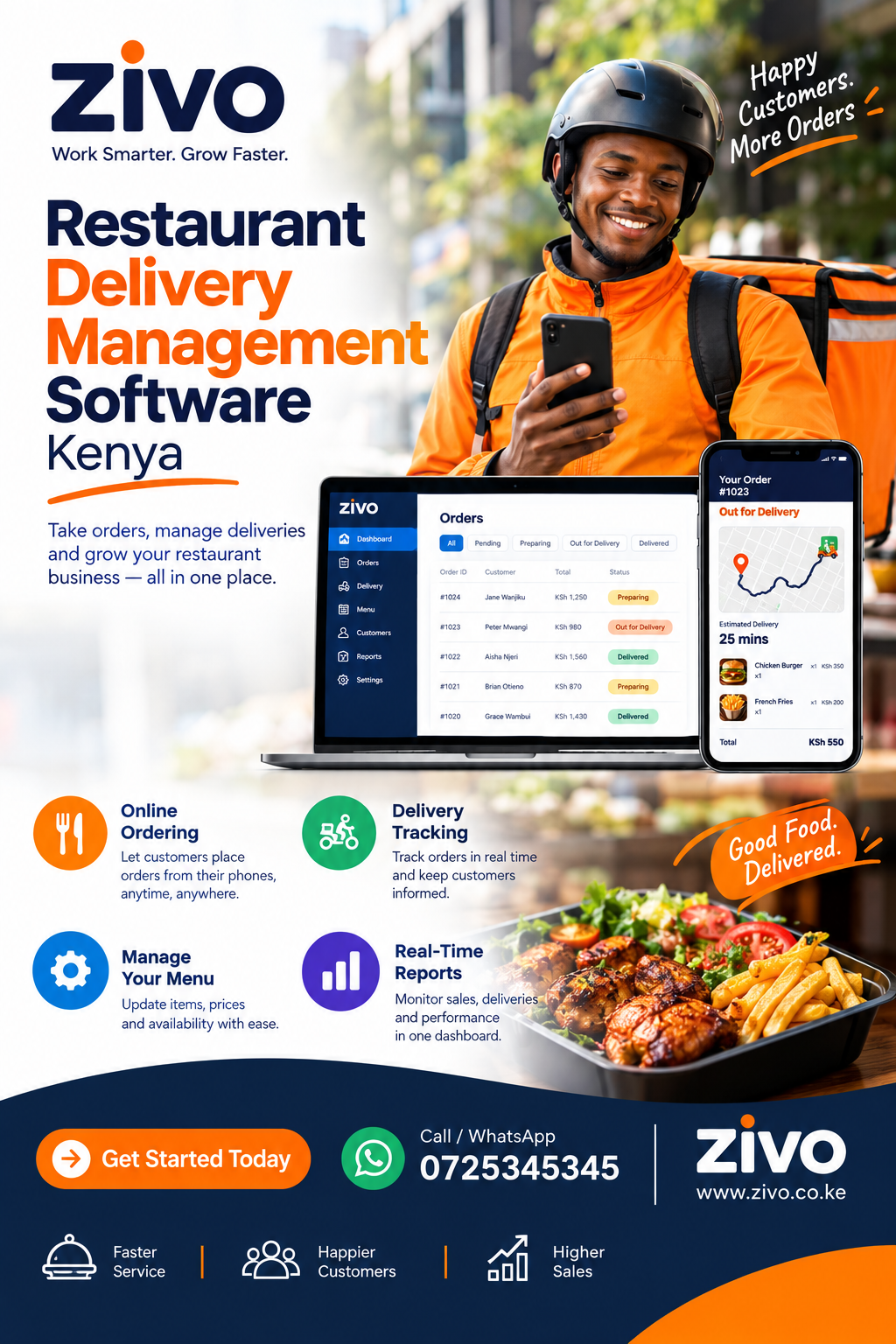
Restaurant Delivery Management Software Kenya: Complete Guide for Restaurants
Running a restaurant with delivery services requires more than preparing food and sending a rider to a customer’s location. Orders can arrive through WhatsApp, phone calls, social media, websites and walk-in customers, while payments may be made through M-Pesa, cash or other channels. Restaurant Delivery Management Software Kenya can help restaurants connect these activities so that an order can move from customer request to payment, preparation, dispatch and delivery without relying entirely on notebooks, spreadsheets and scattered messages. This guide explains what the software does, the features restaurants should consider, how it can support M-Pesa and delivery operations, and how Kenyan restaurants can choose a system that fits their actual workflow.
For a small takeaway, managing five deliveries a day manually may seem straightforward. The situation changes when orders increase during lunch, evenings, weekends or public holidays. Staff have to know which orders are paid, which are being prepared, which rider has collected each order and which customers are still waiting. Restaurant Delivery Management Software Kenya provides a structured way to organize these steps and keep important order information accessible to the people responsible for completing the delivery.
A restaurant does not necessarily need a complicated technology stack. What matters is having a reliable process. Restaurant Delivery Management Software Kenya can be particularly useful when a restaurant wants to connect ordering, payments, fulfilment, customer information and delivery status instead of treating each activity as a separate task.
What Is Restaurant Delivery Management Software?
Restaurant Delivery Management Software Kenya is a digital system designed to help restaurants organize delivery orders and the activities surrounding them. Depending on the platform, it may cover order capture, customer records, payment confirmation, order preparation, rider assignment, delivery status, receipts, reporting and financial reconciliation.
The key idea is simple: a delivery order should have a clear history from the moment it is received until the customer gets it.
For example, a typical workflow could look like this:
- Customer places an order.
- Restaurant confirms the order.
- Payment is requested or verified.
- Kitchen prepares the food.
- Order is marked ready.
- Rider is assigned.
- Rider collects the order.
- Customer receives delivery.
- Order is closed.
- Payment and delivery information remain in the business record.
Restaurant Delivery Management Software Kenya can make these stages visible to staff and managers. Instead of asking several people whether an order has been prepared or collected, a manager can check its current status.
That visibility becomes increasingly important as order volumes grow.
Why Restaurant Delivery Operations Become Difficult
Delivery looks simple from the customer’s perspective. The customer chooses food, pays and waits. Behind that experience, however, several separate activities must happen correctly.
Restaurant Delivery Management Software Kenya can help coordinate those activities, but it is useful to understand the problems it is designed to solve first.
Orders Come Through Different Channels
A restaurant may receive one order through WhatsApp, another by telephone and another through a website or social media.
When these channels are managed separately, staff may have difficulty maintaining one consistent queue.
Common problems include:
- Missing an order in a busy WhatsApp conversation
- Entering an order incorrectly
- Forgetting a customer address
- Failing to record delivery charges
- Preparing an order before payment is confirmed
- Sending the wrong order to a rider
- Forgetting to update the customer
- Losing the order history after delivery
Restaurant Delivery Management Software Kenya can bring delivery information into a more structured workflow so that staff have one place to check what needs attention.
Payment Confirmation Can Create Delays
Kenyan restaurants frequently deal with mobile-money payments. The Central Bank of Kenya’s current mobile-payments data shows the scale of mobile-money activity in the country, with more than 94 million registered mobile-money accounts reported in July 2026.
For a restaurant, however, the issue is not simply accepting payment. The important question is whether the payment is connected to the correct order.
Restaurant Delivery Management Software Kenya can help establish a workflow in which payment information remains connected to the customer’s order rather than being stored separately in messages or screenshots.
Delivery Status Is Easy to Lose Track Of
Consider a restaurant handling 30 delivery orders during a busy evening.
The manager may need to know:
- Which orders are still waiting for preparation?
- Which meals are ready?
- Which riders are available?
- Which orders have been collected?
- Which deliveries are delayed?
- Which customers have already received their food?
- Which paid orders remain undelivered?
Restaurant Delivery Management Software Kenya can make these statuses easier to monitor when the system provides delivery tracking and operational queues.
Key Features to Look For
Not every restaurant needs every software feature. A useful system should match the restaurant’s size, delivery model, staffing and order volume.
Restaurant Delivery Management Software Kenya should ideally support the most important parts of the restaurant’s delivery workflow without creating unnecessary complexity.
1. Centralized Order Management
The first requirement is a clear order record.
A useful order record should contain information such as:
- Customer name
- Customer phone number
- Items ordered
- Quantities
- Special instructions
- Delivery location
- Delivery fee
- Order total
- Payment status
- Order status
- Assigned rider
- Order time
Restaurant Delivery Management Software Kenya becomes more useful when staff can see these details without searching through multiple conversations.
2. Customer Records
Restaurants should not treat every delivery as an isolated transaction.
A customer record can help the business maintain:
- Contact details
- Previous orders
- Delivery addresses
- Payment history
- Customer notes
- Preferences
- Communication history
Restaurant Delivery Management Software Kenya can support better customer service when staff can quickly understand who placed an order and what needs to happen next.
For example, if a regular customer orders every Friday evening, the restaurant should not need to ask for basic information repeatedly.
3. Payment Tracking
Payment tracking is particularly important for delivery businesses.
The system should distinguish between:
- Payment requested
- Payment pending
- Payment confirmed
- Cash on delivery
- Partially paid
- Refunded
- Cancelled
Restaurant Delivery Management Software Kenya can reduce confusion when the payment state is visible beside the order rather than being maintained in a separate spreadsheet.
4. M-Pesa Integration
M-Pesa is an important consideration for Kenyan restaurants. A delivery workflow should make it easy to identify which payment belongs to which order.
A restaurant evaluating software should ask:
- Does the system support M-Pesa?
- Can customers receive a payment request?
- Is payment confirmation recorded?
- Can exceptions be reconciled?
- Are receipts generated?
- Can managers see unpaid orders?
- Can payments be connected to customer records?
Restaurant Delivery Management Software Kenya should be evaluated partly on how well its payment workflow fits the restaurant’s existing operations.
Zivo, for example, currently describes workflows connecting invoices, M-Pesa STK collection, receipts and paid work, with delivery jobs remaining visible until completion.
5. Delivery Status Tracking
A basic status system can make a major difference.
A restaurant might use:
| Status | Meaning |
|---|---|
| New | Order has been received |
| Confirmed | Restaurant accepted the order |
| Preparing | Kitchen is preparing food |
| Ready | Food is ready for collection |
| Assigned | Rider has been selected |
| Picked Up | Rider has collected the order |
| In Transit | Delivery is on the way |
| Delivered | Customer received the order |
| Cancelled | Order will not be completed |
Restaurant Delivery Management Software Kenya can make these stages easier to follow and report on.
6. Rider Management
Restaurants using internal riders need a way to manage assignments.
Useful rider information may include:
- Rider name
- Phone number
- Availability
- Assigned orders
- Completed deliveries
- Pending deliveries
- Delivery areas
- Delivery fees
- Working schedule
Restaurant Delivery Management Software Kenya can be especially valuable when a restaurant has several riders working simultaneously.
The goal is not necessarily to build a sophisticated logistics company. It is to make ownership clear.
When a manager sees that Order #1045 is ready but unassigned, action can be taken immediately.
7. Delivery Zones and Charges
Restaurants often serve different areas at different delivery costs.
For example:
| Area | Possible business consideration |
|---|---|
| Nearby estate | Lower delivery charge |
| CBD | Traffic and parking considerations |
| Suburbs | Longer travel distance |
| Outlying areas | Higher delivery cost |
| Outside service zone | Delivery may not be available |
Restaurant Delivery Management Software Kenya can help businesses structure delivery charges when the software supports zones and configurable delivery rules.
Restaurants should avoid assuming that one flat delivery fee is suitable for every location.
8. Kitchen Coordination
Delivery software should not operate independently of the kitchen.
The kitchen needs to know:
- What was ordered
- How many portions are required
- Special preparation instructions
- When the order was received
- When the food needs to be ready
Restaurant Delivery Management Software Kenya becomes more useful when the delivery workflow connects with order preparation instead of creating an additional manual step.
A customer does not care which department caused the delay. They simply know that the restaurant promised a delivery.
How the Software Can Improve the Customer Experience
Customer experience is closely connected to communication.
A customer who receives an order confirmation and a clear delivery update is likely to have a different experience from someone who sends several WhatsApp messages asking, “Where is my food?”
Restaurant Delivery Management Software Kenya can help restaurants establish more predictable communication.
For example:
Order received:
“Your order has been received.”
Payment confirmed:
“Your payment has been confirmed.”
Food preparing:
“Your order is being prepared.”
Rider assigned:
“Your order has been assigned for delivery.”
Delivered:
“Your order has been delivered.”
The exact messages depend on the restaurant’s workflow, but the principle is straightforward: customers should not have to chase the restaurant for basic information.
Managing WhatsApp Orders
WhatsApp is already a familiar communication channel for many Kenyan businesses. The challenge is that a chat conversation is not automatically an operations system.
Restaurant Delivery Management Software Kenya can help when WhatsApp orders are converted into structured customer and order records.
A restaurant might receive:
“Hi, I need two chicken burgers and chips delivered to Kilimani.”
A staff member needs to capture:
- Customer
- Phone number
- Items
- Quantity
- Delivery location
- Delivery fee
- Total amount
- Payment status
Once captured correctly, the order can move into preparation and delivery.
Zivo’s current platform documentation describes a shared WhatsApp inbox, customer records, invoices, M-Pesa collection and delivery workflows as connected parts of its business workspace.
Connecting Sales and Delivery
One of the biggest weaknesses of disconnected restaurant systems is that sales and fulfilment can become separate records.
A customer may pay for food, but the kitchen does not know.
The kitchen may prepare the order, but the rider does not know.
The rider may deliver the food, but accounts does not know.
Restaurant Delivery Management Software Kenya helps address this type of workflow when the selected system connects payment, order and delivery records.
Zivo’s jobs-and-delivery workflow describes paid work moving into an assigned job, staff updating progress and the manager closing the delivery loop.
That principle is useful beyond one particular platform. Restaurants should look for systems where the information follows the order.
Restaurant Inventory and Delivery
Delivery operations can affect stock.
If a restaurant sells 50 burgers, it consumes ingredients. If orders are processed manually, stock records may not always reflect actual sales.
Restaurant Delivery Management Software Kenya can support better operational visibility when ordering, stock and fulfilment are connected.
Restaurants should monitor products such as:
- Meat
- Vegetables
- Cooking oil
- Flour
- Rice
- Potatoes
- Packaging
- Drinks
- Sauces
- Disposable containers
Packaging deserves special attention.
A restaurant can have enough food ingredients but still run into problems because it has run out of takeaway containers, bags or sealing materials.
A good operational system should therefore help management understand both food inventory and delivery-related supplies where appropriate.
Managing Paid but Undelivered Orders
One of the most useful reports for a delivery restaurant is the paid-but-undelivered list.
Restaurant Delivery Management Software Kenya can be particularly helpful when management needs to identify orders that have already generated revenue but have not yet reached customers.
Imagine a restaurant manager checking the system at 8:30 p.m. and seeing:
| Order | Payment | Delivery | Action |
|---|---|---|---|
| #1041 | Paid | Delivered | None |
| #1042 | Paid | In Transit | Monitor |
| #1043 | Paid | Preparing | Kitchen |
| #1044 | Paid | Unassigned | Assign rider |
| #1045 | Pending | Not started | Confirm payment |
This is far more useful than searching through multiple M-Pesa messages and WhatsApp conversations.
Zivo specifically describes paid-but-undelivered reporting as part of its jobs and delivery workflow.
Invoicing and Receipts
Restaurants should also consider how delivery transactions are documented.
Restaurant Delivery Management Software Kenya can support a workflow in which an order, payment and financial record remain connected.
Depending on the restaurant’s needs, useful documents may include:
- Quotes
- Invoices
- Receipts
- Customer statements
- Payment records
- Refund records
In Kenya, electronic invoicing is an important consideration. KRA states that persons engaged in business are required to onboard eTIMS and issue electronic tax invoices, subject to the applicable rules and exceptions.
Restaurants should therefore confirm that any software they select supports their actual tax-invoicing requirements. KRA also provides system-to-system integration options for businesses with invoicing systems, including API-based integration through OSCU or VSCU.
Restaurant Delivery Management Software Kenya should therefore be assessed not only on delivery convenience but also on how it fits into the restaurant’s wider financial and compliance workflow.
Reporting for Restaurant Managers
Good reporting changes how a restaurant makes decisions.
Instead of relying on memory, a manager can examine information such as:
- Total delivery sales
- Number of delivery orders
- Average order value
- Cancelled orders
- Payment method
- Delivery fees collected
- Orders by location
- Orders by time
- Rider performance
- Delayed deliveries
- Product popularity
- Paid-but-undelivered orders
Restaurant Delivery Management Software Kenya can support better decisions when the system turns daily transactions into usable reports.
For example, suppose a restaurant discovers that most delivery orders occur between 6 p.m. and 9 p.m. It may decide to increase kitchen staffing during that period.
If a particular delivery area generates many orders but produces low margins after rider costs, management can review the delivery fee or service area.
If a particular menu item frequently causes delays, the kitchen can review its preparation process.
Delivery Profitability Matters
High delivery sales do not automatically mean high delivery profits.
A restaurant should calculate the complete cost of fulfilling a delivery.
A simplified calculation is:
Delivery contribution = Order revenue − food cost − packaging − rider cost − payment costs − discounts − other delivery-related costs
For example:
- Food sales: KSh 1,500
- Food cost: KSh 600
- Packaging: KSh 80
- Rider cost: KSh 250
- Discount: KSh 100
The remaining amount before other overheads would be KSh 470.
Restaurant Delivery Management Software Kenya can be useful when the restaurant wants to bring sales, expenses and fulfilment information closer together so management can examine the economics of delivery.
The exact profitability calculation will differ from restaurant to restaurant.
Choosing Software for a Small Restaurant
A small restaurant does not necessarily need an enterprise system.
Restaurant Delivery Management Software Kenya should be selected according to the restaurant’s actual needs.
A small takeaway might need:
- Order management
- Customer records
- M-Pesa payments
- Delivery status
- Basic reports
- Receipts
- Staff access
A larger restaurant may need:
- POS
- Inventory
- Multiple branches
- Kitchen workflows
- Rider management
- Advanced reporting
- Staff permissions
- Accounting integrations
- API integrations
The important question is not “How many features does the software have?”
It is:
“Does it solve the problems my restaurant actually has?”
Choosing Software for a Growing Restaurant
Growth changes the requirements.
Restaurant Delivery Management Software Kenya should be capable of supporting increasing order volumes without making the team’s daily work unnecessarily complicated.
Before choosing a system, consider:
Order Volume
How many delivery orders are processed each day?
Staff Size
How many people will use the software?
Number of Branches
Does the restaurant have one location or several?
Delivery Model
Does the restaurant use:
- Its own riders?
- Contracted riders?
- Third-party delivery services?
- A combination?
Payment Methods
Does the restaurant accept:
- M-Pesa
- Cash
- Cards
- Online checkout?
Reporting Requirements
Does management need daily reports, branch-level reports, rider reports or financial reports?
Restaurant Delivery Management Software Kenya should fit these operational requirements rather than being selected simply because it has a long feature list.
Common Mistakes When Selecting Delivery Software
Restaurants sometimes make technology decisions based on the wrong criteria.
Choosing Based Only on Price
The cheapest software may not be the cheapest option after considering staff time, errors and missing functionality.
Restaurant Delivery Management Software Kenya should be evaluated against the total operational value it provides.
Buying Too Many Features
The opposite problem also occurs.
A small restaurant may purchase a complicated system with features that employees rarely use.
Complexity can make adoption difficult.
Ignoring Staff Training
Even a capable platform will not help if staff do not understand the workflow.
Restaurant Delivery Management Software Kenya should be accompanied by practical onboarding and clear responsibilities.
Failing to Test Payment Workflows
Always test the actual payment process before going live.
Check:
- Customer receives payment request.
- Payment is made.
- Payment status updates.
- Order reflects payment.
- Receipt is generated where applicable.
- Order moves into fulfilment.
- Delivery is recorded.
Ignoring Data Security
Restaurants hold customer names, phone numbers, addresses and transaction information.
Access should therefore be controlled.
Zivo states that its business workspaces use role-based staff access and that public invoice, receipt and statement links use secure tokens rather than exposing the dashboard.
Restaurant Delivery Management Software Kenya should be assessed for appropriate access controls, backups and data-handling practices.
A Practical Restaurant Delivery Workflow
Here is an example of a straightforward workflow.
Step 1: Customer Places an Order
The customer orders through WhatsApp, website, phone or another channel.
Step 2: Staff Capture the Order
The employee records the items, quantities and delivery information.
Step 3: Payment Is Requested
The restaurant sends a payment request or records the selected payment method.
Step 4: Payment Is Confirmed
The order is marked as paid or cash-on-delivery.
Step 5: Kitchen Receives the Order
The kitchen prepares the food according to the order details.
Step 6: Order Becomes Ready
Staff mark the order ready.
Step 7: Rider Is Assigned
A rider receives the delivery details.
Step 8: Rider Collects the Food
The order changes to picked up or in transit.
Step 9: Customer Receives the Order
The order is marked delivered.
Step 10: Transaction Is Closed
Payment, order and delivery information remain available for reporting.
Restaurant Delivery Management Software Kenya can make this type of process easier to manage when each stage is represented clearly in the system.
How Zivo Fits Into Restaurant Delivery Workflows
Zivo’s current platform is positioned around connecting sales, payments, expenses and operations for Kenyan businesses. Its website describes customer conversations, invoices, M-Pesa collections, stock, delivery and finance as connected workflows.
For a restaurant evaluating Zivo, the relevant concept is the connection between payment and fulfilment.
Restaurant Delivery Management Software Kenya is most useful when paid work does not simply disappear after the payment is received.
Zivo’s jobs-and-delivery functionality describes paid orders becoming visible jobs, assigning responsibility to staff and keeping delivery status connected to the customer and payment record.
That can be useful for restaurants where the main operational problem is not taking orders but ensuring that every paid order actually reaches the customer.
Restaurant Delivery Management Software Kenya can therefore be considered as part of a broader restaurant operations strategy rather than simply as a rider-tracking tool.
The wider Zivo platform also includes invoices, expenses, payment accounts, customer statements, cashflow and reporting.
Restaurant Delivery Management Software Kenya can help a restaurant think about delivery as part of the complete business cycle: sell, collect, prepare, deliver, record and report.
Questions to Ask a Software Provider
Before subscribing, ask the provider specific questions.
Restaurant Delivery Management Software Kenya should be assessed through the restaurant’s actual use cases.
Ask:
- Can I manage delivery orders from one dashboard?
- Can I record customer delivery addresses?
- Can staff update order status?
- Can I assign orders to riders?
- Can I track paid-but-undelivered orders?
- Does the system support M-Pesa?
- Can payments be reconciled?
- Can I issue receipts?
- Does it support my invoicing requirements?
- Can I control staff permissions?
- Can I export business data?
- What happens if the internet connection is interrupted?
- Can the software support multiple branches?
- Are reports available?
- What support is provided after onboarding?
Restaurant Delivery Management Software Kenya becomes easier to evaluate when these questions are answered using actual demonstrations rather than sales descriptions alone.
What Should a Demo Include?
A software demo should use a real restaurant scenario.
Restaurant Delivery Management Software Kenya should be demonstrated using something close to the way your business actually operates.
Ask the provider to demonstrate:
Customer order → payment → kitchen → rider assignment → delivery → receipt → report
Do not settle for a demonstration showing only the dashboard.
The workflow is what matters.
For example, create a sample order for two meals.
Then:
- Send it through the selected ordering channel.
- Record the customer’s address.
- Apply a delivery charge.
- Process the payment.
- Confirm the order.
- Assign a rider.
- Mark the food ready.
- Mark it picked up.
- Mark it delivered.
- View the transaction in a report.
Restaurant Delivery Management Software Kenya should make this sequence understandable to both management and frontline staff.
How to Prepare Your Restaurant for Implementation
Buying software is only the beginning.
Before going live, clean up your existing information.
Prepare:
- Menu items
- Prices
- Product categories
- Customer records
- Delivery areas
- Delivery fees
- Staff accounts
- Rider information
- Payment accounts
- Expense categories
- Tax settings
- Reporting requirements
Restaurant Delivery Management Software Kenya can deliver better results when the information entering the system is accurate.
Staff should also understand who is responsible for each stage.
For example:
Cashier: records order and payment.
Kitchen: prepares and updates food status.
Dispatcher: assigns rider.
Rider: collects and delivers.
Manager: monitors exceptions and reports.
Measuring Delivery Performance
Once the system is operational, management should monitor measurable indicators.
Restaurant Delivery Management Software Kenya can help produce useful data when delivery events are recorded consistently.
Consider tracking:
Delivery Time
How long does an order take from confirmation to delivery?
Preparation Time
How long does the kitchen take to prepare an order?
Dispatch Time
How long does a ready order wait before a rider collects it?
Cancellation Rate
How many orders are cancelled?
Delivery Failure Rate
How many orders are not successfully completed?
Average Order Value
What is the typical value of a delivery order?
Repeat Customers
How many delivery customers order again?
Rider Utilization
How many deliveries does each rider complete?
Restaurant Delivery Management Software Kenya can make these metrics easier to review if the relevant information is captured throughout the delivery process.
Delivery Software and Customer Retention
A restaurant does not build loyalty simply by delivering food.
It builds loyalty by delivering consistently.
Customers notice:
- Accurate orders
- Reasonable delivery times
- Clear communication
- Correct billing
- Reliable payment handling
- Professional receipts
- Quick responses to problems
Restaurant Delivery Management Software Kenya can support consistency by giving employees a repeatable workflow.
Customer information can also help restaurants understand buying patterns.
For example, management might identify customers who regularly order lunch, weekend family meals or specific menu items.
That information can inform legitimate marketing and service decisions without relying on guesswork.
Cost Considerations
Software pricing varies considerably, so restaurants should avoid assuming that one price model applies everywhere.
Possible pricing structures include:
- Monthly subscription
- Annual subscription
- Per branch
- Per user
- Per transaction
- Setup fees
- Optional support fees
- Messaging charges
- Payment-processing charges
- Integration costs
Restaurant Delivery Management Software Kenya should be evaluated based on total cost rather than subscription price alone.
For example, a low-cost system that requires several manual processes may consume more staff time.
Conversely, an expensive system may contain features the restaurant does not need.
The right calculation is:
Total software cost + implementation cost + transaction-related costs + staff time − operational savings and business value
Should a Restaurant Replace WhatsApp?
Not necessarily.
WhatsApp can remain useful for customer communication.
The important question is whether the restaurant can connect communication with structured business records.
Restaurant Delivery Management Software Kenya can complement communication channels when customer messages are converted into trackable orders and delivery jobs.
A restaurant might therefore use:
WhatsApp → Customer conversation
Software → Order record
M-Pesa → Payment
Kitchen → Preparation
Delivery workflow → Rider assignment
Reports → Management
This approach keeps communication convenient while improving operational control.
Should Restaurants Build Their Own Delivery System?
For most small and medium restaurants, building software from scratch may be unnecessary.
Restaurant Delivery Management Software Kenya can provide a ready-made starting point when the restaurant’s requirements fit the platform.
Building custom software may make sense for a large operation with highly specialized processes, but it also introduces development, maintenance, security, testing and support responsibilities.
Before commissioning custom software, a restaurant should confirm whether an existing platform can solve the problem.
When a Restaurant Should Consider Delivery Software
Several signs indicate that manual processes may no longer be sufficient.
Restaurant Delivery Management Software Kenya may be worth evaluating when:
- Orders are frequently missed.
- Staff rely heavily on WhatsApp searches.
- Customers regularly ask for delivery updates.
- Payment reconciliation takes too long.
- Managers cannot see pending orders quickly.
- Riders receive incomplete information.
- Paid orders remain undelivered.
- Reports are prepared manually.
- Multiple branches need shared visibility.
- Delivery errors are increasing.
These problems are operational signals.
The goal of software is not to make the restaurant look more technological. It is to make the work easier to control.
A Simple Implementation Plan
A restaurant can introduce delivery software in stages.
Phase 1: Document the Current Process
Write down exactly how an order currently moves from customer to delivery.
Phase 2: Identify the Bottlenecks
Find where orders are commonly delayed, lost or duplicated.
Phase 3: Configure the Software
Set up customers, products, staff, payment methods and delivery areas.
Phase 4: Test With Realistic Orders
Use sample orders that reflect busy periods.
Phase 5: Train Staff
Train each employee according to their role.
Phase 6: Start With One Workflow
Avoid changing every business process simultaneously.
Phase 7: Monitor Results
Review delivery times, errors, cancellations and customer complaints.
Restaurant Delivery Management Software Kenya can be introduced gradually when the restaurant wants to improve one operational area before expanding into additional workflows.
Frequently Asked Questions
What is Restaurant Delivery Management Software?
Restaurant Delivery Management Software Kenya is software designed to organize restaurant delivery activities such as orders, customer information, payments, preparation, rider assignment, delivery status and reporting.
Is delivery software useful for small restaurants?
Yes. A small restaurant may benefit when manual order tracking is becoming difficult. The restaurant should choose software that matches its actual order volume rather than paying for unnecessary complexity.
Restaurant Delivery Management Software Kenya can be useful even for smaller operations when it addresses specific problems such as missed orders, payment tracking or delivery visibility.
Can restaurant delivery software work with M-Pesa?
This depends on the software provider and configuration. Restaurants should verify whether the system supports their preferred M-Pesa workflow, payment confirmation and reconciliation requirements.
Restaurant Delivery Management Software Kenya should therefore be tested using an actual payment scenario before implementation.
Can I manage my own riders?
Many delivery-management systems can support rider assignments and delivery statuses, but capabilities vary.
Restaurant Delivery Management Software Kenya should be assessed based on whether the restaurant uses employed riders, contracted riders or third-party delivery providers.
Can delivery software manage WhatsApp orders?
Some platforms support WhatsApp-connected workflows, while others require staff to manually enter WhatsApp orders.
Restaurant Delivery Management Software Kenya should be evaluated by asking the provider to demonstrate the complete WhatsApp-to-delivery process.
Does restaurant delivery software replace a POS?
Not always.
Some platforms combine POS, inventory, payments and delivery. Others focus primarily on delivery management.
Restaurant Delivery Management Software Kenya should therefore be selected according to the restaurant’s wider technology requirements.
How can restaurants reduce missed deliveries?
The restaurant should create clear order statuses, assign responsibility, maintain customer delivery information and monitor paid-but-undelivered orders.
Restaurant Delivery Management Software Kenya can help when the system makes outstanding delivery work visible to managers and staff.
What should I check before buying restaurant delivery software?
Check order management, payment support, M-Pesa integration, customer records, rider management, delivery tracking, reporting, staff permissions, data access, support and pricing.
Restaurant Delivery Management Software Kenya should be tested against real restaurant scenarios before the business commits.
Final Thoughts
Restaurant delivery is no longer just about getting food from the kitchen to the customer’s door. It involves ordering, customer communication, payment confirmation, food preparation, packaging, dispatch, rider coordination, delivery tracking and financial record keeping.
Restaurant Delivery Management Software Kenya can bring these activities into a more organized workflow so that the restaurant can see what has happened, what is happening and what still needs attention.
The strongest reason to introduce delivery software is not simply automation. It is visibility.
When a restaurant can see every order, know whether it has been paid, identify who is responsible for delivery and confirm whether the customer has received the food, management gains much better operational control.
Restaurant Delivery Management Software Kenya can also support better financial visibility when sales, payments, expenses and fulfilment records are connected.
For Kenyan restaurants, M-Pesa should be an important consideration, while electronic invoicing and other applicable compliance requirements should also be reviewed. KRA’s current guidance confirms that businesses have eTIMS obligations and that system-to-system integration is available for appropriate invoicing systems.
Restaurant Delivery Management Software Kenya should therefore be viewed as part of a complete restaurant operations strategy rather than simply another application.
The right solution can help a restaurant move from scattered messages and manual records toward a repeatable workflow:
Customer order → payment → preparation → rider assignment → delivery → receipt → reporting.
Restaurant Delivery Management Software Kenya can be especially valuable when this process is growing beyond what staff can comfortably manage through spreadsheets and phone conversations.
For restaurants considering Zivo, the platform currently connects invoicing, M-Pesa workflows, customer records, jobs and delivery, expenses and reporting in a broader business workspace.
Restaurant Delivery Management Software Kenya should ultimately be judged by how well it fits the restaurant’s real daily operations.
Start by identifying the biggest delivery problem.
If orders are being missed, solve order visibility.
If payments are difficult to reconcile, solve payment tracking.
If riders are difficult to coordinate, improve dispatch and status management.
If managers cannot understand delivery performance, improve reporting.
Restaurant Delivery Management Software Kenya becomes valuable when it solves those specific problems and gives restaurant staff a practical way to deliver consistent service.
The objective is simple: fewer missed orders, clearer payment records, better delivery visibility and a more organized restaurant operation.
Restaurant Delivery Management Software Kenya can support that objective when selected, configured and implemented around the restaurant’s actual workflow rather than around a generic list of software features.
A restaurant that takes time to map its process, test the software and train its staff is in a better position to turn delivery technology into a practical operational tool.
Restaurant Delivery Management Software Kenya should therefore be evaluated as an investment in the entire customer journey—from the first order message to the final delivery confirmation.
For Kenyan restaurants that are expanding takeaway and delivery operations, that connected approach can provide the structure needed to handle more orders without allowing basic operational details to disappear between WhatsApp messages, payment notifications, kitchen notes and rider phone calls.
Restaurant Delivery Management Software Kenya can be part of that transition when the platform’s capabilities match the restaurant’s requirements.
The final step is to compare the available options, request a practical demonstration and test the complete delivery workflow using realistic orders.
Restaurant Delivery Management Software Kenya should pass that practical test before a restaurant commits to a long-term system.
For businesses already using Zivo for invoicing, payments, expenses or other workflows, the existing connected approach can make it possible to extend operations into delivery rather than creating another isolated system. Zivo currently describes its jobs and delivery functionality as a way to keep paid work visible until completion.
Restaurant Delivery Management Software Kenya can therefore be considered by restaurant operators looking for a connected way to manage customer orders, payments and delivery work within a broader business workspace.