
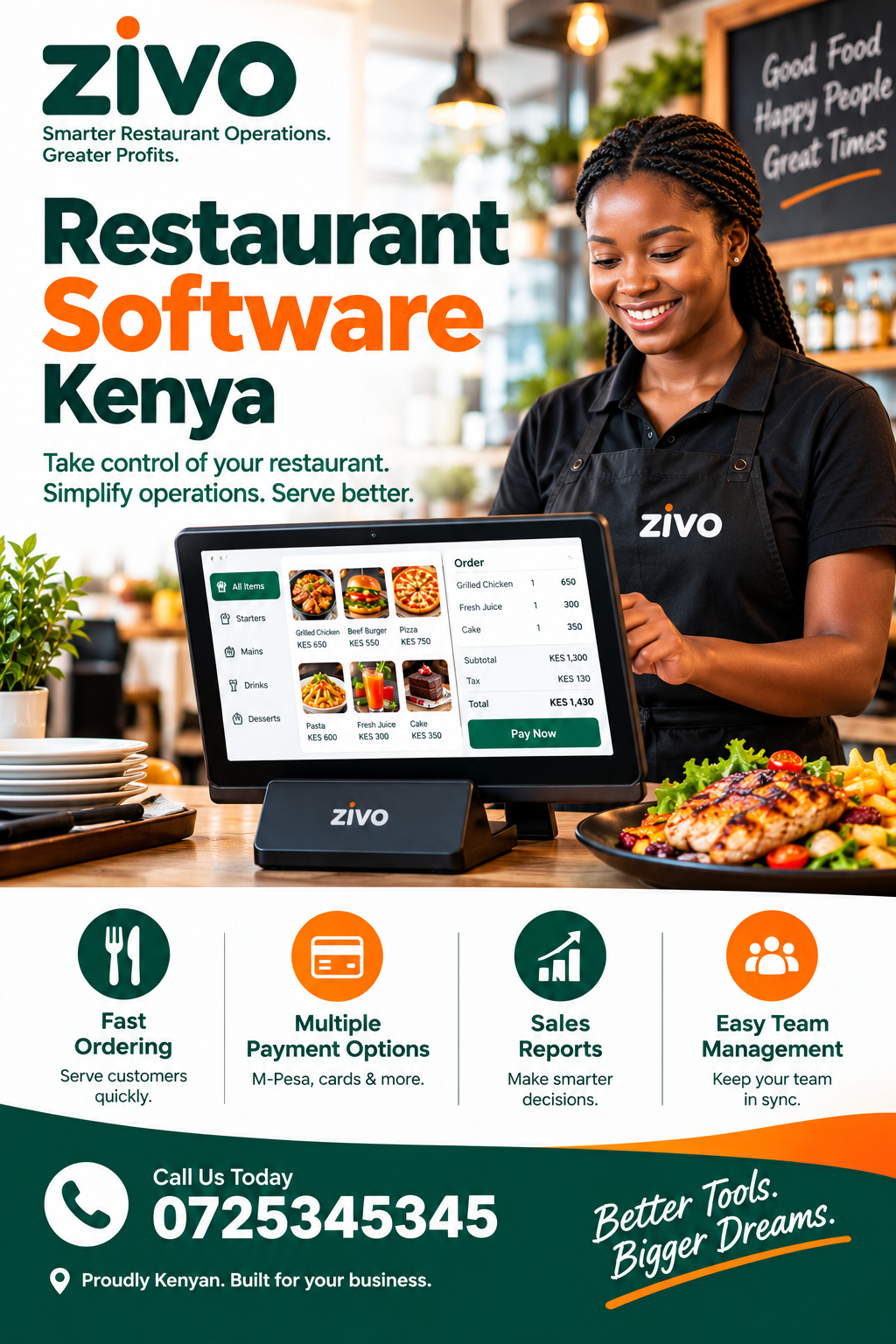
Running a restaurant in Kenya involves much more than preparing good food. Owners and managers have to coordinate orders, payments, stock, suppliers, employees, customers, delivery riders and daily financial records. Restaurant Software Kenya solutions can bring these activities into one organized system, helping restaurants reduce manual work and gain better visibility over their operations. This guide explains how restaurant management software works, the features to look for, how it can support food delivery, how it can improve inventory and payments, and what Kenyan restaurant owners should consider before choosing a system.
What Is Restaurant Management Software?
Restaurant management software is a digital system designed to help restaurants manage their daily operations from a centralized platform. Instead of relying on notebooks, spreadsheets, separate payment records and multiple disconnected applications, a restaurant can use software to coordinate important activities.
A typical system may include:
- Point-of-sale functionality
- Order management
- Menu management
- Inventory tracking
- Sales reporting
- Payment records
- Customer management
- Staff management
- Supplier records
- Delivery management
- Invoicing
- Business performance reports
For a small café, the system might primarily be used for sales and stock control. A larger restaurant may need multiple tills, branch management, kitchen order processing, delivery coordination and detailed financial reporting.
The main objective is not simply to replace paper. It is to create a reliable flow of information between different parts of the business.
For example, when a customer places an order, the system can record the items ordered, calculate the bill, update the relevant sales records and provide information needed by the kitchen. If inventory is connected to the ordering process, management can also monitor how the sale affects available stock.
This makes Restaurant Software Kenya particularly relevant for businesses that want to move away from fragmented restaurant operations and gain a clearer picture of what happens every day.
Why Kenyan Restaurants Need Better Digital Management
Kenyan restaurants operate in an environment where customers increasingly expect convenient ordering and payment options. A customer may walk into a restaurant, order through WhatsApp, place an order on a website, call the business or use a third-party delivery platform.
At the same time, restaurant owners need to manage rising operational complexity.
A restaurant may have to answer questions such as:
- Which menu items sold most today?
- How much stock was used?
- Which ingredients need to be reordered?
- How much money came through different payment channels?
- Which orders are still pending?
- Which delivery orders have been completed?
- Which staff members processed particular transactions?
- How much revenue did a particular branch generate?
- What were the busiest hours?
Without a centralized system, finding these answers can take considerable time.
Restaurant Software Kenya can help centralize operational information so that managers do not have to reconstruct the day’s activities from different notebooks, receipts and spreadsheets.
This becomes even more important as a restaurant grows. A business with ten daily orders may be able to manage manually. A business handling hundreds of orders, multiple payment methods and delivery requests needs stronger processes.
Restaurant Software for Food Delivery Businesses
Food delivery creates another layer of complexity. A restaurant serving customers at its premises only has to coordinate the customer, kitchen and cashier. A delivery-focused business must also manage addresses, delivery charges, rider assignments, order status and customer communication.
A suitable system can help restaurants organize this process.
For example, a delivery order can move through stages such as:
- Order received
- Payment confirmed
- Order accepted
- Food being prepared
- Food ready
- Rider assigned
- Order picked up
- Order delivered
- Transaction completed
This provides staff with a consistent process rather than relying on phone calls and informal messages.
A restaurant offering delivery can also use Restaurant Software Kenya to maintain records of delivery orders alongside in-house sales, making it easier to compare different sales channels.
The system does not necessarily have to replace every delivery platform. Instead, it should help the restaurant maintain accurate internal records and coordinate orders effectively.
Managing Orders From Multiple Channels
Modern restaurants can receive orders from many sources.
These may include:
- Walk-in customers
- Telephone orders
- Social media
- Restaurant websites
- Mobile applications
- Online marketplaces
- Food delivery platforms
- Corporate customers
Each additional channel creates another opportunity for errors.
A customer could place an order through one channel while another employee records it separately. A payment could be received but not immediately matched with an order. A menu item could become unavailable while it remains visible to customers.
Centralized order management reduces these problems.
Restaurant Software Kenya can help restaurant teams establish a consistent process for recording, processing and completing orders regardless of where the order originated.
The exact integrations available will depend on the software provider, so restaurants should confirm which channels and platforms are supported before purchasing.
Point of Sale and Restaurant Sales
A point-of-sale system is one of the most important components of restaurant technology.
A POS system records transactions and provides staff with a structured method of processing sales. It can also support menu selection, discounts, receipts, payment records and sales reporting.
For restaurants, speed matters. Customers do not want to spend unnecessary time waiting while staff manually calculate bills.
A well-designed POS workflow can allow a cashier or waiter to select menu items, apply relevant charges or discounts and process payment quickly.
Restaurant Software Kenya can therefore be useful for restaurants that want to connect sales activity with broader business management processes.
However, restaurant owners should look beyond the appearance of the POS interface. A system should also provide useful reporting, appropriate user permissions, reliable transaction records and practical support.
M-Pesa and Digital Payments
Digital payments are an important consideration for Kenyan restaurants.
Customers may pay using M-Pesa, cards, bank transfers, cash or other digital payment methods. The more payment options a restaurant accepts, the more important accurate reconciliation becomes.
A restaurant should be able to answer:
- How much was paid?
- Which payment method was used?
- Which order does the payment belong to?
- Was the payment completed?
- Was a refund issued?
- Does the recorded sale match the payment record?
Payment integration can reduce manual reconciliation when properly implemented.
Restaurant Software Kenya can support a broader restaurant workflow when payment information is connected to order and sales records.
Restaurants should confirm the exact payment integrations supported by a software provider rather than assuming that every system automatically supports every payment method.
Inventory Management for Restaurants
Food businesses can lose money through poor inventory management.
Ingredients can expire, quantities can be miscounted, prices can change and employees may use different quantities when preparing the same menu item.
Inventory software provides a structured way to monitor stock.
Important inventory functions may include:
- Ingredient records
- Stock quantities
- Stock-in records
- Stock-out records
- Supplier information
- Purchase records
- Low-stock alerts
- Stock adjustments
- Wastage records
- Inventory reports
A restaurant selling burgers, for example, may need to monitor beef, buns, cooking oil, cheese, vegetables, sauces and packaging materials separately.
Restaurant Software Kenya can help restaurants establish more disciplined stock records when inventory functionality is included.
The objective should be to understand what enters the business, what is used, what is wasted and what remains available.
Reducing Food Waste
Food waste is both an operational and financial concern.
Restaurants can waste ingredients because of:
- Overstocking
- Poor storage
- Expired products
- Incorrect portioning
- Customer cancellations
- Preparation mistakes
- Unsold prepared food
- Damaged stock
Software can help management identify patterns.
For example, if a restaurant consistently records high wastage for a particular ingredient, the manager can investigate whether purchasing quantities, portion sizes or menu demand are responsible.
Restaurant Software Kenya can support better decision-making by giving management structured records from which operational patterns can be identified.
Software does not eliminate waste automatically. Staff still need good procedures, but accurate information makes those procedures easier to enforce.
Menu Management
Restaurants frequently change menus.
Prices may change because ingredient costs increase. Seasonal dishes may be introduced. Some meals may be discontinued. Restaurants may also offer different prices for dine-in, takeaway and delivery.
A centralized menu management system allows authorized staff to update information without repeatedly changing paper records.
Useful menu management features can include:
- Menu item names
- Prices
- Categories
- Descriptions
- Add-ons
- Modifiers
- Availability
- Tax settings
- Product images
- Branch-specific menus
Restaurant Software Kenya can make menu administration easier when the software provides centralized product management.
Restaurants with multiple branches should pay particular attention to whether menu changes can be managed centrally while still allowing branch-specific differences.
Kitchen Order Management
The kitchen is where restaurant orders become actual meals.
When communication between front-of-house employees and kitchen staff is poor, mistakes can occur. Orders may be missed, prepared incorrectly or delayed.
Kitchen order management can create a clearer workflow.
A waiter enters an order, the kitchen receives the required information, the preparation status is updated and the front-of-house team can see when the meal is ready.
Restaurant Software Kenya can support this type of workflow when kitchen management functionality is included.
For busy restaurants, the system should be simple enough for staff to use during peak periods. Complicated interfaces can create new problems instead of solving existing ones.
Table and Dine-In Management
Restaurants serving customers on-site may need table management in addition to ordinary order processing.
A table management system can help staff know:
- Which tables are occupied
- Which tables are available
- Which tables have active orders
- Which waiter is serving a table
- Whether a bill has been settled
- Whether a table has been reserved
This becomes especially valuable during busy periods.
Restaurant Software Kenya can help connect table information with order and payment workflows where such functionality is supported.
Restaurants should assess their own service model before selecting table management features. A takeaway shop may have little need for complex table functionality, while a full-service restaurant may depend on it.
Customer Management and Repeat Business
A restaurant’s relationship with its customers does not have to end when an order is completed.
Customer management tools can help businesses maintain useful information such as:
- Customer names
- Contact details
- Order history
- Preferences
- Frequent purchases
- Delivery locations
- Feedback
- Loyalty activity
This information can support better service.
For example, if a customer regularly orders a particular meal, the restaurant can use order history to understand demand patterns.
Restaurant Software Kenya can be useful for restaurants that want to organize customer information alongside sales records.
Restaurants should also handle customer data responsibly and limit access to authorized employees.
Managing Restaurant Delivery
Delivery management can become difficult when a restaurant receives many orders simultaneously.
A delivery workflow should ideally make it clear which orders are:
- Waiting for preparation
- Ready for collection
- Assigned to a rider
- In transit
- Delivered
- Cancelled
This reduces uncertainty.
Restaurant Software Kenya can support delivery operations where the selected platform provides relevant delivery-management functionality.
Restaurants should also consider whether delivery is handled internally or through external riders and platforms. The system should fit the actual delivery model rather than forcing the business into an unsuitable workflow.
Managing Delivery Riders
Restaurants that employ or coordinate their own riders may need additional tools.
Useful rider information can include:
- Rider name
- Contact details
- Assigned orders
- Delivery status
- Completed deliveries
- Delivery charges
- Working schedules
Management can use these records to understand delivery activity.
Restaurant Software Kenya may help businesses organize delivery-related records when rider management is included in the selected software.
For restaurants using third-party delivery providers, the important requirement may instead be order reconciliation and reporting.
Restaurant Invoicing
Invoices are an important part of restaurant administration, especially for businesses serving corporate customers, events and large orders.
A restaurant may need to produce invoices for:
- Corporate catering
- Office lunches
- Events
- Conferences
- Bulk orders
- Recurring customers
Automated invoicing reduces the need to prepare every document manually.
Restaurant Software Kenya can be part of a wider digital workflow when invoicing is integrated into the restaurant’s management system.
Restaurants should verify whether the software supports the type of invoice and tax information their business requires.
eTIMS and Restaurant Businesses in Kenya
Tax compliance is an important consideration when selecting restaurant software.
The Kenya Revenue Authority states that persons engaged in business are required to onboard eTIMS and issue electronic tax invoices. KRA also provides several eTIMS solutions, including online, client, Lite and system-to-system options.
This means restaurant owners should consider how their operational software interacts with their invoicing requirements.
KRA states that businesses with an existing invoicing system can use system-to-system integration through OSCU or VSCU, subject to the relevant requirements.
Restaurant Software Kenya should therefore be evaluated partly on its ability to support the restaurant’s invoicing and compliance workflow.
Restaurants should not assume that a system is eTIMS-compliant simply because it has an invoicing feature. Ask the provider what integration is available and whether the relevant integration has been implemented and certified where required.
Sales Reporting and Business Intelligence
A restaurant owner should not have to wait until the end of the month to understand what happened in the business.
Useful restaurant reports may include:
- Daily sales
- Weekly sales
- Monthly sales
- Sales by menu item
- Sales by employee
- Sales by branch
- Sales by payment method
- Delivery sales
- Discounts
- Refunds
- Inventory movement
These reports help management identify patterns.
For example, a restaurant may discover that lunch sales are strongest on weekdays while dinner sales increase on weekends.
Restaurant Software Kenya can help turn transaction records into useful operational information when reporting tools are included.
The important point is that reports should be understandable. A restaurant manager should be able to interpret the numbers without needing specialist accounting or data-analysis skills.
Employee and Staff Management
Restaurant operations depend heavily on employees.
A restaurant may have:
- Cashiers
- Waiters
- Chefs
- Kitchen assistants
- Supervisors
- Managers
- Riders
- Cleaners
Software can help define what each employee can access.
For example, a cashier may be allowed to process sales but not change menu prices. A manager may have permission to view reports and approve discounts.
Restaurant Software Kenya can help restaurants introduce clearer user roles where staff-management and permission features are available.
User permissions also create accountability because management can limit sensitive actions to authorized employees.
Preventing Revenue Leakage
Revenue leakage occurs when money that should belong to the business is lost through errors, unrecorded sales, incorrect discounts, refunds or other weaknesses.
Software can reduce some of these risks by creating transaction records.
Management can investigate:
- Voided transactions
- Discounts
- Refunds
- Cancelled orders
- Cash shortages
- Unusual stock adjustments
- Price changes
Restaurant Software Kenya can provide better visibility when sales, user activity and transaction records are connected.
Software is not a substitute for internal controls. Restaurants still need appropriate policies, staff training and management oversight.
Multi-Branch Restaurant Management
Growing restaurant brands often face a new challenge: multiple locations.
A business with three branches may need to know:
- Which branch generated the most sales?
- Which products are popular at each branch?
- How much stock does each branch have?
- Which branch has the highest wastage?
- How are payment totals distributed?
- Which branch needs additional inventory?
Restaurant Software Kenya can help centralize branch information where multi-branch functionality is supported.
Centralization can also help head-office teams compare branches using consistent reports.
However, each branch may still need its own staff permissions, stock records, tills and operating settings.
Managing Suppliers and Purchases
Restaurants depend on reliable suppliers for food, beverages, packaging and other materials.
Supplier management can include:
- Supplier names
- Contact details
- Products supplied
- Purchase orders
- Purchase prices
- Delivery records
- Outstanding balances
- Supplier history
Restaurant Software Kenya can help restaurants bring purchasing information into the wider business-management process when supplier functionality is available.
A restaurant should also monitor supplier price changes. If the cost of a major ingredient increases significantly, management may need to review menu prices or portion sizes.
Cost Control and Menu Profitability
Sales volume alone does not tell a restaurant whether a menu item is profitable.
A meal may sell frequently but have a small margin if ingredient and preparation costs are high.
Restaurant management systems can help businesses compare sales information with inventory and purchasing data.
For example:
| Metric | What it tells the restaurant |
|---|---|
| Sales volume | How frequently an item sells |
| Selling price | Revenue generated per sale |
| Ingredient cost | Approximate production cost |
| Gross margin | Difference between selling price and direct cost |
| Wastage | Stock lost during operations |
| Popularity | Customer demand |
| Discount rate | Impact of promotions |
Restaurant Software Kenya can support more informed menu decisions when the system provides sufficient sales and cost information.
Restaurants should avoid removing an item based on sales alone. An item with moderate sales but strong margins may still be valuable.
Restaurant Promotions and Discounts
Promotions can attract customers, but uncontrolled discounts can reduce profitability.
A restaurant may offer:
- Lunch promotions
- Weekend discounts
- Buy-one-get-one offers
- Customer loyalty rewards
- Corporate rates
- Seasonal offers
Software can help record promotional activity and compare it with sales.
Restaurant Software Kenya can be part of a broader operational setup when the system includes promotion, pricing or discount controls.
Managers should ensure that employees cannot apply unauthorized discounts without appropriate permission.
Loyalty Programs
Customer loyalty programs can encourage repeat purchases.
A restaurant might award points based on spending, visits or selected products.
A simple loyalty system could work as follows:
- Customer creates a profile.
- Customer makes a purchase.
- The system records the transaction.
- Eligible points are calculated.
- Points accumulate over time.
- Customer redeems a reward.
Restaurant Software Kenya can help support this kind of customer relationship workflow where loyalty features are included.
The best loyalty programs are easy for customers and staff to understand. Complicated reward structures can create confusion.
Using Restaurant Data to Improve Decisions
Restaurant data becomes valuable when it leads to action.
Suppose sales reports show that a particular meal sells heavily between 12 p.m. and 2 p.m. Management could prepare ingredients earlier and schedule enough kitchen staff during that period.
If delivery data shows that certain neighbourhoods generate many orders, the restaurant could consider delivery staffing or targeted promotions for those areas.
If inventory records show frequent wastage of a particular ingredient, management can review purchasing quantities.
Restaurant Software Kenya can help create the information base needed for these operational decisions when the relevant reporting and management functions are available.
The purpose of reporting should therefore be practical: identify what is happening, understand why it is happening and decide what action should follow.
Cloud-Based Restaurant Software
Many modern business systems are cloud-based.
A cloud system allows authorized users to access business information through an internet-connected device, depending on the provider’s architecture.
Potential advantages include:
- Easier access
- Centralized information
- Simplified updates
- Multi-location visibility
- Reduced dependence on one computer
However, restaurants should ask about internet dependency, offline functionality, backups, security and data ownership.
Restaurant Software Kenya should be assessed according to the restaurant’s actual environment rather than simply whether the provider calls it cloud-based.
A restaurant with unreliable connectivity may need offline capabilities for certain operations.
Security and User Permissions
Restaurant systems contain commercially sensitive information.
This may include:
- Sales records
- Customer details
- Employee accounts
- Supplier information
- Business reports
- Prices
- Transaction information
Access should therefore be controlled.
Good practices include:
- Individual staff accounts
- Strong passwords
- Role-based permissions
- Limited administrative access
- Audit trails
- Regular backups
- Secure devices
- Timely removal of former employees’ access
Restaurant Software Kenya should be evaluated partly on the security controls provided by the vendor.
Restaurants should also ask where data is stored, how backups work and what happens if a device is lost.
Choosing Software for a Small Restaurant
A small restaurant does not necessarily need the most complicated system.
The priority should be functionality that solves actual problems.
A small restaurant might prioritize:
- POS
- Sales reporting
- Inventory
- Payment records
- Menu management
- Basic customer records
- Invoicing
- Simple staff permissions
Restaurant Software Kenya may be appropriate for a small business if it provides the functionality required without creating unnecessary complexity.
Before purchasing, list the restaurant’s current problems. Then evaluate whether the system solves those problems.
Choosing Software for a Growing Restaurant
A growing restaurant needs to think beyond today’s requirements.
Ask whether the software can support:
- Additional users
- More menu items
- Multiple branches
- More transactions
- Delivery operations
- Additional payment channels
- Advanced reporting
- Supplier management
- Customer loyalty
- Integrations
Restaurant Software Kenya should be evaluated for scalability if the restaurant expects substantial growth.
Changing systems later can be expensive and disruptive, particularly if historical data needs to be transferred.
What to Ask a Restaurant Software Provider
Before signing up, ask practical questions.
About functionality
- Does it support POS?
- Does it support inventory?
- Can it manage delivery orders?
- Can it manage multiple branches?
- Does it provide detailed reports?
- Can it manage different payment methods?
About integrations
- Does it integrate with the payment methods we use?
- Does it support eTIMS integration where applicable?
- Can it connect with existing systems?
- Does it support APIs or other integrations?
About security
- How are user accounts managed?
- Are permissions customizable?
- How is data backed up?
- What happens if a device fails?
About support
- Is training provided?
- How quickly does support respond?
- Is support available during restaurant operating hours?
- Are software updates included?
Restaurant Software Kenya should be considered alongside these questions rather than selected solely because of a low advertised price.
Common Mistakes When Choosing Restaurant Software
One common mistake is choosing software based only on appearance.
A modern interface is useful, but functionality matters more.
Another mistake is failing to test the system using real restaurant scenarios.
For example, during a demonstration, ask the provider to show exactly how the system handles:
- A cancelled order
- A partial refund
- A discount
- A stock shortage
- A delivery order
- A split payment
- A new menu item
- A price change
- A branch transfer
- An eTIMS-related invoicing workflow
Restaurant Software Kenya should be tested against real operational situations before implementation.
A third mistake is purchasing too many features that staff will never use. Complexity can slow adoption.
Training Restaurant Staff
Even good software can fail if employees do not understand how to use it.
Training should cover:
- Logging in
- Creating orders
- Processing payments
- Correcting mistakes
- Printing or sending receipts
- Managing tables
- Checking order status
- Recording stock
- Handling cancellations
- Escalating technical problems
Restaurant Software Kenya becomes more valuable when staff understand how the system fits into their daily responsibilities.
Training should not happen only on the first day. Restaurants should provide refreshers when new features are introduced or when recurring mistakes are identified.
Implementation Without Disrupting Operations
Changing restaurant systems can be disruptive if implementation is poorly planned.
A practical implementation process may involve:
Step 1: Document existing processes
Write down how orders, payments, inventory and reporting currently work.
Step 2: Identify problems
Determine which processes create delays, errors or unnecessary manual work.
Step 3: Configure the system
Set up menus, users, branches, payment options, suppliers and inventory.
Step 4: Test
Run realistic transactions before going live.
Step 5: Train staff
Ensure each employee understands their responsibilities.
Step 6: Go live
Begin using the system while monitoring problems closely.
Step 7: Review
After implementation, assess whether the software is actually improving operations.
Restaurant Software Kenya should therefore be introduced as part of an operational change process rather than treated as a simple software installation.
Restaurant Software and Accounting
Restaurant management and accounting are closely connected.
Sales transactions provide information that may be needed for financial reporting. Purchases provide information about expenses and inventory. Payment records help with reconciliation.
However, restaurant software should not automatically be treated as a complete accounting system.
A restaurant should determine whether it needs:
- Accounting integration
- Expense tracking
- Payroll integration
- Tax reporting
- Financial statements
- Bank reconciliation
Restaurant Software Kenya can help create cleaner operational records, but businesses should confirm exactly which accounting functions the platform provides.
Restaurant Software for Catering Businesses
Catering companies have different operational requirements from traditional restaurants.
They may handle large pre-booked orders for:
- Weddings
- Conferences
- Corporate events
- Private parties
- Schools
- Hotels
- Institutions
The system may need to manage advance orders, quantities, invoices, delivery schedules and customer requirements.
Restaurant Software Kenya can support catering operations when the selected platform offers appropriate order and customer-management tools.
Catering businesses should prioritize scheduling and bulk-order functionality rather than selecting software designed only for individual walk-in transactions.
Managing Takeaway Orders
Takeaway businesses need fast order processing.
A customer may call ahead and expect the food to be ready upon arrival. The system should make it clear when the order was placed, what was ordered, how much was paid and when it should be collected.
Restaurant Software Kenya can support takeaway workflows when order status and payment functions are available.
Clear takeaway procedures can also reduce congestion at busy collection points.
Improving Customer Experience
Restaurant technology should ultimately support better customer service.
Customers generally value:
- Accurate orders
- Shorter waiting times
- Clear prices
- Convenient payment
- Reliable delivery
- Correct receipts
- Responsive communication
Restaurant Software Kenya can contribute to customer experience when it removes operational friction behind the scenes.
For example, faster order processing may reduce queues, while accurate order records may reduce mistakes.
Technology should support the staff rather than make the customer experience feel unnecessarily complicated.
Restaurant Software Pricing Considerations
Software pricing varies widely depending on the provider and functionality.
Possible pricing models include:
- Monthly subscriptions
- Annual subscriptions
- Per-user pricing
- Per-branch pricing
- One-time licensing
- Transaction-based charges
- Custom enterprise pricing
Do not compare prices without comparing what is included.
A cheaper system may exclude important integrations or support. A more expensive system may include features the restaurant does not need.
Restaurant Software Kenya should therefore be assessed based on total value and actual requirements rather than price alone.
Ask about setup costs, training, hardware, integrations, support and future upgrades.
Measuring the Success of Restaurant Software
After implementation, restaurant owners should measure whether the software is achieving its purpose.
Useful indicators may include:
- Order processing time
- Order accuracy
- Stock variance
- Food wastage
- Daily sales visibility
- Payment reconciliation time
- Delivery completion time
- Reporting time
- Customer complaints
- Staff productivity
Restaurant Software Kenya should produce measurable operational improvements if it is solving genuine business problems.
The measurements should be established before implementation where possible so that the restaurant can compare the old process with the new one.
The Role of Automation
Automation can reduce repetitive administrative tasks.
Examples include:
- Automatic sales calculations
- Inventory updates
- Digital receipts
- Low-stock alerts
- Automated reports
- Order status updates
- Customer notifications
- Recurring reports
Restaurant Software Kenya can help automate routine processes where the selected features support them.
Automation should be applied carefully. A restaurant should understand the process being automated and have procedures for correcting errors.
Restaurant Software and Business Growth
Growth creates complexity.
A restaurant that starts with one location may eventually have several branches, a delivery operation, catering services and a larger team.
Manual processes that worked initially may become difficult to maintain.
Restaurant Software Kenya can provide a centralized foundation for growth when the platform can scale with the restaurant’s requirements.
The key is to choose technology that supports the business model rather than purchasing features simply because they are available.
Practical Example: A Nairobi Restaurant
Consider a hypothetical Nairobi restaurant serving dine-in, takeaway and delivery customers.
During lunch, customers arrive while delivery orders are coming through WhatsApp. The cashier is recording sales, kitchen staff are preparing meals and a manager is checking stock.
Without a centralized process, the team may struggle to keep information synchronized.
With suitable software, the restaurant can structure the process:
- Customer order is recorded.
- Order reaches the relevant preparation point.
- Payment is recorded.
- Sales are included in the daily report.
- Relevant stock records are updated.
- Delivery order receives a status.
- Management can review the transaction later.
Restaurant Software Kenya can help coordinate this type of workflow when the necessary features are available.
The software does not replace the restaurant’s employees. It gives them a shared operational system.
Practical Example: A Multi-Branch Restaurant
Consider a restaurant brand operating in Nairobi, Kiambu and Mombasa.
Head office needs visibility across all three locations while each branch needs to manage its own staff and daily transactions.
A multi-branch system could allow management to compare:
| Area | Branch-level information |
|---|---|
| Sales | Daily and monthly revenue |
| Inventory | Stock received and consumed |
| Menu | Product availability |
| Staff | User activity |
| Payments | Payment-method totals |
| Delivery | Orders completed |
| Customers | Repeat purchasing |
| Reports | Branch performance |
Restaurant Software Kenya can support centralized management when the software has appropriate multi-branch functionality.
This is particularly useful when management wants consistent procedures across locations.
What Makes Restaurant Software Useful?
The value of software is not determined by how many buttons it has.
Useful restaurant software should make important processes easier, clearer or more reliable.
A good system should ideally provide:
- Simple daily workflows
- Accurate records
- Useful reports
- Appropriate integrations
- Strong user permissions
- Reliable support
- Scalable functionality
- Practical inventory tools
- Convenient payment management
Restaurant Software Kenya should be evaluated according to these practical outcomes.
The best system for one restaurant may not be the best system for another. A small takeaway operation and a multi-branch restaurant have different needs.
Questions Restaurant Owners Should Answer Before Buying
Before contacting software providers, write down answers to these questions:
- How many orders do we process each day?
- How many staff members need access?
- Do we have one location or several?
- Do we offer delivery?
- Which payment methods do customers use?
- Do we need inventory management?
- Do we need supplier management?
- Do we need customer loyalty features?
- What reports does management require?
- What invoicing requirements apply to our business?
Restaurant Software Kenya becomes easier to evaluate when the restaurant has clearly defined its requirements.
A written checklist also makes it easier to compare several providers consistently.
Frequently Asked Questions
What is restaurant software?
Restaurant software is a digital system used to manage restaurant activities such as sales, orders, inventory, payments, customers, employees, invoicing and reporting.
Can restaurant software support food delivery?
Yes. Depending on the platform, restaurant software can help manage delivery orders, order status, rider assignments, delivery charges and customer information. Restaurants should confirm which delivery functions and integrations are actually supported.
Can restaurant software manage M-Pesa payments?
Some systems can integrate with supported digital payment services. However, the exact payment functionality varies by provider. Restaurants should confirm the specific M-Pesa integration available before subscribing.
Is restaurant software useful for a small restaurant?
Yes. A small restaurant can use software for POS, sales tracking, inventory, payments and reporting. The important consideration is choosing a system that matches the restaurant’s size and operational requirements.
Does restaurant software help with inventory?
Many restaurant management systems include inventory functionality. Depending on the system, this may include stock levels, purchases, suppliers, wastage and low-stock alerts.
Can restaurant software support multiple branches?
Some platforms support multi-branch operations. These systems can allow management to view consolidated information while maintaining separate branch records and user permissions.
Does restaurant software replace accounting software?
Not necessarily. Some restaurant systems provide financial reports or integrate with accounting platforms, but restaurants should verify the exact accounting capabilities before assuming that a POS or restaurant-management system is a complete accounting solution.
What should I check before buying restaurant software in Kenya?
Check the system’s POS, inventory, payments, delivery, reporting, user permissions, support, security, scalability and integration capabilities. If eTIMS integration is relevant to your business, confirm how the provider handles it and what certification or integration arrangement applies.
Does every restaurant need the same software?
No. A takeaway, café, fine-dining restaurant, catering company and multi-branch restaurant can have very different requirements. Software should be selected according to the actual workflow and scale of the business.
How long does restaurant software implementation take?
Implementation time depends on the size of the restaurant, number of branches, amount of data, integrations and staff training requirements. A simple setup may be relatively quick, while a larger operation may require configuration, testing and phased training.
Final Thoughts
Restaurants in Kenya are managing increasingly complex operations. Customers expect convenient ordering and payment, while owners need accurate information about sales, stock, employees, suppliers and delivery.
The right technology can bring these activities together and make daily management more structured.
Restaurant Software Kenya can help restaurants organize important operational processes when the chosen platform matches their requirements.
The most important step is not choosing software based on marketing claims alone. Restaurant owners should identify their operational problems first, then test whether a prospective system solves those problems.
A restaurant considering new software should pay particular attention to order management, POS functionality, inventory, payment reconciliation, delivery, reporting, user permissions, customer management, integrations and support.
For Kenyan businesses, invoicing and eTIMS considerations should also be included in the evaluation. KRA provides multiple eTIMS options, including system-to-system integration for businesses with invoicing systems, so restaurant owners should establish exactly how their chosen software fits into the applicable invoicing workflow.
Restaurant Software Kenya is ultimately most valuable when it improves the restaurant’s ability to serve customers, control costs and understand its performance.
A good implementation should leave the restaurant with clearer records, faster workflows, better visibility and fewer avoidable manual tasks.
As the business grows, the system should also be capable of supporting additional staff, menu items, orders, delivery operations or branches without forcing management to rebuild its entire process.
For restaurant owners evaluating software today, the strongest starting point is simple: document how the business currently operates, identify where mistakes and delays occur, list the features required to solve those problems, and then test potential systems using real restaurant scenarios.
That approach makes the technology decision practical rather than theoretical—and gives the restaurant a clearer path toward more organized, measurable and scalable operations.
Restaurant Software Kenya can be part of that transformation when it is selected, implemented and used according to the actual needs of the restaurant.
Restaurant Software Kenya
Restaurant Software Kenya
Restaurant Software Kenya
Restaurant Software Kenya
Restaurant Software Kenya
Restaurant Software Kenya
Restaurant Software Kenya
Restaurant Software Kenya
Restaurant Software Kenya
Restaurant Software Kenya