
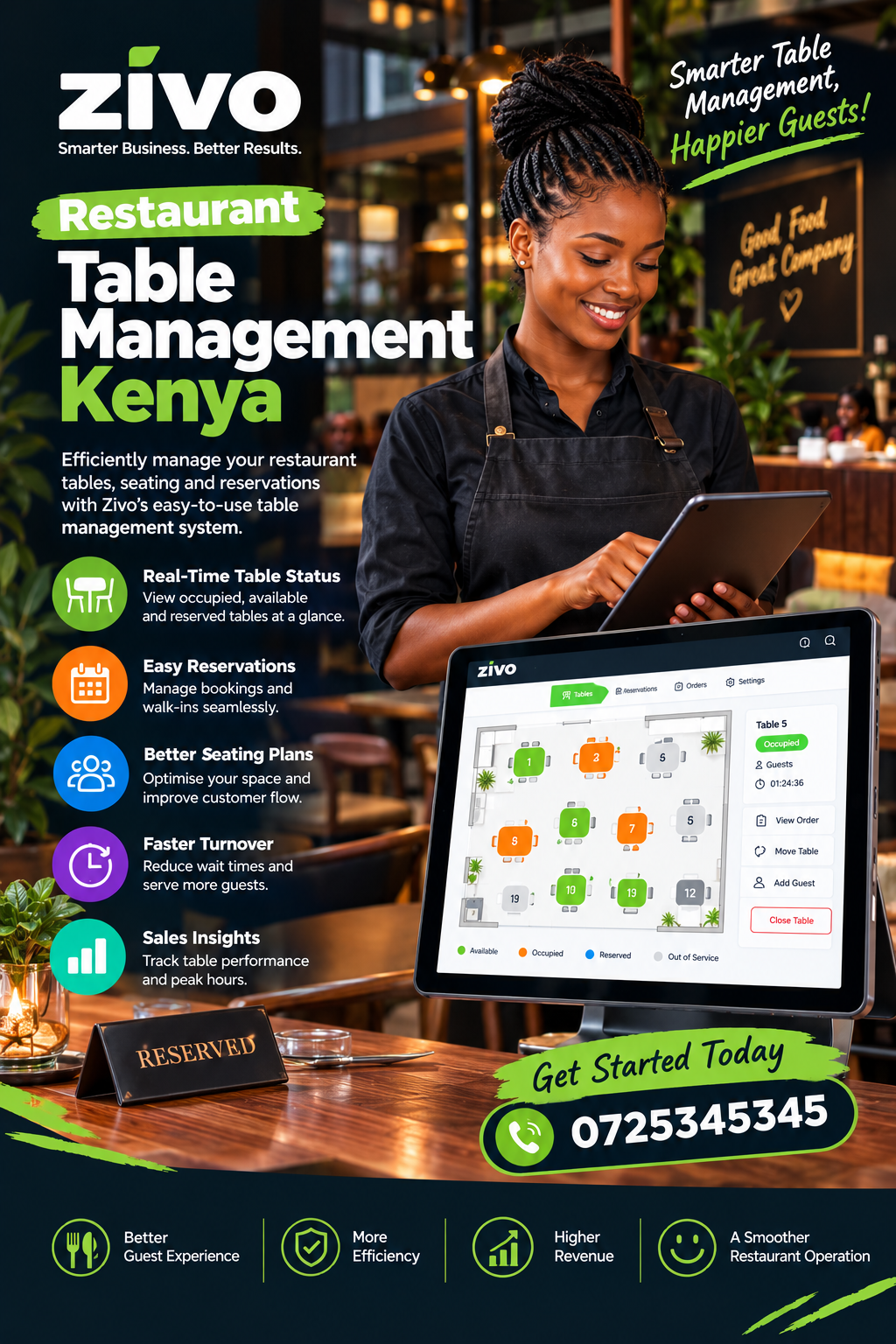
A Practical Guide to Restaurant Table Management in Kenya
Running a restaurant in Kenya involves more than serving good food. Managers have to keep tables turning at the right pace, coordinate waiters, manage reservations, seat walk-in guests, track occupied and available tables, and make sure orders move smoothly from the dining area to the kitchen and cashier. A reliable Restaurant Table Management Kenya approach helps restaurants organize these activities in one operational flow. This guide explains what restaurant table management means, why it matters, which features to look for, how it can improve service, and how Kenyan restaurants can choose a practical digital solution.
What restaurant table management means
Clear table visibility is the foundation of Restaurant Table Management Kenya, especially when several service activities happen at once.
Restaurant table management is the process of organizing dining tables from the moment a guest arrives until the table is cleared, cleaned, and ready for the next party. It covers seating, table status, reservations, guest movement, waiter assignments, order progress, and table turnover.
For a small café, this may start with a simple floor plan and a notebook. For a busy restaurant, however, the number of moving parts grows quickly. A manager may need to know which tables are occupied, which guests are waiting, which tables are reserved, which section belongs to each waiter, and which tables have finished meals but have not yet been cleared.
A structured Restaurant Table Management Kenya process gives staff a shared view of the dining room. Instead of relying on verbal updates, the team can work from current table information.
Good table management should answer practical questions quickly:
- Which tables are free?
- Which tables are occupied?
- Which tables are reserved?
- How many guests are waiting?
- Which waiter is responsible for a table?
- Which tables are ready to be cleaned?
- Which tables have active orders?
- How long has a table been occupied?
- Which tables are approaching payment or clearance?
These questions sound simple, but answering them consistently can have a major effect on restaurant service.
Why table management matters in Kenyan restaurants
A practical Restaurant Table Management Kenya process should fit the restaurant’s size, layout, staffing model, and service style.
Restaurants operate under pressure. During lunch, dinner, weekends, holidays, events, and payday periods, guest arrivals can happen in waves. A dining room that looks easy to manage at 10 a.m. can become difficult to coordinate at 1 p.m.
Using Restaurant Table Management Kenya practices can help managers reduce confusion during those busy periods. The goal is not to make staff dependent on technology. The goal is to give staff better information so they can make decisions faster.
Consider a Nairobi restaurant with 25 tables. At peak time, several groups arrive within a few minutes. Two tables are reserved, four are occupied, three are waiting for food, two have requested bills, and another table has just been vacated. Without a clear system, staff can easily seat guests at a reserved table, overlook a waiting party, or leave a cleared table unused.
A good Restaurant Table Management Kenya workflow creates visibility across the floor. The host, floor manager, waiter, and cashier can understand what is happening without repeatedly asking one another.
This can improve:
- Guest experience – Customers spend less time waiting for a table or looking for assistance.
- Table turnover – Cleared tables can be reassigned more quickly.
- Staff coordination – Waiters know which tables belong to them.
- Reservation control – Reserved tables are easier to protect.
- Order visibility – Active tables can be connected to their orders.
- Management decisions – Managers can see patterns instead of relying on memory.
Common table management problems
Good Restaurant Table Management Kenya is less about adding complexity and more about giving staff accurate information at the right moment.
Many restaurants do not have a single dramatic problem. Instead, they have small operational weaknesses that accumulate.
A restaurant may use a paper reservation book, a handwritten floor chart, verbal waiter assignments, and a separate point-of-sale process. Each method can work on its own, but together they create gaps.
With Restaurant Table Management Kenya, restaurants can design a more connected process around the dining room rather than treating every activity as separate.
Double-booked tables
Double bookings are especially damaging because guests experience the mistake directly. A reservation may have been accepted over the phone, while another staff member seats a walk-in party at the same table.
The solution is not simply telling employees to “be more careful.” A better approach is to maintain one current reservation and table-status view.
Poor visibility of table status
A table can be physically empty but not immediately available. It may still need cleaning, have a bill open, or be reserved for a party arriving shortly.
A simple free/occupied status is therefore not always enough. Staff may need statuses such as:
- Available
- Reserved
- Occupied
- Ordering
- Food served
- Bill requested
- Payment pending
- Cleaning
- Out of service
Slow table turnover
Table turnover should never mean rushing guests. It means reducing avoidable delays between one dining party and the next.
If a waiter does not know that a table has been vacated, or if the clearing team receives information late, the next customer waits unnecessarily.
Unclear waiter assignments
When staff do not have clear sections, some tables may receive excellent attention while others wait. A table management system can help managers assign sections and keep responsibility visible.
Core features of a restaurant table management system
Restaurants can use Restaurant Table Management Kenya to create consistent rules for seating, reservations, clearing, and reassignment.
A useful Restaurant Table Management Kenya solution should match the restaurant’s actual workflow. More features do not automatically mean a better system.
The most valuable features are those that solve recurring operational problems.
Digital table layout
A visual floor plan can show the restaurant’s tables and their current status. Managers can see which tables are available, occupied, reserved, or awaiting service.
The layout should be easy to update when the restaurant changes its seating arrangement.
Reservation management
Reservation management should allow staff to record guest names, contact information where appropriate, booking time, party size, and table preference.
A useful system can also reduce conflicts by showing existing bookings before staff assign a table.
Walk-in management
Not every customer makes a reservation. Restaurants need to manage walk-ins without losing track of waiting parties.
A waiting list can capture:
- Guest or group name
- Party size
- Arrival time
- Preferred seating
- Special notes
- Current waiting status
This gives hosts a clearer basis for seating decisions.
Table status tracking
Table status is at the heart of restaurant floor management. Staff should be able to update a table quickly without navigating through complicated screens.
The faster table information can be updated, the more useful it becomes during busy service.
Waiter or section assignment
A restaurant may divide its dining room into sections. A digital system can show which waiter is responsible for each section and help managers rebalance workloads when necessary.
Order connection
Table management becomes much more useful when table information connects with orders. A manager should be able to identify the table associated with an active order without searching through multiple records.
Billing and payment visibility
When a guest asks for the bill, staff should know that the table has moved into a payment stage. This reduces uncertainty and makes it easier to coordinate the next step.
For Kenyan restaurants, payment workflows may include cash, card, mobile money, or other approved methods. The exact payment process should match the restaurant’s existing systems.
How table management improves the guest experience
Customers may never see the restaurant’s internal software, but they notice its effects.
A guest notices when:
- They are seated quickly.
- Their waiter knows where they are sitting.
- Staff do not repeatedly ask which table ordered something.
- A reservation is recognized correctly.
- The bill arrives promptly.
- A cleared table is prepared before another group arrives.
A strong Restaurant Table Management Kenya process helps turn these small moments into a more consistent customer experience.
Consistency matters because restaurant customers compare experiences over time. A customer who receives excellent service one day but waits unnecessarily on the next visit may question whether the restaurant can manage busy periods.
Table management cannot replace friendly staff or good food. It gives those staff better operational support.
Table turnover without sacrificing service quality
Effective Restaurant Table Management Kenya should reduce idle time without making guests feel rushed.
Table turnover is often discussed as a revenue metric, but managers should be careful. Faster turnover is not automatically better if customers feel rushed.
The better objective is to remove avoidable idle time.
For example, suppose a table finishes at 7:30 p.m. If the bill is settled at 7:35, the table is cleared at 7:42, and the next party is seated at 7:50, the restaurant has lost several minutes that could have been reduced through better coordination.
A Restaurant Table Management Kenya workflow can help staff identify where delays happen.
Managers can examine the stages:
- Guest arrival
- Seating
- Order placement
- Food preparation
- Food service
- Bill request
- Payment
- Table clearing
- Table reset
- Next seating
The objective is to improve the process without putting unreasonable pressure on servers or kitchen staff.
Managing reservations more effectively
Reservation planning becomes easier when Restaurant Table Management Kenya gives the team one current view of bookings and tables.
Reservations create an important planning advantage. They tell the restaurant something about expected demand before guests arrive.
A reservation system should help managers understand:
- How many parties are expected
- Expected arrival times
- Party sizes
- Preferred tables
- Special requirements
- Which tables are already committed
A Restaurant Table Management Kenya system can make this information easier to access during service.
Restaurants should also establish clear reservation policies. For example, they can define how long a reserved table is held after the booking time, how cancellations are recorded, and how late arrivals are handled.
The policy should be communicated to customers before it becomes necessary to enforce it.
Handling walk-in customers
Waiting lists are easier to manage when Restaurant Table Management Kenya records parties in a clear order.
Walk-ins are an important part of restaurant demand, particularly when customers decide where to eat at short notice.
A restaurant should avoid treating walk-ins as an afterthought. A structured waiting list helps staff estimate when a table may become available.
Suppose three groups are waiting:
| Party | Size | Arrival | Preferred area | Status |
|---|---|---|---|---|
| A | 2 | 12:10 | Any | Waiting |
| B | 4 | 12:15 | Indoor | Waiting |
| C | 3 | 12:22 | Outdoor | Waiting |
This information gives the host a logical basis for seating. It is better than trying to remember the order in which people arrived.
A Restaurant Table Management Kenya process can also help staff avoid skipping a waiting customer simply because the restaurant becomes busy.
Managing different table sizes
Table capacity decisions become more consistent when Restaurant Table Management Kenya shows available sizes and current occupancy.
Restaurants often have tables for two, four, six, eight, or larger groups. Effective table management should consider table capacity.
If two customers are seated at an eight-person table while a group of eight waits, the restaurant may lose useful capacity.
This does not mean every small party should be squeezed into a small table. Comfort, accessibility, reservations, and restaurant layout still matter.
The key is to make seating decisions using current information rather than guesswork.
A Restaurant Table Management Kenya system can help staff see available table sizes before assigning a party.
Restaurants can also use table combinations when appropriate. Two nearby four-person tables may be joined for a larger party, provided the floor plan allows it.
Supporting waiter performance
Managers can use Restaurant Table Management Kenya to balance sections and identify tables that need attention.
Table management can also support staff coordination.
A waiter should know which tables are in their section and which tables require attention. Managers can use table status to identify where service may be slowing down.
This is especially useful during busy periods when a manager cannot personally monitor every table.
A Restaurant Table Management Kenya approach can help managers answer questions such as:
- Which sections are busiest?
- Which tables have been occupied for a long time?
- Which tables are waiting for bills?
- Which tables are newly seated?
- Which tables have not yet received attention?
The information should be used to support staff, not simply to criticize them.
Integrating table management with restaurant operations
Connecting Restaurant Table Management Kenya with orders can reduce duplicate records and unnecessary communication.
Table management works best when it is part of a broader restaurant management process.
A restaurant may need to coordinate:
- Tables
- Reservations
- Orders
- Menu items
- Kitchen operations
- Inventory
- Billing
- Payments
- Staff
- Sales reporting
- Customer information
A Restaurant Table Management Kenya system that connects with other operational areas can reduce duplicate work.
For example, when a table is linked to an order, staff do not need to maintain a separate handwritten record of which table ordered which items.
The more information that can move through one workflow, the fewer opportunities there are for transcription errors.
M-Pesa and Kenyan payment workflows
Payment visibility is an important part of Restaurant Table Management Kenya because a table should not be treated as available too early.
Mobile money is central to everyday commerce in Kenya, so restaurants need payment processes that work well for their customers.
The exact implementation depends on the restaurant’s technology stack and payment provider. However, the table workflow should make it clear when a bill is pending, paid, partially settled, or otherwise awaiting confirmation.
A Restaurant Table Management Kenya process can help staff understand the relationship between the table, bill, and payment status.
For example:
- A guest requests the bill.
- The bill is prepared.
- The guest selects an available payment method.
- Payment is confirmed.
- The table is marked for clearing.
- Staff reset the table.
- The table becomes available.
Clear stages reduce the risk of seating new customers at a table whose previous transaction has not been properly completed.
Reporting and management decisions
Useful reporting turns Restaurant Table Management Kenya data into information managers can act on.
Restaurant managers need more than a visual table map. They also need information that can support decisions.
Useful reports may include:
- Table occupancy patterns
- Reservation volumes
- Average table duration
- Sales by table or section
- Peak service periods
- Waiting-list activity
- Cancelled reservations
- No-show patterns
- Payment status
- Staff section performance
A Restaurant Table Management Kenya system can make these records easier to organize.
Reports should answer real management questions. A report that looks impressive but does not help the manager make a decision has limited value.
For example, if Saturday dinner consistently creates a seating bottleneck, management can consider staffing levels, reservation spacing, table allocation, and kitchen capacity.
Using data to improve restaurant capacity
Capacity planning becomes more reliable when Restaurant Table Management Kenya highlights where time is being lost.
A restaurant has a physical capacity limit. It cannot simply add more customers without considering tables, staff, kitchen output, and customer comfort.
Table data can reveal where capacity is being lost.
Suppose a restaurant has 30 tables but regularly struggles to seat customers. Management might assume that more tables are needed. The actual problem could be slow clearing, inefficient table combinations, delayed billing, or uneven waiter coverage.
A Restaurant Table Management Kenya system can help managers investigate these possibilities.
Before expanding the dining room, examine the existing process.
Questions worth asking
- How long do customers wait before seating?
- How long do tables remain unused after guests leave?
- How often are reservations missed?
- Which periods create the longest queues?
- Which tables are difficult for staff to serve?
- Are bills being delayed?
- Does the kitchen create a bottleneck?
Answers can reveal operational improvements that cost less than physical expansion.
Choosing the right software for a Kenyan restaurant
The best Restaurant Table Management Kenya platform is one that matches the restaurant’s real workflow.
Restaurants should evaluate software based on actual needs rather than a long feature list.
A small café may need simple table layouts, order management, billing, and reporting. A large restaurant may need reservations, multiple dining areas, staff permissions, detailed reporting, and integrations.
A Restaurant Table Management Kenya solution should be easy enough for employees to learn quickly.
When evaluating a platform, consider:
Ease of use
Busy service is not the time for staff to learn complicated workflows. Buttons, statuses, and table actions should be clear.
Mobile and device support
Restaurants may use tablets, phones, computers, or dedicated POS devices. The system should fit the restaurant’s actual equipment.
Reliability
A restaurant cannot afford frequent interruptions during peak service. Ask how the system handles connectivity problems, backups, updates, and support.
Permissions
Managers, waiters, cashiers, and administrators may need different access levels.
Reporting
Check whether reports are useful for actual decisions. Ask whether data can be filtered by date, branch, section, or other relevant categories.
Support
A local or responsive support process can be valuable when staff need help during implementation.
Restaurant table management for small businesses
Even a small café can benefit from Restaurant Table Management Kenya when manual tracking starts becoming difficult.
Small restaurants sometimes assume that table software is only for large establishments. That is not necessarily true.
A small restaurant can benefit when the owner also acts as manager, cashier, or floor supervisor. A simple system can reduce the mental load of remembering reservations, table status, and active orders.
A Restaurant Table Management Kenya workflow can also help a growing restaurant prepare for higher customer volumes.
The important point is proportionality. A small restaurant should not buy an overly complicated system simply because it has many features.
Choose the functions that solve current problems while leaving room for growth.
Multi-branch restaurant operations
For growing restaurant groups, Restaurant Table Management Kenya can help standardize processes across locations.
Restaurants with multiple branches face a different challenge. Management may want consistent procedures while each branch handles its own dining room.
A multi-branch system should make it possible to distinguish locations and monitor performance without mixing records.
A Restaurant Table Management Kenya setup can support standardization when the underlying software also handles branches appropriately.
Management may want to compare:
- Table utilization
- Sales
- Reservations
- Peak periods
- Staff workloads
- Customer waiting times
The goal is not to create competition between branches at the expense of service. The goal is to identify practices that can be shared across the business.
Security and access control
Access controls should be part of Restaurant Table Management Kenya whenever several employees use the same system.
Restaurant systems contain operational and financial information. Access should therefore be controlled.
Different roles may require different permissions.
For example:
| Role | Typical access |
|---|---|
| Manager | Full operational and reporting access |
| Host | Reservations and table status |
| Waiter | Assigned tables and orders |
| Cashier | Billing and payments |
| Administrator | System configuration and user management |
The exact roles depend on the software and restaurant.
A Restaurant Table Management Kenya system should make it possible to limit sensitive actions where appropriate.
Managers should also review staff accounts periodically and remove access for former employees.
Training restaurant staff
Training makes Restaurant Table Management Kenya more valuable because staff need confidence during busy service.
Even excellent software can fail if employees do not understand how to use it.
Training should focus on real restaurant situations rather than abstract demonstrations.
Practice scenarios can include:
- A walk-in party of four arrives.
- A reserved party arrives early.
- A guest requests a table change.
- A table is combined with another table.
- A guest requests separate bills.
- A customer pays through mobile money.
- A table is vacated.
- A new party is waiting.
- A reservation is cancelled.
- A table is temporarily taken out of service.
A Restaurant Table Management Kenya implementation becomes more effective when staff can complete these actions confidently.
Training should also explain why each step matters. Employees are more likely to follow a process when they understand how it affects the customer and the rest of the team.
Common mistakes when implementing table management software
Implementation problems are easier to prevent when Restaurant Table Management Kenya is introduced around clear operational goals.
Software implementation can fail for reasons that have little to do with technology.
Choosing features instead of solving problems
A restaurant may choose a platform because it has many features. The better question is whether those features solve the restaurant’s biggest operational problems.
Ignoring the actual floor layout
A digital table map should reflect the real restaurant. If the layout is inaccurate, staff lose trust in the system.
Failing to define statuses
If one employee marks a table as free while another considers it reserved, the system becomes confusing. Establish clear definitions.
Not training all relevant staff
Training only managers is not enough if hosts, waiters, and cashiers use the system every day.
Keeping parallel manual records forever
Paper notes can be useful during transition, but maintaining two systems indefinitely can create conflicting information.
Ignoring feedback
Employees who work on the floor often identify problems that managers do not see. Collect feedback after implementation.
A practical implementation plan
A phased Restaurant Table Management Kenya rollout gives the team time to test the workflow before peak service.
Restaurants can introduce table management in stages.
Step 1: Map the current process
Document how reservations, seating, orders, billing, payment, clearing, and reassignment currently work.
Step 2: Identify bottlenecks
Look for delays and repeated tasks. Ask employees where mistakes commonly occur.
Step 3: Configure the floor plan
Create the digital layout using the actual table numbers and seating capacities.
Step 4: Define table statuses
Agree on the statuses the team will use and what each one means.
Step 5: Set user permissions
Give each employee only the access they need.
Step 6: Train staff
Use realistic examples from normal service.
Step 7: Run a controlled test
Test the system during a quieter period before relying on it during the busiest shift.
Step 8: Review performance
After implementation, collect feedback and identify areas for improvement.
A Restaurant Table Management Kenya rollout should be treated as an operational change, not simply a software installation.
What restaurant owners should measure
Managers should use Restaurant Table Management Kenya data to improve decisions rather than simply collect reports.
Once a table management process is in place, owners should track meaningful indicators.
Useful measures include:
- Average waiting time
- Table turnover time
- Reservation no-show rate
- Number of cancelled bookings
- Time between guest departure and next seating
- Sales by service period
- Average spend per table
- Occupancy by time period
The purpose of measurement is improvement.
If average waiting time falls but customer complaints increase, management needs to investigate why. If table turnover improves while average spend falls sharply, the restaurant may be rushing service.
Metrics should therefore be considered together.
How technology can support customer retention
Consistent service can be supported by Restaurant Table Management Kenya when customer-facing teams have clear operational information.
Customer retention starts with food and service, but operational consistency matters too.
When customers return, they expect the restaurant to remember basic preferences and provide a reliable experience.
Table information can help staff understand seating patterns and reservations. However, restaurants should collect and use customer information responsibly and only for legitimate business purposes.
A Restaurant Table Management Kenya workflow can support consistency by making the operational history easier to manage.
The best customer experience is often the result of many small details working together.
Cost considerations
Restaurant owners should compare the cost of Restaurant Table Management Kenya with the cost of avoidable delays and errors.
The cost of restaurant management software varies according to the provider, features, number of users, branches, devices, integrations, and support arrangements. Restaurants should not assume that the most expensive option is the best.
Before buying, calculate the cost of current inefficiencies.
For example, consider:
- Lost sales caused by avoidable waiting
- Errors caused by manual records
- Staff time spent searching for information
- Missed reservations
- Delayed table clearing
- Billing mistakes
- Management time spent compiling reports
A Restaurant Table Management Kenya solution can be evaluated against those costs.
Ask vendors for a clear explanation of setup fees, subscriptions, support, device requirements, integrations, and any additional charges. Avoid making a decision based only on the advertised starting price.
Questions to ask a software provider
A vendor should be able to explain how its Restaurant Table Management Kenya features solve the restaurant’s specific problems.
Before selecting a system, restaurant owners can ask:
- Can the table layout match our actual floor plan?
- Can staff manage reservations and walk-ins?
- Can we define our own table statuses?
- Can tables be linked to orders?
- Does the system support our payment workflow?
- What reports are available?
- Can different employees have different permissions?
- Can the system support multiple branches?
- What happens if internet connectivity is interrupted?
- What training is included?
- How is customer and business data protected?
- How quickly is support provided when an issue occurs?
These questions move the discussion away from generic sales language and toward operational fit.
Restaurant table management and customer flow
Restaurant Table Management Kenya supports information flow, but managers should still examine the physical movement of people.
Customer flow is broader than table occupancy. It includes how guests move through the restaurant from arrival to departure.
Poor flow can occur when:
- The entrance is crowded.
- Waiting guests block seated customers.
- Servers cross through congested areas.
- Tables are difficult to access.
- Bills are handled at a bottleneck.
- Cleared dishes accumulate near the dining room.
A Restaurant Table Management Kenya solution can help organize table information, but managers should also observe the physical movement of people.
Software can show that a table is occupied. It cannot automatically redesign a badly arranged dining room.
That is why technology and operational observation should work together.
Improving service during peak hours
Peak-hour preparation is stronger when Restaurant Table Management Kenya helps staff see expected demand and current table status.
Peak-hour planning is one of the strongest reasons to formalize table management.
Before a busy period, managers can review reservations, expected party sizes, staff sections, table availability, and likely demand.
During service, the manager can monitor:
- Waiting guests
- Reserved tables
- Occupied tables
- Tables awaiting bills
- Tables being cleaned
- Staff workload
After service, the team can review what happened.
This creates a continuous improvement cycle rather than treating every busy shift as a new emergency.
FAQ: Restaurant table management in Kenya
Restaurant Table Management Kenya should make answers to common floor-management questions easier to find.
1. What is restaurant table management?
Restaurant table management is the process of organizing tables, reservations, seating, table status, waiter assignments, orders, billing stages, and table turnover. A Restaurant Table Management Kenya solution can bring these activities into a more coordinated workflow.
2. Why do restaurants need table management software?
Restaurants need table management software when manual methods make it difficult to track reservations, table availability, waiting guests, active orders, or turnover. A Restaurant Table Management Kenya approach can improve visibility and reduce avoidable coordination problems.
3. Can small restaurants use table management software?
Yes. Small restaurants can use it to organize reservations, table status, walk-ins, and service. The system should be matched to the restaurant’s size and operational needs rather than selected simply because it has many features.
4. Does table management software handle M-Pesa payments?
Some restaurant platforms can integrate with payment workflows, but the exact capabilities depend on the software and payment provider. Restaurants should confirm the specific integration before purchasing.
5. Can table management software improve table turnover?
It can help by making table status visible and reducing delays between guest departure, clearing, and the next seating. However, turnover also depends on kitchen performance, staffing, customer behavior, and physical restaurant layout.
6. How does reservation management help restaurants?
Reservation management reduces double booking, improves planning, and gives staff visibility into expected demand. It can also make it easier to coordinate reservations with walk-in customers.
7. What should I look for in restaurant management software?
Look for ease of use, table layouts, reservation management, order connection, billing visibility, reporting, permissions, reliability, support, and compatibility with your restaurant’s devices and payment workflows.
8. Is table management useful for restaurants with multiple branches?
Yes. A suitable system can help separate branch data while giving management a broader view of performance. The exact multi-branch capabilities should be confirmed with the provider.
Final checklist for restaurant owners
Before buying Restaurant Table Management Kenya, owners should confirm that the system supports their actual table sizes and service process.
Before choosing a table management solution, review these questions:
- Does it reflect our actual floor plan?
- Can staff update table status quickly?
- Can it handle reservations?
- Can it manage walk-ins?
- Can tables connect to orders?
- Can staff see bill and payment stages?
- Does it provide useful reports?
- Can access be controlled by role?
- Is it suitable for our devices?
- Can it grow with the restaurant?
- Is support available when staff need help?
- Does the total cost make business sense?
A good system should make the restaurant easier to operate, not add another layer of confusion.
A restaurant can also use Restaurant Table Management Kenya as a starting point for broader process improvement, provided the system remains simple for frontline staff.
For restaurants reviewing their next operational improvement, Restaurant Table Management Kenya can be evaluated alongside ordering, billing, payments, and reporting workflows.
Conclusion
Restaurant table management is fundamentally about control, visibility, and service flow. When managers know what is happening across the dining room, staff can respond faster and customers can receive a more consistent experience.
For Kenyan restaurants, the strongest approach is one that fits the realities of local operations, including busy peak periods, reservations, walk-ins, mobile payment workflows, staff coordination, and the need for clear business reporting. A well-designed Restaurant Table Management Kenya workflow can connect the front-of-house process with broader restaurant operations.
The right solution should not be chosen because it has the longest feature list. Choose it because it solves real problems: unclear table status, slow seating, reservation conflicts, weak staff coordination, delayed billing, or limited management visibility.
Start by mapping your current process. Identify the biggest bottlenecks. Then compare systems against those needs, test the workflow with your staff, and measure the results after implementation.
When table information is accurate and available at the right time, restaurant teams can spend less effort searching for answers and more effort serving customers well.